
Cash Conversion Cycle: Formula and Worked Example for Distributors
The cash conversion cycle measures how many days pass between paying a supplier for inventory and collecting from the customer who bought it. For a distributor, that gap is the business model in one number: you buy, you hold, you sell on terms, and you wait.
Every day in the cycle is financed by someone. If it is not the supplier, through payment terms, it is your line of credit or your own cash. A profitable distributor can still run short of cash when the cycle stretches, and a growing one needs more cash every month to fund that growth.
This guide gives the cash conversion cycle formula, works through an example for a distributor, shows what a single day is worth, and covers practical ways to shorten each of the three parts.
What Is the Cash Conversion Cycle?
The cash conversion cycle (CCC), also called the cash-to-cash cycle, is the number of days cash is tied up in operations. It adds the time inventory sits before it is sold to the time customers take to pay, then subtracts the time you take to pay suppliers.
A shorter cycle means less cash is needed to support the same sales. A longer cycle means more borrowing, more interest, and less room to grow.
The Cash Conversion Cycle Formula
Cash conversion cycle = DIO + DSO − DPO
The three parts:
Days inventory outstanding (DIO) = Average inventory ÷ Cost of goods sold × 365
Days sales outstanding (DSO) = Average accounts receivable ÷ Revenue × 365
Days payables outstanding (DPO) = Average accounts payable ÷ Cost of goods sold × 365
Notes on the inputs:
- DIO and DPO use cost of goods sold because inventory and supplier invoices are carried at cost. DSO uses revenue because receivables are carried at selling price.
- If a meaningful share of sales is cash or card at the counter, use credit sales in DSO, or the number will flatter your collections.
- Use trade payables only. Payroll, taxes, and loans do not belong in DPO.
- Use average balances for the period. A single period-end balance can be distorted by one large receipt or payment.
- For a period shorter than a year, replace 365 with the days in that period.
Worked Example for a Distributor
A distributor has these annual figures:
- Revenue: $24,000,000
- Cost of goods sold: $18,000,000
- Average inventory: $3,000,000
- Average accounts receivable: $2,800,000
- Average accounts payable: $1,500,000
DIO = $3,000,000 ÷ $18,000,000 × 365 = 60.8 days
DSO = $2,800,000 ÷ $24,000,000 × 365 = 42.6 days
DPO = $1,500,000 ÷ $18,000,000 × 365 = 30.4 days
Cash conversion cycle = 60.8 + 42.6 − 30.4 = 73.0 days
As a timeline for an average dollar of inventory:
| Day | Event | Cash position |
|---|---|---|
| 0 | Inventory is received | Nothing paid yet. The supplier is financing it |
| 30 | Supplier is paid | Cash goes out |
| 61 | Inventory is sold and invoiced | Still out. Inventory has become a receivable |
| 103 | Customer pays | Cash comes back, with the margin |
Cash is out from day 30 to day 103, which is the 73-day cycle. The working capital tied up is inventory plus receivables less payables: $3,000,000 + $2,800,000 − $1,500,000 = $4,300,000.
What One Day Is Worth
Turning days into dollars makes the priorities clear.
- One day of DIO = Cost of goods sold ÷ 365 = $18,000,000 ÷ 365 = $49,315
- One day of DSO = Revenue ÷ 365 = $24,000,000 ÷ 365 = $65,753
- One day of DPO = Cost of goods sold ÷ 365 = $49,315
For this distributor, collecting one day sooner frees more cash than selling inventory one day sooner, because a receivable includes the margin. That does not make DSO the automatic priority. Inventory usually has more days in it to remove.
Shortening DIO: Inventory
- Recalculate reorder points and order quantities from current demand and lead times. See the reorder point formula.
- Size safety stock by item, not with a blanket number of weeks. See the safety stock formula.
- Identify stock that has stopped selling and clear it. See dead stock and obsolete inventory.
- Transfer between warehouses before placing a new purchase order.
- Use drop ship or special order for slow, expensive items.
- Keep counts accurate so buyers are not padding orders to cover for records they do not trust. See cycle counting.
DIO is the same information as inventory turnover, stated in days. See our inventory turnover guide.
Shortening DSO: Receivables
DSO has two parts: the terms you grant, and the days customers take beyond them. Most of the avoidable days come from your own process, not from slow payers.
- Invoice the day the order ships. Every day between shipment and invoice is a day added to DSO that no collector can recover.
- Get the invoice right. Wrong prices, missing PO numbers, and quantities that do not match the delivery are the most common reasons a customer’s payables team sets an invoice aside.
- Deliver invoices the way the customer processes them: email, portal, or EDI.
- Set credit limits and terms deliberately, and review them. See credit management best practices.
- Follow up on a schedule. Statements and reminders before and after the due date, with disputes logged and resolved quickly.
- Make it easy to pay: online payment, card, and ACH.
For the whole flow from order to payment, see order-to-cash optimization.
Managing DPO: Payables
A higher DPO shortens the cycle, but it is the part to handle most carefully. Paying suppliers late damages the relationship, risks credit holds, and tends to come back as worse pricing.
- Negotiate longer terms with key suppliers, especially on stocking orders and new lines.
- Pay on the due date, not when the invoice happens to be approved.
- Match invoices to purchase orders and receipts quickly, so the payment date is a choice and not an accident. See the procure-to-pay process.
- Evaluate early-payment discounts with arithmetic, not habit.
The arithmetic for a discount of 2% if paid in 10 days, otherwise net 30:
Annualized return = Discount % ÷ (100% − Discount %) × 365 ÷ (Net days − Discount days)
= 2 ÷ 98 × 365 ÷ 20 = 37.2%
Paying 20 days early to earn 2% is worth about 37% a year. If your cost of borrowing is well below that, take the discount even though it lowers DPO. A shorter cash conversion cycle is a means to an end, not the goal itself.
Putting It Together
Suppose the distributor in the example makes three modest changes over a year:
| Change | Days | Value per day | Cash freed |
|---|---|---|---|
| DIO down from 60.8 to 52.8 | 8 | $49,315 | $394,521 |
| DSO down from 42.6 to 37.6 | 5 | $65,753 | $328,767 |
| DPO up from 30.4 to 34.4 | 4 | $49,315 | $197,260 |
| Total | 17 | $920,548 |
The cycle falls from 73.0 to 56.0 days, and about $920,000 that was tied up in operations is available to pay down the line of credit or fund growth, with no change in sales.
Reading the Number
- Watch the trend. There is no universal target. Terms, product mix, and service expectations differ too much between industries. Your own cycle over time, and each of its three parts, is the useful comparison.
- Expect seasonality. Inventory builds before a busy season and receivables peak after it. Compare the same month year over year.
- Look at the parts. A flat cycle can hide inventory growing while payables are stretched to cover it.
- Plan for growth. If the cycle stays at 73 days and sales grow 20%, working capital grows with them: 20% of $4,300,000 is another $860,000 that has to come from profit or borrowing.
- A negative cycle is possible when customers pay before suppliers are due, as with deposits, card sales, or drop shipping.
Common Mistakes
- Using revenue in DIO or DPO, which mixes cost and selling price
- Calculating from one period-end balance that happens to be unusually high or low
- Counting cash sales in DSO
- Including non-trade liabilities in payables
- Improving the cycle by paying suppliers late
- Refusing early-payment discounts in order to protect DPO
- Blaming customers for DSO when invoices go out days after shipment
- Tracking the total and not the three parts
See Bizowie in Action
Real screens from Bizowie, not mockups. Click any screen to enlarge.
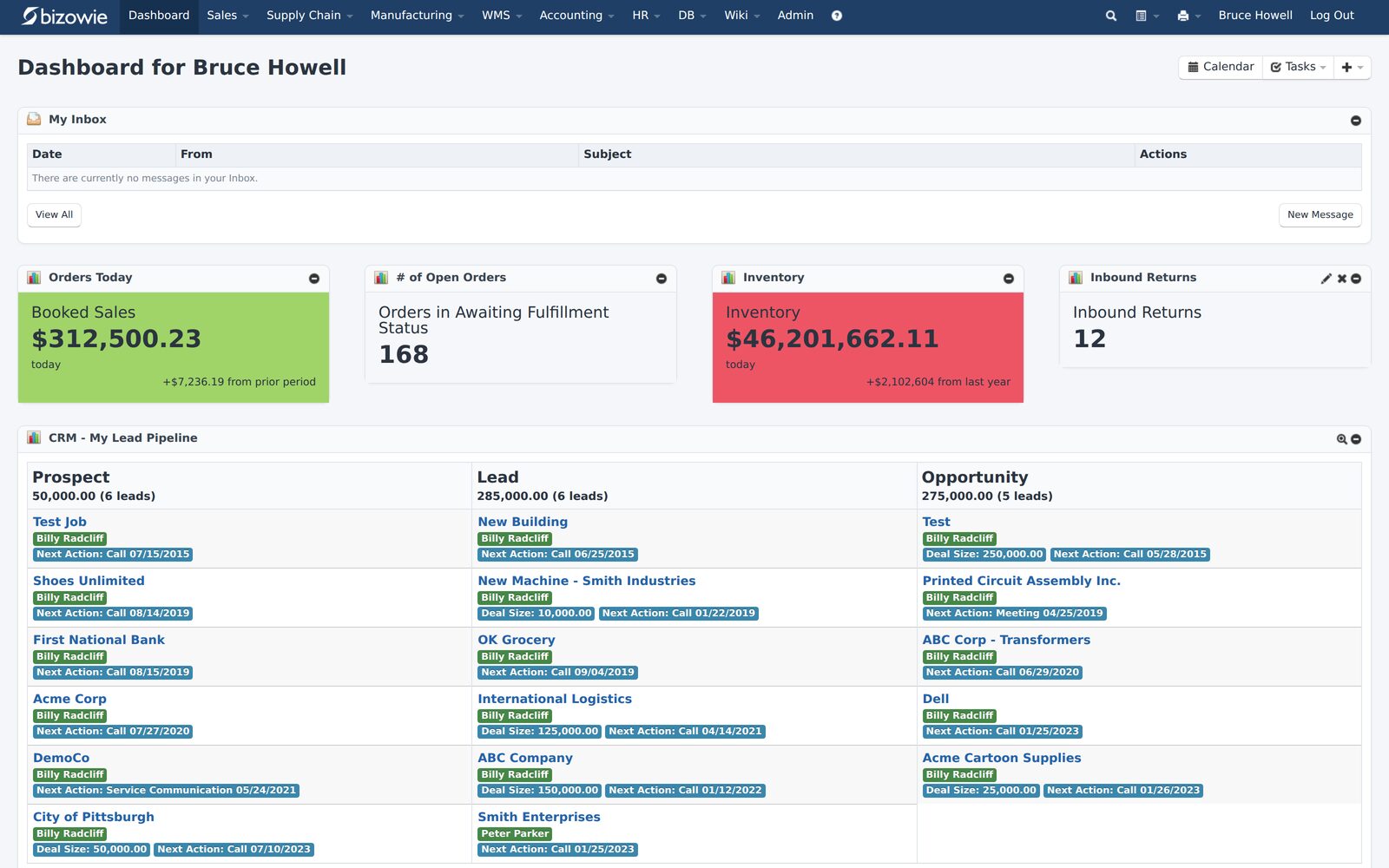
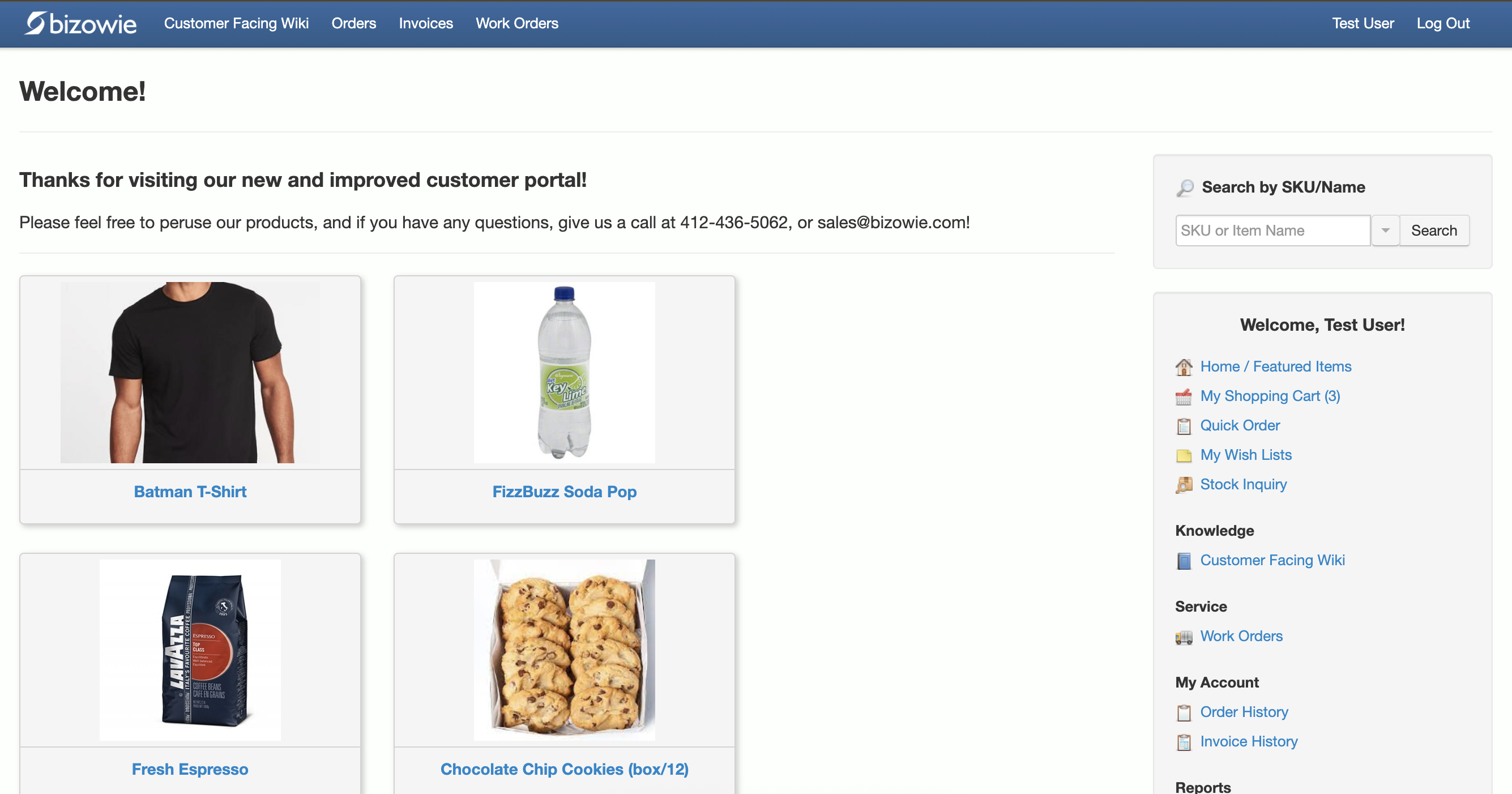
Bookings, open orders awaiting fulfillment, and inventory value at a glance.
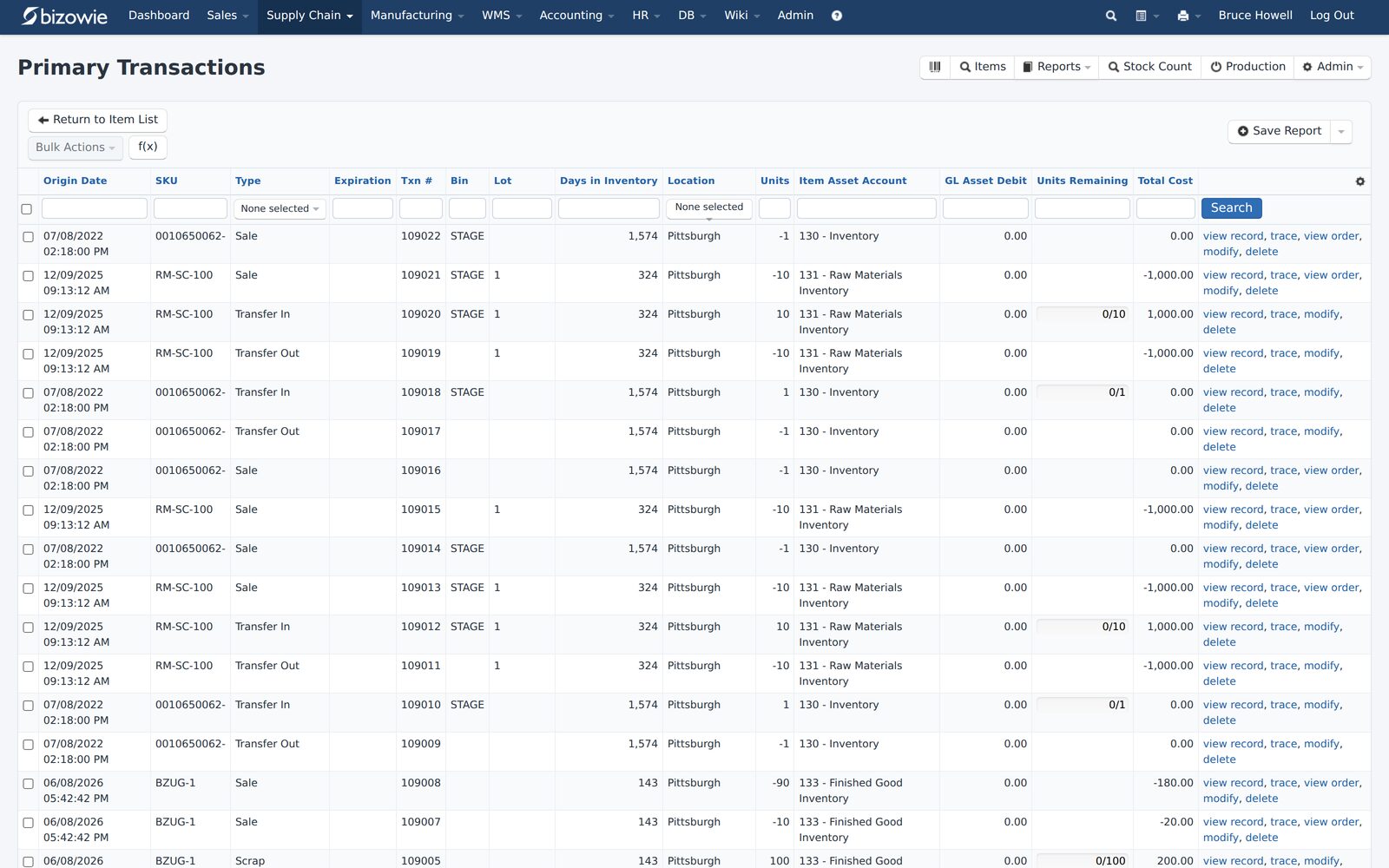
Every receipt, transfer, build, and quarantine move by SKU, lot, bin, and location.
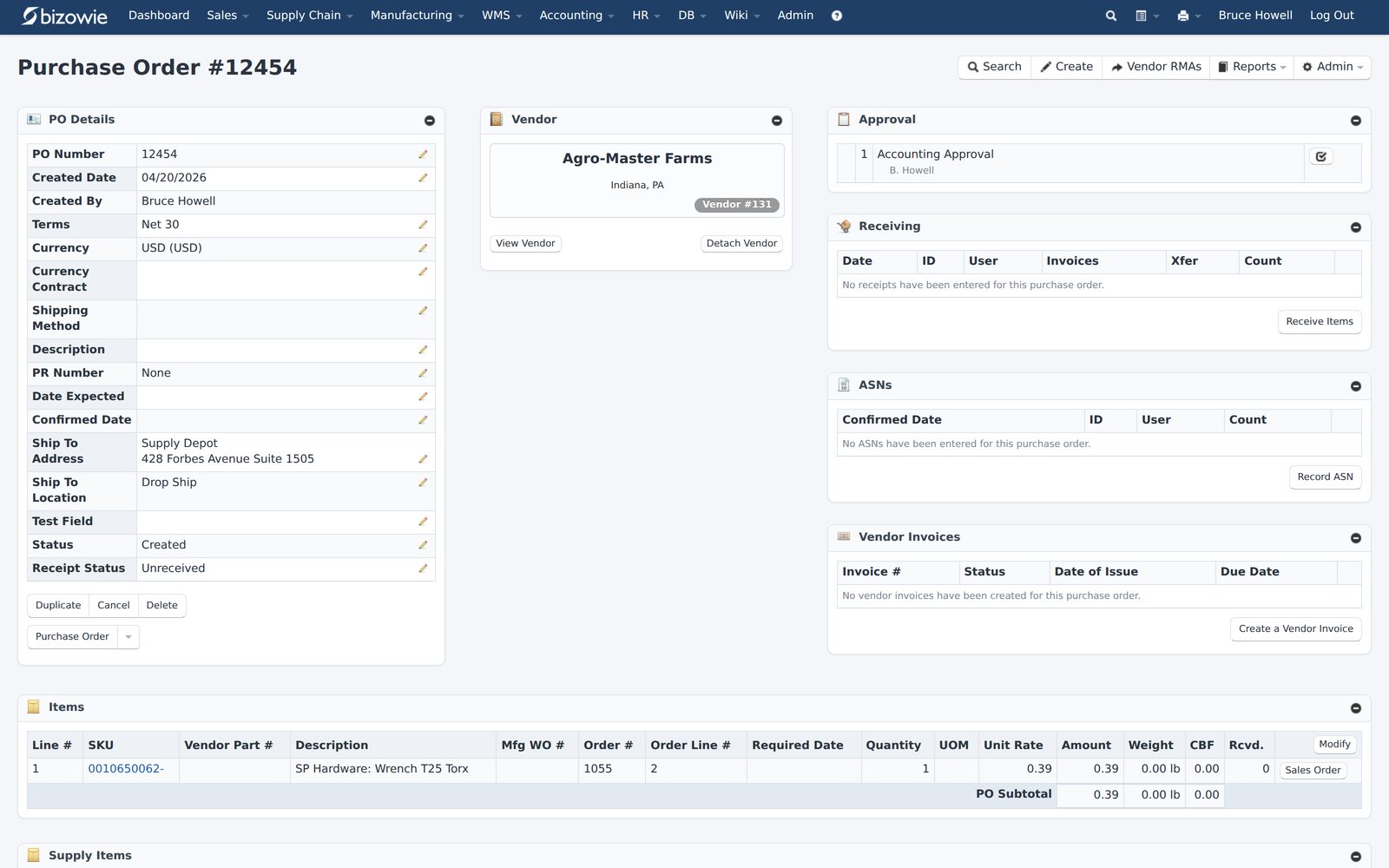
Purchase orders with approvals, receiving, ASNs, and vendor invoices on one screen.
Customers search items, place orders, and check order and invoice history themselves.
Orders, Inventory, and Cash in Bizowie
The Bizowie Cloud Financial Suite invoices directly from sales and service orders, calculates due dates and payment discounts automatically, generates invoices, statements, and reminders, and automates invoice and statement distribution. Customers can pay invoices online through the B2B portal, with integrated credit card processing. On the payables side, invoices are created from purchase orders and matched to them, early payment discounts are tracked, and historical and outstanding payables are reported. Cash flow forecasting and reporting is part of cash management, and purchasing supports item- and location-level min/max quantities. Inventory, orders, and financials update from the same transactions in real time. For the wider evaluation, see our distribution ERP software buyer’s guide and the month-end close checklist.
“From our first contact all the way through to our implementation, Bizowie has been a first class organization to work with… We strongly recommend the Bizowie software program.”
Alan Seymour — President, Cleveland Electric Labs
Frequently Asked Questions
What is the cash conversion cycle formula?
Cash conversion cycle = days inventory outstanding + days sales outstanding − days payables outstanding. The result is the number of days cash is tied up between paying suppliers and collecting from customers.
What is a good cash conversion cycle?
Shorter is generally better, but there is no single benchmark. It depends on your payment terms, product mix, and how much stock customers expect you to hold. Track your own trend and each of the three parts.
Can the cash conversion cycle be negative?
Yes. If customers pay before you pay suppliers, the cycle is negative and suppliers are financing your operations. This happens with customer deposits, card sales, and drop-shipped orders.
How do you calculate DSO?
Divide average accounts receivable by revenue for the period and multiply by the number of days in the period. Use credit sales if a significant share of revenue is paid at the time of sale.
Is a higher DPO always better?
No. Longer negotiated terms help. Paying late does not, and skipping an early-payment discount to hold cash a few more days is often an expensive choice.
Bring Us Your Aging Reports
Tell us where cash gets stuck today: inventory, invoicing, collections, or payables. We’ll show you how Bizowie connects orders, inventory, and accounting in one system, and if we are not the right fit, we will tell you.
See how Bizowie would run your order-to-cash
Tell us a little about your operation and we’ll reply with an honest assessment of fit, not a sales pitch.
- A real person reviews your submission and replies within one business day.
- No automated email sequences.
- If we’re not the right fit, we’ll tell you.
Prefer to talk?
Call (888) 635-2517, Mon–Fri, 9 AM–5 PM Eastern