
Looking for a NetSuite Alternative? Compare Bizowie
Oracle NetSuite is one of the best-known cloud ERP systems in the world, and it appears on almost every mid-market shortlist. It is a broad business suite with strong financials, multi-subsidiary management, and a large ecosystem of partners and add-on applications.
For manufacturers and distributors, the question is narrower. NetSuite serves many industries, and its depth on the shop floor and in the warehouse depends significantly on which modules you license. Before committing, it makes sense to compare it with platforms where manufacturing and distribution are the core focus rather than industries among many.
Bizowie is a cloud ERP platform built for mid-market manufacturers and distributors. It brings manufacturing, inventory, warehouse operations, EDI, financials, and reporting together in one unified operating environment, implemented directly by the Bizowie team.
What Is NetSuite?
NetSuite is a cloud ERP suite owned by Oracle. Its core covers financials, order management, inventory, purchasing, and CRM, with additional modules for industries and functions including manufacturing, warehouse management, ecommerce, planning, and global multi-subsidiary operations.
For manufacturers, NetSuite supports bills of material, assembly items, work orders, and routings with work-in-process tracking. Material requirements planning uses NetSuite’s demand planning and advanced inventory capabilities. Advanced Manufacturing adds capabilities such as engineering change management, a product configurator, operation-level shop floor data collection, and finite-capacity production scheduling.
For distributors, NetSuite supports inventory across multiple locations, demand planning, and distribution requirements planning. Its WMS module adds mobile barcode scanning, put-away and picking strategies, wave picking, and cycle counting.
NetSuite is sold as an annual subscription, typically combining a base platform license, per-user licenses, and individual modules. Implementation is performed by NetSuite’s own professional services team or by NetSuite Solution Provider partners.
That is important context. NetSuite is a capable, widely adopted platform. The more useful question is whether a broad business suite, configured for manufacturing through modules, is the best fit for how your plant actually runs.
Why Do Manufacturers and Distributors Evaluate NetSuite Alternatives?
Companies comparing NetSuite against other options usually do so for one or more of these reasons:
- Uncertainty about which manufacturing modules will be required, and what they will cost
- Per-user licensing costs when extending access to shop floor and warehouse staff
- Concern about how renewal pricing will change over time
- A need to test finite scheduling and shop floor reporting in depth
- Mixed-mode manufacturing that needs to work in a single system
- A preference for manufacturing expertise in the implementation team
- Concerns about maintaining scripted customizations through platform releases
- Complex customer-specific and contract pricing
- EDI requirements from large retail or industrial trading partners
- High-volume warehouse operations that need to be tested in depth
The decision is not “NetSuite or nothing.” It is whether a broad suite or a manufacturing-and-distribution-focused platform is the better foundation for your business.
Bizowie vs. NetSuite at a Glance
| Area | Bizowie | NetSuite |
|---|---|---|
| Primary market | Mid-market manufacturing and distribution | Businesses across many industries, from small companies to large multinationals |
| Platform approach | Unified platform with manufacturing, WMS, EDI, and financials operating in one environment | Broad business suite extended through licensed modules and SuiteApps |
| Manufacturing modes | Make-to-stock, make-to-order, engineer-to-order, assembly, and process, in one system | Assembly and work order manufacturing, with additional capability through Advanced Manufacturing |
| Distribution | Multi-location inventory, customer-specific pricing, integrated barcode WMS, and direct ANSI X12 EDI | Multi-location inventory and demand planning, with warehouse management through the NetSuite WMS module |
| Planning | MRP and replenishment planning within the core platform | MRP through demand planning and advanced inventory features |
| Shop floor and scheduling | Shop floor data collection to replace paper travelers | Operation-level shop floor data collection and finite scheduling through Advanced Manufacturing |
| Engineering | Document management and ECO/ECR workflows with controlled drawings | Engineering change management through Advanced Manufacturing |
| Pricing model | Subscription; ask for pricing against your own scenario | Annual subscription combining a base license, per-user licenses, and modules |
| Implementation | Vendor-direct implementation by the Bizowie team | NetSuite professional services or Solution Provider partners |
| Customization | Configuration, no-code platform capabilities, and workflows | SuiteCloud platform, including scripting and a large SuiteApp marketplace |
| Potential best fit | Manufacturers and distributors that want production, warehouse, EDI, and finance in one platform with one accountable vendor | Organizations that value a broad suite, global multi-subsidiary financials, and a large ecosystem |
This comparison reflects publicly available vendor information reviewed in September 2026. Product capabilities, packaging, pricing, and deployment options can change. Buyers should validate their specific requirements directly with each vendor.
See Bizowie in Action
Real screens from Bizowie, not mockups. Click any screen to enlarge.
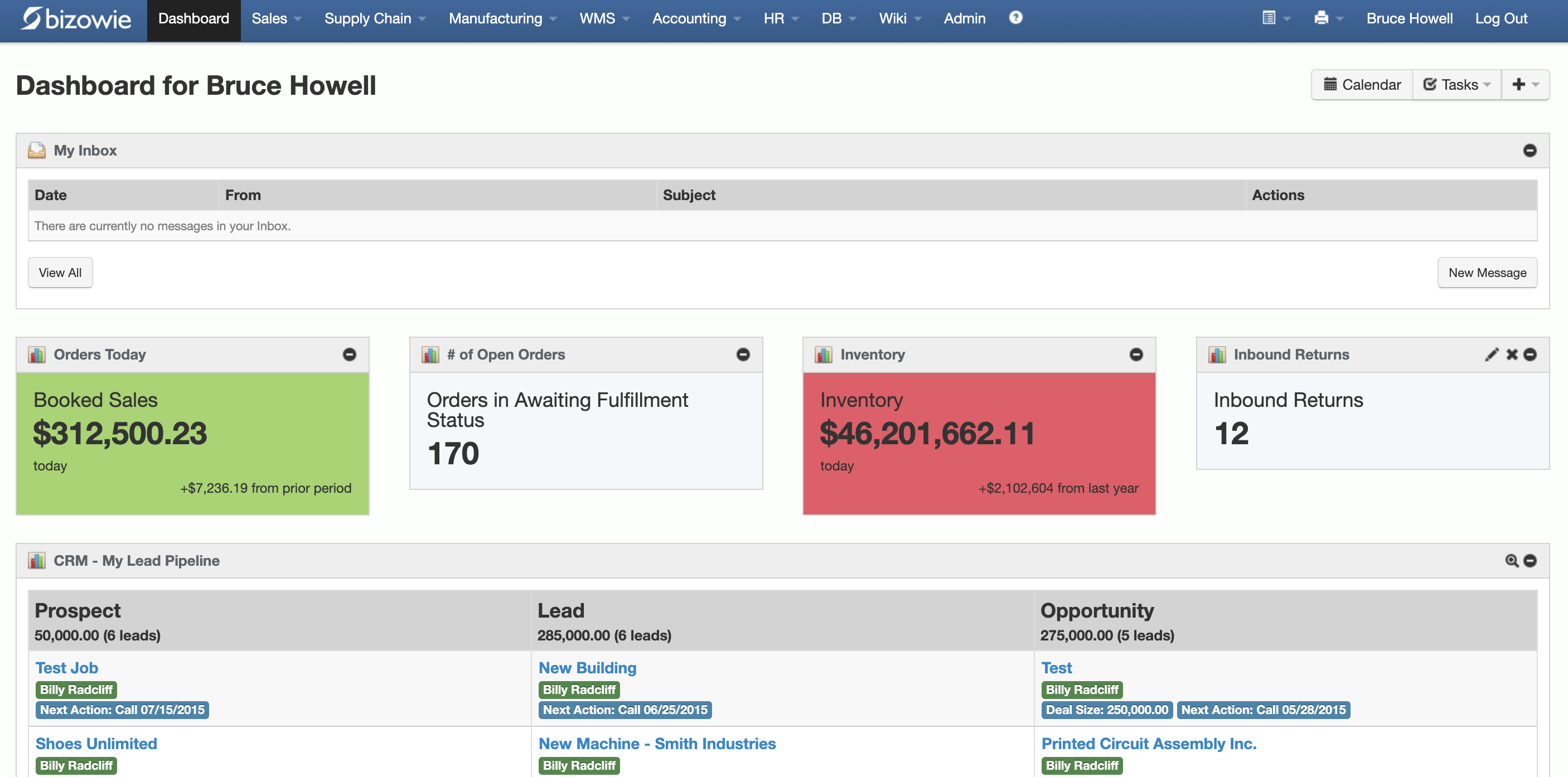
Live Dashboard
Bookings, open orders awaiting fulfillment, and inventory value at a glance.
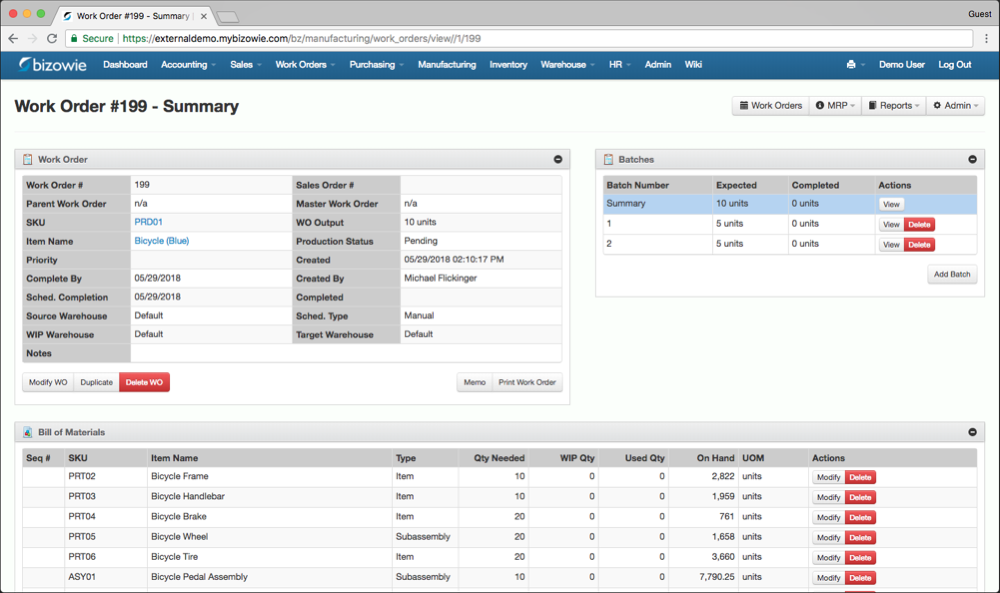
Work Orders & BOMs
Each work order carries its multi-level bill of materials, batches, and live on-hand quantities.
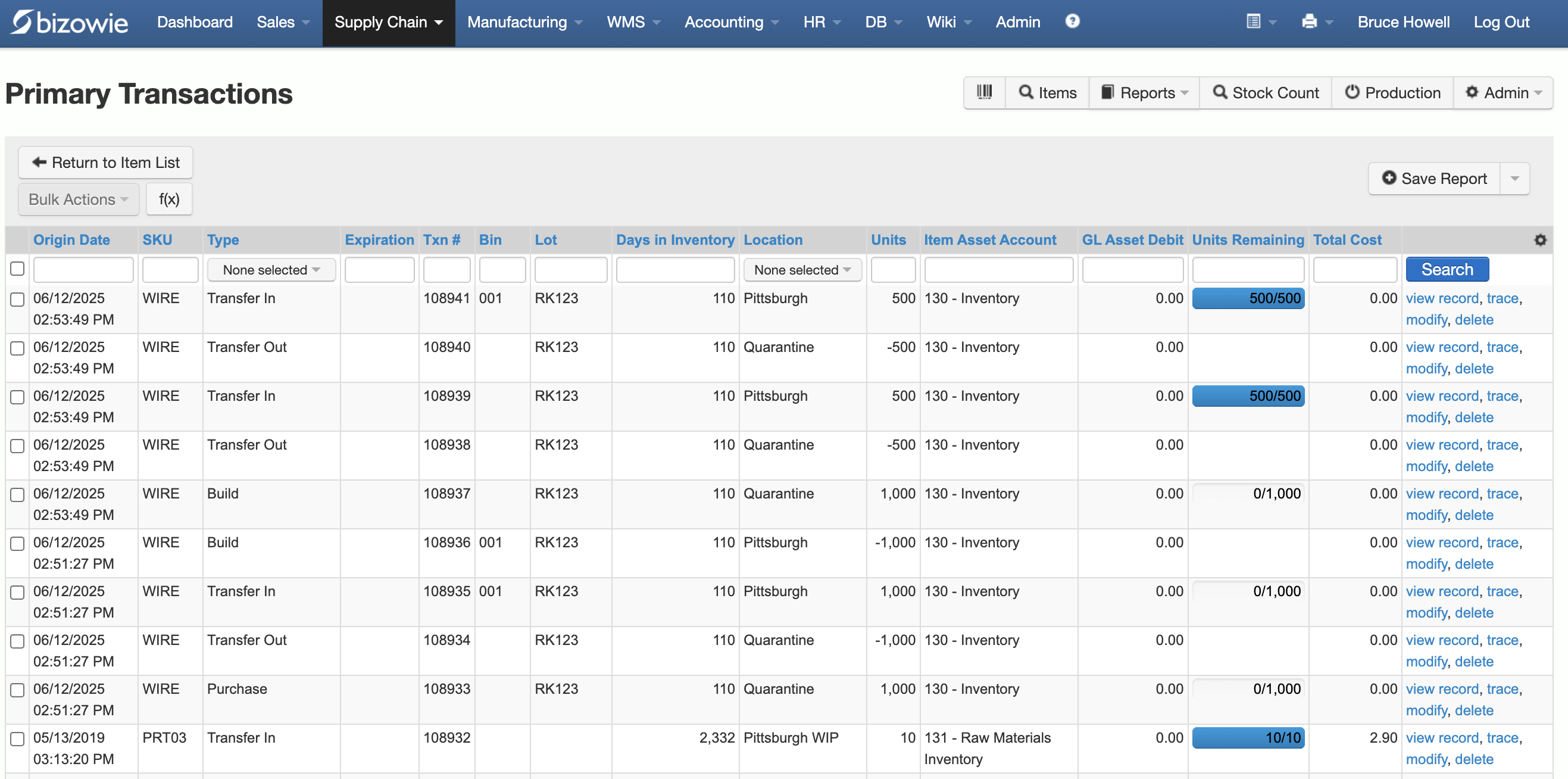
Inventory Transactions
Every receipt, transfer, build, and quarantine move by SKU, lot, bin, and location.
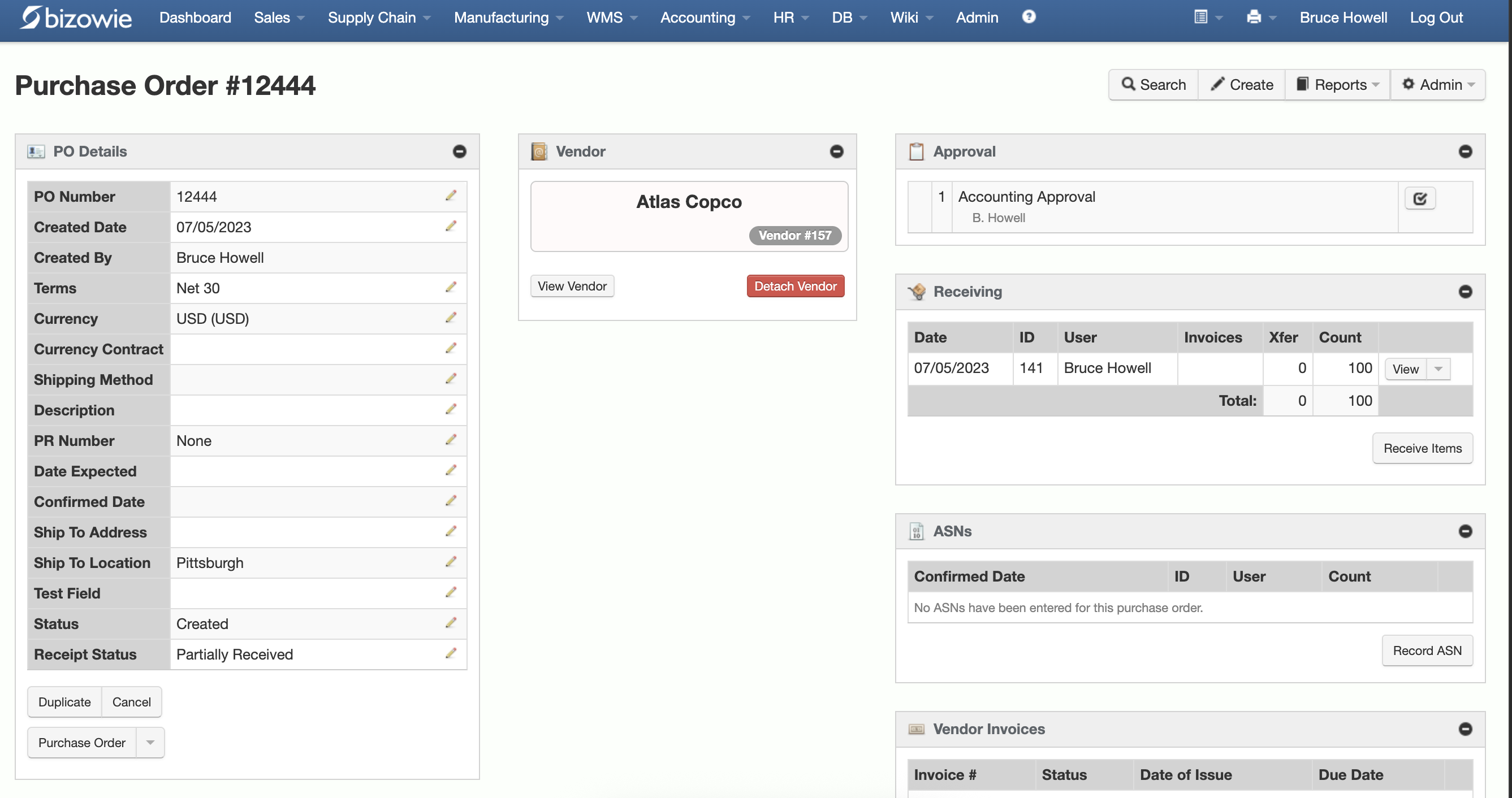
Purchasing & Receiving
Purchase orders with approvals, receiving, ASNs, and vendor invoices on one screen.
Suite Breadth vs. Operational Depth
The most useful comparison is not “big vendor versus small vendor.” It is whether you want a broad suite configured for manufacturing, or a platform where manufacturing and distribution are the primary focus.
The NetSuite Approach
NetSuite’s strength is breadth. One suite covers financials, CRM, ecommerce, global subsidiaries, and a wide range of industries, and much of its manufacturing capability is delivered through modules you add as you need them. That flexibility is valuable, but it means your manufacturing and warehouse capability, and your cost, depend on which modules you license.
The Bizowie Approach
Bizowie is designed around the operational core of manufacturers and distributors: production, inventory, warehouse, EDI, and the financial consequences of each. The objective is for a shop floor transaction, an inventory movement, and a general ledger entry to come from the same event, without handoffs between products.
The strategic question is therefore:
Are production, inventory, and the warehouse one of several things your ERP needs to do, or are they the center of your business?
Know Exactly Which Modules You Need
With NetSuite, two companies can receive very different proposals depending on the modules included. Before comparing prices, get a written answer to which modules each of these requires:
- Multi-level bills of material and routings
- Work-in-process tracking and costing
- Material requirements planning
- Finite-capacity scheduling
- Operation-level shop floor data collection
- Engineering change management
- Product configuration for make-to-order
- Quality management and lot or serial traceability
- Customer-specific and contract pricing
- Distribution requirements planning
- Warehouse management and EDI
Then ask the same question of Bizowie. Comparing a partial proposal against a complete one is the most common way ERP budgets are misjudged.
Pricing: Account for Users, Modules, and Renewals
NetSuite subscriptions typically combine a base license, per-user licenses, and modules. For manufacturers, the user question matters: if you want operators, supervisors, quality staff, and warehouse staff working in the system rather than on paper, ask exactly how each of those people will be licensed.
Ask every vendor to price the same scenarios:
- Your business as it operates today, including shop floor and warehouse users
- Your business with 30% more users and transactions
- Your business after adding a location, entity, or product line
- The expected cost at your first and second renewal
Add implementation, integrations, EDI, and ongoing support. Our manufacturing ERP total cost of ownership guide walks through what to include.
Manufacturing Depth: Make Them Run Your Scenarios
Ask each vendor to run your own production scenarios, live, using the modules in their proposal:
- Release an engineering change to a component used on three open work orders at different stages
- Insert a rush job into a loaded schedule and show what it displaces
- Receive 60 of 100 components against a scheduled job
- Scrap four units at an intermediate operation and show where the cost lands
- Report labor and quantity from the shop floor without supervisor rekeying
- Close a job and explain its variance against the estimate
- Trace a raw material lot to every customer who received it
- Run a make-to-order job and a make-to-stock replenishment in the same system
Make sure the demonstration uses only the modules in your proposal. A scenario shown with modules you have not priced is not a like-for-like comparison.
For more, see our manufacturing ERP software buyer’s guide, our explanation of ERP vs. MRP, and our guide to shop floor visibility.
“From our first contact all the way through to our implementation, Bizowie has been a first class organization to work with… We strongly recommend the Bizowie software program.”
Alan Seymour — President, Cleveland Electric Labs
Distribution Depth: Make Them Run Your Orders
For distributors, and for manufacturers that also stock and resell products, the order is where systems are separated. Ask each vendor to run these scenarios live:
- Take an EDI purchase order from a major customer through to an invoice without rekeying
- Price an order for a customer with contract pricing, quantity breaks, and a promotion
- Allocate limited stock across competing orders and two warehouses
- Transfer inventory between locations and show when it becomes available
- Receive a purchase order, put it away by scanner, then pick, pack, and ship an order
- Show true margin on an order after freight, landed cost, and rebates
- Process a drop shipment and a backorder
- Trace a lot from receipt to every customer who received it
Ask exactly which of these use the modules in your proposal, which need an add-on, and which need a separate product with its own contract.
Bizowie includes barcode-driven warehouse management, direct ANSI X12 EDI, multi-location inventory, and customer-specific pricing in the same platform as manufacturing and financials. For a full view of what distributors should look for, see our distribution ERP software buyer’s guide.
“We have seen immediate economic benefit for our business in terms of productivity from our warehouse staff, eliminated processing errors, and better stock control.”
Julius Hart — Managing Director, LensesOnline
Customization and Long-Term Maintainability
NetSuite’s SuiteCloud platform is powerful, and many NetSuite customers extend the system with scripts and SuiteApps. That flexibility carries a cost: every script and add-on is something your team or partner must maintain as the platform releases new versions.
Bizowie emphasizes configuration and no-code workflows over custom code. Whichever system you choose, ask for a list of every customization in the proposal, who will own it, and how it will be tested when the platform updates.
When NetSuite May Be the Right Choice
NetSuite may be the better fit if:
- You operate many subsidiaries across countries and need consolidated global financials
- You want ERP, CRM, and ecommerce from a single vendor
- Your manufacturing requirements are well covered by the modules in your proposal
- A large marketplace of add-on applications is important to you
- You value the backing and scale of Oracle
When Bizowie Deserves Serious Consideration
Bizowie deserves a close look if:
- Manufacturing or distribution is the center of your business, not one function among many
- You distribute at volume, with complex customer pricing and EDI trading partners
- You run more than one manufacturing mode and need them in a single system
- You want shop floor and warehouse staff working in the system, not on paper
- Warehouse management and EDI are as important to you as production
- You want one company accountable for the software, the implementation, and support
- You would rather configure a platform than maintain scripted customizations
14 Questions to Ask Before Choosing NetSuite or an Alternative
- Which modules does our manufacturing scope require, in writing?
- How will operators, supervisors, quality staff, and warehouse staff be licensed?
- What will our subscription cost at first and second renewal?
- Which requirements are native, which are modules, and which are SuiteApps or third-party products?
- How are engineering changes applied to open work orders?
- Is scheduling finite, and which module provides it?
- How do operators report production from the floor, and on what devices?
- How is job cost accumulated, and how is variance explained?
- How are customer-specific prices and contracts maintained?
- Is EDI native, a module, a SuiteApp, or a third-party product?
- Who will implement our system, and how much manufacturing experience does that team have?
- Which customizations will we own, and how do they survive platform releases?
- Can we speak with a manufacturer of our size and mode that went live in the last 18 months?
- What happens to our data and our contract if we leave?
Frequently Asked Questions
What is the best NetSuite alternative?
It depends on whether you manufacture, distribute, or both, on your size, and on how central operations are to your business. Companies commonly compare NetSuite with Bizowie, Acumatica, Epicor, and Microsoft Dynamics 365 Business Central. The strongest evaluations test each system against the same live production and order scenarios.
Does NetSuite have manufacturing capabilities?
Yes. NetSuite supports bills of material, work orders, routings, and work-in-process tracking, with MRP through its planning features. Advanced Manufacturing adds engineering change management, product configuration, shop floor data collection, and finite scheduling.
Is NetSuite good for distribution?
NetSuite supports multi-location inventory, demand planning, and distribution requirements planning, and its WMS module adds barcode-driven warehouse workflows. It is a credible option for many distributors. Confirm which modules your proposal includes and test them against your own pricing, EDI, allocation, and warehouse scenarios.
Is NetSuite MRP included?
NetSuite’s MRP relies on its demand planning and advanced inventory features. Confirm with NetSuite which features and modules your proposal includes.
How is NetSuite priced?
NetSuite is typically sold as an annual subscription combining a base platform license, per-user licenses, and individual modules. Implementation is priced separately.
Can Bizowie replace NetSuite?
For many mid-market manufacturers and distributors, yes. The right way to find out is to bring your own scenarios to a demonstration: a representative order with your pricing, a warehouse workflow, or a bill of material and a hard scheduling problem.
How difficult is it to migrate from NetSuite?
Most of the effort is data: items, customers and price lists, bills of material, routings, bin locations, open orders, inventory balances, open transactions, and history. Scripted customizations also need to be reviewed, since many may be replaced by standard functionality or configuration.
What should we ask to see in a Bizowie demonstration?
Your own scenarios: an EDI order at contract pricing, allocation across warehouses, a pick-pack-ship workflow, an engineering change on open jobs, a rush order in a loaded schedule, job cost and variance, and a lot trace to customers. We would rather show you a hard workflow than a generic tour.
Evaluate Your Next ERP From a Clean Sheet
NetSuite is a credible platform, and it belongs on many shortlists. The goal is not to rule it out, but to make sure your final choice is based on how each system handles the way your business actually works, with every required module priced.
Bring us your hardest order or production scenario. We’ll show you how Bizowie handles it, and if we are not the right fit, we will tell you.
See if Bizowie fits your operation
A real person will reply within one business day with an honest assessment, not a sales pitch.
- We review your submission personally.
- No automated email sequences.
- If we’re not the right fit, we’ll tell you.
Prefer to talk?
Call (888) 635-2517, Mon–Fri, 9 AM–5 PM Eastern
Other comparisons: Acumatica, Prophet 21, Dynamics GP, Sage 100, and outgrowing QuickBooks. See all on our switching ERP page.
Product information sources: Bizowie Cloud ERP for Manufacturers, Bizowie Cloud ERP for Distributors, Bizowie Cloud Manufacturing Suite, and NetSuite's official manufacturing ERP and WMS pages.
Acumatica is a trademark of Acumatica, Inc. NetSuite and Oracle are trademarks of Oracle and/or its affiliates. Bizowie is not affiliated with or endorsed by these companies.