
NetSuite vs. Acumatica: How They Compare for Manufacturers and Distributors
NetSuite and Acumatica are both established cloud ERP systems, and if both are on your shortlist, NetSuite vs. Acumatica is a hard comparison to make from feature lists alone. Both are credible, and both cover inventory, order management, manufacturing, and warehouse operations.
They differ less in features than in how they are packaged, priced, and delivered. NetSuite is a broad business suite that you extend with licensed modules and per-user licenses. Acumatica is sold in industry editions, priced on consumption with unlimited users, and bought through a reseller. Those differences decide what you pay, who you work with, and how the system grows with you.
This guide compares NetSuite vs. Acumatica for manufacturers and distributors: where each one fits, where buyers run into trouble, and how to choose between them. We build a competing platform, so we have kept the comparison to what each vendor says about its own product and marked the points you should confirm directly with them.
The Quick Verdict
- NetSuite tends to fit organizations that value a broad suite: companies with many subsidiaries across countries that need consolidated global financials, or that want ERP, CRM, and ecommerce from a single vendor with a large marketplace of add-on applications.
- Acumatica tends to fit companies with many occasional users, where per-user pricing would be a significant cost, and that have found a reselling partner with deep experience in their industry.
- Neither is automatically the better manufacturing or distribution system. Both have credible functionality. A feature checklist will not separate them. Your own production and order scenarios, run live with the modules or edition in your proposal, will.
NetSuite vs. Acumatica at a Glance
| Area | NetSuite | Acumatica |
|---|---|---|
| What it is | Cloud ERP suite owned by Oracle | Cloud ERP platform sold in industry editions |
| Primary market | Businesses across many industries, from small companies to large multinationals | Small and mid-sized businesses across several industry editions |
| Packaging | Core suite extended through licensed modules and SuiteApps | Editions including General Business, Distribution, Manufacturing, Construction, and Retail-Commerce |
| Pricing model | Annual subscription combining a base license, per-user licenses, and modules | Consumption-based by edition, applications, and transaction volume, with unlimited users |
| How you buy and implement | NetSuite professional services or Solution Provider partners | Through an authorized value-added reseller, which typically leads implementation and first-line support |
| Manufacturing | Bills of material, assembly items, work orders, and routings with work-in-process tracking; more through Advanced Manufacturing | Manufacturing Edition with bills of material and routings, estimating, a product configurator, and engineering change control |
| Planning and scheduling | MRP through demand planning and advanced inventory features; finite-capacity scheduling through Advanced Manufacturing | MRP, with advanced planning and scheduling |
| Shop floor | Operation-level shop floor data collection through Advanced Manufacturing | Manufacturing data collection, including a Shop Floor Kiosk |
| Distribution | Multi-location inventory, demand planning, and distribution requirements planning | Distribution Edition covering sales orders, purchasing, multi-warehouse inventory, requisitions, and replenishment |
| Warehouse management | WMS module with mobile barcode scanning, put-away and picking strategies, wave picking, and cycle counting | Warehouse management in the Distribution Edition with barcode-driven receiving, picking, packing, and shipping |
| EDI | Ask whether it is native, a module, a SuiteApp, or a third-party product | Confirm EDI scope with your partner |
| Extending it | SuiteCloud platform, including scripting and a large SuiteApp marketplace | A large ecosystem of partners and third-party add-ons |
| Often the best fit | Organizations that value a broad suite, global multi-subsidiary financials, and a large ecosystem | Businesses that value unlimited users, a large partner ecosystem, and a choice of implementers |
Product details come from our NetSuite and Acumatica comparison pages, which reflect publicly available vendor information reviewed in September 2026. Capabilities, packaging, and pricing can change, so validate your specific requirements with each vendor. NetSuite and Oracle are trademarks of Oracle and/or its affiliates. Acumatica is a trademark of Acumatica, Inc. Bizowie is not affiliated with or endorsed by these companies.
NetSuite: Who It Fits and Where Buyers Run Into Trouble
NetSuite is one of the best-known cloud ERP systems in the world. Its core covers financials, order management, inventory, purchasing, and CRM, with additional modules for manufacturing, warehouse management, ecommerce, planning, and global multi-subsidiary operations. Its strength is breadth: one suite across many industries, with a large ecosystem of partners and add-on applications.
For manufacturers, NetSuite supports bills of material, assembly items, work orders, and routings with work-in-process tracking. Advanced Manufacturing adds engineering change management, a product configurator, operation-level shop floor data collection, and finite-capacity production scheduling. For distributors, it supports inventory across multiple locations, demand planning, and distribution requirements planning, and its WMS module adds mobile barcode scanning, put-away and picking strategies, wave picking, and cycle counting.
NetSuite is often a fit when:
- You operate many subsidiaries across countries and need consolidated global financials
- You want ERP, CRM, and ecommerce from a single vendor
- Your manufacturing or distribution requirements are well covered by the modules in your proposal
- A large marketplace of add-on applications is important to you
- You value the backing and scale of Oracle
Where buyers run into trouble:
- Module scope. Much of NetSuite’s manufacturing and warehouse capability is delivered through modules, so two companies can receive very different proposals. Capability and cost both depend on what you license.
- Per-user licensing. If you want operators, supervisors, quality staff, and warehouse staff working in the system and not on paper, ask exactly how each of those people will be licensed.
- Renewals. Ask what the subscription will cost at your first and second renewal, in writing.
- Scripted customizations. SuiteCloud is powerful, and many customers extend the system with scripts and SuiteApps. Every script and add-on is something your team or partner must maintain as the platform releases new versions.
Acumatica: Who It Fits and Where Buyers Run Into Trouble
Acumatica is one of the most frequently shortlisted cloud ERP systems for small and mid-sized manufacturers and distributors. It is sold in industry editions, and its unlimited-user pricing is attractive for companies with many occasional users.
For manufacturers, the Manufacturing Edition includes bill of materials and routing management, material requirements planning, advanced planning and scheduling, estimating, a product configurator, engineering change control, and manufacturing data collection, including a Shop Floor Kiosk for capturing production data as work happens. For distributors, the Distribution Edition brings together sales orders, purchasing, inventory across multiple warehouses, requisitions, replenishment, and warehouse management with barcode-driven receiving, picking, packing, and shipping.
Acumatica is often a fit when:
- You have many occasional users and per-user pricing would be a significant cost
- You have identified a partner with deep experience in your industry and trust them
- You want the flexibility to change implementation partners later
- Your requirements fit well within one of Acumatica’s industry editions
- A large ecosystem of third-party add-ons is important to you
Where buyers run into trouble:
- Partner dependence. The software vendor and the implementer are different companies. A good partner may bring deep experience in your industry, and you can choose among many. It also means your outcome depends heavily on which partner you choose, and accountability for a problem can sit between two organizations.
- Consumption pricing as you grow. The subscription tier is driven by the applications you license and the transaction volume and resources you consume. Model what it costs at higher volume before you sign.
- Add-ons behind the demo. If a scenario has to be “taken offline” in a demonstration, it is usually a customization or a partner add-on. Find out which, and who will maintain it.
- EDI scope. Confirm with your partner whether EDI is native, a partner add-on, or a third-party product.
Pricing: Per-User vs. Consumption
This is the difference most likely to change your total cost, and it cuts in different directions for different companies.
NetSuite is typically sold as an annual subscription combining a base platform license, per-user licenses, and individual modules. Implementation is priced separately. Your cost is tied to the people and modules you add.
Acumatica uses consumption-based pricing. You license an edition and applications, and the subscription tier reflects transaction volume and computing resources, not user count. Users are unlimited. Implementation and partner services are priced separately. Your cost is tied to the applications you license and the volume you run.
A company with many occasional users and moderate transaction volume will see the two models very differently from a company with few users and heavy volume. A single quote will not show you that. Ask both vendors to price the same scenarios:
- Your business as it operates today, including shop floor and warehouse users
- Your business with 30% more users, orders, and inventory transactions
- Your business after adding a location, entity, or product line
- The expected cost at your first and second renewal
Then add implementation, partner services, integrations, EDI, and ongoing support to each. Our manufacturing ERP total cost of ownership guide walks through what to include.
How to Choose Between Them
- Get the scope in writing. For NetSuite, which modules does your scope require? For Acumatica, which edition and applications, and which partner add-ons? Comparing a partial proposal against a complete one is the most common way ERP budgets are misjudged.
- Decide how you want to buy. With Acumatica you are choosing a reselling partner as much as a product. With NetSuite you are choosing between NetSuite’s own professional services and a Solution Provider partner. In both cases, ask who the actual people on your project will be and how much experience they have with companies like yours.
- Model three years of cost, not one. Use the four scenarios above.
- Run your own scenarios live. For manufacturing: release an engineering change to a component on three open work orders, insert a rush job into a loaded schedule, scrap units at an intermediate operation and show where the cost lands, and close a job and explain its variance. For distribution: take an EDI purchase order through to an invoice without rekeying, price an order with contract pricing and quantity breaks, allocate limited stock across two warehouses, and receive, put away, pick, pack, and ship by scanner.
- Make sure the demonstration matches the proposal. A scenario shown with modules or add-ons you have not priced is not a like-for-like comparison.
- Ask who maintains every customization. Get a list of each script, add-on, and customization in the proposal, who will own it, and how it will be tested when the platform updates.
- Check references that look like you. Ask each vendor for a company of your size and type that went live in the last 18 months.
If you are down to these two and still undecided, see how to choose between two qualified ERP vendors and our ERP RFP template.
See Bizowie in Action
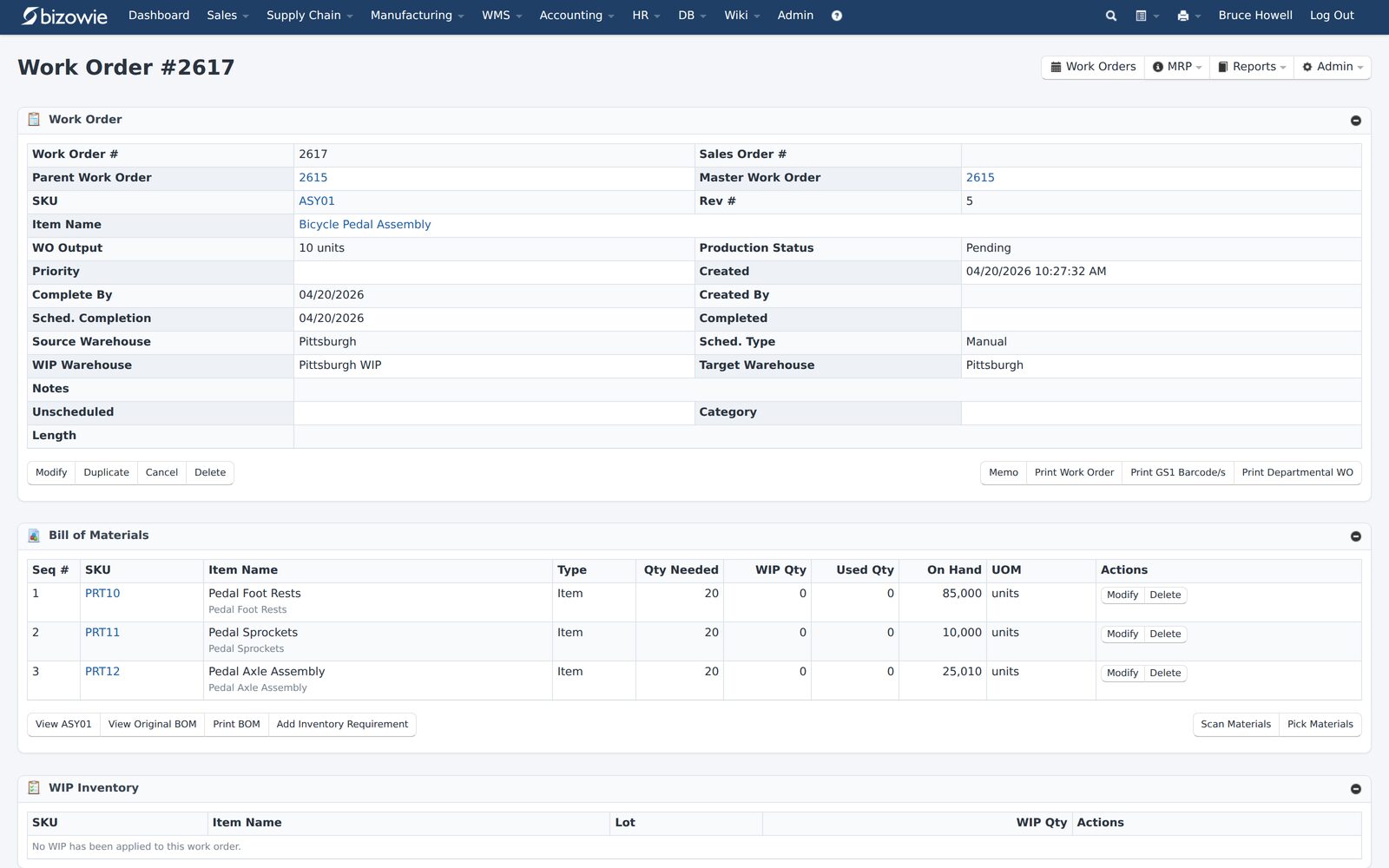
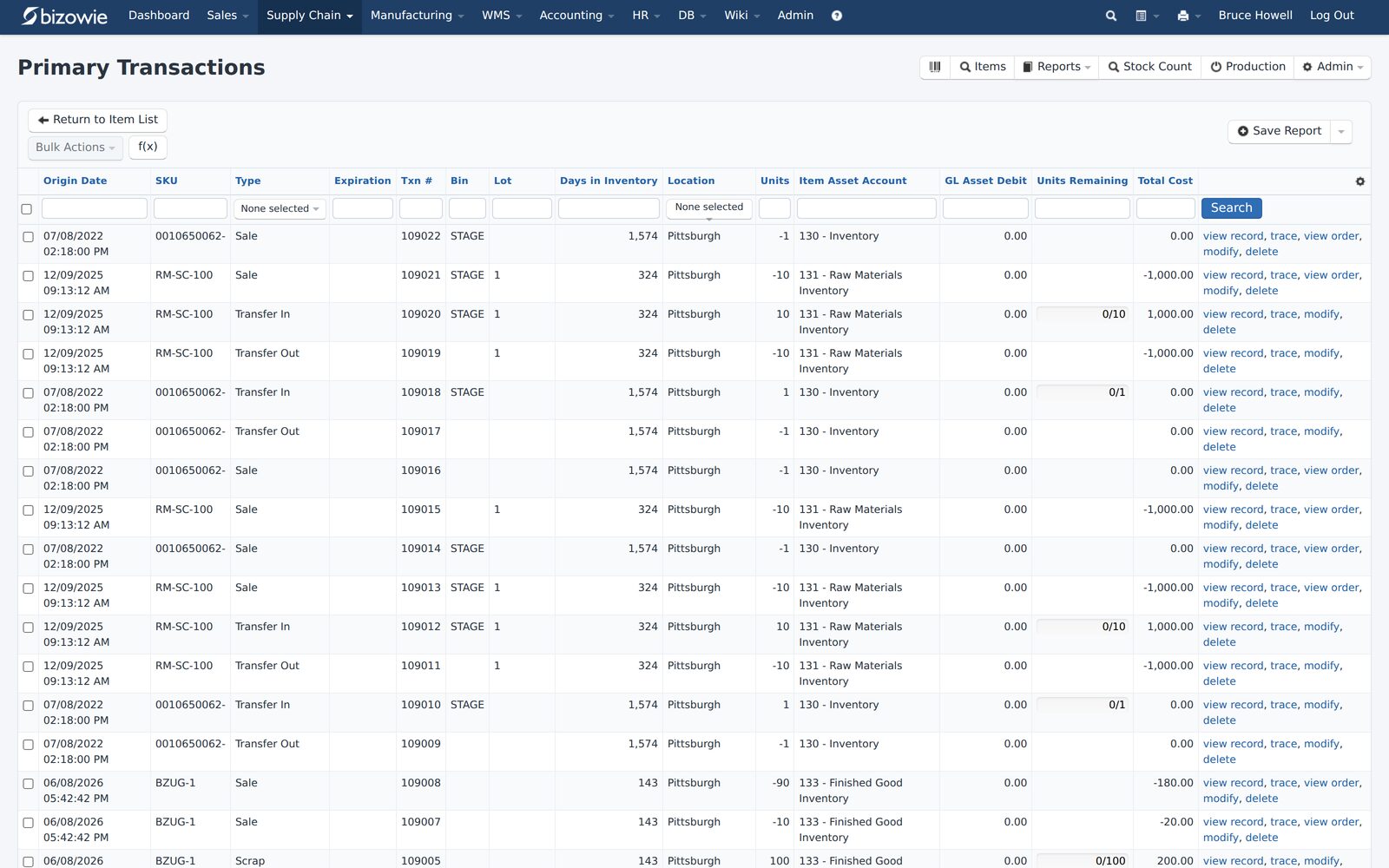
Real screens from Bizowie, not mockups. Click any screen to enlarge.
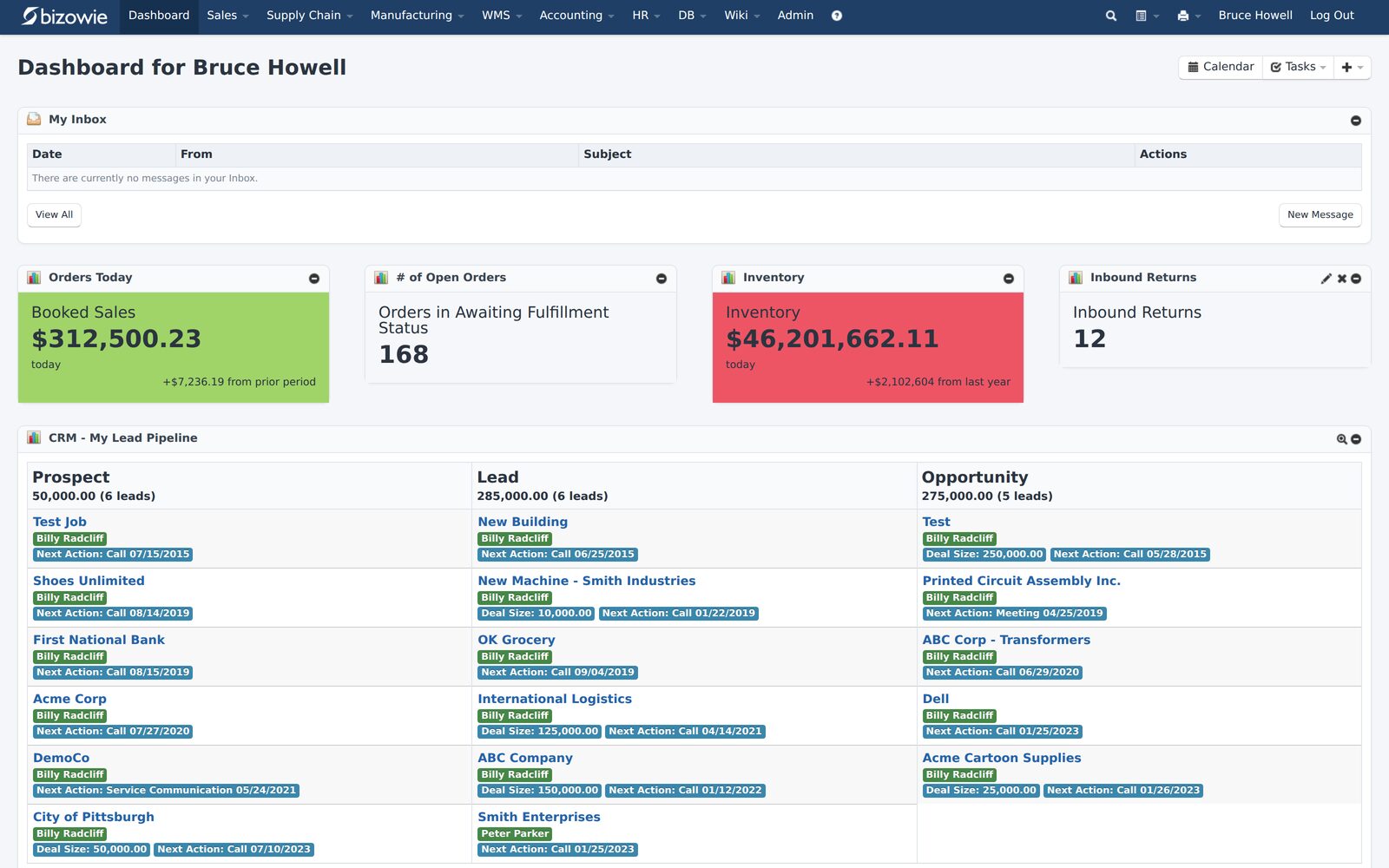
Bookings, open orders awaiting fulfillment, and inventory value at a glance.
Each work order carries its multi-level bill of materials, batches, and live on-hand quantities.
Every receipt, transfer, build, and quarantine move by SKU, lot, bin, and location.
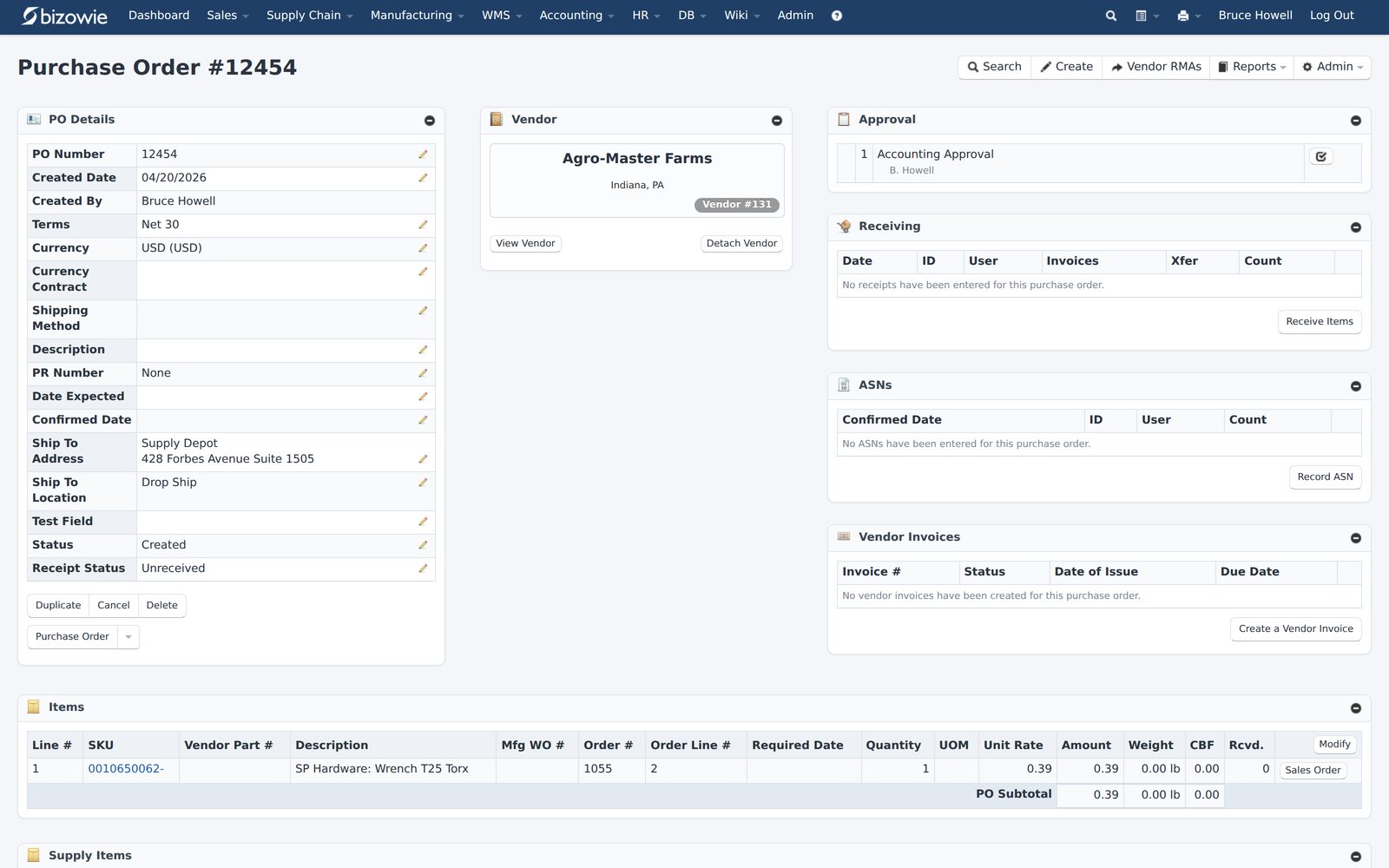
Purchase orders with approvals, receiving, ASNs, and vendor invoices on one screen.
A Third Option: Bizowie
NetSuite and Acumatica both belong on many shortlists, and for the companies described above, one of them may well be the right answer. A third approach is worth a look if production, inventory, and the warehouse are the center of your business and you would rather not assemble modules or choose a reseller. Bizowie is a cloud ERP platform built for mid-market manufacturers and distributors. Manufacturing, inventory, barcode-driven warehouse management, direct ANSI X12 EDI, customer-specific pricing, financials, and reporting run in one environment, with make-to-stock, make-to-order, engineer-to-order, assembly, and process manufacturing in the same system. The company that builds the software also implements and supports it, so one team is accountable for the outcome. Bizowie emphasizes configuration and no-code workflows over custom code. It is not the right choice for everyone: if global multi-subsidiary financials is your first requirement, NetSuite is built for that, and if a wide choice of implementation partners matters most, Acumatica offers it. See our buyer’s guides to manufacturing ERP software and distribution ERP software for what to test in any system.
“From our first contact all the way through to our implementation, Bizowie has been a first class organization to work with… We strongly recommend the Bizowie software program.”
Alan Seymour — President, Cleveland Electric Labs
Frequently Asked Questions
What is the main difference between NetSuite and Acumatica?
Packaging, pricing, and delivery. NetSuite is a broad cloud suite sold as a base license plus per-user licenses and modules, implemented by NetSuite or a Solution Provider partner. Acumatica is sold in industry editions with consumption-based pricing and unlimited users, and is bought and implemented through a value-added reseller.
Is NetSuite or Acumatica better for manufacturing?
Both have credible manufacturing functionality. NetSuite delivers finite scheduling, shop floor data collection, and engineering change management through Advanced Manufacturing. Acumatica’s Manufacturing Edition includes MRP, advanced planning and scheduling, estimating, a configurator, and manufacturing data collection. Test both against your own production scenarios, using only what is in each proposal.
Is NetSuite or Acumatica better for distribution?
Both are credible options for many distributors. NetSuite offers multi-location inventory, demand planning, and a WMS module. Acumatica’s Distribution Edition covers sales orders, purchasing, multi-warehouse inventory, replenishment, and warehouse management. Test each against your own pricing, EDI, allocation, and warehouse scenarios.
Is Acumatica cheaper than NetSuite?
It depends on your users and your volume. Acumatica does not charge by user, which helps companies with many occasional users. Its subscription tier reflects transaction volume and computing resources. NetSuite combines a base license with per-user licenses and modules. Ask both to price the same scenarios, including growth and renewals.
Can I buy Acumatica directly from Acumatica?
Acumatica is sold through authorized value-added resellers, and the reselling partner typically leads implementation and support. NetSuite is implemented by its own professional services team or by Solution Provider partners.
What are the alternatives to NetSuite and Acumatica?
Companies commonly compare them with Bizowie, Epicor, and Microsoft Dynamics 365 Business Central. The right list depends on whether you manufacture, distribute, or both, and on whether you want a partner-led or vendor-direct implementation. See our switching ERP page for more comparisons.
Bring Us the Scenario Neither Demo Has Answered
Send us the order or production scenario you are using to compare NetSuite and Acumatica. We’ll show you how Bizowie handles it, and if we are not the right fit, we will tell you.
See how Bizowie compares on your own scenarios
Tell us a little about your operation and we’ll reply with an honest assessment of fit, not a sales pitch.
- A real person reviews your submission and replies within one business day.
- No automated email sequences.
- If we’re not the right fit, we’ll tell you.
Prefer to talk?
Call (888) 635-2517, Mon–Fri, 9 AM–5 PM Eastern