
Month-End Close Checklist for Distributors and Manufacturers
In many distribution and manufacturing companies, month-end close takes two weeks, and the last few days are spent proving that the systems agree with each other.
Inventory in the warehouse system does not match inventory on the balance sheet. Receipts have no invoices yet. Freight bills arrive after the goods. Production costs are sitting in work in process that nobody has reviewed. By the time the numbers are final, the month they describe is long gone.
This guide gives you a practical month-end close checklist for distributors and manufacturers, explains the steps that usually slow the close down, and shows how to get it faster without cutting corners.
What Month-End Close Involves
Month-end close is the process of making sure every transaction for the month is recorded, correct, and in the right period, then producing financial statements. For product companies, the hard part is rarely the general ledger itself. It is getting inventory, purchasing, sales, and production activity to agree with the ledger.
A Typical Close Timeline
| When | Focus |
|---|---|
| Last days of the month | Cutoff preparation: shipments, receipts, and invoices in the right period |
| Business days 1–2 | Subledgers: AR, AP, inventory, fixed assets, bank reconciliations |
| Business days 2–4 | Accruals, inventory and cost adjustments, intercompany |
| Business days 4–5 | Review, variance analysis, and financial statements |
A five-business-day close is a reasonable goal for many mid-market companies. Some close faster; many take two weeks or more.
Month-End Close Checklist
1. Cutoff
- All shipments made in the month are invoiced in the month
- All goods received in the month are recorded as received
- Shipments and receipts near the cutoff are checked against dates
- Credit memos and returns are recorded in the right period
2. Cash
- Reconcile every bank account and credit card statement
- Record bank fees, interest, and payment processor charges
- Clear or explain outstanding items
3. Accounts Receivable
- Reconcile the AR aging to the general ledger
- Review past-due balances and update the bad debt allowance
- Apply unapplied cash and credits
See credit management best practices.
4. Accounts Payable and Accruals
- Reconcile the AP aging to the general ledger
- Accrue goods received but not yet invoiced
- Accrue freight, duties, and services not yet billed
- Accrue recurring expenses: utilities, payroll, commissions
5. Inventory
- Reconcile the inventory subledger to the general ledger
- Review and post cycle count adjustments
- Review inventory in transit and on consignment
- Update reserves for obsolete and slow-moving stock. See dead stock and obsolete inventory.
- Allocate landed cost to receipts
6. Fixed Assets and Prepaids
- Record additions and disposals
- Post depreciation
- Amortize prepaid expenses
7. Revenue
- Review deferred revenue, deposits, and billings in advance
- Record rebates and customer allowances
8. Review and Report
- Compare results to budget and prior periods, and explain large variances
- Review gross margin by product line and customer
- Close the period to prevent back-dated entries
- Produce and distribute financial statements
Inventory Reconciliation
The inventory value in the general ledger should equal the value of inventory on hand in the inventory system. When the two are separate systems, or when warehouse transactions post to the ledger in batches, they drift. Common causes:
- Receipts or adjustments recorded in one system but not the other
- Landed cost charged to expense instead of inventory
- Unit-of-measure or costing errors
- Transactions posted to the wrong period
When every inventory transaction posts to the ledger as it happens, the reconciliation becomes a check rather than a project. See cycle counting and landed cost tracking.
Accruals: Received-Not-Invoiced and Freight
Goods often arrive before the vendor’s invoice. At month-end, the liability for those receipts must be recorded, usually as a “received not invoiced” accrual, so inventory and liabilities are both correct. The same applies to inbound freight and duties that have not been billed yet. A purchasing system that tracks receipts against purchase orders makes this accrual a report instead of a hunt. See the procure-to-pay process.
Additional Steps for Manufacturers
- Review work in process and close completed jobs. See WIP inventory.
- Compare applied overhead to actual overhead and record any difference. See manufacturing overhead rates.
- Review and dispose of standard cost variances. See manufacturing cost variances.
- Confirm scrap and outside processing have been recorded
Multiple Entities and Consolidation
Companies with more than one legal entity also need to reconcile intercompany balances, eliminate intercompany transactions, revalue foreign currency balances, and consolidate. See multi-currency and multi-entity ERP.
Why Closes Run Long
- Operational systems that post to the ledger in batches, or not at all
- Spreadsheets used to calculate accruals, costs, and allocations
- Late vendor invoices and freight bills
- Inventory adjustments discovered at month-end instead of during the month
- No clear owner or deadline for each task
- Too many manual journal entries
How to Close Faster
- Close continuously: reconcile bank accounts and review inventory weekly, not just at month-end
- Automate recurring entries and standard accruals
- Assign every checklist step an owner and a due day
- Fix the root causes of recurring adjustments
- Run operations and accounting in one system, so inventory, purchasing, sales, and production post to the ledger as they happen
See Bizowie in Action
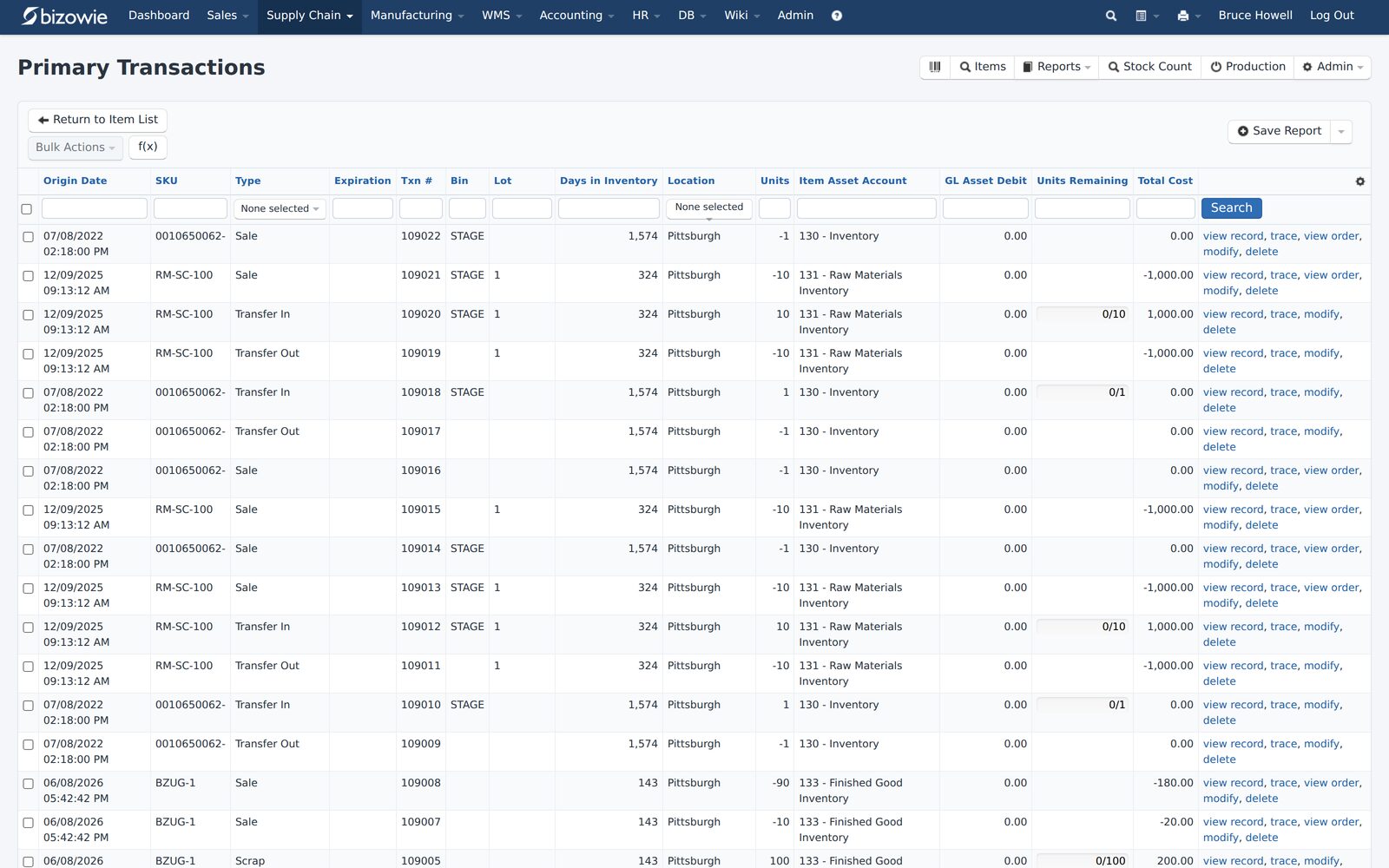
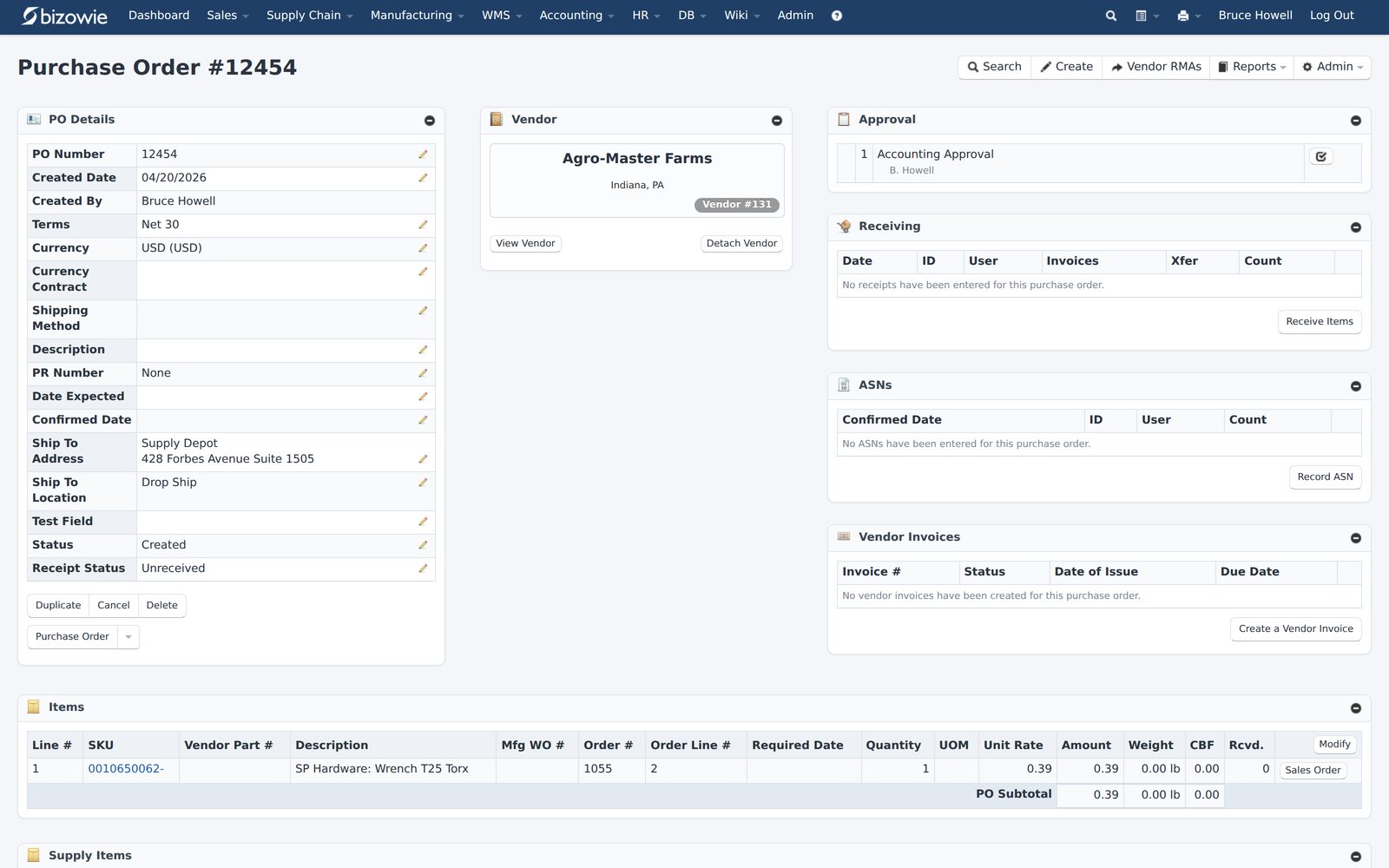
Real screens from Bizowie, not mockups. Click any screen to enlarge.
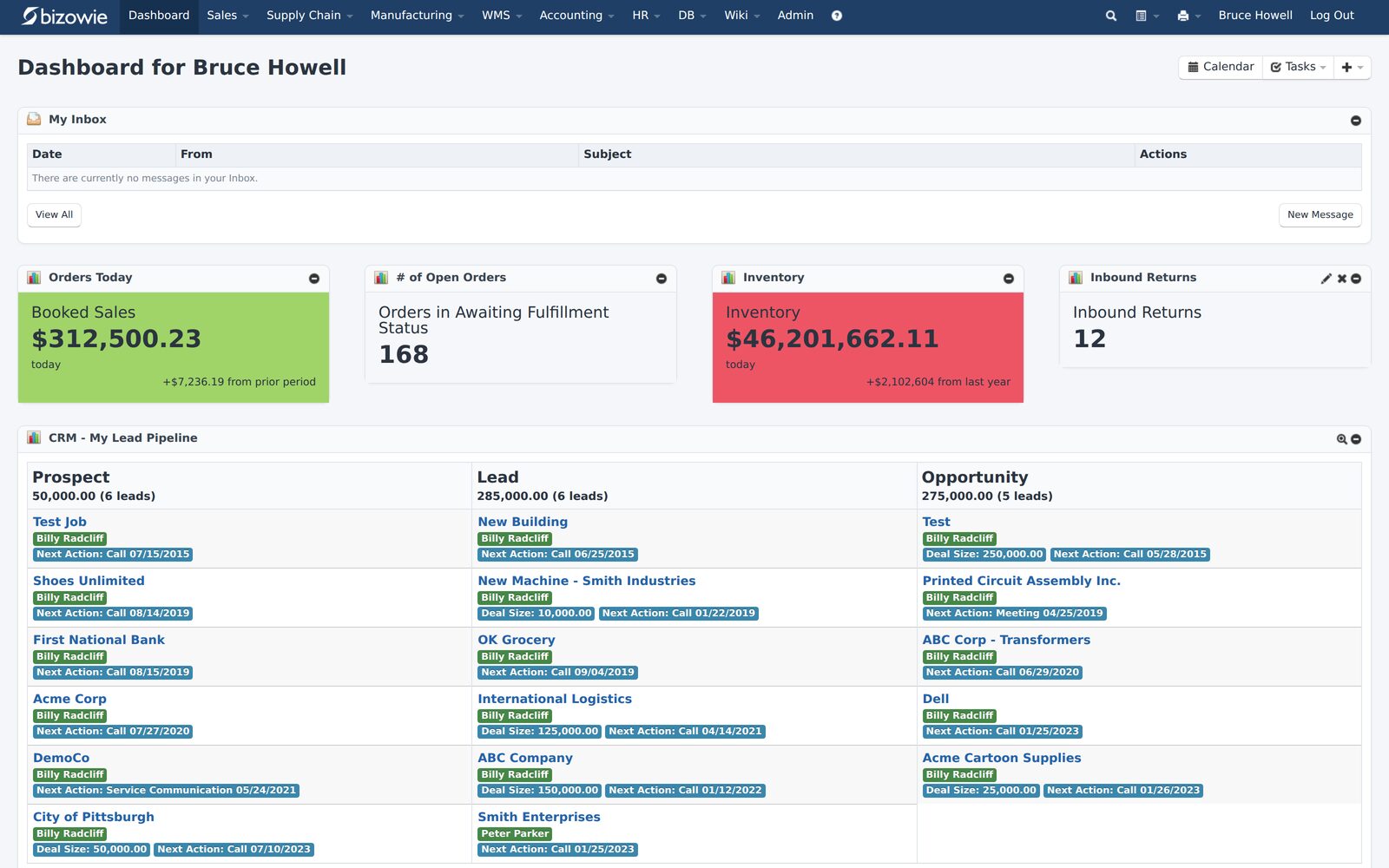
Bookings, open orders awaiting fulfillment, and inventory value at a glance.
Every receipt, transfer, build, and quarantine move by SKU, lot, bin, and location.
Purchase orders with approvals, receiving, ASNs, and vendor invoices on one screen.
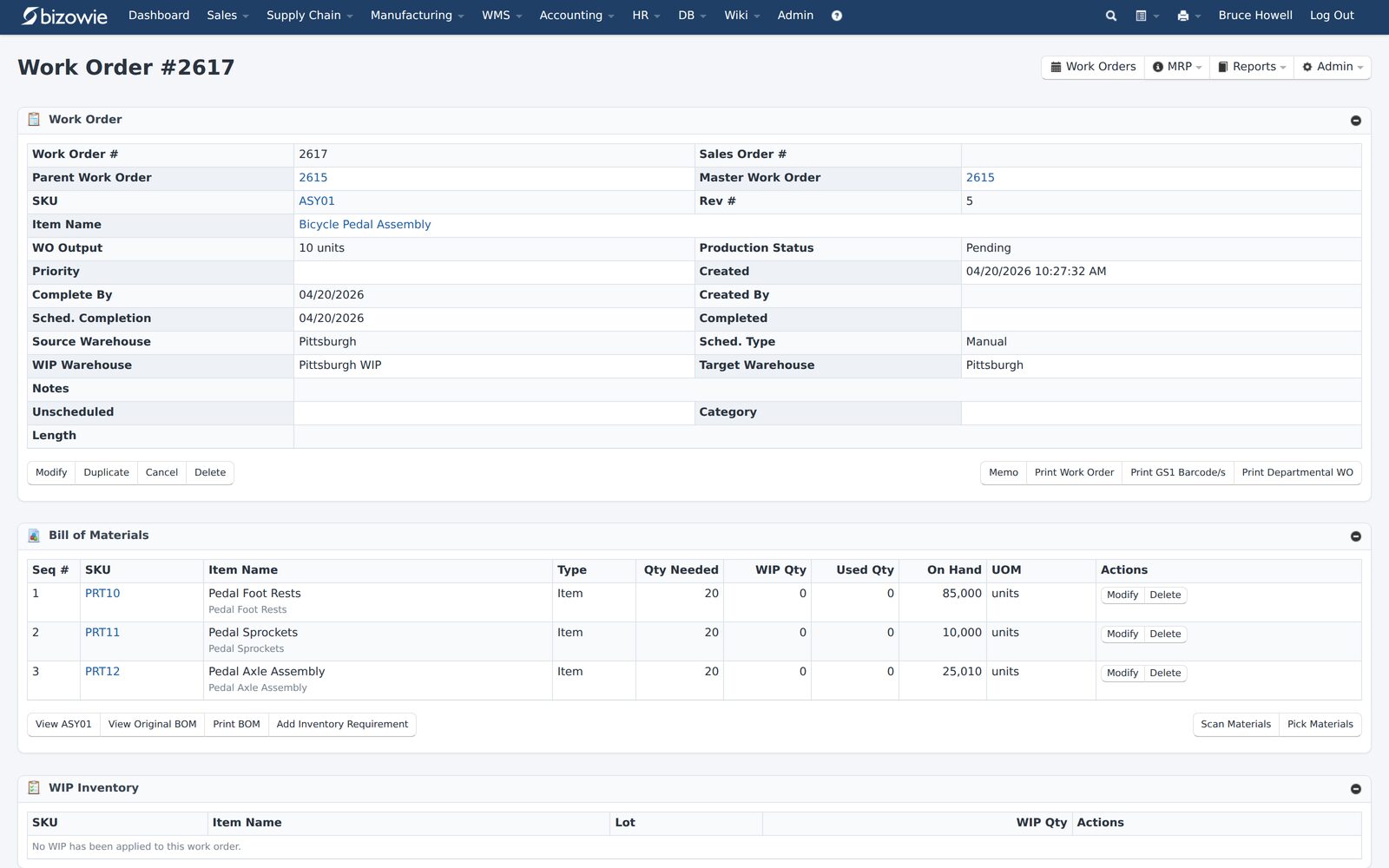
Each work order carries its multi-level bill of materials, batches, and live on-hand quantities.
Month-End Close in Bizowie
Bizowie’s financial suite is built on a double-entry, GAAP-compliant base, with financial period management, recurring and template transactions, bank reconciliation, credit card and bank statement import, budgeting, cash flow forecasting, deferred revenue recognition, and dimensional reporting by cost center, location, department, and more. Multi-company, multi-entity, and full multi-currency capabilities include revaluation. Because order management, inventory, shipping, warehouse management, and manufacturing all post in real time, with no batch updates or imports, the operational side of the close is already reconciled. Role-based controls and an audit trail cover every transaction. See why full audit logs are non-negotiable.
“What used to take us 30 to 45 minutes can now be done in 3 to 5 minutes.”
Bridget Gaussa — Director of Program Development, Cribs for Kids
Frequently Asked Questions
How long should month-end close take?
Many mid-market companies aim for five business days or fewer. The biggest gains usually come from automating reconciliations between operational systems and the ledger.
What is included in a month-end close checklist?
Cutoff, bank reconciliation, AR and AP reconciliation, accruals, inventory reconciliation and reserves, fixed assets and prepaids, revenue review, variance analysis, and financial reporting.
What is a received-not-invoiced accrual?
A liability recorded for goods received during the month whose vendor invoices have not yet arrived, so inventory and liabilities are both stated correctly.
Why doesn’t inventory match the general ledger?
Usually because transactions were recorded in one system and not the other, posted to the wrong period, or costed incorrectly. Real-time posting from operations to the ledger removes most of the causes.
Bring Us Your Close Checklist
Tell us how long your close takes and where the time goes. We’ll show you how it would work in Bizowie, and if we are not the right fit, we will tell you.
See how Bizowie would speed up your close
For manufacturers and distributors. Tell us a little about your operation and we’ll reply with an honest assessment of fit, not a sales pitch.
- A real person reviews your submission and replies within one business day.
- No automated email sequences.
- If we’re not the right fit, we’ll tell you.
Prefer to talk?
Call (888) 635-2517, Mon–Fri, 9 AM–5 PM Eastern