

Scrap Rate and Yield: Formulas, Examples, and How to Reduce Scrap
Scrap rate and yield measure the same thing from opposite sides: how much of what you start becomes product you can sell. Scrap rate counts what was lost. Yield counts what made it through.
Both are easy to calculate and easy to get wrong. A plant can report 98% yield while a meaningful share of its output is being reworked, and a scrap rate based on units can hide the fact that most of the dollars are lost at the last operation. The formulas matter less than agreeing on what counts as scrap, where it is measured, and what it costs.
This guide gives the formulas for scrap rate, yield, first pass yield, and rolled throughput yield with worked examples, shows how to cost scrap and plan for it in bills of materials and work orders, and covers practical ways to reduce it.
Scrap, Rework, and Yield Defined
- Scrap is material or product that cannot be used or economically repaired. Its cost is lost, apart from any salvage value.
- Rework is product that failed inspection but can be corrected and sold. It is not scrap, but it consumes extra labor, machine time, and sometimes material.
- Yield is the share of units started, or material put in, that comes out as good product.
The Scrap Rate and Yield Formulas
Scrap rate = Units scrapped ÷ Total units produced × 100
Total units produced means everything that came off the process, good and scrapped.
Yield = Good units ÷ Units started × 100
First pass yield = Units that pass the first time, with no rework ÷ Units started × 100
When every started unit ends up either good or scrapped, scrap rate and yield add up to 100%. First pass yield is always equal to or lower than yield, and the gap between them is the rework you are doing.
| Metric | Counts rework as good? | What it tells you |
|---|---|---|
| Scrap rate | Yes | How much is thrown away |
| Yield | Yes | How much ends up sellable |
| First pass yield | No | How often the process gets it right the first time |
| Rolled throughput yield | No | The chance a unit passes every operation with no rework |
Worked Example
A work order starts 2,000 units. At final inspection:
- 1,900 pass the first time
- 60 fail, are reworked, and then pass
- 40 are scrapped
Scrap rate = 40 ÷ 2,000 = 2.0%
Yield = (1,900 + 60) ÷ 2,000 = 1,960 ÷ 2,000 = 98.0%
First pass yield = 1,900 ÷ 2,000 = 95.0%
A report that shows only yield says 98% and looks healthy. First pass yield shows that one unit in twenty needed extra work or was lost.
Rolled Throughput Yield
When a product passes through several operations, losses compound. Rolled throughput yield multiplies the first pass yield of each operation:
Rolled throughput yield = FPY of operation 1 × FPY of operation 2 × … × FPY of operation n
Example: three operations with first pass yields of 98%, 96%, and 99%.
Rolled throughput yield = 0.98 × 0.96 × 0.99 = 93.1%
No single operation looks bad, yet about 7 units in 100 need rework or are scrapped somewhere along the routing. The more operations a product has, the more this matters. Tracking yield by operation also shows where the loss occurs, which a final inspection number cannot. For related measures, see OEE and the manufacturing KPIs that matter.
The Cost of Scrap
A scrapped unit costs more the later it is scrapped, because it carries the material, labor, and overhead of every operation it has been through.
Scrap cost = Units scrapped × Cost accumulated at the point of scrap − Salvage value
From the example: the 40 scrapped units had accumulated $32.00 each in material, labor, and overhead, with no salvage value. The 60 reworked units took an extra $6.00 each to correct.
- Scrap: 40 × $32.00 = $1,280
- Rework: 60 × $6.00 = $360
- Total cost of scrap and rework on the order: $1,640
Measuring scrap in dollars as well as units changes priorities. Ten units scrapped at the first operation may cost less than one scrapped after final assembly. How scrap is charged, to the job, to overhead, or to a variance account, is a costing policy your accountant should set. See manufacturing cost variances.
Planning for Scrap: Scrap Factors and Yield
If you know a process loses material, plan for it. Otherwise every order comes up short.
Quantity to start = Good units required ÷ Expected yield
A customer needs 1,000 good units and the expected yield is 96%: 1,000 ÷ 0.96 = 1,041.7, so start 1,042 units.
The same idea applies to components through a scrap factor on the bill of materials:
Gross component requirement = Net requirement ÷ (1 − Scrap factor)
A job needs 500 feet of tubing net and the component carries a 4% scrap factor: 500 ÷ (1 − 0.04) = 520.8 feet
Some systems calculate this as 500 × 1.04 = 520 feet. The difference is small at low percentages and grows as scrap increases, so know which method your system uses.
Scrap factors and yields in the system should be reviewed against actual results. A factor set too low causes shortages. One set too high buys and issues material you do not need, and hides a process that has improved or deteriorated. See bill of materials management and how MRP calculates requirements.
Yield in Process Manufacturing
In batch and process manufacturing, yield is usually measured by weight or volume against the theoretical output of the formula:
Batch yield = Actual output ÷ Theoretical output × 100
A batch has a theoretical output of 1,000 lb and produces 925 lb: 925 ÷ 1,000 = 92.5%
If the standard yield for the product is 94%, the batch should have produced 940 lb. It came up 15 lb short. At a standard cost of $2.40 per lb, the yield variance is 15 × $2.40 = $36 unfavorable.
Some loss is expected: moisture, trim, material left in the equipment. The point of a standard yield is to separate normal loss from a batch that went wrong. See ERP for food and beverage manufacturers.
How to Reduce Scrap
- Record scrap when and where it happens. Capture the quantity, the operation, and a reason code at the work center, not from memory at the end of the shift.
- Keep reason codes short and specific. Setup, material defect, operator error, machine fault, and dimensional are useful. “Other” is not.
- Rank causes by cost. A small number of parts, operations, and reasons usually account for most of the loss. Start there.
- Attack setup scrap. First-piece inspection, documented setups, and fewer changeovers through better sequencing all cut the units lost at the start of a run. See production scheduling.
- Check incoming material. If scrap traces back to a supplier or a lot, the fix is in receiving inspection and supplier quality, not on the floor.
- Maintain equipment before it drifts. Worn tooling and uncalibrated machines produce scrap gradually, which makes it easy to miss.
- Keep work instructions and revisions current. Building to an old drawing is scrap that looks like an operator problem. See engineering change management.
- Feed results back into standards. Update scrap factors and yields so planning, costing, and quoting reflect what the process actually does.
There is no universal target for scrap rate. Acceptable levels differ by process, material, and tolerance. The useful comparisons are against your own standard and your own trend.
Common Mistakes
- Reporting yield only, so rework stays invisible
- Measuring scrap only at final inspection, with no idea which operation caused it
- Counting units and ignoring the dollars
- Not reporting scrap at all, which leaves inventory overstated and jobs undercosted
- Scrap factors on the bill of materials that nobody has reviewed in years
- Reason codes so vague that most scrap lands in “other”
- Treating rework as free because the unit eventually shipped
- Comparing scrap rates between plants or products that define scrap differently
See Bizowie in Action
Real screens from Bizowie, not mockups. Click any screen to enlarge.
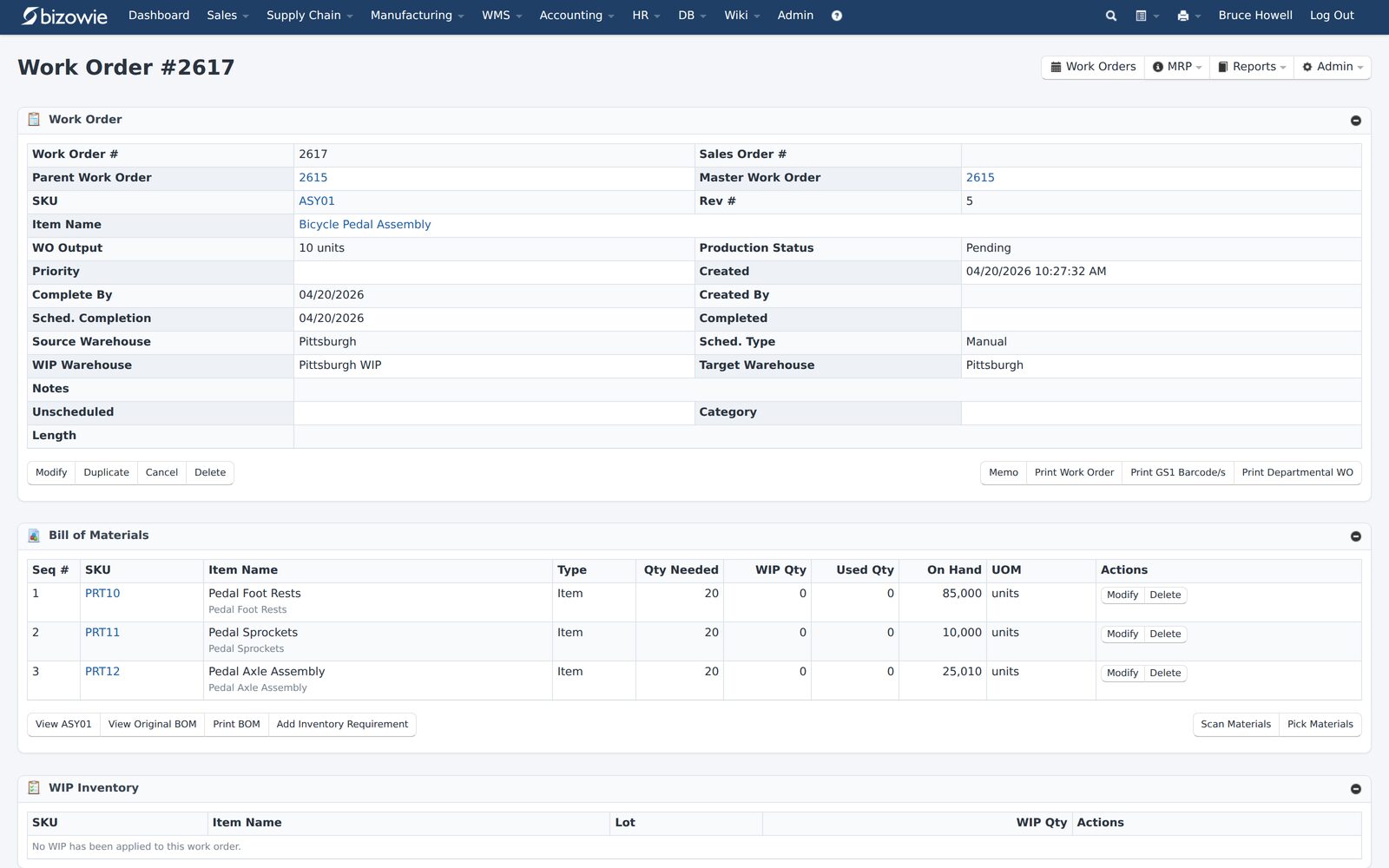
Each work order carries its multi-level bill of materials, batches, and live on-hand quantities.
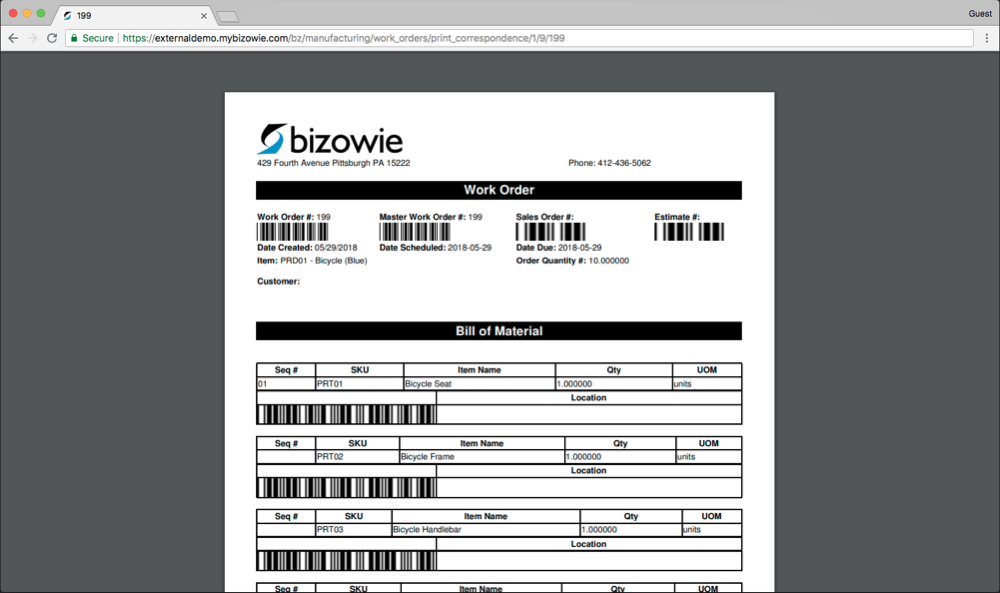
Printed work orders with barcoded BOM lines, so the shop floor scans instead of writing.
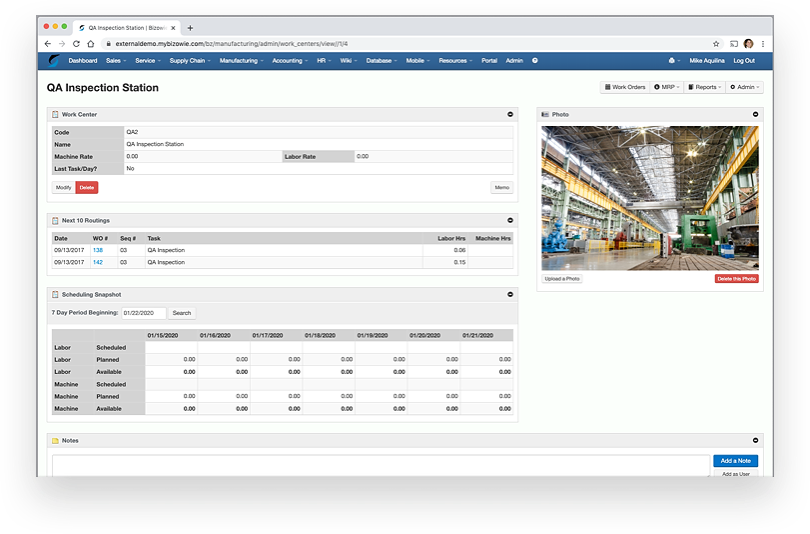
Routings, labor and machine rates, and a scheduling snapshot for every work center.
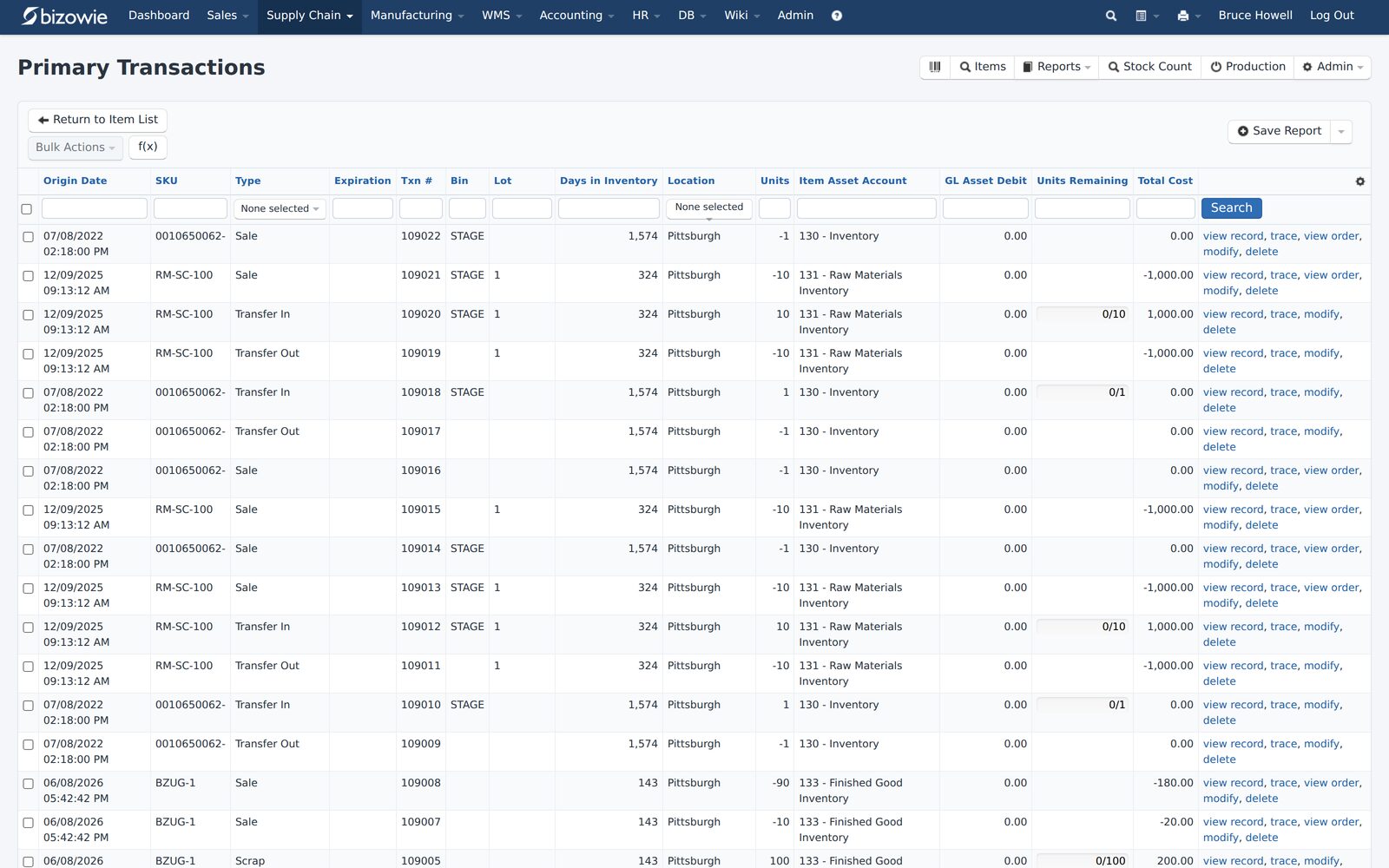
Every receipt, transfer, build, and quarantine move by SKU, lot, bin, and location.
Tracking Production and Quality in Bizowie
Bizowie collects production data in real time from computers, tablets, or touchscreens on the shop floor, and labor and machine time are recorded and applied as costs to the work order. Quality data tracking is part of the platform, with user-customizable data sets and workflows. For process manufacturers, batch functionality lets you split production across batch numbers, adjust formulations at the batch level, and compare actual production with expected yield. Every production event updates inventory, costing, and the general ledger at the same time. For the wider evaluation, see our manufacturing ERP software buyer’s guide.
“From our first contact all the way through to our implementation, Bizowie has been a first class organization to work with… We strongly recommend the Bizowie software program.”
Alan Seymour — President, Cleveland Electric Labs
Frequently Asked Questions
How do you calculate scrap rate?
Divide the number of units scrapped by the total units produced, good and scrapped, and multiply by 100. Scrap rate can also be measured in cost: scrap cost divided by total production cost.
What is the difference between scrap rate and yield?
Scrap rate measures the share of production that is lost. Yield measures the share that ends up as good product. When every unit is either good or scrapped, the two add up to 100%.
What is first pass yield?
The percentage of units that pass through a process correctly the first time, with no rework. It is calculated as units passing the first time divided by units started.
What is a good scrap rate?
It depends on the process, material, and tolerances, so there is no single benchmark. Compare your scrap rate with your own standard and track whether it is improving.
How do you account for scrap in a bill of materials?
Add a scrap factor to the component. The gross requirement is the net requirement divided by one minus the scrap factor, so planning and purchasing cover the expected loss.
Bring Us Your Worst Part Number
Tell us how you record scrap and rework today. We’ll show you how Bizowie captures production and quality data on the floor, and if we are not the right fit, we will tell you.
See how Bizowie would track your production
Tell us a little about your operation and we’ll reply with an honest assessment of fit, not a sales pitch.
- A real person reviews your submission and replies within one business day.
- No automated email sequences.
- If we’re not the right fit, we’ll tell you.
Prefer to talk?
Call (888) 635-2517, Mon–Fri, 9 AM–5 PM Eastern