
OEE and the Manufacturing KPIs That Matter
Most plants track too many numbers and act on too few.
The right manufacturing KPIs show where time, material, and money are lost, and point to what to fix next. Overall equipment effectiveness (OEE) is the best known, but it is not the only one that matters, and it is easy to calculate wrong.
This guide explains how to calculate OEE with a worked example, what a realistic target is, and the other manufacturing KPIs worth tracking, with how to get trustworthy data for all of them.
What Is OEE?
Overall equipment effectiveness measures how much of a machine’s planned time produced good parts at full speed.
OEE = Availability × Performance × Quality
- Availability = Run time ÷ Planned production time
- Performance = (Ideal cycle time × Total parts produced) ÷ Run time
- Quality = Good parts ÷ Total parts produced
OEE Worked Example
A machine is scheduled for one 8-hour shift: 480 minutes of planned production time.
- It is down for 60 minutes (breakdowns and changeovers), so run time is 420 minutes. Availability = 420 ÷ 480 = 87.5%
- Its ideal cycle time is 1 minute per part, and it produced 360 parts. Performance = (1 × 360) ÷ 420 = 85.7%
- Of those, 342 were good. Quality = 342 ÷ 360 = 95.0%
OEE = 87.5% × 85.7% × 95.0% ≈ 71%
A quick check: 342 good parts at 1 minute each equals 342 minutes of fully productive time, out of 480 planned. 342 ÷ 480 = 71.25%.
The Losses Behind OEE
| Factor | Typical losses |
|---|---|
| Availability | Breakdowns, changeovers and setups, waiting for material or operators |
| Performance | Slow cycles, small stops, running below rated speed |
| Quality | Scrap, rework, and startup rejects |
The value of OEE is in the breakdown. A machine at 71% because of changeovers needs different action than one at 71% because of scrap.
What Is a Good OEE?
Figures around 85% are often described as world class for discrete manufacturing, and many plants run well below that when they first measure honestly. More useful than a benchmark is your own trend: measure consistently, focus on the biggest loss category, and track improvement.
Apply OEE to constraint and high-value equipment first. A non-bottleneck machine with low OEE may not matter much; the bottleneck’s OEE sets the output of the plant. See capacity planning.
Other Manufacturing KPIs That Matter
| KPI | What it measures | How to calculate |
|---|---|---|
| On-time delivery | Promises kept to customers | Orders shipped by promise date ÷ orders shipped |
| Schedule attainment | How well the plan is executed | Jobs or operations completed as scheduled ÷ scheduled |
| First-pass yield | Quality without rework | Units passing first time ÷ units started |
| Scrap rate | Material and labor lost | Scrap quantity or cost ÷ total produced |
| Manufacturing lead time | Speed through the plant | Average time from job release to completion |
| Labor efficiency | Actual vs. standard hours | Standard hours earned ÷ actual hours |
| Job cost variance | Accuracy of estimates and standards | Actual cost − estimated or standard cost |
| Inventory turns | How hard inventory works | Cost of goods sold ÷ average inventory |
See manufacturing cost variances, WIP inventory, and inventory turnover.
Getting Data You Can Trust
KPIs are only as good as the data behind them. Numbers built from paper travelers typed in at the end of the week are late and often wrong. Data captured at the work center as work happens, including start and stop times, quantities, scrap with reasons, and downtime with causes, is timely and specific enough to act on. See shop floor visibility and control.
See Bizowie in Action
Real screens from Bizowie, not mockups. Click any screen to enlarge.
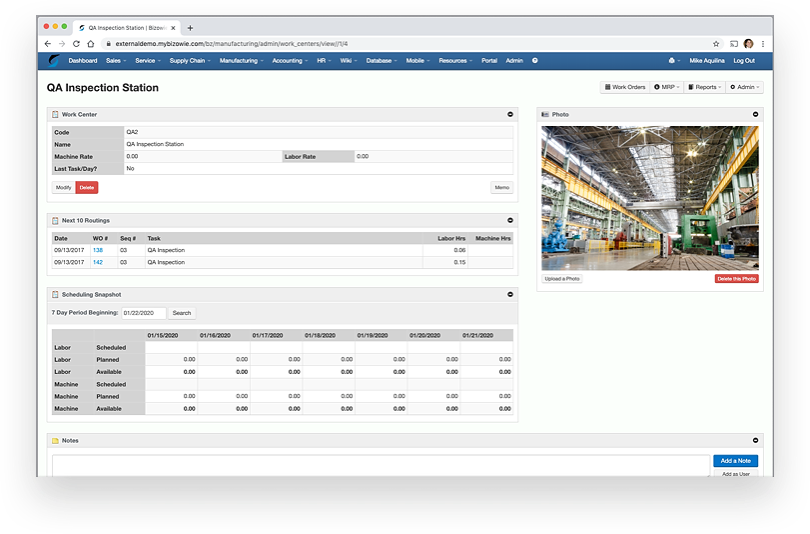
Work Centers & Capacity
Routings, labor and machine rates, and a scheduling snapshot for every work center.
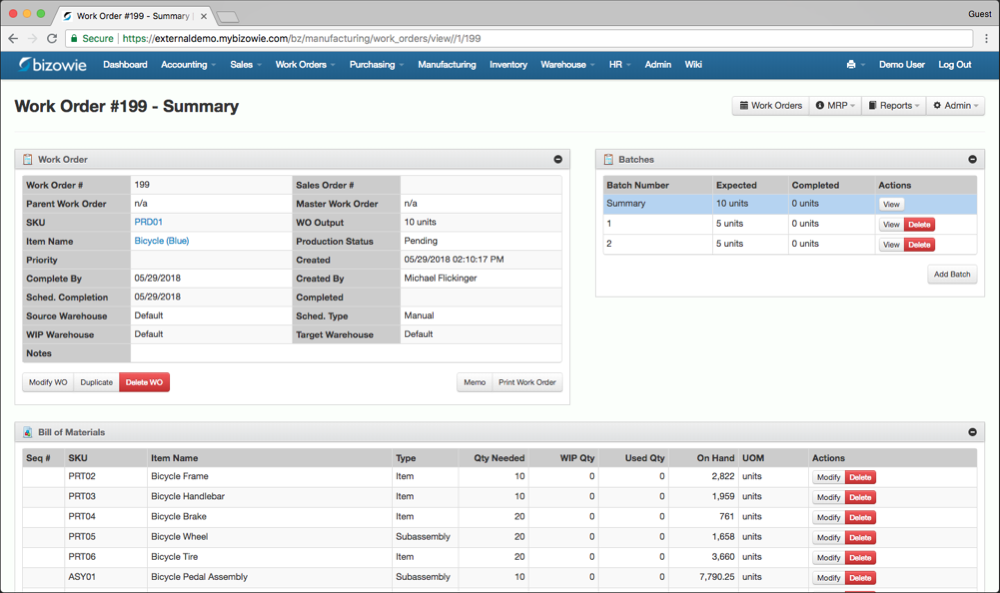
Work Orders & BOMs
Each work order carries its multi-level bill of materials, batches, and live on-hand quantities.
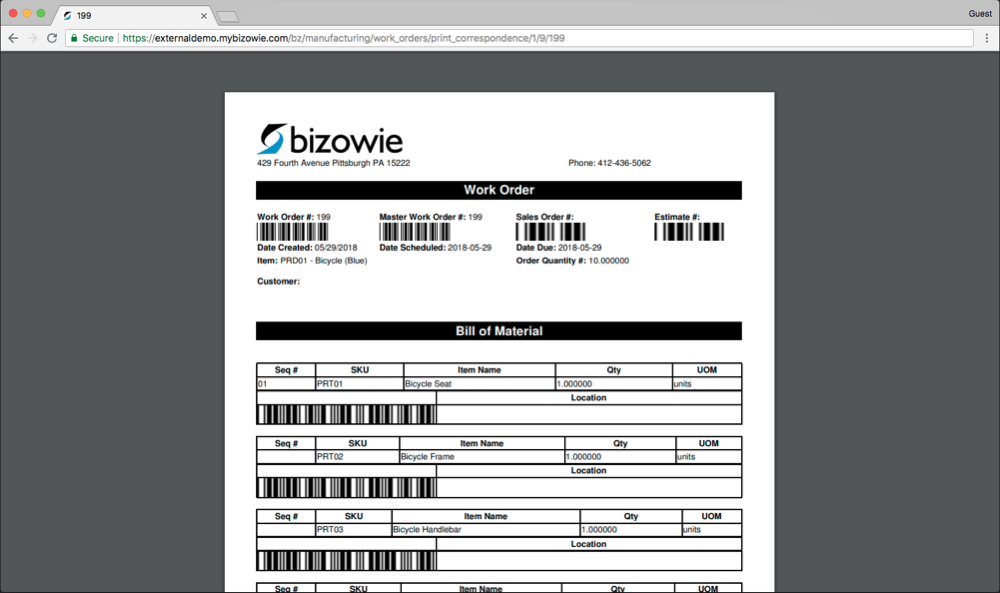
Barcoded Travelers
Printed work orders with barcoded BOM lines, so the shop floor scans instead of writing.
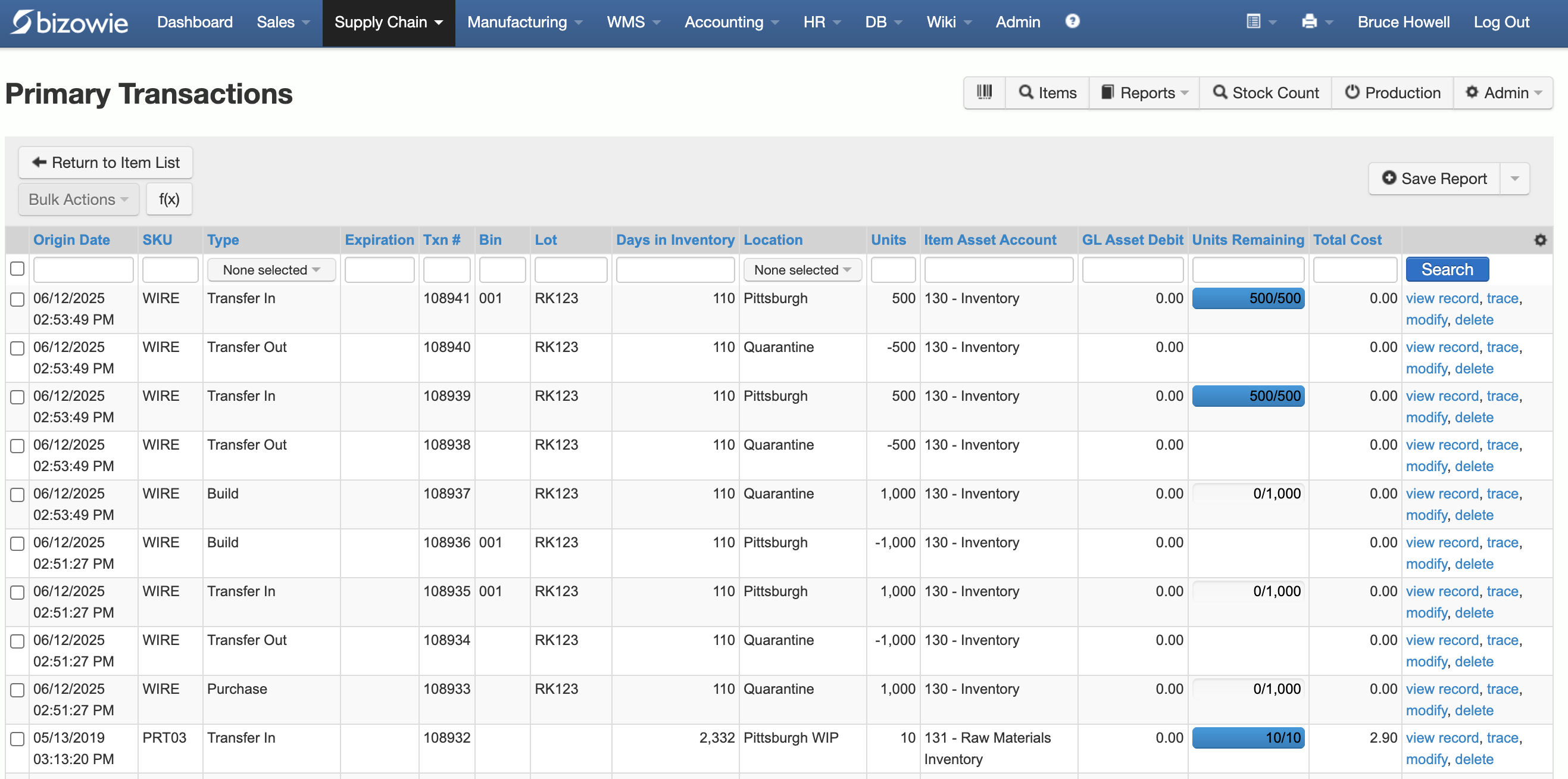
Inventory Transactions
Every receipt, transfer, build, and quarantine move by SKU, lot, bin, and location.
Common KPI Mistakes
- Tracking OEE on every machine instead of the constraints
- Using rated speeds that are not realistic as the ideal cycle time, or speeds that are too easy
- Excluding changeovers from planned time to make availability look better
- Reporting KPIs monthly, too late to act
- Measuring without assigning anyone to improve the result
Production Data in Bizowie
Bizowie collects real-time data directly from computers, tablets, or touchscreen devices on the shop floor. Labor time tracking informs the work order with real-time details, labor and machine time are applied as direct costs, and a work center dashboard shows each work center’s current load, WIP, and inbound jobs. Reporting on activity for a particular day, work center, or employee is built in, and profitability can be reviewed by job, product, customer, and sales rep.
“From our first contact all the way through to our implementation, Bizowie has been a first class organization to work with… We strongly recommend the Bizowie software program.”
Alan Seymour — President, Cleveland Electric Labs
Frequently Asked Questions
How do you calculate OEE?
Multiply availability (run time ÷ planned time), performance (ideal cycle time × total count ÷ run time), and quality (good count ÷ total count).
What is a good OEE score?
Around 85% is often cited as world class for discrete manufacturing; many plants start well below that. Your own improvement trend matters more than the benchmark.
What are the most important manufacturing KPIs?
For most plants: on-time delivery, OEE on constraint equipment, schedule attainment, first-pass yield, scrap rate, manufacturing lead time, and job cost variance.
Bring Us a Work Center
Tell us how you capture production data today. We’ll show you how Bizowie would capture and report it, and if we are not the right fit, we will tell you.
See how Bizowie would measure your plant
Tell us a little about your operation and we’ll reply with an honest assessment of fit, not a sales pitch.
- A real person reviews your submission and replies within one business day.
- No automated email sequences.
- If we’re not the right fit, we’ll tell you.
Prefer to talk?
Call (888) 635-2517, Mon–Fri, 9 AM–5 PM Eastern