
AI in ERP for Manufacturers and Distributors: What Works, What Doesn’t, and What It Needs
Every ERP vendor now has an AI story. Some of it is genuinely useful. Much of it is a demo, a roadmap slide, or basic automation with a new label.
Every ERP vendor now has an AI story. Some of it is genuinely useful. Much of it is a demo, a roadmap slide, or basic automation with a new label.

For manufacturers and distributors, the question isn't whether AI matters. It's which uses deliver real results today, what they need in order to work, and how to tell a working feature from a marketing claim. The answer depends far less on the AI than on the system and the data underneath it.
This guide covers where AI in ERP helps manufacturers and distributors, where it doesn't yet, what your data and processes need first, the risks to manage, and the questions to ask any vendor.
"AI" covers several different technologies, and vendors rarely say which one they mean:
Each one has different strengths, different data requirements, and different risks. "Our ERP has AI" tells you nothing until you know which of these it means and which business task it improves.
A great deal of what is sold as AI is rule-based automation: create a purchase order when stock falls below the reorder point, release backorders when inventory arrives, route an approval when a purchase order exceeds a limit. These rules are predictable, auditable, and extremely valuable. They are not AI, and they don't need to be.
| Rule-based automation | AI | |
|---|---|---|
| How it decides | Rules you define | Patterns learned from data |
| Predictability | Same input, same result | Probabilistic; can be wrong |
| Best for | Known, repeatable processes | Messy inputs, prediction, and judgment calls |
| Explaining a result | Easy: the rule fired | Harder; needs supporting detail |
| Data needed | Accurate current data | Accurate current and historical data |
Most companies get more value from automating the processes they already understand than from adding AI on top of manual ones. See how distributors can automate 80% of manual order entry.
For how analytics and prediction fit into reporting, see ERP reporting tools, from dashboards to predictive insights.
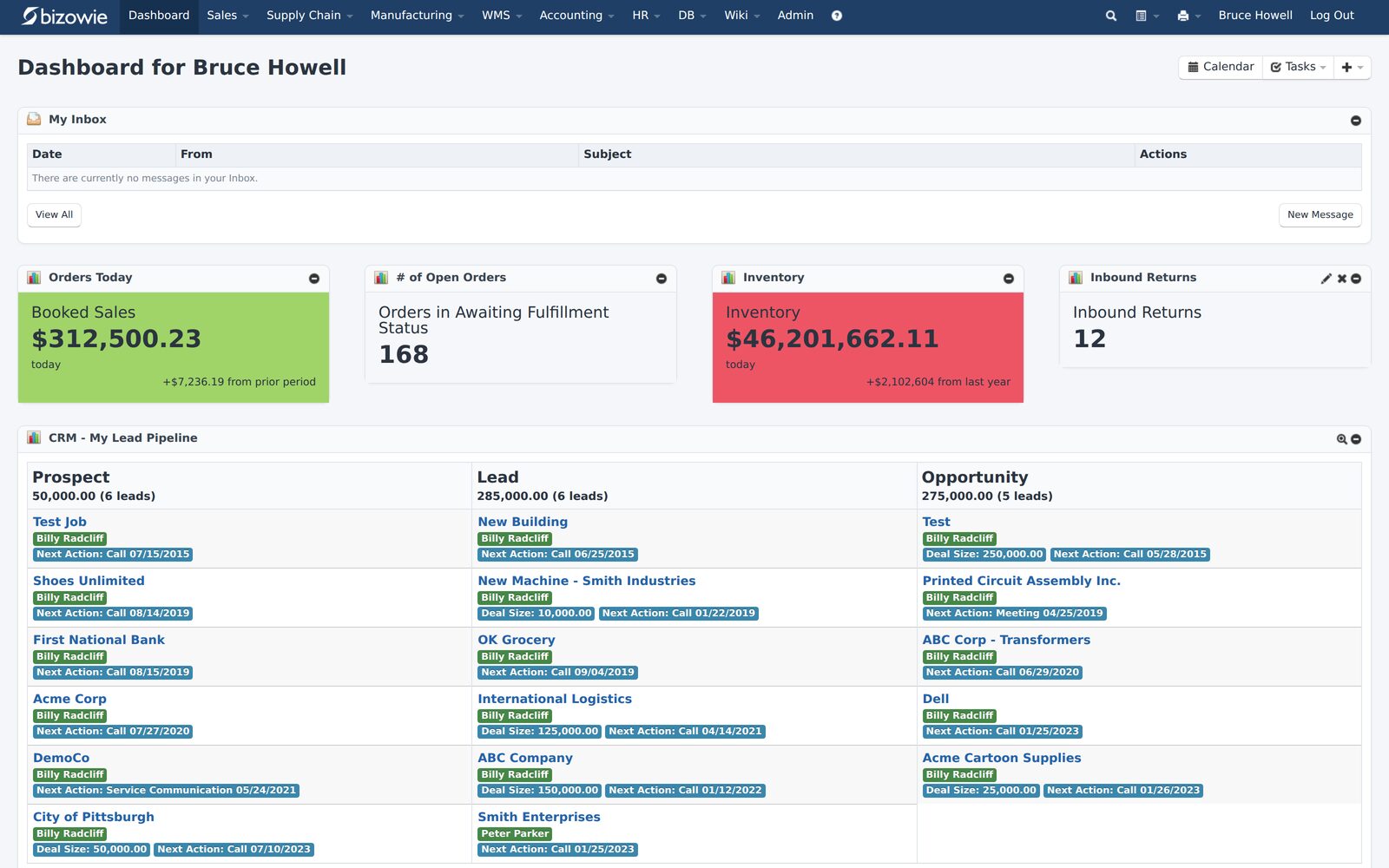
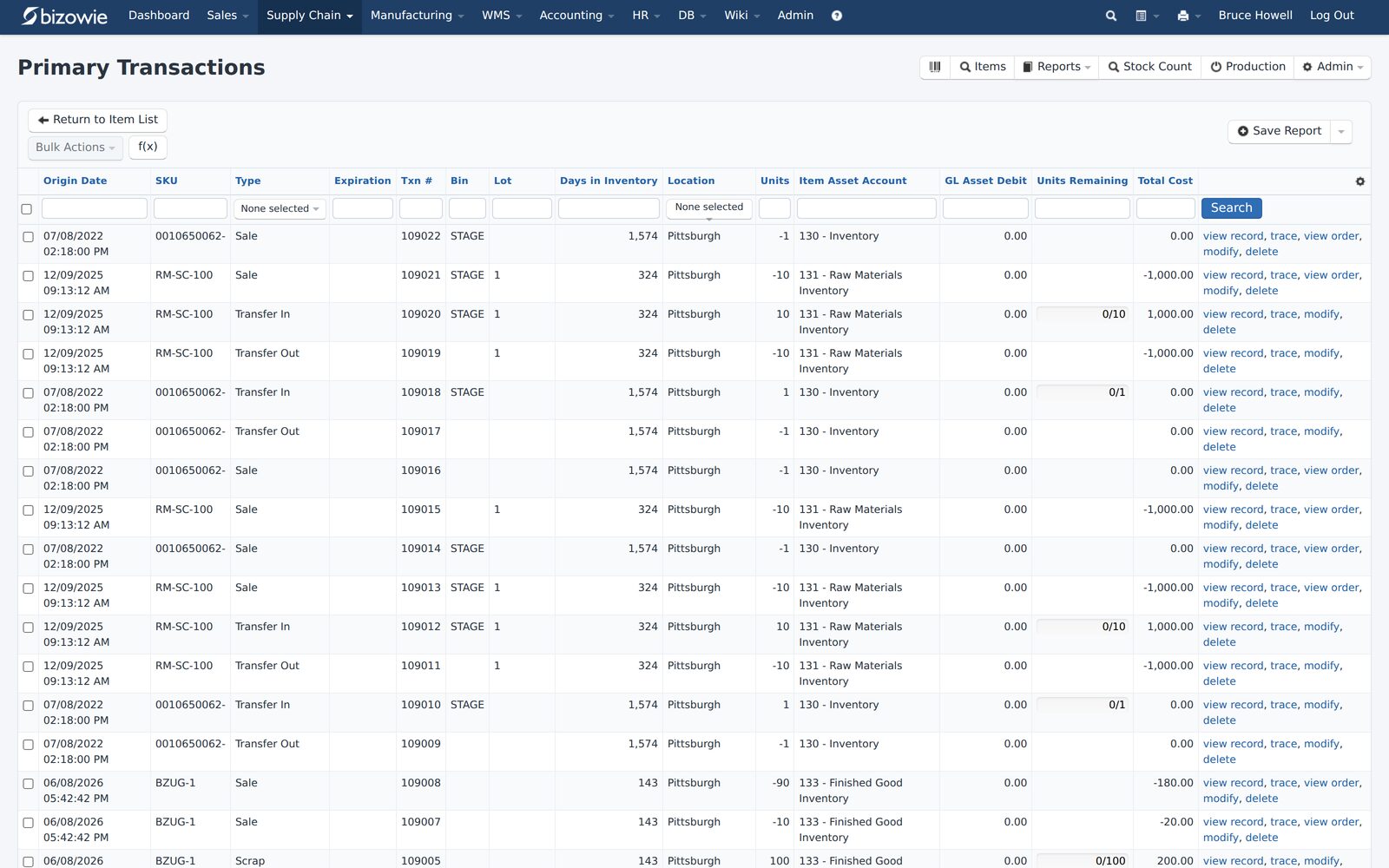
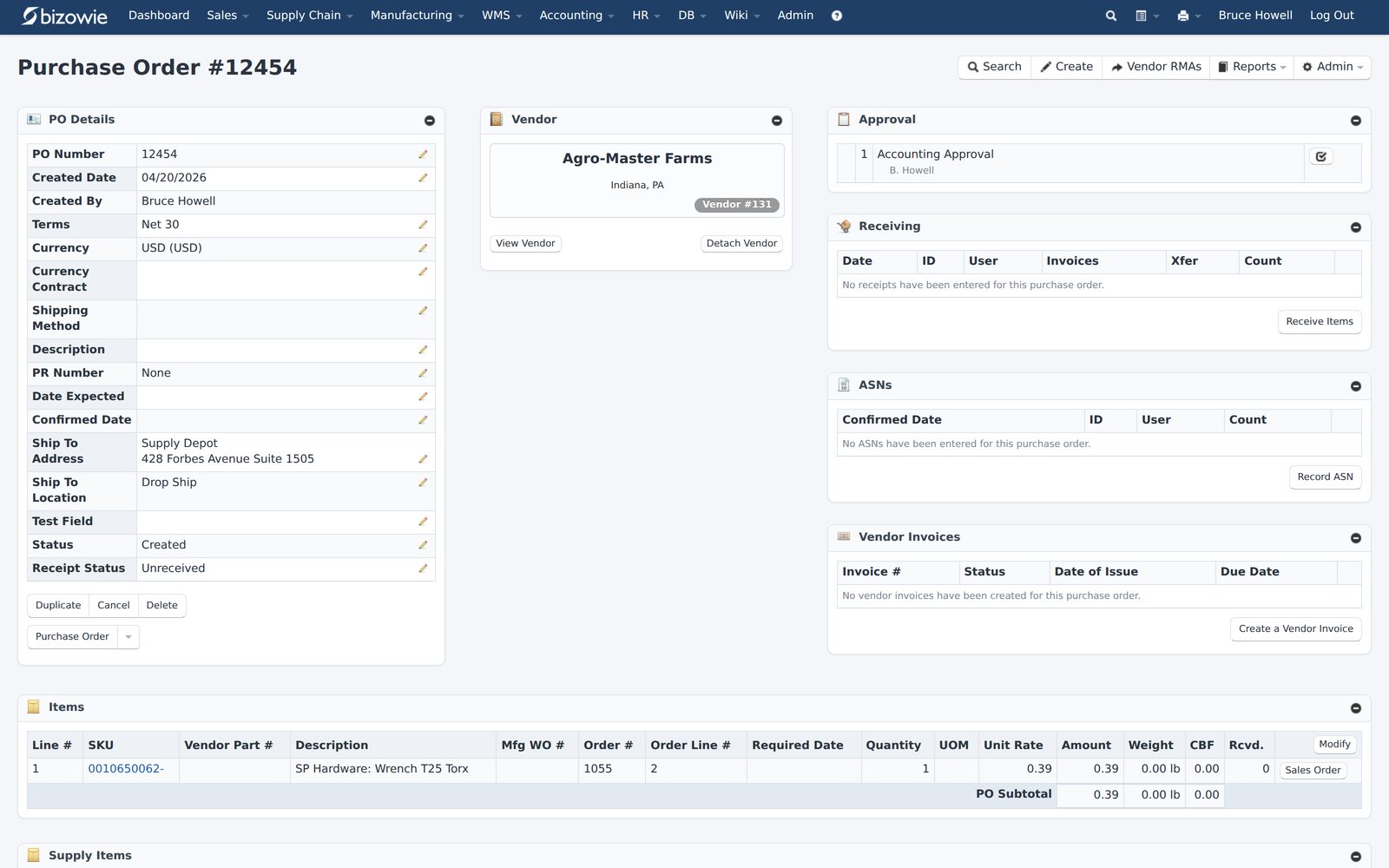
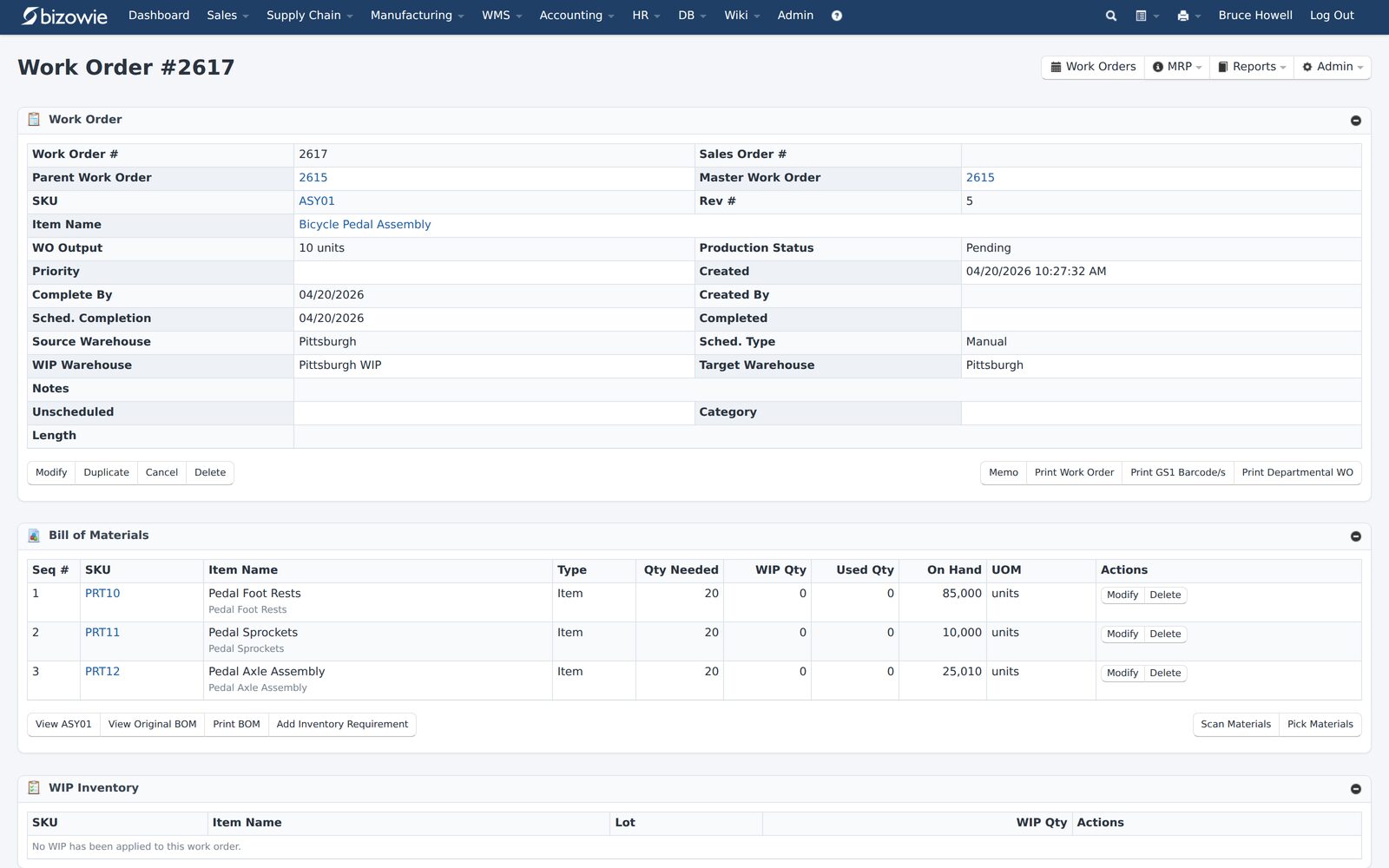
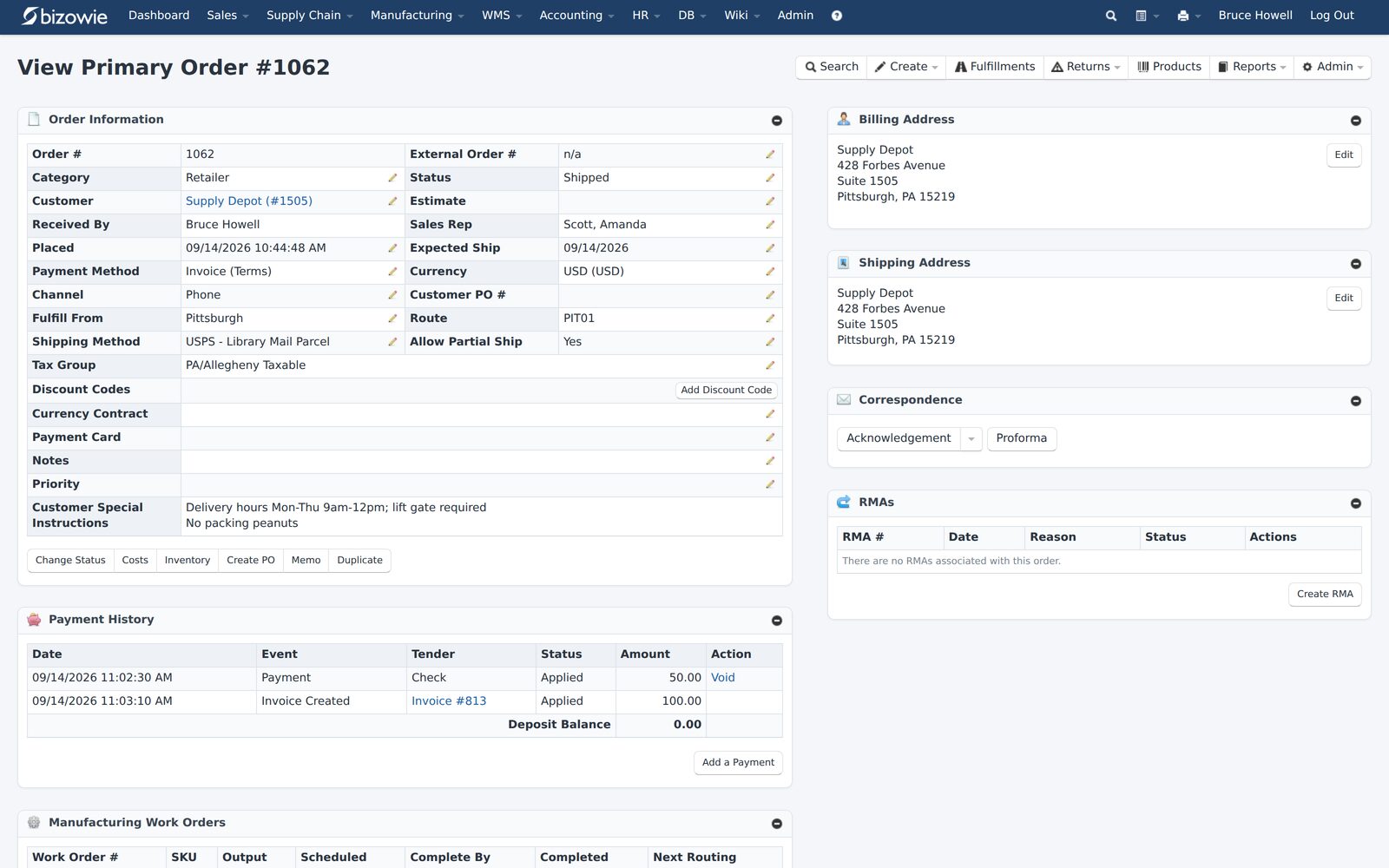
Real screens from Bizowie, not mockups. Click any screen to enlarge.
Bookings, open orders awaiting fulfillment, and inventory value at a glance.
Every receipt, transfer, build, and quarantine move by SKU, lot, bin, and location.
Purchase orders with approvals, receiving, ASNs, and vendor invoices on one screen.
Each work order carries its multi-level bill of materials, batches, and live on-hand quantities.
For what to look for in a cloud ERP system, see What Is Cloud ERP? How It Works, Benefits & What to Look For.
Every useful AI application in ERP depends on the same foundation:
A company with clean, unified, real-time data in a modern ERP is ready to benefit from AI. A company with data spread across spreadsheets and disconnected systems should fix that first, and will see a return from that work alone. See ERP data hygiene and best-of-breed vs. all-in-one.
For the broader evaluation, see 25 questions to ask before you sign.
For a longer view of building a system that will last, see how to future-proof your ERP investment and cloud ERP trends for 2026.
“We have seen immediate economic benefit for our business in terms of productivity from our warehouse staff, eliminated processing errors, and better stock control.”
Julius Hart — Managing Director, LensesOnline
The foundation AI depends on is what Bizowie is built to provide. Inventory, orders, purchasing, finance, warehousing, manufacturing, and more run in one real-time system, with no batch updates or import/export between modules. Much of the work other systems leave to people is automated with rules: purchase orders and transfers created automatically to meet demand, work orders created from sales activity and planned demand, backorders released by rule, and EDI orders received and processed automatically, with alerts when errors are detected. Bizowie is implemented directly by the team that builds and supports the software.
Have a question about your own system? Talk to the team that builds Bizowie.
The use of machine learning, document understanding, and generative AI inside an ERP system to predict demand, read documents, detect anomalies, answer questions, and suggest actions, based on the business data the ERP holds.
Common uses include demand forecasting, replenishment suggestions, reading emailed purchase orders and vendor invoices, pricing and margin alerts, production scheduling suggestions, predictive maintenance, quality analysis, and plain-language reporting.
No. Automation follows rules you define and produces the same result every time. AI learns patterns from data and makes predictions that can be wrong. Most ERP value still comes from rule-based automation.
You need a system that can support it: one real-time system of record with clean data. Evaluate specific AI features by the tasks they improve and see them working on real data before paying for them.
Accurate, unified, real-time data across orders, inventory, purchasing, production, and accounting, plus enough clean history for models to learn from.
Tell us how your operation runs today. We'll show you how Bizowie would unify and automate it, and if we are not the right fit, we will tell you.
For manufacturers and distributors. Tell us a little about your operation and we’ll reply with an honest assessment of fit, not a sales pitch.
Prefer to talk?
Call (888) 635-2517, Mon–Fri, 9 AM–5 PM Eastern