
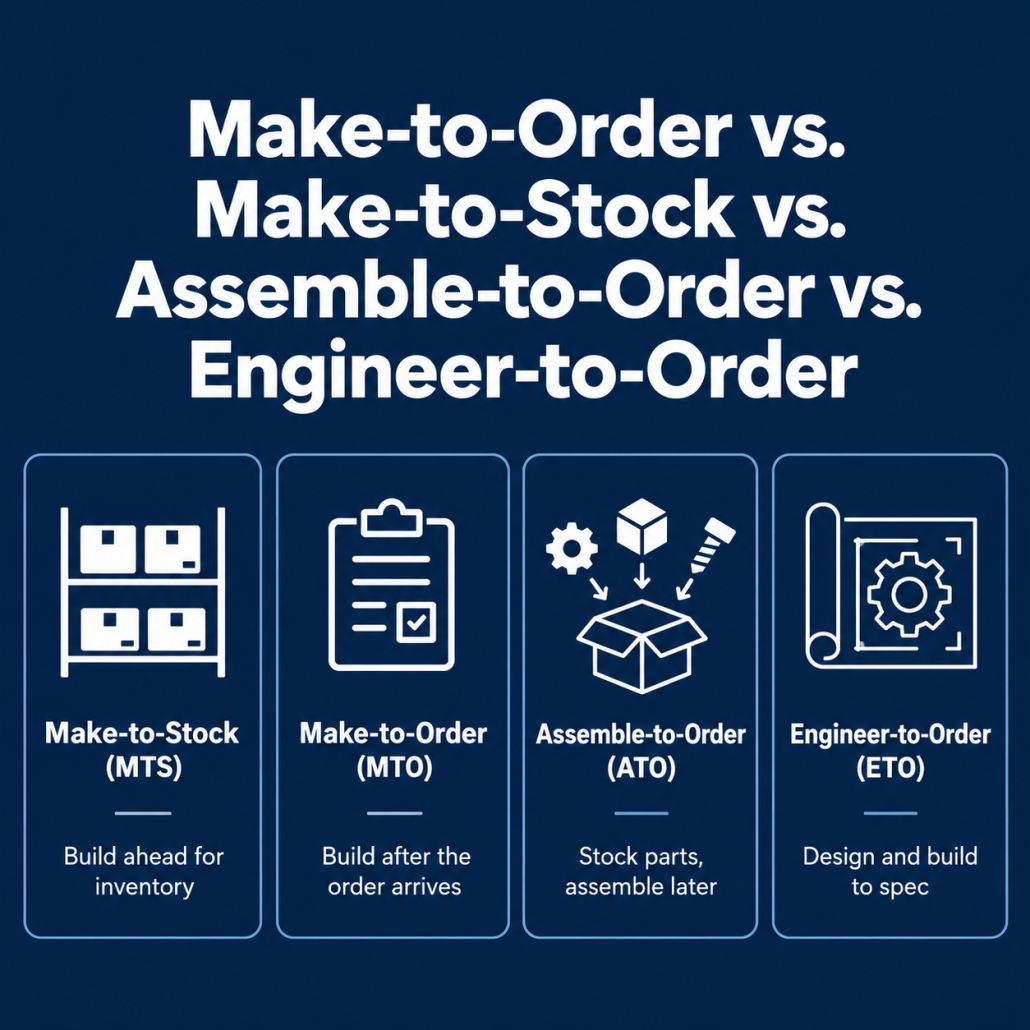
Make-to-Order vs. Make-to-Stock vs. Assemble-to-Order vs. Engineer-to-Order
Every manufacturer has to decide when production starts: before the customer orders, or after.
Make-to-stock builds ahead of demand so products are ready to ship. Make-to-order builds after an order arrives. Assemble-to-order builds components ahead and finishes on order. Engineer-to-order designs the product after the order. Each choice changes lead time, inventory, cash, planning, and what the customer experiences, and many manufacturers use more than one at the same time.
This guide compares the four strategies, explains when each fits, and how to run several of them in one plant.
The Four Production Strategies
The difference between them is the point at which a customer order enters the process, sometimes called the customer order decoupling point. Everything before that point is driven by forecasts; everything after it is driven by the actual order.
Side-by-Side Comparison
| Make-to-stock | Assemble-to-order | Make-to-order | Engineer-to-order | |
|---|---|---|---|---|
| Production starts | Before the order | Components before, final assembly after | After the order | Design and production after the order |
| Customer lead time | Shortest | Short | Longer | Longest |
| Finished goods inventory | High | Low | Little or none | None |
| Customization | None | Options from defined components | Moderate | High |
| Planning driven by | Forecast | Forecast for components, orders for assembly | Orders | Orders and engineering |
| Main risk | Overstock and obsolescence | Component availability | Lead time and capacity | Cost and schedule overruns |
Make-to-Stock
Products are built to forecast and stored as finished goods. It suits standard, high-volume products where customers expect immediate delivery. Success depends on forecasting and replenishment: too little stock means lost orders, too much ties up cash. See manufacturing inventory management.
Make-to-Order
Production begins when an order is received, usually from an existing design with order-specific quantities or options. It reduces finished goods inventory and obsolescence risk, but customer lead time includes production time, so scheduling and capacity matter most. See production scheduling.
Assemble-to-Order
Common components and subassemblies are built or bought ahead, and final assembly happens when the customer chooses options. It offers short lead times with variety, if component availability is planned well. See how MRP calculates requirements.
Engineer-to-Order
Each order is designed or significantly engineered for the customer. Lead times are long, and costing and project control are critical. See ERP for engineer-to-order manufacturers.
How to Choose
Ask, for each product line:
- How long will customers wait? If less than your production time, you need stock somewhere.
- How predictable is demand? Stable demand favors make-to-stock; lumpy demand favors make-to-order.
- How much variety do customers want? More options push the decoupling point later.
- How costly is holding inventory? Expensive, bulky, or perishable products favor building to order.
- How much capacity do you have? Make-to-order needs capacity available when orders arrive; make-to-stock can level production.
Running More Than One Strategy
Most mid-market manufacturers do not pick one. Standard products are made to stock, configured products are assembled to order, and custom jobs are made or engineered to order, often on the same equipment. That only works if the ERP supports all of them at once: forecast-driven and order-driven planning together, shared capacity, and costing that works for both stock and jobs. See discrete vs. process manufacturing ERP.
See Bizowie in Action
Real screens from Bizowie, not mockups. Click any screen to enlarge.
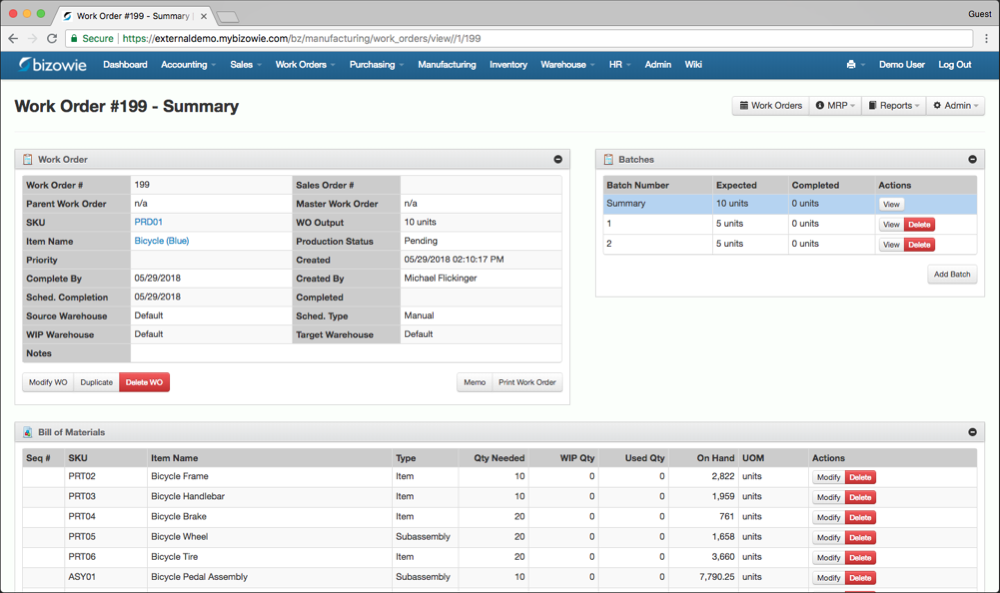
Work Orders & BOMs
Each work order carries its multi-level bill of materials, batches, and live on-hand quantities.
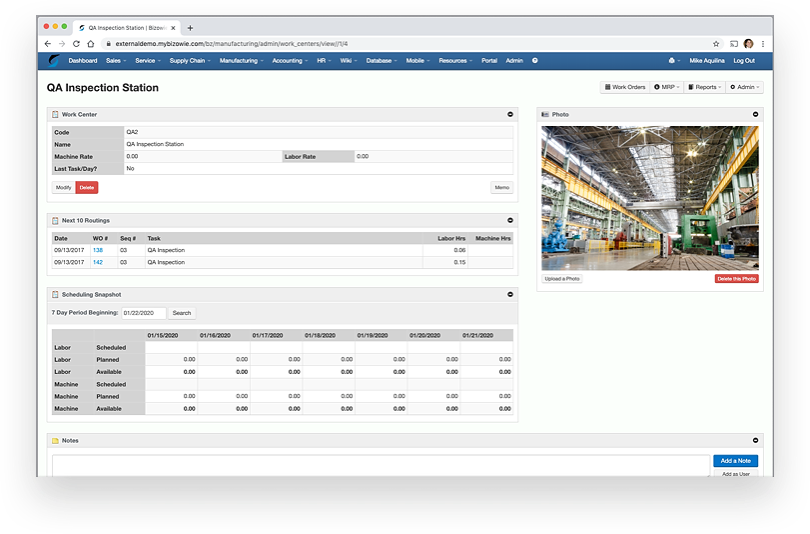
Work Centers & Capacity
Routings, labor and machine rates, and a scheduling snapshot for every work center.
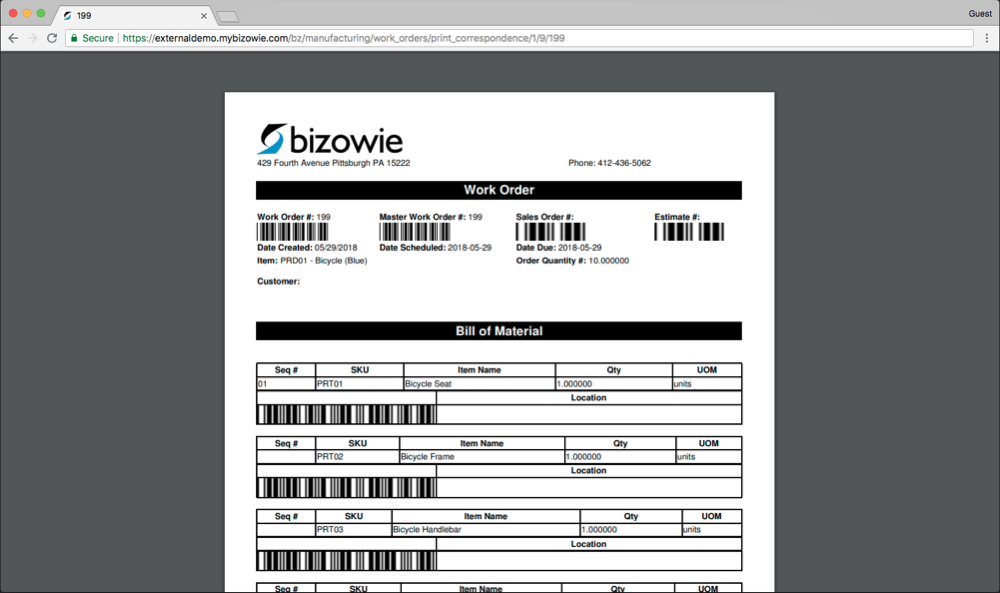
Barcoded Travelers
Printed work orders with barcoded BOM lines, so the shop floor scans instead of writing.
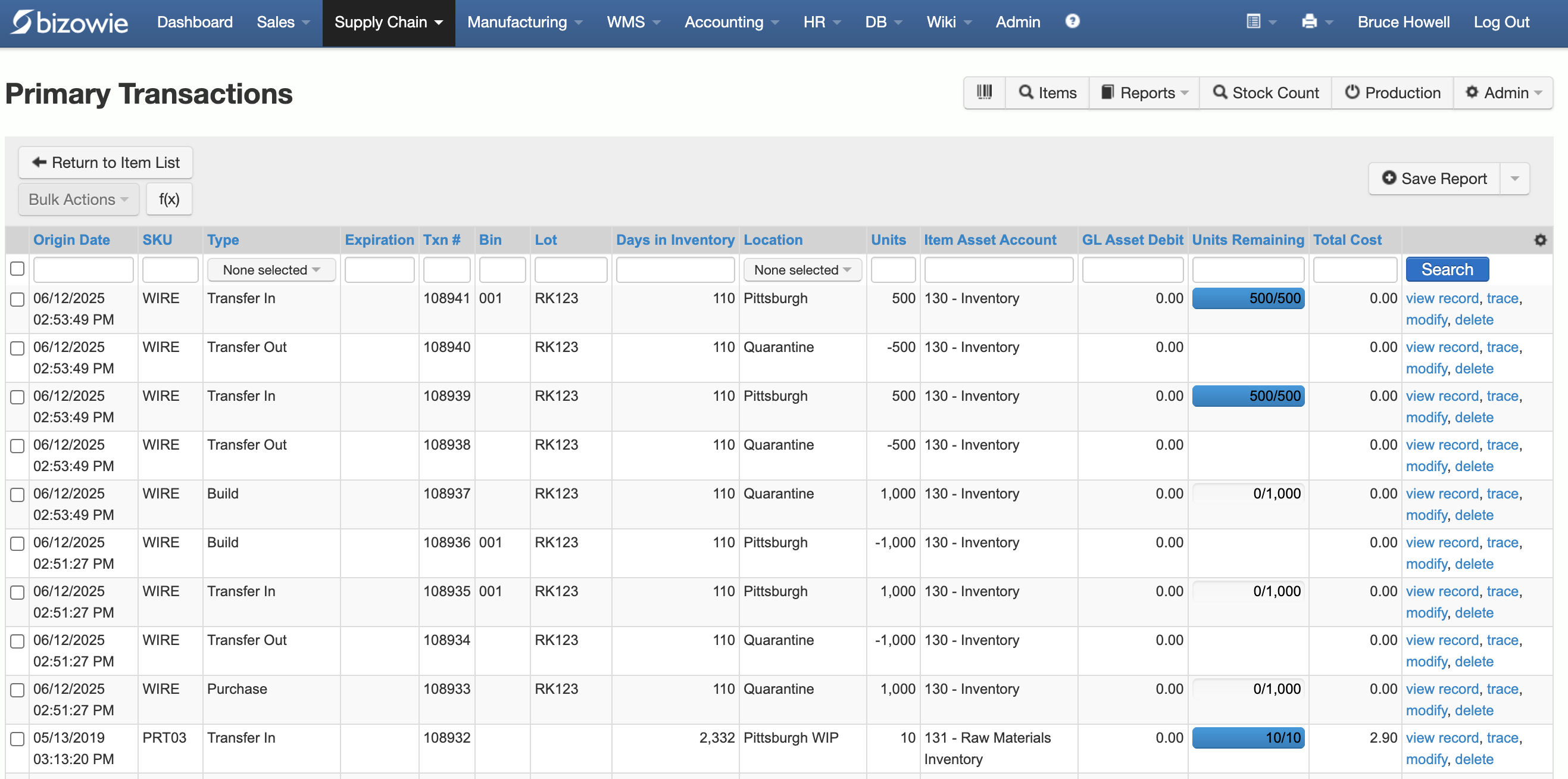
Inventory Transactions
Every receipt, transfer, build, and quarantine move by SKU, lot, bin, and location.
Mixed-Mode Manufacturing in Bizowie
Bizowie supports make-to-stock, make-to-order, engineer-to-order, assembly, and process manufacturing, in any combination, so different product lines or order flows can follow different workflows. Work orders are created automatically or manually from sales activity and planned demand, including dependent work orders for multi-level subassemblies, MRP is always up to date, and production is scheduled based on labor and machine capacity. Sales orders are released as batches are completed.
“From our first contact all the way through to our implementation, Bizowie has been a first class organization to work with… We strongly recommend the Bizowie software program.”
Alan Seymour — President, Cleveland Electric Labs
Frequently Asked Questions
What is the difference between make-to-order and make-to-stock?
Make-to-stock builds products before orders arrive, from a forecast, and ships from inventory. Make-to-order starts production after an order is received.
What is assemble-to-order?
A strategy in which components are built or bought ahead of demand and final assembly happens after the customer orders, often with options.
Can a manufacturer use both make-to-order and make-to-stock?
Yes, and many do, using different strategies for different product lines. The ERP must support both in the same system.
What is a customer order decoupling point?
The point in the production process where work switches from forecast-driven to order-driven.
Bring Us Your Product Mix
Tell us how you build each product line today. We’ll show you how Bizowie would plan and run them together, and if we are not the right fit, we will tell you.
See how Bizowie would run your product mix
Tell us a little about your operation and we’ll reply with an honest assessment of fit, not a sales pitch.
- A real person reviews your submission and replies within one business day.
- No automated email sequences.
- If we’re not the right fit, we’ll tell you.
Prefer to talk?
Call (888) 635-2517, Mon–Fri, 9 AM–5 PM Eastern