
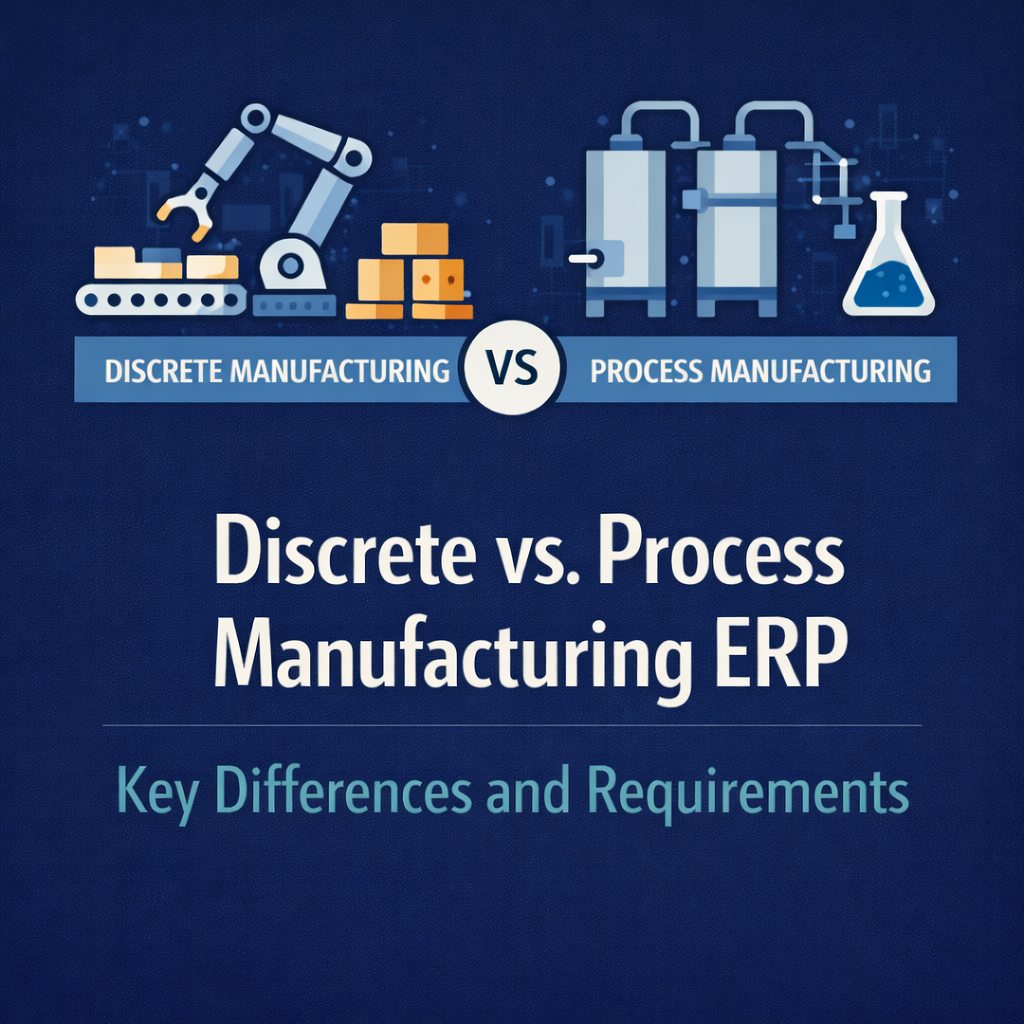
Discrete vs. Process Manufacturing ERP: Key Differences and Requirements
Not all manufacturing is the same—and not all ERP systems handle different manufacturing types equally well. A pharmaceutical company blending chemical compounds operates fundamentally differently than a machinery manufacturer assembling components. Their production processes, inventory challenges, quality requirements, and regulatory obligations diverge in ways that demand different ERP capabilities.
Choosing an ERP system without understanding these distinctions is a recipe for expensive disappointment. Manufacturers end up forcing their operations into software designed for different production realities, creating workarounds that undermine efficiency and frustrate users. The right approach starts with understanding whether your operation is discrete, process, or a hybrid—then selecting an ERP platform equipped to handle your specific requirements.
Understanding the Fundamental Distinction
The difference between discrete and process manufacturing comes down to what you’re making and how you’re making it. This distinction shapes everything from inventory management to production scheduling to quality control.
What Is Discrete Manufacturing?
Discrete manufacturing produces distinct, countable items that can be seen, touched, and individually identified. Think of automobiles rolling off an assembly line, appliances moving through production cells, or electronic devices assembled from components. Each finished unit is separate and whole, built by combining parts through assembly operations.
In discrete manufacturing, products can typically be disassembled back into their component parts. A laptop can be taken apart to recover the screen, keyboard, processor, and memory. This reversibility reflects the nature of discrete production—bringing together distinct components that retain their individual identity within the assembly.
Bills of Materials in discrete manufacturing list specific components with precise quantities. One finished unit requires exactly four bolts, two brackets, one motor, and one housing. Production counts in whole numbers. You can’t produce half a machine or three-quarters of a circuit board.
What Is Process Manufacturing?
Process manufacturing creates products through chemical, biological, or physical transformation of ingredients. The inputs undergo fundamental change—mixing, heating, fermenting, distilling, reacting—and emerge as something entirely different. Food and beverage production, pharmaceutical manufacturing, chemical processing, and cosmetics production all exemplify process manufacturing.
Unlike discrete products, process-manufactured goods typically cannot be disassembled into their original ingredients. You can’t unbake a cake to recover the flour, eggs, and sugar. The transformation is permanent, which creates unique challenges for quality control and batch management.
Formulas and recipes replace traditional Bills of Materials in process manufacturing. These specifications often involve variable quantities, concentration percentages, and yield calculations that account for transformation losses. Production frequently deals with continuous quantities measured by weight, volume, or concentration rather than discrete counts.
Hybrid Manufacturing Realities
Many manufacturers don’t fit neatly into one category. A food company might use process manufacturing to create sauces and discrete manufacturing to package them. A pharmaceutical operation might blend compounds through process methods, then count and package tablets discretely. An electronics manufacturer might produce circuit boards through process-like methods before assembling them into discrete products.
These hybrid operations need ERP systems capable of handling both manufacturing modes, often within the same production flow. Software designed exclusively for discrete or process manufacturing will fall short for hybrid manufacturers.
Key Differences That Shape ERP Requirements
The discrete versus process distinction creates divergent requirements across virtually every ERP function. Understanding these differences helps manufacturers evaluate whether potential systems can truly support their operations.
Bills of Materials vs. Formulas and Recipes
Discrete manufacturing relies on structured Bills of Materials that specify exact components and quantities. One finished product requires precisely defined parts in fixed amounts. BOM structures can be multi-level, showing how sub-assemblies combine into final products, but quantities remain deterministic.
Process manufacturing uses formulas or recipes that introduce complexity BOMs don’t capture. Formulas specify ingredient proportions that may scale based on batch size. They account for potency variations in raw materials, yield losses during transformation, and by-products generated alongside primary outputs. Co-products and by-products—multiple outputs from a single production run—are common in process manufacturing but rare in discrete.
ERP systems must accommodate these structural differences. A system designed around discrete BOMs will struggle with formula-based production that involves variable yields, potency adjustments, and multiple outputs.
Units of Measure Complexity
Discrete manufacturing typically works with straightforward unit of measure conversions. Parts might be purchased in cases but consumed individually, requiring simple conversion factors. The complexity is limited because discrete items maintain their identity through production.
Process manufacturing involves far more complex unit conversions. Ingredients might be purchased by weight, stored by volume, and consumed by concentration. Temperature and pressure affect density, changing the relationship between weight and volume measurements. Potency variations mean that the active ingredient content varies between lots of the same material. ERP systems for process manufacturing must handle these multidimensional conversions accurately.
Inventory Management Approaches
Discrete manufacturers manage inventory in countable units with relatively straightforward tracking. Serial numbers identify individual items. Lot tracking groups items produced together. Inventory accuracy means counts match system records.
Process manufacturers face additional inventory complexity. Bulk materials in tanks and silos require different tracking than discrete items on shelves. Catch-weight scenarios arise when items are managed by one unit but valued by another—cases of meat priced by weight, for instance. Potency and grade variations mean that not all inventory of the same material is interchangeable. Shelf life and expiration become critical for materials that degrade over time.
Production Scheduling Differences
Discrete manufacturing scheduling focuses on sequencing operations, managing work center capacity, and coordinating component availability. Changeover times between different products depend on tooling and setup requirements. Production quantities are typically flexible—you can decide to make 100 units or 102 units based on order requirements.
Process manufacturing scheduling must consider additional constraints. Batch sizes often have minimum and maximum limits dictated by equipment capacity or reaction requirements—you can’t make half a batch in a reactor designed for full batches. Sequencing decisions affect changeover complexity; running similar formulas consecutively minimizes cleaning and setup. Some processes involve fixed timing requirements where operations must complete within specific windows. Campaign manufacturing groups production of similar products to minimize changeovers.
Quality Management Requirements
Both manufacturing types require quality management, but their approaches differ significantly.
Discrete manufacturing quality typically focuses on dimensional accuracy, functional testing, and defect detection. Inspection often occurs at defined points—incoming materials, in-process checks, final testing. Defective items can frequently be reworked or scrapped individually without affecting the rest of production.
Process manufacturing quality emphasizes specification compliance across continuous or batch production. Testing often involves laboratory analysis of samples that represent larger quantities. When quality issues arise, entire batches may be affected rather than individual units. Potency, purity, concentration, and contamination are common quality concerns that require sophisticated testing and specification management.
Traceability and Lot Control
Traceability requirements exist in both manufacturing types but manifest differently.
Discrete manufacturing traceability tracks components through assembly into finished goods. Serial numbers enable item-level tracking for high-value products. Lot tracking groups items sharing common production characteristics. Where-used analysis shows which finished products contain specific component lots.
Process manufacturing traceability must track ingredient lots through transformation into potentially multiple outputs. Batch genealogy shows which ingredient lots contributed to which finished batches. Forward traceability identifies all batches containing a specific ingredient lot—critical for recall management. The transformation nature of process manufacturing makes traceability more complex than simply following components through assembly.
Regulatory and Compliance Demands
Regulatory requirements vary by industry more than by manufacturing type, but process manufacturing industries tend to face more intensive compliance demands.
Food and beverage manufacturers must meet FDA food safety requirements, allergen management, and nutritional labeling standards. Pharmaceutical companies operate under strict FDA regulations including 21 CFR Part 11 electronic record requirements, validation protocols, and detailed batch documentation. Chemical manufacturers face environmental regulations, safety documentation, and hazardous material handling requirements.
Discrete manufacturers face their own compliance requirements—aerospace quality standards, automotive traceability requirements, electrical safety certifications—but these typically involve less production process documentation than process manufacturing regulations.
ERP Requirements for Discrete Manufacturing
Discrete manufacturers should prioritize specific ERP capabilities that align with their production realities.
Robust BOM Management
The ERP system must handle complex, multi-level Bills of Materials efficiently. Support for engineering BOMs, manufacturing BOMs, and configurable BOMs enables different product structure views for different purposes. Revision control and engineering change management keep BOMs current and traceable.
Configure-to-Order Capabilities
Many discrete manufacturers offer configurable products with customer-selected options. The ERP system should support rules-based configuration that generates accurate BOMs, routings, and pricing for custom combinations without requiring manual specification of every variant.
Work Order and Routing Flexibility
Discrete manufacturing benefits from work order management that supports varied routing scenarios—alternative operations, outside processing, concurrent operations, and rework routing. The system should track progress through multiple operations at different work centers while managing component consumption at each stage.
Serial and Lot Tracking
For products requiring item-level traceability, serial number management throughout production and into finished goods is essential. Lot tracking with full genealogy supports less granular but still comprehensive traceability. The system should capture this information without creating excessive data entry burden.
Assembly and Kit Management
Support for assembly operations, kitting, and sub-assembly production streamlines discrete manufacturing workflows. The system should handle kit-to-order scenarios where components are grouped for shipment without formal assembly operations.
Integration with Design Systems
Discrete manufacturers often generate product designs in CAD systems and PLM platforms. ERP integration with these design tools enables BOM import, engineering change synchronization, and drawing management that keeps production specifications aligned with engineering intent.
ERP Requirements for Process Manufacturing
Process manufacturers need ERP capabilities specifically designed for formula-based, batch-oriented production.
Formula and Recipe Management
The ERP system must support formula structures that differ fundamentally from discrete BOMs. This includes scalable formulas that adjust ingredient quantities based on batch size, potency and grade-based calculations that account for ingredient variations, co-product and by-product management for processes generating multiple outputs, and yield percentage calculations that project output from inputs.
Batch Management and Control
Batch-centric production requires comprehensive batch tracking from creation through completion. The system should manage batch sizing within equipment constraints, batch splitting and merging operations, and batch status controls that enforce quality holds and release procedures.
Potency and Grade Management
When ingredient potency or grade varies between lots, the ERP system must calculate actual quantities needed based on target concentrations. This capability ensures formulas produce consistent products despite incoming material variation.
Catch-Weight Processing
Many process industries require catch-weight inventory management where items are tracked in one unit but valued in another. The ERP system should handle catch-weight scenarios throughout purchasing, inventory, production, and sales without manual intervention.
Expiration and Shelf Life Management
Process manufacturing often involves materials with limited shelf life. The ERP system should track expiration dates, enforce first-expired-first-out (FEFO) consumption, provide alerts for approaching expiration, and prevent use of expired materials in production.
Laboratory and Quality Integration
Process manufacturing quality relies heavily on laboratory testing. The ERP system should integrate with laboratory information management systems (LIMS) or provide built-in capabilities for managing samples, test results, specifications, and certificate of analysis documentation.
Regulatory Compliance Support
For regulated process industries, the ERP system must support compliance requirements including electronic signatures and audit trails meeting FDA 21 CFR Part 11, batch record documentation, recall management with complete traceability, and regulatory reporting capabilities.
Evaluating ERP Systems for Your Manufacturing Type
The evaluation process should verify that potential ERP systems genuinely support your manufacturing type rather than offering superficial or bolt-on capabilities.
Assess Core Architecture
Some ERP systems were designed from the ground up for discrete or process manufacturing. Others started with one type and added capabilities for the other through acquisitions or extensions. Systems with native support for your manufacturing type typically provide more integrated, intuitive functionality than those where capabilities were added later.
Ask vendors about the history of their process or discrete manufacturing capabilities. Request references from customers with similar manufacturing profiles. Evaluate whether the capabilities feel integrated or bolted on.
Verify Formula/BOM Capabilities
Test the system’s formula or BOM functionality against your actual product structures. Can it handle your most complex formulas? Does it support your co-product scenarios? Can it manage the BOM depth and variant complexity your products require? Abstract demonstrations prove nothing—use your real data.
Evaluate Lot and Batch Tracking
Traceability requirements deserve careful evaluation. Walk through complete forward and backward traceability scenarios using the system. Verify that the system captures the information your quality and compliance requirements demand without creating impractical data entry requirements.
Test Quality Management Integration
Quality management is critical for both manufacturing types but often underserves process manufacturing’s laboratory-centric requirements. Evaluate how the system handles specification management, sample tracking, test result capture, and quality holds. For regulated industries, verify compliance support capabilities in detail.
Consider Hybrid Capabilities
If your operation involves both discrete and process manufacturing, evaluate how the system handles transitions between modes. Can a process-manufactured intermediate become a component in discrete assembly? Can the system manage production flows that span both types? Hybrid manufacturers need systems that handle both modes natively, not two separate systems awkwardly connected.
The Bizowie Advantage for Manufacturing ERP
Bizowie’s cloud ERP platform delivers comprehensive manufacturing capabilities that support discrete, process, and hybrid manufacturing operations. The integrated platform was designed to handle manufacturing complexity without forcing operations into ill-fitting structures.
For discrete manufacturers, Bizowie provides robust BOM management with multi-level structures, full revision control, and engineering change integration. Work order management supports complex routings with flexible operation sequences. Serial and lot tracking delivers complete traceability without excessive administrative burden.
For process manufacturers, Bizowie offers formula management designed for batch-centric production with potency calculations, yield projections, and co-product handling. Batch tracking provides complete genealogy for compliance and recall management. Quality management integrates laboratory workflows with production processes.
For hybrid manufacturers, Bizowie’s unified platform handles transitions between process and discrete production seamlessly. A single system supports your complete manufacturing operation rather than requiring separate solutions awkwardly integrated.
Because Bizowie is a true cloud platform, manufacturers gain real-time visibility across all production activities from anywhere. Multiple facilities share consistent processes and consolidated reporting. Continuous platform updates deliver capability improvements without disruptive upgrade projects.
Making the Right Choice
Understanding the difference between discrete and process manufacturing isn’t academic—it’s essential for selecting ERP software that will actually support your operations. The wrong choice means fighting your system rather than leveraging it, creating workarounds rather than streamlining processes, and accumulating frustration rather than gaining efficiency.
Take time to honestly assess your manufacturing type, including any hybrid characteristics. Evaluate ERP systems against your specific requirements, not generic feature lists. Verify capabilities with your actual data and scenarios. The investment in thorough evaluation pays dividends through years of effective system performance.
Ready to see how Bizowie supports your manufacturing operation—whether discrete, process, or hybrid? Let’s talk!
Frequently Asked Questions
How do I determine if my operation is discrete, process, or hybrid manufacturing?
Consider what happens to your inputs during production. If components are assembled into products that could theoretically be disassembled, you’re likely discrete manufacturing. If ingredients undergo transformation into something fundamentally different that can’t be reversed, you’re likely process manufacturing. If your operation includes both—perhaps processing ingredients that then become components in assembled products—you’re a hybrid manufacturer. Many operations discover they’re more hybrid than they initially assumed when they examine their complete production flows.
Can a discrete manufacturing ERP system handle process manufacturing requirements?
Generally, no—at least not well. ERP systems designed for discrete manufacturing lack fundamental capabilities process manufacturers need: formula management with potency and yield calculations, batch tracking through transformation, co-product and by-product handling, catch-weight processing, and expiration management. Attempting to force process manufacturing into a discrete system creates workarounds that undermine efficiency and data quality. Process manufacturers should select systems with native process manufacturing capabilities.
What are the biggest ERP implementation challenges for process manufacturers?
Process manufacturers often struggle with formula conversion from legacy systems or spreadsheets, especially when existing formulas don’t cleanly fit the new system’s structure. Batch tracking implementation requires careful planning to capture required data without creating prohibitive data entry burden. Potency management demands accurate incoming material testing processes to provide the data the system needs. Regulatory compliance requirements add validation and documentation demands that extend implementation timelines. Starting with clear requirements and realistic timelines helps address these challenges.
How important is industry-specific ERP functionality versus general manufacturing capabilities?
Industry-specific functionality matters significantly for process manufacturers in regulated industries. A generic process manufacturing system may handle batch production adequately but lack the compliance support, documentation capabilities, and regulatory reporting that pharmaceutical or food manufacturers require. Evaluate whether potential systems serve your specific industry and include customers similar to your operation. Industry-specific functionality that’s deeply integrated typically outperforms generic systems with compliance features added as extensions.
What role does quality management play in ERP selection for process manufacturers?
Quality management is often the decisive factor for process manufacturing ERP selection. Process manufacturers typically rely on laboratory testing, sample management, and specification compliance in ways that discrete manufacturers don’t. The ERP system must integrate quality workflows with production processes, manage certificates of analysis, enforce quality holds, and support regulatory documentation. Systems with superficial quality modules may handle discrete manufacturing adequately but fall short for process manufacturing’s laboratory-centric quality requirements.
How do ERP requirements differ for batch versus continuous process manufacturing?
Batch process manufacturing produces discrete batches that can be individually tracked, tested, and managed. Continuous process manufacturing runs without stopping, producing output measured over time rather than in batches. Continuous manufacturing requires different scheduling approaches, quality sampling strategies, and production tracking methods. Not all process manufacturing ERP systems handle continuous production well. Manufacturers with continuous processes should specifically verify that potential systems support continuous production models, not just batch-oriented process manufacturing.
Should hybrid manufacturers select discrete or process manufacturing ERP systems?
Hybrid manufacturers should select ERP systems that natively support both manufacturing modes within a single integrated platform. Choosing a discrete system and forcing process operations to fit—or vice versa—creates problems for whichever manufacturing type doesn’t match the system’s strengths. Similarly, implementing separate systems for discrete and process operations creates integration challenges and information silos. The best approach is a unified platform designed to handle both manufacturing types, enabling seamless transitions between modes within connected production flows.
Related Reading
- Manufacturing ERP Software: A Buyer’s Guide — the complete guide this article is part of
- Bill of Materials (BOM) Management: The Foundation of Manufacturing ERP
- Work Order Management: Complete Guide for Manufacturers