
Cost of Goods Manufactured (COGM): Formula and Worked Example
Cost of goods manufactured (COGM) is the total cost of the products a plant finished during a period. It is the number that moves production cost out of work in process and into finished goods, and it is the starting point for cost of goods sold.
The formula is short, but it depends on three inventory balances and three cost categories being right. If raw material usage is misstated, if overhead is applied at a stale rate, or if ending work in process is a guess, COGM is wrong, and so are unit costs, margins, and the income statement.
This guide gives the COGM formula, walks through a worked example step by step, shows the schedule of cost of goods manufactured, and explains how COGM differs from total manufacturing cost and cost of goods sold.
What Is Cost of Goods Manufactured?
Cost of goods manufactured is the production cost of all units completed and transferred to finished goods during a period, whether or not they have been sold. It includes three kinds of cost:
- Direct materials used in production
- Direct labor spent making the product
- Manufacturing overhead applied to production, such as indirect labor, equipment depreciation, utilities, and shop supplies
COGM does not include selling, general, and administrative expenses. It also does not include the cost of units still in process at the end of the period. Those stay on the balance sheet as work in process.
The COGM Formula
Cost of goods manufactured = Beginning work in process + Total manufacturing costs − Ending work in process
Where:
Total manufacturing costs = Direct materials used + Direct labor + Manufacturing overhead
And:
Direct materials used = Beginning raw materials + Purchases − Ending raw materials
The logic is a roll-forward. Start with the cost already sitting in unfinished production, add everything spent on production this period, and subtract the cost still unfinished at the end. What is left is the cost of what was completed.
Worked Example: Calculating COGM Step by Step
A manufacturer has the following figures for the year.
Step 1: Direct materials used
- Beginning raw materials inventory: $80,000
- Raw material purchases: $420,000
- Ending raw materials inventory: $95,000
Direct materials used = $80,000 + $420,000 − $95,000 = $405,000
Step 2: Total manufacturing costs
- Direct materials used: $405,000
- Direct labor: $260,000
- Manufacturing overhead applied: $390,000
Total manufacturing costs = $405,000 + $260,000 + $390,000 = $1,055,000
Step 3: Adjust for work in process
- Beginning work in process: $60,000
- Ending work in process: $75,000
Cost of goods manufactured = $60,000 + $1,055,000 − $75,000 = $1,040,000
Work in process grew by $15,000 during the year, so COGM is $15,000 lower than total manufacturing costs. Some of this year’s spending is still on the floor.
The Schedule of Cost of Goods Manufactured
Accountants present the same calculation as a schedule that supports the income statement. Using the example above:
| Line | Amount |
|---|---|
| Beginning raw materials | $80,000 |
| Plus: purchases | $420,000 |
| Less: ending raw materials | ($95,000) |
| Direct materials used | $405,000 |
| Direct labor | $260,000 |
| Manufacturing overhead applied | $390,000 |
| Total manufacturing costs | $1,055,000 |
| Plus: beginning work in process | $60,000 |
| Less: ending work in process | ($75,000) |
| Cost of goods manufactured | $1,040,000 |
If raw materials include indirect materials such as shop supplies, those are not direct materials. They belong in overhead, and the schedule should separate them.
COGM vs. COGS vs. Total Manufacturing Cost
These three numbers are often confused. They measure different things.
| Measure | What it is | In the example |
|---|---|---|
| Total manufacturing costs | Everything spent on production during the period | $1,055,000 |
| Cost of goods manufactured | The cost of units completed during the period | $1,040,000 |
| Cost of goods sold | The cost of units sold during the period | $1,020,000 |
COGM feeds cost of goods sold through finished goods inventory:
Cost of goods sold = Beginning finished goods + Cost of goods manufactured − Ending finished goods
If the manufacturer started the year with $150,000 of finished goods and ended with $170,000:
Cost of goods sold = $150,000 + $1,040,000 − $170,000 = $1,020,000
Only cost of goods sold appears on the income statement. The difference between each pair of numbers is a change in inventory: work in process between the first two, finished goods between the last two. For more on the middle step, see our guide to work in process inventory.
From COGM to Cost per Unit
Dividing COGM by the units completed gives an average manufactured cost per unit:
Cost per unit manufactured = Cost of goods manufactured ÷ Units completed
If the plant completed 26,000 units: $1,040,000 ÷ 26,000 = $40.00 per unit
This average is useful for a plant that makes one product or a narrow family. For a mixed product line it hides more than it shows, because products use material, labor, and machine time very differently. In that case you need cost by job, work order, or item. See job costing in manufacturing ERP and, for the planned cost of a single item, the costed BOM.
Where the Numbers Come From
The textbook formula assumes a periodic approach: count inventory at the end of the period and back into what was used. Most manufacturers running an ERP system work the other way. Each transaction is costed when it happens:
- Material issued to a work order moves cost from raw materials to work in process
- Labor and machine time reported against the work order add conversion cost
- Overhead is applied as production is reported, using a predetermined rate
- Completing the work order moves its cost from work in process to finished goods
In a perpetual system, COGM for the period is the total of those completion transactions. The formula then becomes a check: beginning WIP plus costs added minus ending WIP should equal what the system transferred to finished goods. When it does not, the usual causes are unreported scrap, labor that was never booked, or work orders that were finished but never closed.
Two points on overhead. First, COGM normally uses applied overhead, not actual overhead. The difference between the two is under- or over-applied overhead, which is handled at period-end. See how to calculate a manufacturing overhead rate. Second, if you run standard costs, completions are valued at standard, and the gap between standard and actual shows up as manufacturing cost variances rather than inside COGM.
Common Mistakes
- Using raw material purchases in place of materials used, which ignores the change in raw materials inventory
- Treating total manufacturing costs as COGM and skipping the work in process adjustment
- Estimating ending work in process without counting or costing open work orders
- Including selling and administrative costs in manufacturing overhead
- Mixing indirect materials into direct materials
- Applying overhead with a rate that has not been updated in years
- Leaving finished work orders open, so their cost stays in work in process
- Confusing COGM with cost of goods sold when reviewing margins
See Bizowie in Action
Real screens from Bizowie, not mockups. Click any screen to enlarge.
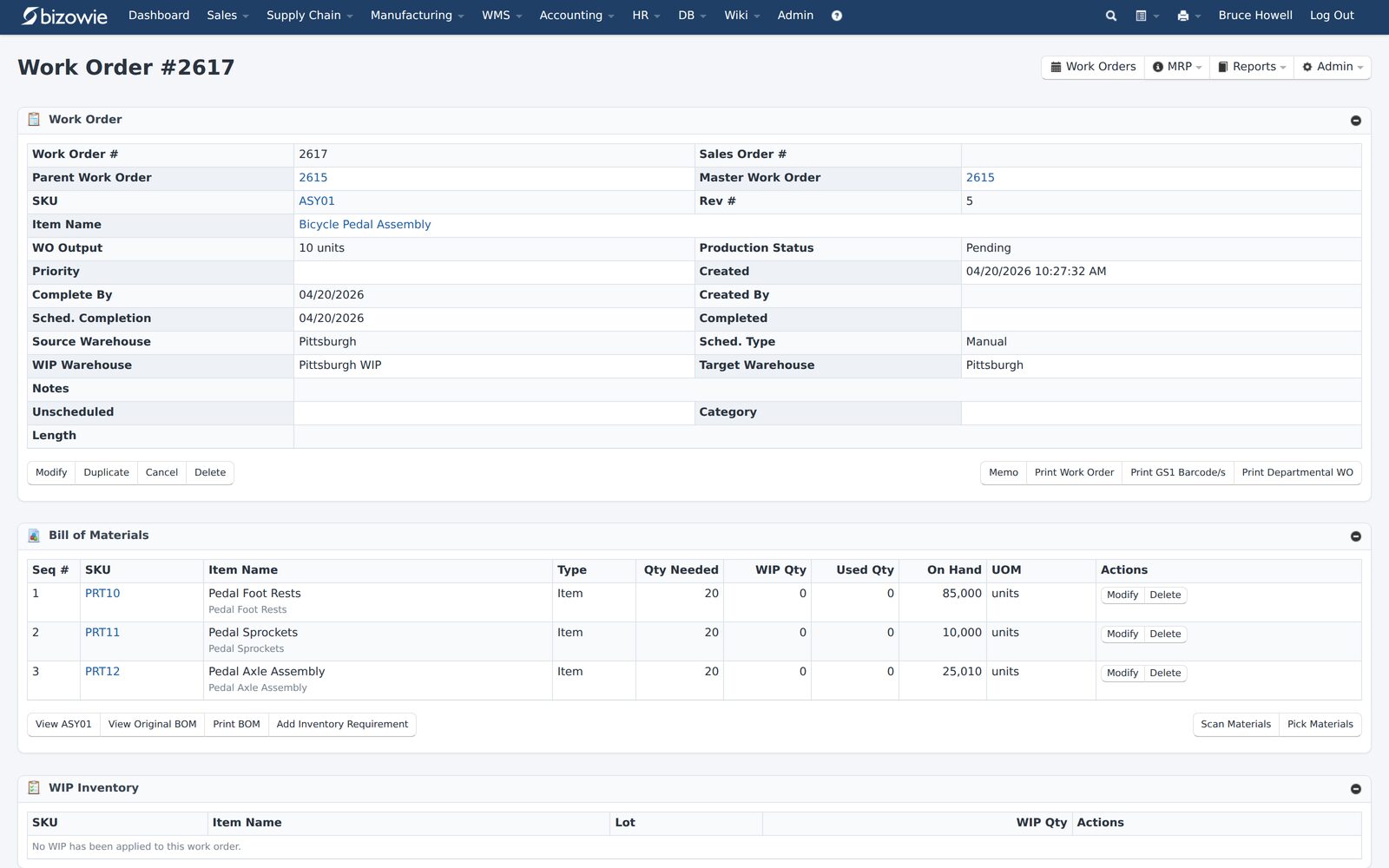
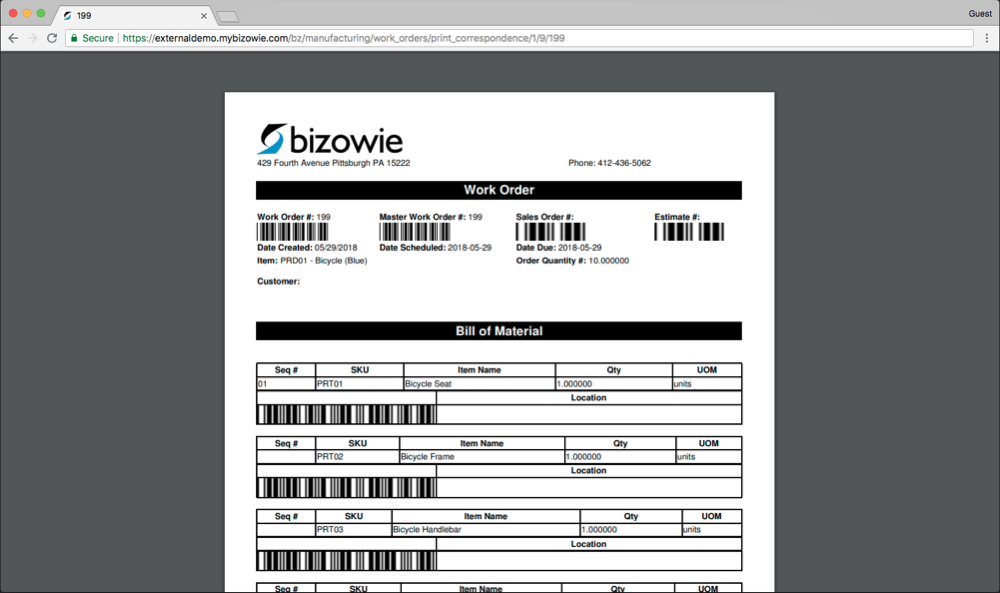
Each work order carries its multi-level bill of materials, batches, and live on-hand quantities.
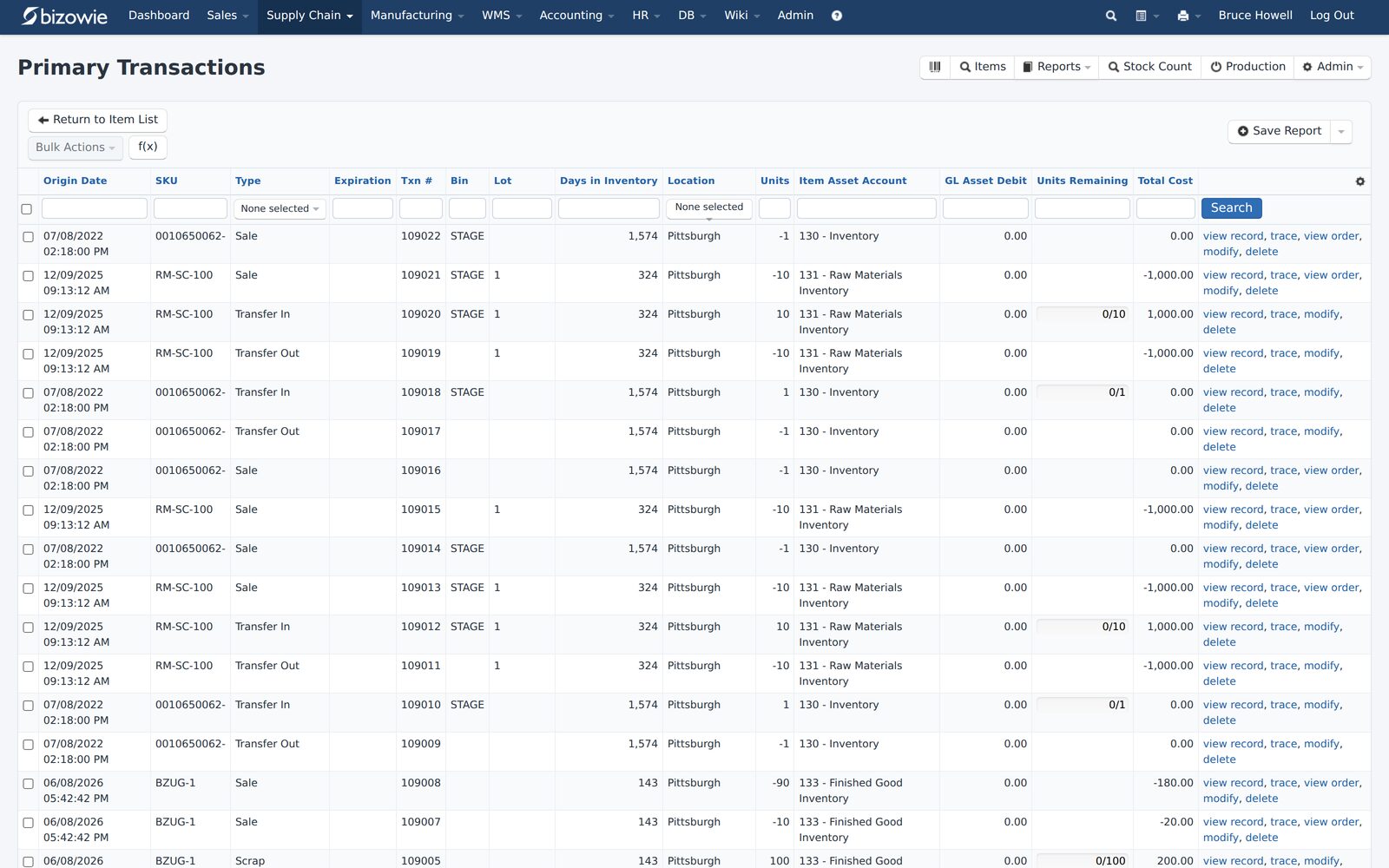
Every receipt, transfer, build, and quarantine move by SKU, lot, bin, and location.
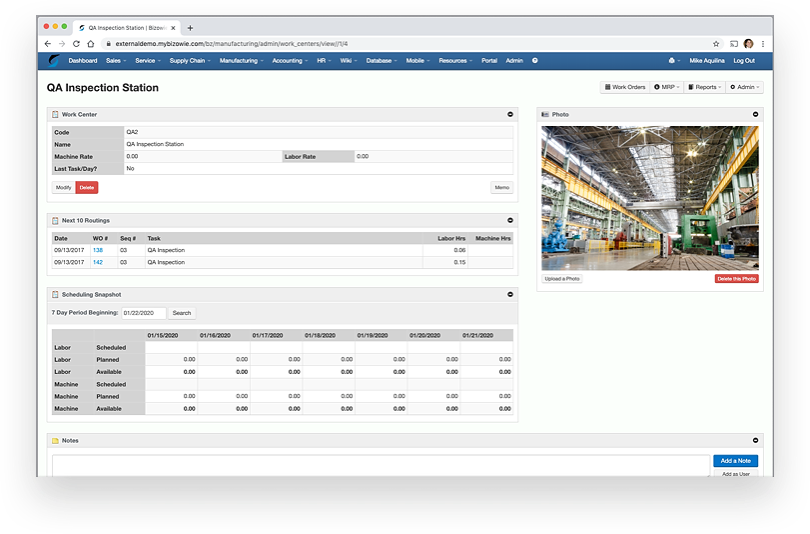
Routings, labor and machine rates, and a scheduling snapshot for every work center.
Printed work orders with barcoded BOM lines, so the shop floor scans instead of writing.
Production Costing in Bizowie
In Bizowie, inventory is picked to work orders, labor and machine time are recorded on the shop floor, and direct costs are applied to finished goods, using actual or standard costs. Work in process is tracked as production moves through each operation, and both direct and indirect job costs can be tracked. Every production event updates inventory, costing, and the general ledger at the same time, so the figures behind cost of goods manufactured come from recorded transactions rather than a period-end estimate. For how costing fits into a full system evaluation, see our manufacturing ERP software buyer’s guide and the month-end close checklist.
“From our first contact all the way through to our implementation, Bizowie has been a first class organization to work with… We strongly recommend the Bizowie software program.”
Alan Seymour — President, Cleveland Electric Labs
Frequently Asked Questions
What is the formula for cost of goods manufactured?
Cost of goods manufactured = Beginning work in process + Total manufacturing costs − Ending work in process. Total manufacturing costs are direct materials used plus direct labor plus manufacturing overhead.
What is the difference between COGM and COGS?
COGM is the cost of units completed during the period. COGS is the cost of units sold during the period. COGS equals beginning finished goods plus COGM minus ending finished goods.
Is cost of goods manufactured on the income statement?
Not as its own line. It appears on the schedule of cost of goods manufactured, which supports the cost of goods sold figure on the income statement.
Can COGM be higher than total manufacturing costs?
Yes. When ending work in process is lower than beginning work in process, the plant completed more cost than it added during the period, so COGM exceeds total manufacturing costs.
Does COGM include overhead?
Yes. It includes manufacturing overhead applied to production, such as indirect labor, depreciation, and utilities. It does not include selling or administrative expenses.
Bring Us Your Last Month-End Numbers
Tell us how you arrive at production cost today. We’ll show you how Bizowie records material, labor, and machine cost against work orders, and if we are not the right fit, we will tell you.
See how Bizowie would cost your production
Tell us a little about your operation and we’ll reply with an honest assessment of fit, not a sales pitch.
- A real person reviews your submission and replies within one business day.
- No automated email sequences.
- If we’re not the right fit, we’ll tell you.
Prefer to talk?
Call (888) 635-2517, Mon–Fri, 9 AM–5 PM Eastern