
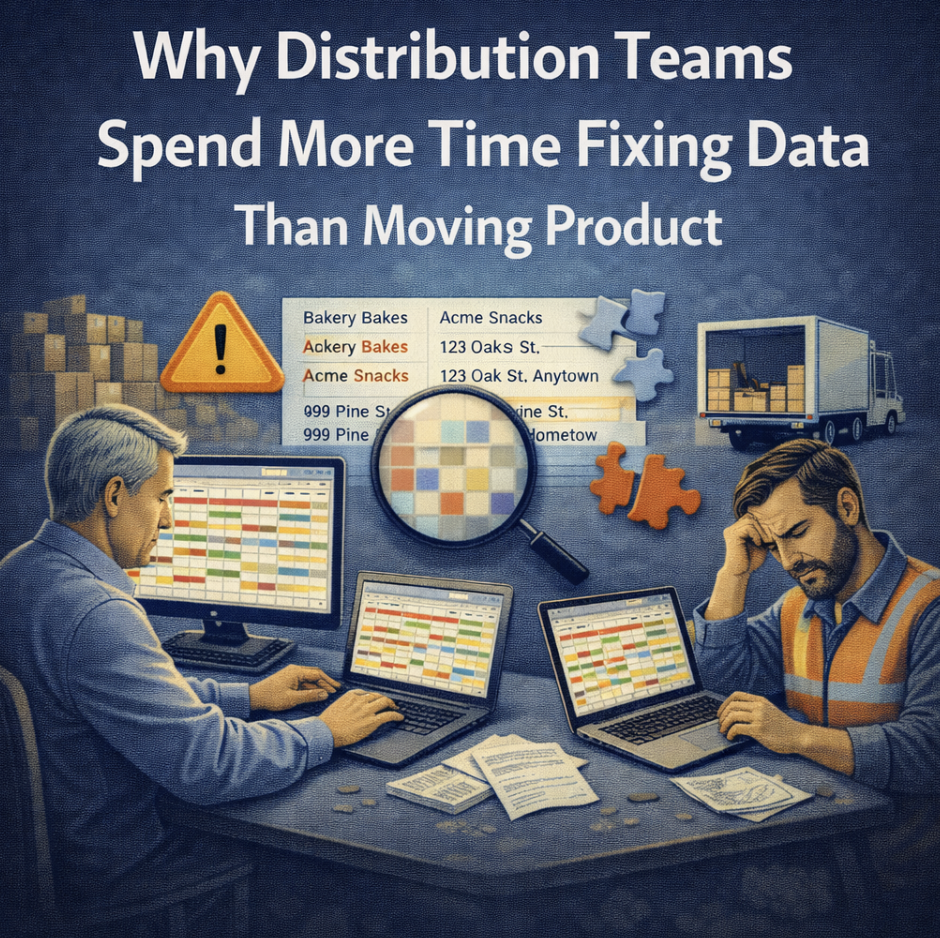
Why Distribution Teams Spend More Time Fixing Data Than Moving Product
Your warehouse supervisor just spent forty-five minutes tracking down a discrepancy. The system showed 200 units of a popular item in bin location A-15-3. The picker found 47 units. Somewhere between receiving, putaway, and this morning’s pick ticket, 153 units vanished from reality while remaining perfectly visible in your ERP.
This isn’t theft. It’s not a receiving error—at least not one anyone can identify now. It’s the accumulated drift between what your systems believe and what physically exists. And while your supervisor investigates, three customer orders wait, the delivery truck idles, and your operations manager fields calls asking why shipments are delayed.
This scene plays out daily in distribution operations everywhere. The warehouse team that should be picking, packing, and shipping instead hunts for missing inventory. The customer service team that should be building relationships instead researches why orders show shipped but customers never received them. The purchasing team that should be optimizing supply instead reconciles why received quantities don’t match purchase orders. The accounting team that should be analyzing profitability instead adjusts records to reflect what actually happened versus what the system recorded.
Data problems have become so endemic to distribution operations that most companies accept them as inevitable friction—a cost of doing business in complex operations. But this acceptance obscures a painful truth: the time spent fixing data is time stolen from actually running the business. And the cumulative cost is staggering.
The Hidden Time Tax of Data Quality Problems
Data quality issues consume operational capacity in ways that rarely appear in productivity metrics or efficiency analyses. The time vanishes into the gaps between transactions, absorbed into standard job functions until fixing data becomes indistinguishable from doing the job.
Inventory discrepancy investigation consumes warehouse management capacity daily. Every cycle count that reveals variances triggers investigation. Every pick that can’t locate items requires research. Every receipt that doesn’t match the purchase order demands reconciliation. Warehouse supervisors report spending 2-4 hours daily on discrepancy investigation—time that should go to optimizing pick paths, training staff, and improving throughput. For a distribution center with three supervisors, that’s 6-12 hours of management capacity lost daily to data problems.
Order error research consumes customer service capacity with every transaction that doesn’t match expectations. Wrong items shipped because product data was incorrect. Wrong quantities because unit-of-measure conversions failed. Wrong addresses because customer records weren’t updated. Wrong prices because pricing rules conflicted. Each error triggers customer contact, research, correction, and documentation. Customer service teams typically spend 25-40% of their time on issues rooted in data problems rather than actual service delivery.
Purchasing reconciliation consumes procurement capacity every time receipts don’t match orders. Quantities differ from what was ordered. Items received don’t match item numbers on the PO. Pricing on invoices doesn’t match agreed terms. Delivery dates don’t align with system expectations. Purchasing staff report spending 15-25% of their time reconciling transactions rather than managing supplier relationships and optimizing procurement strategy.
Financial close reconciliation extends month-end close by days as accounting staff align system records with reality. Inventory values that don’t match physical counts. Receivables that don’t reconcile with customer records. Payables that don’t match vendor statements. Margin analyses that don’t reflect actual transaction costs. The time from period end to closed books—a direct measure of data quality—typically runs 5-10 days for distributors with significant data issues versus 2-3 days for those with clean data.
Customer master maintenance consumes ongoing capacity as contact information, addresses, credit terms, pricing agreements, and preferences change. When this maintenance falls behind, orders ship to wrong addresses, invoices go to outdated contacts, pricing doesn’t reflect current agreements, and credit decisions rely on stale information. The backlog of customer data updates creates ongoing operational friction that compounds with each passing month.
Item master cleanup requires continuous attention as products change, are discontinued, get replaced, or have specifications updated. When item data degrades, warehouse staff can’t identify products, customers receive wrong items, purchasing orders incorrect quantities, and inventory valuations become unreliable. The gap between item master accuracy and operational reality widens constantly without dedicated maintenance effort.
Integration error handling consumes IT and operations capacity when data flowing between systems fails validation or produces conflicts. EDI transactions that reject due to data format issues. E-commerce orders that fail due to inventory synchronization problems. Warehouse management updates that conflict with ERP records. Each integration failure requires investigation, correction, and often manual data re-entry—work that scales with transaction volume and integration complexity.
The aggregate time spent on data problems across a typical mid-sized distributor is staggering. Warehouse management loses 15-20 hours weekly to inventory discrepancy investigation. Customer service loses 30-40% of capacity to order error research. Purchasing loses 15-25% of capacity to reconciliation. Finance loses 3-5 extra days monthly to close reconciliation. IT loses 10-15 hours weekly to integration error handling. For a $100 million distributor, this easily represents $500K-800K annually in labor cost absorbed by data problems—before accounting for the errors, delays, and customer impact that data issues create.
Why Data Quality Problems Are Systemic, Not Random
The data problems consuming operational capacity aren’t random occurrences or staff errors—they emerge systematically from how traditional distribution systems handle information. Understanding these systemic causes reveals why the problems persist despite ongoing cleanup efforts.
Manual data entry introduces errors at predictable rates. Human keystroke accuracy runs approximately 99% for trained data entry staff—which sounds excellent until you calculate the implications. At 99% accuracy, every 100 keystrokes produces one error. A typical order entry transaction might involve 50-100 keystrokes. A day of order entry might comprise hundreds of transactions. The mathematical certainty is that errors will occur constantly, distributed randomly through transaction data. No amount of training or motivation can overcome the fundamental accuracy limits of manual data entry.
Multiple system architecture multiplies data inconsistency opportunities. When customer data exists in your ERP, CRM, e-commerce platform, and accounting system, each system can diverge from the others. A customer address updated in the CRM doesn’t automatically update in the ERP. A pricing change in the ERP doesn’t synchronize to the e-commerce platform. A credit limit adjustment in accounting doesn’t flow to order management. Each system represents a different version of truth, and the effort to keep them synchronized consumes capacity while never fully succeeding.
Integration translation creates data corruption. When data flows between systems, it often requires transformation—mapping field formats, converting codes, translating terminology. Each transformation introduces opportunities for errors: a product code that doesn’t map correctly, a unit-of-measure that converts improperly, a date format that translates incorrectly. Integration logic that worked when implemented gradually fails as data patterns evolve, creating systematic corruption that’s difficult to detect until it causes operational problems.
Temporal inconsistency ensures systems and reality diverge. Batch processing means systems always reflect past reality rather than current state. Inventory updated nightly doesn’t capture today’s transactions. Customer data synchronized hourly lags current changes. Pricing updated weekly doesn’t reflect mid-week adjustments. The gap between system state and actual state at any moment creates friction—friction that surfaces as apparent “errors” requiring investigation and correction.
Insufficient validation at entry points allows bad data into systems. Traditional ERP implementations often lack robust validation rules, allowing data that shouldn’t be accepted: incomplete addresses, invalid product configurations, inconsistent unit-of-measure relationships, duplicate customer records. Once bad data enters the system, it propagates through transactions until it causes operational failures—at which point correction is far more expensive than prevention would have been.
User workarounds corrupt data systematically. When systems don’t accommodate legitimate business needs, users create workarounds that corrupt data integrity. A customer-specific discount entered as a line item adjustment rather than in pricing rules. A special handling requirement noted in a free-text field rather than systematic flag. A product substitution recorded through inventory adjustment rather than proper substitution workflow. Each workaround makes sense to the user in the moment but degrades data quality for everyone who relies on that information subsequently.
Master data governance gaps allow degradation over time. Most distribution operations lack formal ownership and maintenance processes for master data—customer records, item data, vendor information, pricing tables. Without clear responsibility for data quality, maintenance happens reactively when problems surface rather than proactively to prevent issues. The slow drift from accurate to inaccurate accelerates with each year of accumulating changes, departures of knowledgeable staff, and evolution of business relationships.
Historical data burden prevents cleanup. Years of accumulated transactions containing data errors can’t easily be corrected without affecting financial records, audit trails, and historical analyses. Companies often know their historical data has problems but can’t justify the effort and risk of retrospective correction. Instead, bad data persists, contaminating any analysis that spans significant time periods and requiring constant caveats about data reliability.
The systemic nature of these causes explains why data quality problems resist solution through periodic cleanup projects. You can run data cleansing initiatives, but manual entry continues introducing errors. You can synchronize systems, but they begin diverging immediately. You can implement validation, but workarounds find new paths for bad data. Sustainable data quality requires addressing root causes through architecture and automation rather than perpetual correction of symptoms.
The Compounding Cost of Bad Data Decisions
Beyond the direct time spent fixing data, poor data quality corrupts business decisions in ways that compound costs far beyond the original errors. Every decision made on inaccurate information carries risk—risk that accumulates across thousands of daily decisions into significant business impact.
Inventory investment decisions based on inaccurate data systematically misallocate capital. If sales history contains errors—wrong items, wrong quantities, wrong dates—demand forecasts derived from that history will be wrong. Safety stock calculations based on incorrect lead time data produce either stockouts or overstock. Reorder point logic using flawed demand patterns triggers replenishment at wrong times. For a $100 million distributor with $15-20 million in inventory, even 10% misallocation from data-driven errors represents $1.5-2 million in working capital inefficiency.
Pricing decisions based on incomplete cost data erode margins invisibly. If landed cost calculations miss freight components because data wasn’t captured correctly, quoted prices may not cover true costs. If customer-specific costs like returns processing and payment terms aren’t accurately reflected in profitability analysis, pricing strategies optimize for wrong targets. If competitive pricing adjustments aren’t systematically tracked, margin erosion goes undetected until quarterly analysis reveals unexpected shortfalls.
Customer prioritization based on inaccurate relationship data misallocates sales and service resources. If customer profitability calculations are wrong because transaction data is corrupted, you might invest sales resources in unprofitable accounts while neglecting profitable ones. If credit decisions rely on stale payment history, you might extend terms to deteriorating accounts or restrict them for improving ones. If service level decisions use incorrect order history, you might under-serve valuable customers or over-invest in marginal ones.
Supplier management based on incomplete performance data perpetuates poor relationships. If delivery performance metrics miss late shipments because receiving data wasn’t properly recorded, underperforming suppliers escape accountability. If quality data doesn’t accurately capture defect rates, poor quality suppliers continue receiving orders. If cost data doesn’t properly account for exception handling, apparently low-cost suppliers prove expensive when true cost-to-use is calculated.
Capacity planning based on flawed throughput data leads to wrong infrastructure investments. If warehouse productivity metrics are corrupted by time spent on data problems (recorded as productive work), capacity calculations will be wrong. If shipping volume data doesn’t accurately reflect order characteristics, carrier negotiations and capacity commitments miss actual needs. If seasonal pattern data contains errors, staffing decisions for peak periods will miscalculate requirements.
Financial reporting based on reconciled rather than accurate data obscures operational reality. When month-end close involves extensive adjustment, the financial statements reflect accounting reconciliation rather than true operational performance. Margin analysis, cost allocation, and profitability reporting all carry uncertainty proportional to the adjustments required. Executive decisions based on adjusted financials may not reflect operational reality that produced those numbers.
Strategic decisions based on flawed operational data carry compounding risk. Market expansion decisions using corrupted regional sales data may target wrong opportunities. Acquisition evaluation using unreliable operational metrics may misjudge target value. Product line decisions based on inaccurate item profitability may discontinue profitable items or invest in unprofitable ones. Each strategic misfire cascades into years of consequences.
The compounding nature of data quality costs makes them particularly insidious. A single data error might affect one transaction. But when that error influences a decision, the decision affects many transactions. When multiple decisions rely on systematically flawed data, the cumulative impact multiplies dramatically. Companies often don’t connect business problems to data quality causes—they see unexplained margin erosion, puzzling inventory performance, and confusing customer behavior without recognizing that corrupted data drives these outcomes.
How Modern Platforms Prevent Data Problems at the Source
Addressing data quality requires architectural approaches that prevent problems rather than just detecting and correcting them after the fact. Modern cloud-native ERP platforms designed for distribution provide capabilities fundamentally different from traditional systems—capabilities that maintain data quality through design rather than discipline.
Single source of truth architecture eliminates the synchronization problems that plague multi-system environments. When customer data, inventory records, pricing information, and transaction history all reside in a unified database, there’s no possibility of systems diverging. The customer address is what it is—not one version in CRM, a different version in ERP, and yet another in accounting. This architectural simplicity prevents an entire category of data problems that consume massive operational capacity in traditional environments.
Real-time transaction processing eliminates temporal gaps between reality and system state. When every transaction updates the system immediately, there’s no batch processing window during which systems and reality diverge. Inventory reflects current position, not last night’s count. Order status shows current progress, not this morning’s snapshot. Customer activity reflects latest transactions, not weekly synchronization. Real-time architecture dramatically reduces the investigation effort required when systems don’t match expectations.
Automated data capture eliminates manual entry errors through integration and scanning. Barcode scanning captures item and location data without keystroke errors. EDI and API integrations bring order data directly from customers without transcription. Mobile devices enable warehouse transactions without paper-based recording and later entry. Scale integration captures weights without manual recording. Each automation point removes human error opportunity while speeding transaction processing.
Validation rules at entry points prevent bad data from entering the system rather than allowing it in for later cleanup. Address validation ensures shipments have deliverable destinations. Product configuration rules prevent incompatible combinations. Credit validation confirms terms before order acceptance. Inventory validation ensures transactions reference valid items and locations. Prevention at the gate is far more efficient than correction after the fact.
Workflow-embedded data maintenance makes updates happen as natural part of operations rather than separate maintenance effort. Customer address confirmation during order entry, not quarterly cleanup project. Item specification update during receiving inspection, not annual inventory audit. Supplier performance rating during receipt processing, not periodic vendor review. Embedding maintenance in workflow ensures it happens continuously rather than never.
Intelligent duplicate detection prevents the record proliferation that creates confusion and inconsistency. When a customer calls with slight name variation, the system identifies potential matches rather than creating new records. When a product is entered with different description, similar item matching surfaces existing records. When a vendor submits invoice with variations, the system connects to existing vendor relationship. Duplicate prevention maintains clean master data without continuous deduplication projects.
Audit trail preservation makes investigating and correcting issues efficient when they do occur. Every data change tracks who, when, why, and what the previous value was. Transaction lineage traces from current state back through all modifications. System logs capture all activities for forensic analysis when needed. When investigation is necessary, complete audit trails reduce research time from hours to minutes.
Exception-based management focuses attention on data that doesn’t conform rather than requiring review of all data. Dashboard highlighting items approaching reorder point but lacking supplier assignment. Alerts for customers with recent orders but incomplete credit setup. Warnings for products with sales activity but missing cost data. Exception visibility concentrates maintenance effort where it matters rather than distributing it across all records.
Integration platform design ensures data flowing between systems maintains integrity. Canonical data models prevent format translation errors. Transaction logging captures all integration activity for troubleshooting. Validation at integration boundaries prevents bad data from propagating. Error handling ensures failed transactions are captured and addressed rather than silently lost. Integration architecture designed for reliability rather than just connectivity.
Machine learning data quality monitoring identifies patterns and anomalies that human review would miss. Algorithms that recognize when data entry patterns deviate from historical norms. Models that identify transactions with characteristics matching past errors. Analysis that surfaces systematic issues before they accumulate into major problems. Intelligent monitoring scales where manual review cannot.
The cumulative effect of these capabilities transforms data quality from perpetual struggle to maintained state. Companies on modern platforms typically report 60-80% reduction in time spent on data-related issues, 75-90% reduction in transaction errors requiring correction, 50-70% faster financial close through reduced reconciliation, and dramatically improved confidence in business decisions based on system data. These aren’t aspirational goals—they’re documented outcomes when architecture prevents problems rather than requiring constant correction.
The Real Value of Accurate Data: What Becomes Possible
When data quality stops consuming operational capacity and corrupting decisions, organizations discover capabilities they couldn’t achieve when fighting constant data problems. The value extends far beyond time savings into strategic capabilities that bad data prevents.
Real-time operational visibility becomes trustworthy. Dashboards showing inventory position, order status, shipping activity, and financial performance actually reflect reality. Executives can make decisions based on current data without caveating that “the numbers might be off.” Operations managers can respond to what’s happening rather than investigating whether what the system shows is accurate. Visibility only has value when the data it reveals is reliable.
Automation becomes viable when data can be trusted. Automated reorder point purchasing requires accurate inventory data and reliable lead times. Automated order promising requires real-time inventory visibility and dependable supplier performance data. Automated customer communications require correct contact information and accurate order status. Each automation initiative fails when underlying data isn’t reliable—which is why automation projects often stall in organizations with data quality problems.
Analytics and business intelligence produce actionable insights rather than caveated reports. Customer profitability analysis is meaningful when transaction data is accurate. Demand forecasting improves when historical data is reliable. Supplier performance benchmarking is valid when delivery and quality data is complete. The entire category of data-driven decision-making depends on having data worthy of trust.
Customer experience consistency becomes achievable. When customer records are accurate, orders ship to right addresses. When pricing is properly maintained, invoices match expectations. When inventory is reliable, delivery promises are kept. When order history is complete, service representatives have full context. Customer experience excellence requires data excellence—there’s no shortcut.
Regulatory compliance simplifies when data supports required documentation. Lot traceability for food safety depends on accurate receipt and distribution records. Chemical handling compliance requires reliable product data. Financial reporting requirements depend on transaction accuracy. Audit preparation shrinks from weeks to days when data supports rather than contradicts required reporting.
Mergers and acquisitions execute faster when data is clean. Due diligence accelerates when operational data is reliable. Integration planning improves when customer and vendor data is accurate. Synergy capture happens faster when systems can be consolidated without extensive data cleanup. Acquisitive growth strategies depend on data readiness that problematic data prevents.
Talent retention improves when staff work on value creation rather than data correction. High performers don’t want jobs that consist of fixing data errors. They want roles where they can apply expertise to business improvement. The best warehouse supervisors want to optimize operations, not hunt for inventory discrepancies. The best customer service representatives want to build relationships, not research order errors. The best analysts want to generate insights, not reconcile conflicting data sources. Data quality directly affects ability to attract and retain operational talent.
Strategic agility increases when operational systems reflect operational reality. Pursuing new market opportunities doesn’t require data remediation projects. Adding new product lines doesn’t demand master data overhaul. Acquiring companies doesn’t necessitate years of data integration. Strategic initiatives move at business speed rather than data cleanup speed.
The opportunity cost of persistent data problems extends far beyond the direct time spent fixing errors. It includes the automation that can’t be implemented, the analytics that can’t be trusted, the customer experience that can’t be delivered, the talent that can’t be retained, and the strategic initiatives that can’t be pursued. When data quality improves, these constrained capabilities suddenly become achievable—often revealing value that vastly exceeds the direct efficiency gains.
Measuring Data Quality Costs in Your Operation
Quantifying the operational impact of data quality problems helps prioritize improvement investment and establish baseline for measuring progress. Most organizations dramatically underestimate data quality costs because they disperse across operational activities rather than concentrating in visible expense categories.
Time study methodology reveals labor absorption by data problems. Track how warehouse supervisors, customer service representatives, purchasing staff, and accounting personnel spend their time over a representative period. Categorize activities as value-creating work versus data investigation, reconciliation, correction, and cleanup. Most organizations discover 20-35% of operational labor absorbs data problems—a proportion that shocks executives who haven’t measured it.
Transaction error rates quantify the frequency of data-driven problems. Sample recent orders for shipping accuracy—right items, right quantities, right addresses. Sample recent receipts for matching to purchase orders. Sample recent invoices for pricing accuracy. Sample recent inventory counts for location accuracy. Error rates above 1-2% indicate systemic data problems; rates above 5% indicate critical issues requiring immediate attention.
Cycle count variance provides inventory data quality indicator. What percentage of counted items match system quantities? What’s the average variance magnitude? How much adjustment value flows through monthly? Healthy operations show 95%+ count accuracy with less than 1% total inventory value adjustment monthly. Significant variance indicates either process problems or data problems—often both.
Financial close duration reflects data quality through reconciliation burden. How many days from period end to closed books? How many adjusting entries are required? How many hours does finance staff spend on reconciliation versus analysis? Streamlined close—3 days or less with minimal adjustment—indicates good data quality. Extended close—7+ days with extensive adjustment—indicates systemic data problems.
Customer complaint analysis reveals data-driven service failures. Categorize recent complaints by root cause. What percentage trace to wrong item shipped, wrong quantity, wrong address, wrong price, missing communication, or other data issues? Most organizations find 40-60% of customer complaints originate in data problems rather than operational failures—a revelation that reframes improvement priorities.
Integration failure rates quantify data problems in system connectivity. What percentage of EDI transactions require manual intervention? How many e-commerce orders fail automatic processing? What volume of exceptions flows to error queues daily? High integration exception rates indicate data format, validation, or synchronization problems that consume IT and operations capacity.
Master data completeness assesses foundation data health. What percentage of items have complete cost data? What percentage of customers have validated addresses? What percentage of vendors have current lead time data? What percentage of products have accurate weights and dimensions? Incomplete master data guarantees ongoing operational friction and corrupt downstream transactions.
Decision confidence assessment captures qualitative data quality impact. Survey operational managers about confidence in data used for decisions. Do they trust inventory reports? Rely on customer profitability analysis? Believe sales forecasts? Act on supplier performance data? Low confidence indicates data quality problems even when other metrics seem acceptable—staff know when they can’t trust what systems tell them.
The quantification exercise typically reveals data quality costs of 3-5% of operational labor plus 1-3% of revenue in decision-quality impacts—far exceeding what most executives estimate before measurement. This baseline enables calculating ROI for data quality improvement initiatives and establishing metrics for ongoing monitoring. Organizations that measure data quality consistently outperform those that assume their data is “good enough” without verification.
Implementation: From Data Chaos to Data Confidence
Improving data quality requires both platform capabilities that prevent problems and organizational disciplines that maintain accuracy over time. The transition follows predictable phases with clear milestones indicating progress.
Phase 1: Visibility establishment creates understanding of current state before attempting improvement. Implement the measurement approaches described above to quantify data quality costs. Identify the highest-impact problem areas—typically inventory accuracy, customer data completeness, or item master quality. Document the specific errors and discrepancies consuming operational capacity. This baseline enables prioritization and progress tracking.
Phase 2: Quick wins capture addresses obvious issues while building momentum. Clean up duplicate customer records that create confusion. Validate and correct addresses causing shipping failures. Complete missing item data blocking transaction processing. Reconcile major inventory variances consuming investigation time. Quick wins demonstrate improvement possibility and build organizational support for deeper changes.
Phase 3: Process improvement addresses root causes of ongoing data problems. Implement validation rules preventing bad data entry. Automate data capture currently done through manual entry. Establish workflow-embedded maintenance replacing periodic cleanup projects. Create exception monitoring surfacing issues before they cause operational failures. Process changes prevent new problems while cleanup addresses existing issues.
Phase 4: Platform modernization replaces architecture that inherently creates data problems with systems designed for data integrity. Migrate to unified data architecture eliminating synchronization issues. Implement real-time processing removing temporal gaps between reality and system state. Deploy automated integration replacing manual data transfer. Enable mobile data capture at point of activity. Platform change addresses systemic causes that process improvement alone cannot fix.
Phase 5: Governance establishment creates organizational structures maintaining data quality permanently. Assign clear ownership for master data categories—customer data, item data, vendor data, pricing data. Establish quality metrics and monitoring processes. Create feedback loops connecting data problems to root causes. Implement continuous improvement disciplines rather than periodic cleanup projects. Governance ensures that achieved improvements persist rather than gradually degrading.
Phase 6: Advanced capability activation leverages reliable data for automation and intelligence. Implement automated reordering based on trustworthy inventory data. Enable automated customer communication based on accurate order data. Deploy predictive analytics based on reliable historical data. Activate machine learning based on quality training data. These capabilities become possible only after data quality supports them.
The timeline for meaningful improvement typically spans 12-18 months: 2-3 months for visibility and quick wins, 3-6 months for process improvement, 6-9 months for platform modernization, and ongoing governance establishment. Organizations expecting instant transformation underestimate the depth of accumulated data problems. Those planning realistic timelines with appropriate resources achieve sustainable results.
Change management investment significantly impacts success probability. Staff accustomed to working around data problems may resist new processes requiring data discipline. Training on both new systems and new expectations is essential. Leadership reinforcement of data quality priority prevents regression to old habits. The cultural dimension of data quality improvement often proves more challenging than technical implementation.
The Competitive Advantage of Data Excellence
Distribution has become an industry where data quality directly determines competitive capability. The gap between data-excellent and data-struggling organizations widens annually as customer expectations and operational complexity increase.
Service reliability differentiation depends on data accuracy. Distributors who consistently ship right products to right addresses on promised dates earn customer loyalty that competitors can’t easily capture. This reliability isn’t luck or exceptional effort—it’s the natural outcome of accurate data enabling consistent execution. Companies with data problems can’t achieve this consistency regardless of how hard their staff works.
Operational efficiency advantages compound from data quality foundation. Automation, analytics, and optimization all require reliable data. Organizations with good data implement these capabilities; those with bad data cannot. The efficiency gap accelerates over time as data-excellent competitors continuously improve while data-challenged competitors remain stuck fixing problems. The labor cost differential between data-excellent and data-struggling distributors typically runs 20-30%—a permanent margin advantage for those with clean data.
Decision quality superiority accumulates from trustworthy information. Every day, distribution operations make thousands of decisions—what to order, what to ship, how to route, what to charge, who to prioritize. When these decisions rely on accurate data, they’re more likely to be correct. When they rely on corrupted data, errors are inevitable. The compound effect of better daily decisions creates sustainable competitive advantage that’s difficult for competitors to replicate.
Talent acquisition and retention favors data-excellent organizations. The best operational professionals don’t want jobs consisting of fixing data problems. They want roles where expertise creates business value. Organizations known for data quality attract better candidates, retain high performers longer, and build stronger operational teams. Talent advantage reinforces competitive advantage in a compounding cycle.
Strategic agility enables market response that data-challenged competitors cannot match. When launching new products doesn’t require data remediation, speed to market improves. When entering new geographies doesn’t demand data cleanup projects, expansion accelerates. When pursuing acquisitions doesn’t necessitate years of data integration, growth through acquisition becomes viable strategy. Strategic agility directly correlates with data readiness.
The distribution industry is increasingly stratifying between companies that have mastered data quality and those still struggling with it. This stratification is not temporary—it will likely intensify as technology capabilities advance and customer expectations continue rising. Companies that address data quality now build advantages that compound over time. Those that continue accepting data problems as inevitable cost of business fall progressively further behind competitors who have moved beyond this limitation.
For distributors ready to transform data quality from persistent problem to competitive advantage, Bizowie delivers the platform architecture that data excellence requires. Our cloud-native unified database eliminates synchronization issues, real-time processing prevents temporal gaps, automated data capture reduces manual entry errors, validation rules prevent bad data at entry, and integrated workflows embed maintenance in operations. Data quality becomes achieved state rather than ongoing struggle—freeing operational capacity for value creation and enabling capabilities that unreliable data prevents.
Schedule a demo to see how Bizowie transforms data quality through architecture rather than discipline, or explore how our platform enables the automation, analytics, and operational excellence that clean data makes possible.
Related Reading
- The Cost of Firefighting: Why Nothing Improves When Everything Is Urgent
- ERP Data Hygiene: Why Clean Data Matters (And What It’s Costing You Right Now)
- The Operational Cost of Not Knowing What’s About to Break
- Why ‘Real-Time Inventory’ Breaks Down in High-Volume eCommerce (And How ERP Fixes It)
- Distribution ERP Software: A Buyer’s Guide