
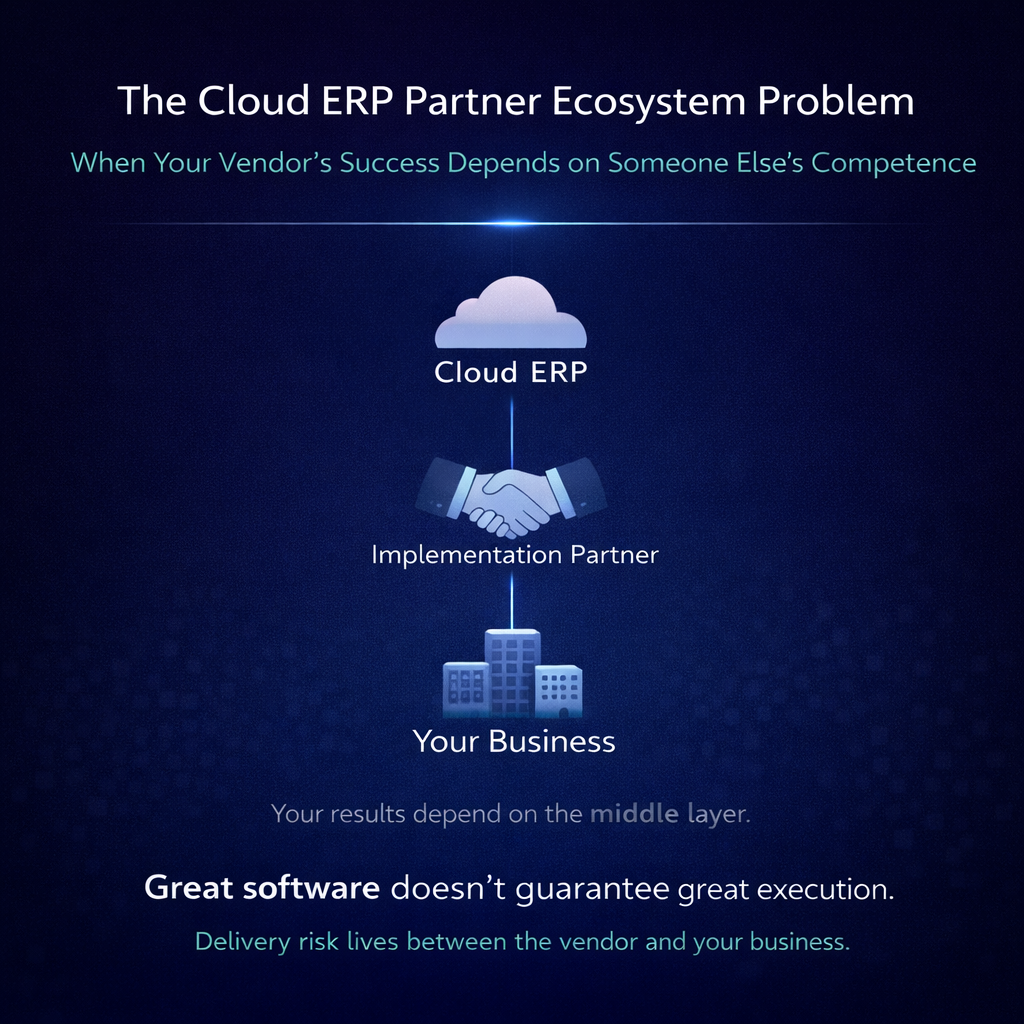
The Cloud ERP Partner Ecosystem Problem: When Your Vendor’s Success Depends on Someone Else’s Competence
There’s a moment in almost every enterprise ERP sales cycle that should alarm the buyer but rarely does. You’ve seen the demo. You like the software. You’re ready to talk about implementation. And the vendor says: “Let me introduce you to one of our implementation partners.”
That sentence means something specific. It means the company that built the software won’t be the company that puts it in your business. Someone else — a third-party consulting firm with their own revenue targets, their own staffing model, their own project management methodology, and their own interpretation of the vendor’s product — will handle the most consequential phase of the entire engagement. The phase where the system is configured to your business, where your data is migrated, where your workflows are designed, where your integrations are built, and where your team learns to depend on a platform they’ll use every day for the next decade.
The vendor calls this a partner ecosystem. The industry calls it a channel. What it actually is, for the customer, is a structural fragmentation of accountability that introduces cost, complexity, and risk that wouldn’t exist if the vendor did the work themselves.
This isn’t a fringe observation. The partner ecosystem model is the dominant implementation approach for the majority of cloud ERP platforms — including most of the names you’d recognize. And the problems it creates are so normalized that buyers have stopped questioning them. They assume that’s just how ERP works. It isn’t. It’s how a particular business model works — one that serves the vendor and the consulting industry far better than it serves you.
How the Partner Ecosystem Actually Works
Understanding why the partner model creates problems requires understanding the business mechanics that drive it. These mechanics aren’t hidden, but they’re rarely explained to buyers.
Why Vendors Use Partners
ERP vendors use implementation partners for one primary reason: scale. A software company that sells 200 new deals per year cannot maintain an internal implementation team large enough to deploy all 200 simultaneously. Implementation is labor-intensive, project-based work that requires deep product knowledge and significant customer interaction. Staffing an internal team large enough to handle peak demand means carrying excess capacity during slower periods. Outsourcing implementation to a network of consulting firms converts that fixed cost into a variable one — the vendor pays for implementations only when implementations happen.
There’s a secondary reason: market coverage. Implementation partners operate in geographic regions, industry verticals, and customer segments that the vendor’s direct team doesn’t reach. A consulting firm in the Midwest that specializes in manufacturing ERP extends the vendor’s reach into a market the vendor would otherwise need to staff locally.
These are rational business decisions for the vendor. But they’re decisions that optimize the vendor’s cost structure and market reach — not the customer’s implementation outcome.
How Partners Make Money
Implementation partners are consulting firms. They sell time. Their revenue is a function of billable hours multiplied by billing rate. Every hour a consultant spends on your project generates revenue. Every hour the project extends beyond the original estimate generates more revenue.
This isn’t a conspiracy theory or an accusation of bad faith. It’s a description of the business model. Consulting firms aren’t charities. They optimize for revenue within the constraints of maintaining customer relationships and professional reputation. But the optimization function — more hours, more revenue — runs structurally counter to the customer’s interest, which is fewer hours, faster completion, and lower total cost.
The misalignment becomes most visible in three scenarios. First, when a project encounters complications — data migration issues, configuration challenges, integration problems — the partner bills additional hours to resolve them, regardless of whether the complications were foreseeable or resulted from the partner’s own decisions. The customer pays for the problem and for the solution. Second, when the initial project is complete and the customer needs ongoing support, configuration changes, or reporting modifications — the partner bills for every engagement, creating a permanent revenue stream from post-implementation dependency. Third, when the partner recommends customizations over standard configuration — because custom development is complex work billed at premium rates, while configuration is straightforward work that might not require a consultant at all.
How Partners Are Selected and Managed
Vendors certify implementation partners through training programs that vary widely in rigor. Some certification programs require extensive product training, supervised implementation experience, and periodic recertification. Others require completing an online course and paying a partnership fee. The certification badge on a partner’s website doesn’t tell you which model produced it.
Partners are typically tiered — gold, silver, platinum, or whatever hierarchy the vendor uses — based on the number of implementations completed, the revenue generated for the vendor, and the certifications held by the partner’s consultants. These tiers reflect the partner’s commercial relationship with the vendor more than they reflect implementation quality. A gold-tier partner that has completed 50 implementations is commercially important to the vendor regardless of how many of those implementations produced satisfied customers.
The vendor’s partner management team monitors the ecosystem with varying levels of diligence. Some vendors actively track partner performance through customer satisfaction surveys, implementation timeline adherence, and post-go-live success metrics. Others take a hands-off approach, intervening only when a customer complaint escalates to the point where the vendor’s reputation is at risk.
From your position as the buyer, this means the quality of your implementation depends on which specific partner you’re assigned to, which specific consultants within that partner are available for your project, and how actively the vendor monitors and manages the relationship. You’re introducing variables that wouldn’t exist if the vendor implemented directly.
Where the Three-Party Model Breaks Down
The structural problems with the partner ecosystem aren’t theoretical. They manifest in specific, predictable ways that affect implementation timelines, costs, outcomes, and the long-term relationship between you and your ERP platform.
The Accountability Gap
In a vendor-direct model, accountability is singular. The vendor sold you the software, configured it for your business, migrated your data, built your integrations, trained your team, and supports you after go-live. If something goes wrong, there’s one organization responsible — one team that owns the outcome, one relationship to manage, one entity that succeeds or fails based on your experience.
In the partner model, accountability fragments across three parties. The vendor is responsible for the software. The partner is responsible for the implementation. You’re responsible for your own team’s readiness, data quality, and decision-making during the project. When something goes wrong — and something always goes wrong in complex implementations — the accountability question becomes a negotiation rather than a resolution.
The data migration that produced incomplete customer records — was that the partner’s migration methodology, the vendor’s export tools, or your team’s data quality? The integration that doesn’t handle a specific EDI scenario — is that a platform limitation the vendor should address, a configuration the partner should have caught, or a requirement you didn’t specify clearly enough? The configuration that doesn’t match your warehouse workflow — did the partner misunderstand the requirement, did the vendor’s product lack the capability, or did your team describe the workflow incorrectly?
Each of these scenarios has a genuine answer. But in a three-party structure, finding that answer — and getting the responsible party to act on it — takes longer, costs more, and generates more friction than in a two-party structure where the vendor owns the entire outcome.
The accountability gap is widest during the post-go-live period. The partner’s project is contractually complete once the system goes live and the acceptance criteria are met. The support relationship shifts to the vendor, whose support team now fields questions about a configuration they didn’t build, serving a customer whose specific setup they don’t know intimately. The institutional knowledge of why specific decisions were made — why this workflow was configured this way, why that integration uses this particular mapping, why that pricing rule has this specific exception — lives with the partner’s consultants, who have moved on to their next engagement.
The Knowledge Gap
The vendor built the software. The partner implements it. These are different kinds of expertise, and the gap between them matters more than the industry acknowledges.
The vendor’s engineering team understands the product at an architectural level. They know why features work the way they do, what the design constraints are, what the edge cases look like, and where the product’s limits lie. They know what’s on the roadmap, what workarounds are temporary versus permanent, and what the platform can be configured to do versus what it genuinely can’t.
The partner’s consulting team understands the product at a practitioner level. They’ve completed training. They’ve implemented it some number of times. They know the standard configuration procedures and the common scenarios. But their knowledge is derived — learned from documentation, training materials, and accumulated project experience rather than from building the software.
This gap is manageable for straightforward implementations. For complex distribution environments — intricate pricing structures, multi-location fulfillment logic, sophisticated warehouse workflows, demanding EDI compliance requirements — the gap becomes a problem. The partner may not know whether a specific configuration will work for your edge case without testing it. They may not know the optimal approach to a requirement because they haven’t encountered it before. They may not know that a better solution exists in the platform because it wasn’t covered in their training.
The vendor’s implementation team, by contrast, knows the product the way an architect knows a building. They know what’s behind the walls. They know which configurations are robust and which are fragile. They know what the next release will improve and how today’s configuration should anticipate it. This depth of knowledge produces better implementations — faster, cleaner, more durable — because the decisions are made by people who understand the platform at its deepest level.
The Incentive Misalignment
The vendor wants you to succeed on their platform because your success drives renewal, expansion, and referral. Their business model depends on your long-term satisfaction.
The partner wants to complete the project profitably and move to the next engagement. Their business model depends on a volume of billable work across many clients. Your long-term satisfaction matters to them — a dissatisfied customer generates warranty work and reputational risk — but it matters less than it matters to the vendor, because the partner’s revenue relationship with you is project-based while the vendor’s is subscription-based.
This misalignment manifests in predictable ways. The partner may recommend solutions that maximize billable work rather than platform efficiency — customization where configuration would suffice, complex integrations where pre-built connectors exist, elaborate processes where the platform’s standard workflow would work. These recommendations aren’t necessarily cynical. The partner may genuinely believe the complex approach is better. But when the recommender’s revenue increases with complexity, the recommendation deserves scrutiny.
The misalignment also appears in knowledge transfer — or the lack of it. A partner that fully enables your team to manage the system independently has worked themselves out of a support revenue stream. A partner that maintains a knowledge advantage — where your team can use the system but can’t configure, troubleshoot, or evolve it without help — has secured an ongoing engagement. The incentive to create dependency isn’t always conscious, but it’s always structural.
The Communication Tax
Every interaction between you and the vendor that routes through the partner adds time, cost, and potential for miscommunication. A question about platform capability goes from you to the partner’s consultant, who interprets it based on their understanding, escalates it to the vendor’s support or product team, receives an answer filtered through the vendor’s support process, interprets the answer, and relays it back to you. The answer may be accurate by the time it arrives. It may also have been modified, simplified, or misinterpreted at each relay point.
Direct communication between you and the vendor’s product team — the people who can answer definitively — is typically not part of the partner model. The partner is the interface. The vendor is behind the curtain. When you need to understand whether the platform can handle a specific requirement, you’re asking someone who learned the product rather than someone who built it.
This communication tax is invisible for routine questions. It becomes expensive for complex ones — the kinds of questions that arise during implementation of a distribution operation with real pricing complexity, real warehouse workflow demands, and real integration requirements.
The Quality Variance
In a vendor-direct model, implementation quality is controlled by a single organization with consistent training, consistent methodology, consistent standards, and direct management of every team member. The quality of your implementation is a function of the vendor’s organizational competence, which you can evaluate through references and track record.
In the partner model, implementation quality varies by partner, by office within the partner, by individual consultant assigned to your project, and by the consultant’s experience level, workload, and engagement with your specific requirements. A partner with 200 consultants may have 20 who are excellent, 100 who are competent, and 80 who are still developing. Which ones you get depends on availability, staffing decisions made by the partner’s management, and chance.
The vendor’s partner certification process is supposed to ensure minimum quality standards. In practice, certification ensures minimum product knowledge — not implementation methodology, not industry expertise, not project management capability, and not the interpersonal skills that determine whether a consultant understands your business well enough to configure a system that serves it.
You can mitigate quality variance by insisting on specific consultants, by checking individual references, and by actively managing the engagement. But these mitigations are your work — effort that wouldn’t be necessary if the vendor implemented directly with a team they manage, train, and are directly accountable for.
The Post-Implementation Dependency
The partner model’s problems don’t end at go-live. They persist — and in some ways intensify — after the implementation project is complete.
Configuration Knowledge Lives With the Partner
During implementation, the partner’s consulting team made hundreds of decisions about your system configuration. How pricing rules are structured. How approval workflows route. How allocation logic prioritizes. How integrations map data between systems. How reports calculate their metrics. How warehouse zones are defined and pick sequences are optimized.
The documentation of these decisions varies from excellent to nonexistent, depending on the partner’s methodology and the consultants’ diligence. Even with good documentation, the reasoning behind decisions — why this approach was chosen over alternatives, what trade-offs were considered, what assumptions were made — is institutional knowledge that lives in the consultants’ heads.
When you need to change something post-go-live — a new pricing structure, a modified workflow, an additional integration — the most efficient path is to call the people who understand the existing configuration. Those people work for the partner, and their time is billed at consulting rates. Every post-implementation change is a paid engagement. Every question about why something works the way it does is a billable conversation.
Over time, this dependency becomes a significant operating cost. The annual consulting spend with the implementation partner — for configuration changes, report modifications, integration adjustments, and the periodic “health check” the partner recommends — can approach or exceed the annual ERP subscription. You’re paying a perpetual tax on institutional knowledge that wouldn’t need to be purchased if the vendor who built the software had also configured it for your business.
Vendor Support Doesn’t Know Your Configuration
When you contact the vendor’s support team with an issue, they know the product. They don’t know your specific configuration. They don’t know why your pricing rules are structured the way they are, why your warehouse zones are defined this way, or why your EDI mapping uses these specific translations. They’re troubleshooting a generic product in a specific environment they didn’t create.
This creates a diagnostic gap. The support team may identify the issue as configuration-related and refer you back to the partner. The partner may identify it as a product issue and refer you back to the vendor. Between the two referrals, you’re losing time while neither party takes ownership.
In a vendor-direct model, support knows your configuration because the same organization configured it. The diagnostic gap doesn’t exist because the team troubleshooting the issue is the team that made the implementation decisions. Resolution is faster because context doesn’t need to be rebuilt. And the feedback loop between support experience and product improvement is direct — problems encountered in supporting real configurations inform product development without an intermediary filtering or delaying the information.
Partner Turnover Affects You
Consulting firms experience employee turnover. The consultant who led your implementation, who understands your configuration intimately, who has the context and the history to support you efficiently — that person may leave the firm within a year or two of your go-live. Their replacement inherits a project they didn’t build, consults documentation they didn’t write, and provides support with less context and less efficiency. You’re paying the same rate for less value.
Vendor-direct teams experience turnover too, but the impact is mitigated by organizational knowledge management. The vendor’s implementation and support teams share systems, documentation, and institutional context that transcends individual employees. A vendor support engineer can access the complete history of your implementation, your support interactions, and your configuration details — regardless of whether the original implementation team member is still with the company.
The Cost of the Three-Party Model
Beyond the structural problems, the partner model has a direct financial cost that buyers underestimate consistently.
Implementation premiums. Partners price their services to cover their own overhead, profit margin, and the vendor’s referral fee or margin share. The total implementation cost through a partner often exceeds what a vendor-direct implementation would cost, because the partner’s organizational expenses are layered on top of the actual work.
Extended timelines. Partner implementations tend to take longer than vendor-direct implementations for the same scope of work. The knowledge gap means more discovery time. The communication tax means more coordination overhead. The incentive structure doesn’t penalize duration as strongly. Each additional week of implementation is a week of delayed value realization — and potentially a week of additional billing.
Post-implementation consulting. The ongoing dependency on the partner for configuration changes, support, and system evolution creates a recurring cost that can persist for the life of the platform. Companies spending $30,000 to $80,000 per year on partner consulting for post-implementation support are not uncommon. Over a five-year platform lifecycle, that’s $150,000 to $400,000 in consulting fees for knowledge that should reside with the vendor.
Rework costs. When a partner’s implementation decisions prove suboptimal — configurations that don’t scale, customizations that create upgrade problems, integrations that break under load — the rework is a new project with a new budget. Whether the partner absorbs that cost depends on the engagement terms, the nature of the issue, and the state of the relationship. In many cases, you’re paying to fix problems that a more knowledgeable implementation team would have avoided.
How to Evaluate the Implementation Model
If the implementation model is as consequential as this article argues — and it is — it deserves the same evaluation rigor you apply to the software itself. Here’s how.
Ask who implements: the vendor’s team or a partner. This is the binary question. If the answer is partners, every subsequent question is about mitigating the risks described in this article. If the answer is the vendor’s own team, the accountability is singular and most of these risks are structurally eliminated.
Ask about the implementation team’s product knowledge. Did they build the software, or did they learn it through a certification program? Can they answer deep architectural questions, or do they need to escalate to the vendor? The depth of knowledge predicts the quality of configuration decisions.
Ask about post-go-live support. Who supports you after the project is complete? Is it the same team that implemented, or does support transfer to a different organization? How much context does the support team have about your specific configuration? The transition from implementation to support is where the partner model’s accountability gap is widest.
Ask about the cost of ongoing changes. When you need to modify a workflow, add a report, or adjust a configuration after go-live, who does that work and what does it cost? If the answer involves calling a consultant at $200 per hour, factor that ongoing cost into the total cost of ownership.
Ask about knowledge transfer. After implementation, will your team be able to manage routine configuration changes independently? Or will you depend on external expertise for every adjustment? The answer determines whether you’re buying a system or renting access to someone else’s knowledge of a system.
Ask to speak with customers who have been live for two or more years. The implementation experience matters, but the post-implementation experience matters more. Customers who’ve been running the system for years can tell you what the ongoing dependency looks like — how often they need external help, what it costs, and whether the support model serves them well.
How Bizowie’s Model Is Different
Bizowie implements directly. Every implementation is led by the team that built the software — the same engineers, the same product experts, the same people who understand the platform at its deepest architectural level.
There’s no partner in between. No consulting firm interpreting our product for your business. No third party whose revenue model depends on the complexity of your engagement. No certification program that approximates product knowledge without achieving it. One team. One relationship. One organization that succeeds when your implementation succeeds and whose subscription revenue depends on your long-term satisfaction.
The people who configure your system are the people who built it. They know every capability, every configuration option, every edge case, and every optimization because they designed them. They know what’s coming in the next release and how today’s configuration should anticipate it. They don’t need to escalate architectural questions because they are the architectural authority.
After go-live, the same organization supports you. The support team knows your configuration because it’s the same organization that built it. There’s no diagnostic gap. There’s no referral loop between vendor and partner. There’s no rebuilding of context with every support interaction. Resolution is faster because the knowledge is continuous.
And when you need changes — new pricing structures, modified workflows, additional integrations — the team that built your configuration is the team that evolves it. No consulting fees. No hourly billing for access to institutional knowledge. No dependency on a third party whose business model benefits from your inability to manage the system independently.
The result is faster implementation, lower total cost, deeper configuration quality, and a support experience that improves with every interaction rather than starting from scratch each time. Not because we’ve found some novel innovation, but because we’ve declined to fragment the most important phase of the customer relationship across organizations with misaligned incentives.
Choose a vendor that does the work, not one that outsources it. Schedule a demo with Bizowie and ask who will implement your system, who will support you after go-live, and who will be there when your business needs the system to evolve. The answer should be the same team every time — because the most important partnership in ERP isn’t between the vendor and the consulting firm. It’s between the vendor and you.
Related Reading
- The Consultant’s Dilemma: Why Big Implementation Firms Push Enterprise ERP to Mid-Market
- Cloud ERP Implementation Guide: How to Get It Right Without the Usual Pain
- The Cloud ERP Vendor Lock-In Myth: What Actually Keeps You Trapped (Hint: It’s Not Your Contract)
- Why ERP Projects Stall After Selection—and How Strong Platforms Prevent It
- Switching ERP Systems? Compare Bizowie