
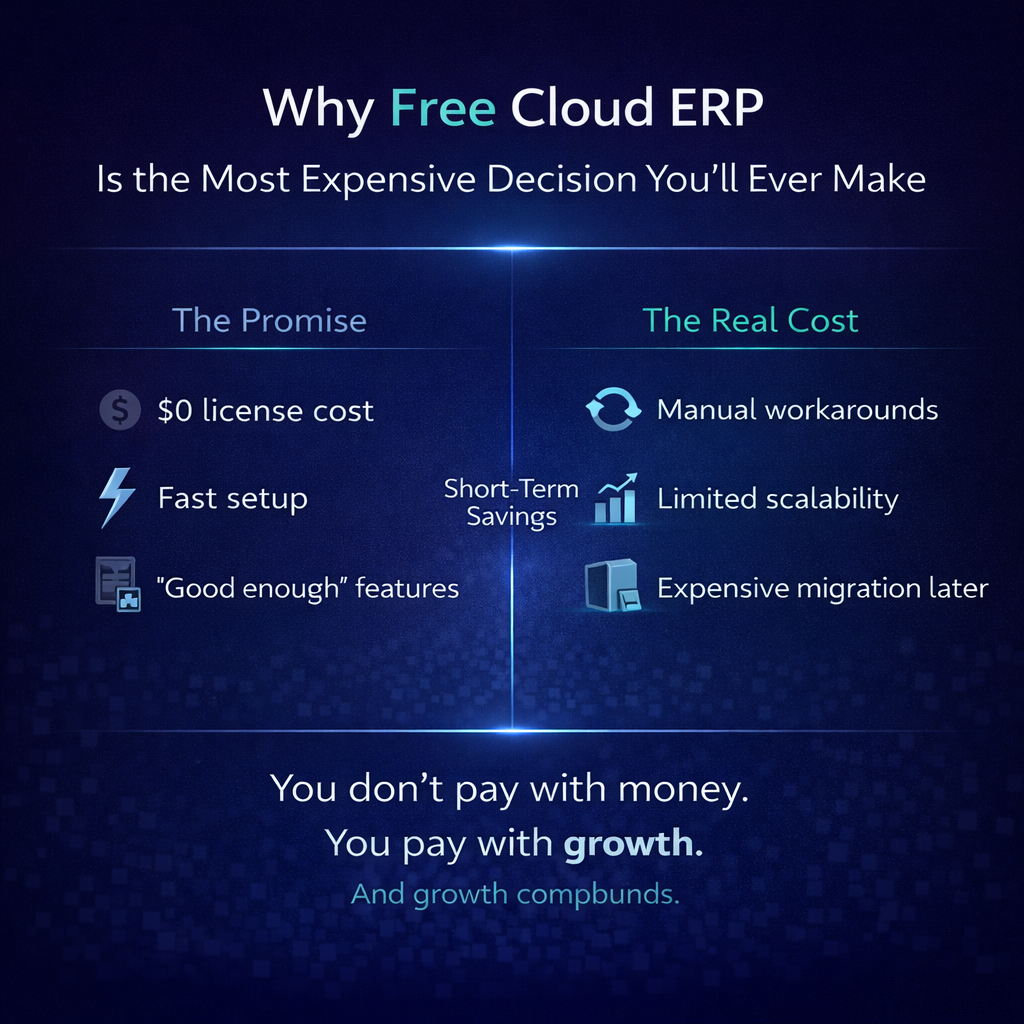
Why Free Cloud ERP Is the Most Expensive Decision You’ll Ever Make
Free is a powerful word. It short-circuits the cost analysis, bypasses the procurement process, and makes the alternative — paying real money for something you could get for nothing — feel irrational. When a distribution company evaluating ERP discovers that platforms exist with no license fee, no subscription cost, and no upfront software investment, the temptation is immediate and understandable. Why would you pay six figures for something you can get for zero?
The answer is that you can’t get it for zero. You never could. Free ERP doesn’t eliminate the cost — it relocates it. The software might not have a price tag, but the implementation does, the customization does, the hosting does, the support does, the integration does, and the labor your team invests in compensating for the platform’s limitations absolutely does. By the time you’ve built something functional enough to run a distribution operation on a “free” platform, you’ve spent more — often dramatically more — than you would have on a commercial platform designed for your business from the start.
This isn’t speculation. It’s the consistent, predictable outcome of a business model that gives away the product and monetizes everything around it. Understanding how that model works — and why it fails distribution companies specifically — protects you from one of the most expensive mistakes in enterprise software.
The Free ERP Business Model: What’s Actually Happening
Free ERP platforms — the most prominent being Odoo’s community edition, ERPNext, and various open-source alternatives — operate on business models that are straightforward once you see them clearly. The software is offered at no cost. The revenue comes from somewhere else.
The Open-Source Model
Open-source ERP platforms publish their source code for anyone to use, modify, and deploy. There’s no license fee because there’s no license — the software is free under an open-source license. The vendor generates revenue through paid enterprise editions with additional features, through hosting services, through implementation consulting, through custom development, and through support subscriptions.
The open-source model works well for certain categories of software — operating systems, databases, development tools — where the user base has deep technical expertise, the implementation effort is manageable, and the gap between the free version and the paid version doesn’t materially affect the core use case.
ERP is not that category.
ERP is the most complex category of business software. It touches every function in the organization. It handles the most sensitive data in the business. It requires deep configuration to match specific operational requirements. And the gap between a generic installation and a system that actually runs a distribution operation is enormous — far larger than any other software category, and far more expensive to bridge.
The Freemium Model
Some platforms offer a free tier with limited functionality — a handful of users, basic modules, restricted transaction volume — and charge for the capabilities that a real business actually needs. The free tier is a marketing tool designed to get you into the ecosystem. The monetization happens when you inevitably need more users, more modules, more transactions, or more support than the free tier provides.
The freemium model is honest in principle — you try before you buy, and you pay when you need more. But in ERP, the gap between what the free tier offers and what a distribution operation requires is so vast that the “free” phase is functionally a demo period. The moment you need multi-location inventory, real-time pricing, warehouse management, EDI, or financial reporting beyond basic bookkeeping, you’re paying. The question is whether the platform you’ve already invested implementation effort into is the one you’d have chosen if you’d been paying from day one.
The Services Model
The most insidious version of free ERP is the platform where the software is genuinely free but the vendor’s business model depends entirely on implementation services, customization, and ongoing consulting. The software is the hook. The services are the revenue.
This model creates a structural misalignment between the vendor’s interests and yours. You want a system that’s easy to implement, straightforward to configure, and simple to maintain. The vendor wants the opposite — because every hour of complexity is an hour of billable services. The software stays free because the software’s limitations generate a permanent revenue stream from the consulting required to work around them.
Where the Real Costs Hide
The total cost of “free” ERP for a distribution company breaks down into categories that aren’t visible in the software’s price tag but are very visible in your operating budget.
Implementation Cost
Free ERP platforms are general-purpose by design. They’re built to serve any business in any industry, which means they’re configured for no business in any industry. Adapting a general-purpose platform to the specific requirements of wholesale distribution — pricing structures, inventory management across locations, warehouse workflows, EDI processing, distribution-specific financial management — requires extensive implementation effort.
That effort comes from one of two sources: a paid consulting firm that specializes in the platform, or your own internal resources. Neither is free.
Consulting firms that implement free ERP platforms typically charge rates comparable to — and sometimes exceeding — those charged by commercial ERP implementation partners. An implementation that takes four months at a consultant’s billing rate can easily cost $100,000 to $250,000. The software was free. The implementation wasn’t.
Internal implementation — your own team configuring and deploying the system — eliminates the consulting fee but replaces it with opportunity cost. Your best operations and IT people are spending months building and configuring an ERP system instead of running and improving your business. That cost is real even though it doesn’t appear on an invoice.
Customization Cost
This is where free ERP costs diverge most dramatically from commercial platforms, and it’s where the open-source model’s apparent advantage becomes its most expensive liability.
Distribution pricing in a free ERP platform typically means basic list pricing with simple discounts. Customer-specific pricing across thousands of accounts, volume-tiered calculations, contract management with date ranges, matrix pricing, cost-plus against real-time landed costs — these capabilities don’t exist in the free version. They have to be built.
Building them means custom development — modifying the source code, creating custom modules, writing bespoke logic that becomes your organization’s responsibility to maintain. In an open-source model, you have the legal right to modify the code. Whether you have the capability, the resources, and the long-term commitment to maintain those modifications is a different question entirely.
Custom development against a free ERP platform is expensive to build, expensive to test, expensive to debug, and ruinously expensive to maintain over time. Every time the base platform updates, your customizations may need to be re-tested, re-validated, and potentially re-written. The customization that cost $30,000 to build initially may cost $15,000 to maintain through each major platform update. Over five years, the maintenance cost can dwarf the original development.
For distribution companies, where pricing complexity, warehouse management depth, and EDI compliance are non-negotiable requirements, the customization bill against a free platform routinely exceeds what a purpose-built commercial platform would have cost — subscription, implementation, and all.
Hosting and Infrastructure Cost
Free ERP platforms that you self-host require infrastructure — cloud servers, database instances, storage, networking, backup systems, monitoring tools, and security layers. You provision it, you configure it, you maintain it, you scale it, and you secure it. None of that is free.
A properly hosted ERP environment for a distribution company — with redundancy, backup, adequate performance, and security that meets basic due diligence standards — typically costs $500 to $2,000+ per month in cloud infrastructure alone, depending on the platform’s resource requirements and your performance expectations. Add the labor cost of someone managing that infrastructure — applying OS patches, monitoring performance, managing backups, troubleshooting issues — and the hosting cost of “free” ERP approaches or exceeds the subscription cost of a commercial SaaS platform that handles all of it for you.
Some free ERP vendors offer managed hosting as a paid service, which eliminates the self-hosting burden but adds a monthly cost that further erodes the “free” proposition. By the time you’re paying for hosting, paying for support, and paying for the enterprise features you need, you’re paying a subscription that competes with commercial platforms — without the benefit of a product designed for your specific industry.
Integration Cost
Distribution companies connect their ERP to e-commerce platforms, EDI networks, shipping carriers, payment processors, banking systems, and other operational tools. Each connection requires integration development.
Commercial ERP platforms designed for distribution typically offer pre-built connectors for common integration scenarios, maintained by the vendor as part of the platform. Free ERP platforms rarely offer distribution-specific connectors. Each integration is a custom development project — built against the platform’s API (if it has one), tested against your specific systems, and maintained by your team or a consultant when either system updates.
The initial development cost of custom integrations adds to the implementation budget. The ongoing maintenance cost — the work required to keep integrations functioning when either the ERP or the connected system changes — is the more dangerous expense because it’s permanent, unpredictable, and grows with every integration you add.
A distribution company with ten active integrations maintained through custom development is carrying a meaningful ongoing maintenance burden. Each integration is a potential failure point. Each requires attention when either system updates. Each represents a cost that a commercial platform with vendor-maintained connectors would have absorbed into the subscription.
Support Cost
Free ERP platforms offer community support — forums, documentation, user-contributed knowledge bases — as the default support model. For straightforward questions about standard functionality, community support can be adequate.
For a distribution company running a production ERP system where downtime means orders don’t ship and customers don’t get served, community support is not adequate. When your system has a critical issue during peak shipping hours, you need a response from someone who understands the platform, understands your configuration, and can diagnose the problem immediately. That response isn’t available in a forum. It’s available through paid support contracts — another cost that turns “free” into “less free.”
Paid support for free ERP platforms typically runs $5,000 to $20,000+ per year depending on the provider and the service level. Higher tiers with faster response times cost more. And even paid support for a free platform may lack the depth of vendor-provided support for a commercial platform — because the support team for a general-purpose free tool doesn’t have the distribution-specific expertise that a purpose-built vendor’s support team carries.
The Hidden Labor Cost
This is the largest cost in most free ERP deployments and the one least likely to appear in any analysis: the ongoing labor your team invests in activities that a commercial platform handles automatically.
Maintaining custom code. Updating integrations. Managing hosting infrastructure. Working around platform limitations that a purpose-built system wouldn’t have. Building reports that a commercial platform includes natively. Manually handling pricing scenarios that a distribution-specific pricing engine would automate. Performing data reconciliation between modules that a unified data architecture would eliminate.
This labor is distributed across your organization — IT, operations, finance, warehouse — and it’s invisible as a line item because it’s embedded in everyone’s job rather than isolated as a distinct cost. But it’s real, it’s ongoing, and it compounds. Every hour your operations manager spends on system maintenance is an hour not spent on operational improvement. Every hour your IT team spends on ERP infrastructure is an hour not spent on strategic technology initiatives.
Why Free ERP Fails Distribution Specifically
The cost arguments above apply to any business running free ERP. For distribution companies specifically, the failures run deeper — because distribution’s operational requirements are precisely the capabilities that free platforms handle most poorly.
Pricing Complexity
Distribution pricing is the single most common point of failure for free ERP in distribution environments. The pricing engines in free platforms are designed for simple commerce — product has a price, maybe a discount, buyer pays. The multi-layered, multi-dimensional pricing reality of wholesale distribution — where the correct price depends on who, how much, when, which contract, what product attributes, and what cost basis — doesn’t fit the architecture.
The result is one of two expensive outcomes: either the company invests heavily in custom pricing development that creates permanent technical debt, or the company maintains pricing in spreadsheets outside the system and manually applies prices to orders — which is exactly the manual process the ERP was supposed to eliminate.
Real-Time Inventory
Free ERP platforms are not typically built on unified data architectures. They’re modular — separate databases or schemas per function, synchronized through batch processes. For distribution companies where real-time inventory visibility across locations is a foundational operational requirement, this architecture produces the same batch-processed, hours-behind inventory data that the company was trying to escape from their previous system.
You can’t fix a data architecture limitation through customization. If the platform is designed with modular data, no amount of custom development gives you the unified real-time data layer that a platform designed with unified architecture delivers natively. You’ve traded one system with delayed inventory visibility for another one that’s free and also has delayed inventory visibility.
Warehouse Management
Free ERP platforms offer basic inventory tracking — what’s in the warehouse, in what quantity. They don’t offer directed warehouse execution — telling associates where to go, what to pick, in what sequence, with real-time confirmation on mobile devices. Building warehouse execution capabilities on top of a free platform is a major development project that, if completed, produces a bespoke WMS that you maintain forever.
Commercial distribution platforms offer warehouse management as a configurable capability — available as a core function or as an advanced module, maintained by the vendor, and integrated into the same data architecture that serves inventory, order management, and finance. The depth is there when you need it. The maintenance burden is the vendor’s, not yours.
EDI Compliance
Native EDI processing — parsing inbound documents, mapping to internal data structures, generating outbound documents in trading partner-specific formats — is a specialized capability that free ERP platforms don’t include. Third-party EDI translation systems can be integrated, but that integration adds a permanent middleware layer with its own cost, its own maintenance, and its own failure potential.
For distribution companies where EDI compliance is a condition of doing business with major accounts, the EDI solution isn’t optional, and its cost isn’t zero regardless of whether the ERP carries a subscription fee. The question is whether you pay for EDI as part of an integrated platform or as a separate system that adds complexity on top of an already-complex technology stack.
Continuous Updates
Multi-tenant commercial SaaS platforms update continuously and automatically — every customer is always current, always receiving improvements, always protected by the latest security patches. Free ERP platforms that you self-host update when you update — which means you’re responsible for evaluating new versions, testing them against your customizations, managing the deployment, and accepting the risk of breaking changes. The update burden that commercial SaaS eliminates is fully your responsibility in a self-hosted free ERP environment.
If you’ve built extensive customizations — which distribution companies on free platforms invariably have — the update process is the same painful version migration that made traditional on-premise ERP so expensive to maintain. You’ve recreated the legacy upgrade problem on a platform that was supposed to be modern.
The Five-Year Total Cost Comparison
The most revealing exercise for any company considering free ERP is a five-year total cost of ownership analysis that includes every cost category — not just the ones the free platform’s marketing highlights.
Commercial cloud ERP (purpose-built for distribution): Subscription (per-active-user, five years), vendor-direct implementation, training, data migration, and integration setup. The subscription includes the platform, hosting, security, updates, and core support. The implementation is a defined cost with a defined timeline.
Free ERP: Software license: $0. Implementation (consulting or internal labor). Customization (pricing engine, warehouse management, EDI, distribution-specific workflows). Hosting infrastructure (cloud servers, backup, monitoring, security). Integration development (each connection custom-built). Integration maintenance (ongoing, per integration, per year). Custom code maintenance (ongoing, growing with each platform update). Paid support contract. Internal labor for platform management, updates, and workaround compensation.
When these costs are totaled honestly over five years, free ERP for a distribution company routinely costs 1.5x to 3x what a purpose-built commercial platform costs — and delivers a system that’s less capable, less reliable, less integrated, and more dependent on internal resources to maintain.
The “free” in free ERP is a pricing strategy, not a cost reality. The software costs nothing. Everything required to make the software functional for your business costs more than a platform that was functional for your business from the start.
When Free ERP Can Make Sense
Intellectual honesty requires acknowledging that free and open-source ERP is the right choice for some organizations.
Companies with strong internal development teams that can build, customize, and maintain the platform without external consulting may find the total cost genuinely competitive — if the ongoing maintenance burden is sustainable alongside the team’s other responsibilities.
Companies with simple operational requirements — single location, basic pricing, limited integration needs, no EDI, straightforward warehouse operations — may find that a free platform covers their needs without extensive customization. These companies are typically sub-$20M in revenue with operational simplicity that matches the platform’s native capabilities.
Companies that need maximum flexibility to build entirely custom workflows — where the business process is so unique that no commercial platform handles it natively — may benefit from the open-source model’s unlimited modifiability. This is rare in distribution, where the core processes are well-established and the value comes from depth of standard implementation rather than uniqueness of custom development.
Companies evaluating ERP for the first time at small scale may find free platforms useful as learning tools — a way to understand what ERP does and what their requirements are before investing in a commercial platform.
For a mid-market distribution company with multi-location operations, complex pricing, warehouse management requirements, EDI obligations, and the transaction volume that comes with $50M+ in revenue — free ERP is almost never the right answer. The requirements exceed the platform’s native capabilities so significantly that the customization, integration, and maintenance costs overwhelm the savings from a $0 license.
How Bizowie Compares
Bizowie costs money. We’re straightforward about that. There’s a per-active-user subscription with user minimums. There’s an implementation investment. There are costs associated with advanced modules like warehouse management and manufacturing.
What those costs buy is a system that works for distribution from day one.
The pricing engine handles your complexity natively — customer-specific, volume-tiered, contract-based, cost-plus, matrix — through configuration, not custom development. The inventory engine provides real-time visibility across all locations on a unified data architecture, not a batch-synced modular framework. Native EDI processes trading partner documents as standard workflow without middleware. Warehouse management is available as an integrated module with the depth distribution operations demand. And the platform updates continuously and automatically — no self-hosted upgrade projects, no customization-compatibility testing, no version management burden.
Implementation is vendor-direct, completed in weeks to months, by the team that built the software. Support comes from people who know distribution and who know our platform at a depth that generalist support for a general-purpose tool can’t match. And the total five-year cost — subscription, implementation, and everything else — is less than the five-year cost of making a free platform functional for distribution. Less cost. More capability. Less risk. Less labor.
The most expensive ERP isn’t the one with the highest subscription. It’s the one that costs nothing for the software and everything for the effort to make the software work. The cheapest ERP is the one where the subscription buys a platform that already does what your business needs — because the most expensive line item in any ERP budget isn’t the software. It’s the labor of compensating for what the software can’t do.
Compare the real cost, not the license fee. Schedule a demo with Bizowie and we’ll walk through exactly what the subscription includes, exactly what implementation involves, and exactly what five years of operation looks like in total cost — because when you compare total cost honestly, the platform that costs money is the one that costs less.
Related Reading
- Cloud ERP FAQ: Answers to the 30 Most Common Questions Buyers Ask
- Cloud ERP Myths vs. Facts: 20 Things the Industry Gets Wrong
- Cloud ERP Customization: What You Can Change, What You Shouldn’t, and Why Configuration Beats Code
- Cloud ERP Pricing: What It Actually Costs, What’s Hidden, and How to Stop Overpaying for Enterprise Software
- Distribution ERP Software: A Buyer’s Guide