
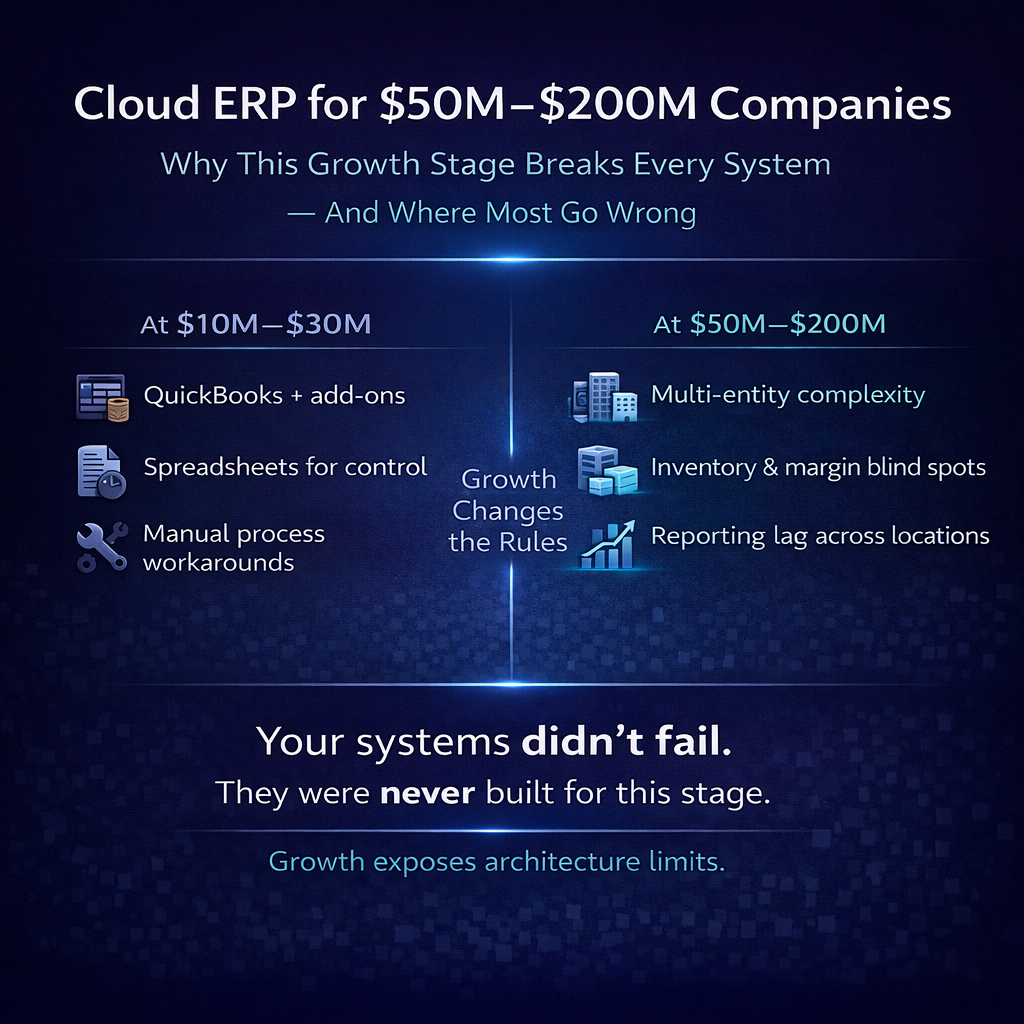
Cloud ERP for $50M–$200M Companies: Why This Growth Stage Breaks Every System That Worked Before
There’s a revenue band in wholesale distribution where everything that used to work stops working. It’s not a crisis. It’s worse — it’s a slow degradation that’s easy to mistake for normal growing pains until the damage is structural.
The band is roughly $50 million to $200 million in annual revenue. Below $50 million, the operational demands are manageable on simpler systems. Above $200 million, the company has typically already invested in enterprise-grade infrastructure. But in between — in the growth stage where the business is too complex for the tools that got it here and too cost-conscious for the platforms designed for companies three times its size — is where systems break, where workarounds multiply, and where the wrong technology decision can cap growth for years.
This is the stage where the QuickBooks-plus-spreadsheets approach that worked at $15 million is a daily liability. Where the entry-level ERP that felt like a step up at $30 million is buckling under volume, pricing complexity, and multi-location demands. And where the enterprise sales teams from SAP and Oracle start circling — offering solutions engineered for companies with $2 billion in revenue and implementation models priced accordingly.
This article is for the operators and executives at distribution companies in this band who know their current system is holding them back but aren’t sure what the right move looks like. The answer isn’t the system you’ve outgrown, and it isn’t the system designed for someone ten times your size. It’s something the market has historically failed to provide — and that’s starting to change.
What Happens Between $50M and $200M
This growth stage isn’t just “bigger.” It’s structurally different from what came before, and the differences create operational demands that expose every limitation in systems designed for smaller or larger companies.
Volume Changes the Physics
A distribution company doing $50 million might process 200 to 500 orders per day. At $150 million, that number could be 1,500 to 3,000. The difference isn’t just volume — it’s the physics of operations at that volume. Processes that tolerated manual intervention at 300 orders per day collapse at 2,000. A pricing exception that took two minutes to resolve manually is no longer a two-minute event when it happens 80 times a day. An allocation decision that a warehouse manager could make intuitively for 50 orders becomes impossible to manage without systematic logic for 500.
The system that “worked” at lower volume worked because your team compensated for its limitations at a scale where compensation was feasible. At this volume, the labor required to compensate exceeds the labor the system was supposed to eliminate. You haven’t outgrown the software’s feature list. You’ve outgrown its architecture’s ability to handle the throughput, the concurrency, and the decision speed your operation now demands.
Pricing Becomes Ungovernable
At $20 million in revenue with 50 customers, pricing is manageable in a spreadsheet. At $100 million with 500 customers, the pricing matrix is a living organism. Customer-specific contracts are layered on top of volume tiers, which interact with promotional programs, which reference cost-plus calculations that shift with every purchase order. A single SKU might have 15 different valid prices depending on who’s buying, how much they’re buying, when they’re buying, and what agreement governs the relationship.
Systems designed for simpler pricing — list price, discount percentage, maybe a customer-specific override for the top 20 accounts — can’t contain this complexity. The overflow goes into spreadsheets maintained by one or two people who become the most operationally critical and least redundant employees in the company. When they’re on vacation, pricing errors spike. When they leave, institutional knowledge walks out the door. The system didn’t scale with the business because the system was never designed for pricing at this level of complexity.
Locations Multiply
The $50M company often operates from one or two locations. The $150M company might have four, six, eight — a primary distribution center, regional warehouses, forward-stocking locations, maybe a facility acquired through a recent deal that runs on a completely different system. Each location adds inventory management complexity, fulfillment routing decisions, transfer logistics, and financial consolidation requirements.
Systems that worked for one warehouse — where inventory visibility was straightforward because there was only one pool to track — struggle with multi-location reality. Available-to-promise calculations that don’t span the network. Fulfillment routing decisions that can’t evaluate options across locations automatically. Transfer management that requires manual tracking. Financial consolidation that’s a month-end project instead of a real-time capability. Every location added to a system that wasn’t built for multi-location multiplies complexity rather than scaling capacity.
The Customer Base Stratifies
At $20 million, you might have a relatively homogeneous customer base with similar expectations and requirements. At $100 million, your customers range from small contractors ordering weekly to national accounts with dedicated pricing, EDI integration requirements, routing guide compliance, packaging specifications, and penalty clauses for non-compliance.
This stratification means the system needs to handle multiple tiers of customer complexity simultaneously. The same order management workflow serves a customer who calls in a 3-line order and a customer whose 200-line EDI purchase order requires ASN generation, GS1 labeling, and carrier routing per their distribution center specifications. If the system can’t handle both ends of that spectrum natively, you’re either over-engineering the simple transactions or under-serving the complex ones.
The Organization Professionalizes
The $20M distribution company is often founder-run with a lean management team where everyone knows everything. At $100M, you have a CFO who needs auditable financial reporting. A VP of Operations who needs performance metrics across locations. A Director of Purchasing who manages a team and needs visibility into vendor performance and replenishment efficiency. A Warehouse Manager at each location who needs directed workflow and productivity tracking. A Sales Director who needs margin analysis by customer, by product line, by region.
Each of these roles needs the system to serve them specifically — not with generic dashboards that require manual assembly, but with role-appropriate views, reports, and workflows that reflect their domain. The system that was adequate when three people ran the entire operation isn’t inadequate because it lacks features. It’s inadequate because it was designed for a flat organization where everyone shared the same view of the business, and the organization has evolved into one where different roles need different lenses on the same data.
Compliance and Regulatory Requirements Escalate
Larger customers impose compliance requirements that smaller customers don’t. EDI isn’t optional when you’re selling to major retailers or national accounts — it’s a condition of the relationship, with financial penalties for errors. Tax complexity increases as you operate across more jurisdictions. If you handle food, pharmaceuticals, chemicals, or other regulated products, traceability requirements become more stringent as volume and trading partner complexity grow. Financial audit requirements become more demanding as revenue increases and the business attracts more scrutiny from lenders, investors, or potential acquirers.
Systems without native EDI, without multi-jurisdiction tax handling, without lot traceability, and without audit-ready financial reporting don’t just create inconvenience at this stage. They create compliance risk with real financial and legal consequences.
Why the Systems at Both Ends of the Market Fail This Segment
The $50M–$200M distribution company sits in a gap that the software market has historically served poorly, squeezed between products designed for companies that are smaller and simpler and products designed for companies that are larger and wealthier.
Why Small-Business Tools Break
QuickBooks, entry-level ERP systems, and industry-specific tools designed for sub-$30M companies share a set of limitations that become acute as the business scales.
Inventory management is flat. Single-location or superficial multi-location support. No real-time available-to-promise across a network. No lot tracking or serial management. No directed warehouse execution. The inventory engine was designed for a company that can see its entire inventory from the shipping dock.
Pricing is basic. List prices and simple discounts. No customer-specific pricing at scale. No volume-tier automation. No contract management. No matrix pricing. The pricing engine was designed for a company where the owner knows every customer’s deal and can override prices from memory.
Financial management is entry-level. Basic general ledger, accounts receivable, accounts payable. No multi-entity support. No real-time cost accounting. No automated inter-company transactions. No landed cost management. The financial engine was designed for a company where the bookkeeper handles everything in one set of books.
Integration is limited or nonexistent. No EDI. No API framework for connecting to e-commerce, carriers, or other systems. No webhook-driven event architecture. The system was designed as a standalone tool for a company whose technology ecosystem consisted of the ERP and a printer.
Scalability hits a wall. The application architecture can’t handle the transaction volume, the concurrent user count, or the data complexity that a $100M operation generates. Performance degrades. Reports take longer. Screens lag. The system that felt responsive at 200 transactions per day feels sluggish at 2,000.
These aren’t criticisms of the products. They’re good tools for the market they serve. But that market isn’t a $100M multi-location distribution company with 500 customers, 20,000 SKUs, EDI compliance requirements, and a warehouse operation that ships 1,500 orders per day. Stretching a small-business tool to serve that operation isn’t scaling up — it’s structural misuse.
Why Enterprise ERP Fails
When the small-business tool breaks, the enterprise vendors arrive with a compelling pitch: you’ve outgrown what you had, and you need a system that can handle your complexity. SAP, Oracle, Microsoft Dynamics — these are the platforms that run the world’s largest companies. Surely they can run yours.
They can. The question is at what cost, in what timeframe, and with what ongoing burden.
Implementation is an odyssey. Enterprise ERP implementations at mid-market companies routinely take 12 to 24 months and cost multiples of the annual subscription. The platforms are designed for Fortune 500 complexity, which means they’re over-engineered for your needs, and the configuration effort to adapt them to a mid-market distribution operation is disproportionate to the outcome. You’re paying to configure away capabilities you’ll never use while simultaneously trying to configure in the distribution-specific depth you actually need.
The consultant tax is permanent. Enterprise platforms are implemented by third-party consulting firms whose business model depends on the complexity of the engagement. The implementation isn’t the end of the consulting relationship — it’s the beginning. Post-go-live configuration changes, reporting modifications, integration adjustments, and the inevitable upgrade projects all require consultant involvement. The consulting firm becomes a permanent fixture in your operating budget.
You’re not a priority customer. A $100M distribution company generating $300,000 in annual subscription revenue is not strategically important to a vendor whose top accounts generate $10M+. Your feature requests don’t influence the roadmap. Your support tickets don’t get escalated. Your industry’s specific needs compete with the needs of manufacturing, retail, healthcare, financial services, and every other sector the platform serves. You’re subsidizing product development for industries that aren’t yours.
The system is built for a different scale of complexity. Enterprise ERP platforms offer depth you’ll never need and lack depth you will. SAP’s manufacturing planning capabilities are world-class, but your distribution-specific pricing and warehouse needs may be treated as secondary. Oracle’s financial management serves multinational conglomerates, but the distribution-specific workflows are generic. The platforms are deep where large enterprises need depth and shallow where mid-market distributors need depth — because mid-market distribution isn’t the customer they designed for.
The total cost is staggering. When you add the subscription, the multi-year implementation, the ongoing consulting fees, the premium support tiers, the add-on modules for functionality you assumed was included, and the internal IT resources required to manage the platform, the five-year total cost of ownership for an enterprise ERP at a mid-market company can exceed $1 million to $3 million — for a platform that’s over-complicated in ways that don’t serve you and under-specialized in ways that matter.
What the $50M–$200M Company Actually Needs
Strip away the vendor marketing and the consultant recommendations, and what a distribution company at this growth stage actually needs is specific and finite.
An ERP platform purpose-built for distribution — not a general-purpose system stretched to fit, not a small-business tool pushed past its limits, but a platform whose data model, workflow engine, pricing logic, warehouse capabilities, and integration framework were designed around the operational reality of companies that buy, warehouse, and ship physical products.
Real-time unified data — a single database where every transaction posts instantly and every function reads from the same source. Not module silos connected by batch processes. Not separate databases per location synced on a schedule. One data layer. Real-time. Everywhere.
Pricing depth that matches distribution reality — customer-specific, volume-tiered, contract-based, cost-plus, matrix, and promotional. All resolved automatically at order entry. All configurable without custom development. All maintaining margin integrity at the transaction level.
Multi-location capability that actually works — real-time inventory across the network, intelligent fulfillment routing, transfer management as a complete workflow, location-specific warehouse configuration with unified visibility, and the ability to add locations through configuration rather than projects.
Warehouse management depth proportional to the operation — core inventory management for simple locations, advanced warehouse execution for high-volume distribution centers, all within the same platform and the same data model. Not a separate WMS bolted on through integration.
Native EDI — processing trading partner documents as a core workflow, not through middleware. Inbound orders flow in. Outbound ASNs and invoices flow out. Compliance is managed within the system.
Financial management integrated at the data level — real-time posting, automated cost accounting, multi-entity support if needed, and reporting that spans the organization without month-end consolidation exercises.
An implementation model that respects the company’s scale — weeks to months, not years. Implemented by the team that built the software. No third-party consulting layer. No artificial complexity. No implementation cost that rivals the subscription.
A continuously updated platform — multi-tenant, automatically upgraded, always current. No version fragmentation. No upgrade projects. No budget line item for “staying current.”
A vendor focused on this segment — where a $100M distribution company is a core customer, not an afterthought. Where the product roadmap is driven by distribution requirements. Where support is provided by people who understand distribution operations at a depth that generic enterprise support desks can’t match.
This isn’t a fantasy wish list. It’s a description of what modern, purpose-built cloud ERP delivers when the vendor is focused on the right market.
The Timing Question: When to Move
The $50M–$200M stage doesn’t last forever. Companies in this band are either growing toward $200M and beyond — in which case the system decision they make now will either enable or constrain that trajectory — or they’re plateauing, in which case the question is whether the plateau is strategic or systemic.
If the plateau is systemic — if the business can’t grow further because the warehouse can’t ship faster, the pricing can’t support new customer tiers, the reporting can’t inform expansion decisions, or the technology can’t absorb new locations and channels — then the ERP isn’t just failing to keep up. It’s the constraint.
And constraints that aren’t addressed become ceilings.
The companies in this band that make the ERP decision proactively — before the constraint becomes a crisis — have better outcomes than those who wait. They evaluate from a position of strength rather than desperation. They implement with adequate time for testing and training. They negotiate from leverage rather than urgency. And they emerge with a platform that supports the next phase of growth rather than one selected under pressure to solve the most immediate fire.
The worst time to select an ERP is when you can’t operate without a new one. The best time is when you can see the limitations clearly enough to know that the current trajectory isn’t sustainable, but you still have the organizational bandwidth to execute a thorough evaluation and a disciplined implementation.
For most distribution companies in this band, that time is right now. The limitations are visible. The workarounds are accumulating. The cost is compounding. The competitors who’ve already moved are pulling ahead. The only question is whether you act while you have the luxury of choice or wait until you don’t.
How Bizowie Serves This Market
Bizowie was built for the $50M–$200M distribution company — not as a secondary market alongside larger or smaller targets, but as the core customer the platform was designed to serve.
The pricing engine handles the full complexity of distribution pricing at this scale without customization and without spreadsheets. The inventory engine provides real-time visibility across multiple locations on a unified data architecture. The order management workflow handles everything from a 3-line phone order to a 200-line EDI transaction with customer-specific compliance. Advanced distribution capabilities are available for warehouses that need directed execution, lot tracking, and pick optimization. Manufacturing capabilities serve distributors that also produce or assemble. Native EDI processes trading partner documents as standard workflow. And the financial engine provides real-time, integrated reporting across entities and locations without month-end consolidation.
Implementation takes weeks to months — not years — led by the team that built the software. No consultants. No intermediaries. No implementation budget that rivals the annual subscription.
The platform is multi-tenant, continuously updated, and always current. No upgrades to plan. No versions to migrate. No consulting fees to stay current.
And Bizowie’s business is focused entirely on making distribution companies in this segment successful. Your needs drive the roadmap. Your industry defines the product. Your success is what our business depends on — not the strategic priorities of Fortune 500 accounts in unrelated industries.
You’re in the growth stage that breaks systems. Make sure the next one doesn’t break. Schedule a demo with Bizowie and bring the complexity that defines your operation at this scale — the pricing, the locations, the volume, the compliance requirements, the warehouse demands. We built the platform for exactly this stage of exactly this kind of business.
Related Reading
- Cloud ERP for Mid-Market Companies: Why You’re Too Big for QuickBooks and Too Smart for SAP
- The Cloud ERP Decision Tree: A Visual Guide to Figuring Out What You Actually Need
- Cloud ERP for Wholesale Distribution: Why Generic Cloud Systems Fall Short
- Does Cloud ERP Work for Complex Businesses? Why Simplicity Doesn’t Mean Simple
- Distribution ERP Software: A Buyer’s Guide