
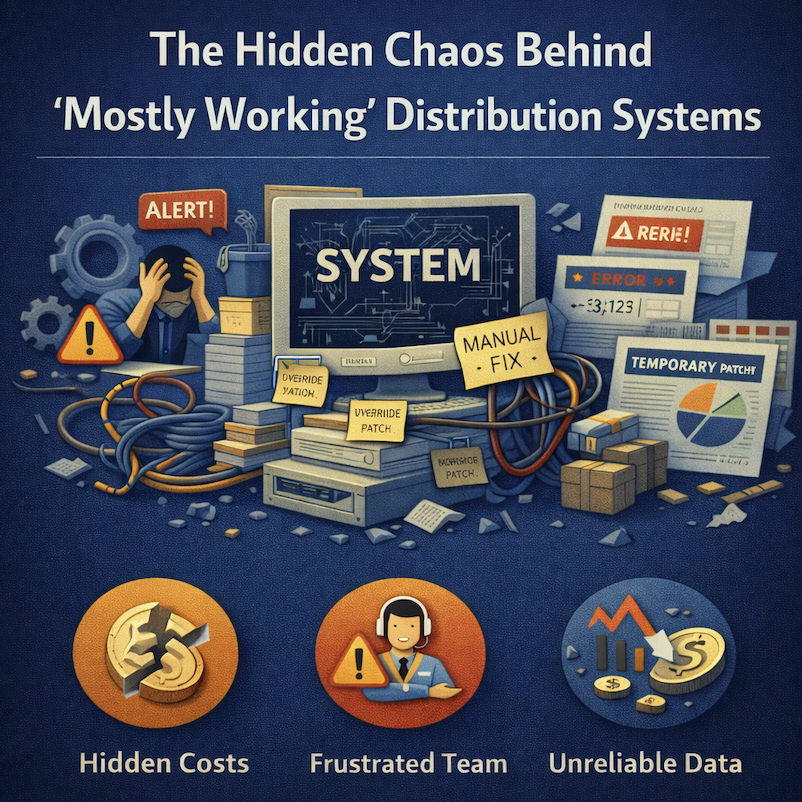
The Hidden Chaos Behind ‘Mostly Working’ Distribution Systems
Executive leadership sees systems that appear functional. Orders get processed. Invoices get sent. Inventory moves through warehouses. Financial reports close monthly. Revenue grows steadily. From the executive perspective, systems are “mostly working.”
Meanwhile, operational staff experience daily chaos that leadership never sees. The warehouse manager keeps a spreadsheet tracking which bin locations the ERP gets wrong. Customer service maintains a separate database of customer preferences the system doesn’t capture. Purchasing uses email and phone calls to manage what should be automated workflows. IT spends half their time keeping fragile integrations from breaking.
This gap between executive perception and operational reality is common in distribution. Systems that appear adequate from 30,000 feet are held together by human effort, institutional knowledge, and elaborate workarounds that remain invisible until the people maintaining them leave.
This article examines the hidden chaos behind “mostly working” distribution systems, why this chaos remains invisible to leadership, and the accumulated costs of operational complexity that appears manageable but prevents growth and innovation.
The Illusion of Functionality
What Leadership Sees
From the executive level, distribution operations appear to function reasonably well:
Orders flow through the system. Daily order volume stays consistent or grows. The warehouse ships products. Customers receive deliveries. Revenue appears on financial reports. The system is clearly doing its job.
Financial reporting closes on schedule. Month-end processes complete, albeit sometimes requiring late nights. Financial statements are available within acceptable timeframes. Auditors don’t raise significant concerns.
Major crises are rare. There aren’t catastrophic system failures, major customer losses due to operational problems, or complete workflow breakdowns. Problems that arise get resolved before escalating to crisis level.
Staff claim everything is fine. When executives ask if systems are adequate, operational managers typically say “yes” or “mostly” with perhaps minor complaints about specific features. No one is demanding immediate replacement.
IT reports systems are stable. Servers stay operational. Backups complete successfully. Security patches are applied. From an IT infrastructure perspective, systems are performing within acceptable parameters.
Based on these indicators, leadership concludes that while systems might not be perfect, they’re adequate for current needs. Investment in replacement or major upgrades doesn’t seem urgent.
What Operations Experiences Daily
The operational reality differs dramatically from executive perception:
Every day requires firefighting. Experienced staff spend hours resolving problems, correcting errors, and managing situations the system should handle automatically. These interventions are so routine that staff don’t think to report them—this is simply “how we work.”
Workarounds are standardized processes. New employees learn elaborate procedures for working around system limitations. “Here’s how you manually update inventory because the system doesn’t sync properly.” “Here’s the spreadsheet where we track actual costs because the ERP doesn’t handle landed costs.”
Information exists in multiple places. Critical operational data lives in spreadsheets, email threads, shared documents, and people’s memories because the ERP doesn’t capture it or makes it too difficult to access. Finding information requires knowing who to ask rather than where to look.
Simple tasks are unnecessarily complex. Checking order status requires navigating six screens. Creating purchase orders involves copying data from supplier emails because integration doesn’t work reliably. Answering customer questions requires switching between multiple systems because data doesn’t connect.
Errors are constant but manageable. Inventory discrepancies, pricing mistakes, shipping errors, and billing problems occur regularly. Staff have become skilled at catching and correcting them before customers notice, but the effort is substantial.
This operational chaos remains hidden because capable staff compensate for system inadequacy, making problems invisible to leadership until those staff members leave and their institutional knowledge disappears.
The Architecture of Workarounds
Spreadsheets That Augment the ERP
In nearly every distribution operation with inadequate ERP systems, critical business processes depend on spreadsheets that staff maintain separately:
The “actual cost” spreadsheet. The purchasing manager maintains an Excel file tracking supplier costs, freight charges, and duty rates because the ERP’s standard costing doesn’t reflect reality. When quoting prices, sales reps check this spreadsheet rather than the ERP because they’ve learned system costs are wrong.
This spreadsheet typically lives on one person’s computer. When that person goes on vacation, no one else can quote accurately. When they leave the company, six months of cost knowledge disappears until someone rebuilds it through painful trial and error.
The “customer preferences” database. Customer service maintains notes about which customers accept substitutions, prefer specific carriers, require special packaging, or have unique delivery requirements. The ERP has a notes field, but it’s free-text and unsearchable, so staff created a structured database elsewhere.
New customer service representatives spend weeks learning that Customer A requires carrier X but Customer B refuses carrier X. This knowledge should be systematized but instead depends on training and memory.
The “inventory location” tracker. The warehouse manager knows the ERP’s bin location data is unreliable—about 30% accurate. Rather than fixing the root cause, they maintain a separate system tracking where high-velocity products actually are. Pickers check both systems, trusting the spreadsheet over the ERP.
This workaround hides the inventory accuracy problem from leadership. Orders ship successfully, so executives assume inventory management works fine. Meanwhile, warehouse productivity suffers because every pick requires checking two sources and making judgment calls about which is correct.
The “freight cost calculator.” Since the ERP doesn’t provide accurate freight quotes, someone built a spreadsheet with carrier rate tables, dimensional weight calculations, and zone-based pricing. Customer service uses this for quoting while the ERP generates invoices with different freight charges, requiring manual corrections.
Email Workflows for What Should Be Automated
Modern distribution should involve minimal email for operational processes, yet many distributors find email has become their primary workflow tool:
Purchase order management via email. Instead of sending POs through EDI or supplier portals, purchasing staff email POs as PDF attachments. Suppliers email acknowledgments. Changes require email exchanges. Order status updates arrive via email and must be manually entered into the ERP.
For a distributor managing 50 active purchase orders across 20 suppliers, this represents dozens of daily emails requiring human processing. An automated system would handle this without human intervention, but “we’ve always done it this way” and changing feels risky.
Customer order entry from emails. Despite having an ERP with order entry capability, many customers send orders via email because using the distributor’s customer portal is inconvenient. Staff manually transcribe email orders into the system—a process taking 5-10 minutes per order and introducing transcription errors.
A distributor receiving 100 daily orders via email spends 8-15 staff hours on data entry that automated integration or usable customer portals would eliminate. Leadership often doesn’t realize this labor cost exists because “processing orders” is expected work.
Internal communication about exceptions. When problems arise—inventory shortages, pricing discrepancies, shipping delays—staff communicate via email rather than the ERP tracking them. This creates information silos where knowledge about problems exists in email threads rather than being systematically visible.
A customer service representative might email the warehouse about a shortage, who emails purchasing about expediting a PO, who emails the supplier requesting status. The email chain contains the entire history, but the ERP shows none of this context. When customers call asking about order status, staff must search email rather than checking the system.
Shadow Systems Run by Departments
When ERP systems don’t meet departmental needs, departments often implement their own solutions:
Warehouse management system workarounds. The ERP has warehouse management features, but they’re clunky or unreliable. The warehouse manager implements barcode scanners connected to a separate database. At end of day, someone manually syncs the data to the ERP.
This dual-system approach creates timing problems and synchronization errors. The ERP thinks inventory is in location A while the warehouse system shows location B. Allocations happen based on stale data. The workaround “works” in the sense that products eventually ship, but creates inefficiency and error risk that proper integration would eliminate.
Sales uses CRM separate from ERP. Salespeople maintain customer relationships and track opportunities in Salesforce or HubSpot because the ERP’s customer management is inadequate. When opportunities convert to orders, data must transfer manually between systems.
Customer information exists in two places with no reliable synchronization. Sales sees customer history that accounting doesn’t. Accounting has financial data sales doesn’t. Neither system provides complete customer visibility, forcing staff to check both for comprehensive information.
Finance runs reporting outside the ERP. The accounting team exports data from the ERP into Excel or specialized reporting tools to create dashboards and financial analyses. The ERP’s native reporting is too limited, inflexible, or slow to meet management needs.
This means the “books” exist in the ERP, but actual business intelligence comes from manual extracts and external analysis. When executives ask questions, finance can’t query the system directly—they must run extract jobs, manipulate data, and build analyses from scratch each time.
The “Key Person” Dependency
Perhaps the most dangerous workaround is relying on specific individuals who understand system quirks and maintain institutional knowledge:
“Ask Sarah” syndrome. Sarah in customer service has worked at the company for 12 years and knows every system workaround, every customer preference, and every product compatibility issue. When problems arise, the solution is invariably “ask Sarah.”
Sarah is invaluable and probably underpaid relative to her organizational importance. She’s also a massive risk. When she’s on vacation, operations slow dramatically. When she eventually retires or leaves, months of productivity disappear as the organization scrambles to document and replace knowledge that existed only in her head.
The IT person who “knows how everything connects.” Mike in IT understands how the ERP integrates with warehouse scanners, how shipping data flows, where the batch processes run, and which Excel macros update which databases. He’s built and maintained the fragile infrastructure over years.
Mike is irreplaceable in the sense that documenting everything he knows would take months, and finding someone capable of maintaining his cobbled-together integrations is nearly impossible. The organization doesn’t realize how dependent they are until Mike announces he’s leaving and they discover that “simple” processes like inventory updates or nightly reporting involve dozens of scripts and workarounds he created.
The warehouse supervisor who knows where things “really” are. The ERP says Product X is in Bin 243, but Tom knows it’s actually in Bin 189 because of the warehouse reorganization that never got updated in the system. Tom can locate any product instantly despite incorrect system data because he maintains mental maps of actual locations.
Tom’s expertise masks deep inventory accuracy problems. Leadership sees high fill rates and assumes warehouse management is effective. In reality, fill rates depend on Tom’s memory, and productivity suffers because other staff can’t efficiently locate products.
Why Chaos Remains Hidden
The Normalization of Dysfunction
When workarounds become standardized, they stop seeming like workarounds—they become “how we do things”:
New employees learn broken processes as standard. Training includes elaborate instructions for working around system limitations. “When the ERP shows zero inventory but you know we have stock, check this spreadsheet.” “If the freight calculator gives an error, use this formula instead.”
Because new employees never experienced better systems, they assume complexity is normal. They don’t question why simple tasks require so many steps—this is simply what distribution work involves.
Experienced staff stop reporting problems. After suggesting improvements that weren’t prioritized, experiencing failed upgrade attempts, or hearing “we can’t afford to replace the system,” staff stop mentioning limitations. Problems that initially frustrated them become accepted reality.
When executives ask “are there any system issues we should address?”, staff respond “nothing major” because they’ve learned that reporting problems doesn’t lead to solutions. Better to keep working around limitations than waste time documenting issues that won’t be fixed.
Success metrics hide operational inefficiency. Leadership measures orders processed, revenue generated, and gross margin—all of which can look healthy even when operations are chaotic. The metrics don’t capture hours wasted on workarounds, errors caught before customer impact, or opportunities missed due to system limitations.
A distribution business might process 500 orders daily with acceptable gross margins while spending 40% more labor than necessary due to operational inefficiency. Because the inefficiency is distributed across many staff and processes, it doesn’t appear as a discrete problem requiring attention.
The Boiling Frog Phenomenon
System inadequacy typically develops gradually. The ERP that worked fine for $10 million in revenue becomes strained at $25 million, then actively problematic at $50 million. But because decline is gradual, it’s difficult to identify the moment when “mostly working” became “seriously inadequate.”
Workarounds accumulate incrementally. First, purchasing creates a spreadsheet to track one supplier’s costs. Then they add another supplier. Then freight charges. Then currency rates. Over three years, a simple spreadsheet becomes a complex database that’s critical to daily operations but was never formally designed, documented, or maintained.
No single moment triggers alarm because each incremental addition seems reasonable. Only stepping back reveals that the organization has recreated significant ERP functionality in Excel because the actual ERP doesn’t work.
Staff additions compensate for system limitations. As order volume grows, the company hires more customer service representatives, more warehouse staff, and more administrative support. Leadership attributes this to business growth, not recognizing that better systems could handle higher volume with the same headcount.
A distributor that grew from 400 to 800 daily orders might have doubled customer service staff from 4 to 8. With modern ERP, they might have grown to 800 orders with 5-6 staff instead. The difference—$120,000-$180,000 annually—is invisible because it never appears as a discrete cost.
Technology initiatives fail, reinforcing status quo. The organization attempts an upgrade or module addition. The project runs over budget, behind schedule, and delivers disappointing results. Leadership concludes that “our ERP is fine, we just need to use it better” rather than recognizing that the platform is fundamentally inadequate.
Failed projects create organizational scar tissue that makes future change more difficult. “We tried integrating the warehouse scanners and it was a disaster” becomes reason to avoid future automation attempts, even when the problem was platform limitations rather than automation generally.
The Communication Gap Between Operations and Leadership
Operational staff and executives often lack a shared language for discussing system adequacy:
Operations communicates in specific complaints. “The inventory sync fails twice weekly.” “Creating purchase orders requires 14 clicks when it should be 4.” “The freight calculator doesn’t handle dimensional weight.”
These specific issues sound minor individually. Leadership hears isolated complaints about feature limitations rather than a coherent message that the entire platform is inadequate.
Leadership evaluates in strategic terms. “Does the system support our growth plan?” “Can we handle 50% more volume?” “What’s our competitive position?”
Operations often can’t translate their daily frustrations into strategic impact. They know the system is painful to use but struggle to articulate that pain prevents the business from growing profitably, serving customers effectively, or competing with more efficient distributors.
The TCO calculation remains incomplete. When evaluating whether to replace systems, leadership calculates visible costs: software licensing, implementation services, staff time during conversion.
What’s missing is the opportunity cost of current systems: labor hours wasted on workarounds, errors requiring correction, customers lost to slower service, strategic initiatives delayed, and staff turnover driven by frustration. These costs are real but diffuse, making them difficult to quantify and include in replacement decisions.
The “Good Enough” Trap
Perhaps the most insidious reason chaos remains hidden is that leaders don’t believe perfect systems exist:
“Every system has limitations.” This is true, but it masks the difference between minor limitations and fundamental inadequacy. Yes, every ERP requires some workarounds, but there’s a vast difference between occasional exceptions and daily firefighting.
“We have unique requirements.” Distributors often believe their processes are so specialized that no standard ERP could meet their needs without extensive customization. This belief justifies accepting inadequate systems because “custom development would be worse.”
In reality, modern distribution-specific ERP platforms handle the complexity that seems unique—multi-warehouse operations, landed cost calculations, customer-specific pricing, and exception management are standard features, not customizations.
“Change is too risky.” The fear of disruption during system replacement keeps organizations trapped in inadequate systems. “Yes, our current ERP is painful, but at least we know how it works. A new system might be worse.”
This risk aversion is understandable but often overestimates change risk while underestimating the ongoing cost of inadequate systems. A 4-month implementation disruption might be less costly than years of operational inefficiency.
The Accumulated Costs of Hidden Chaos
Labor Cost Premium
The most direct cost of “mostly working” systems is excess labor required to maintain operations:
Quantifying the workaround tax. A mid-market distributor with 60 employees might have 15-20 people spending 30-40% of their time on workarounds: manual data entry, system reconciliation, error correction, searching for information across multiple systems, and maintaining shadow databases.
If 18 employees spend 35% of their time on workarounds at a fully loaded cost of $65,000 each, that’s $410,000 annually in labor that modern systems would eliminate. This cost is invisible in the P&L because it doesn’t appear as “workaround expense”—it’s buried in normal operational costs.
The opportunity cost of staff time. Beyond direct labor waste, inadequate systems prevent staff from doing higher-value work:
Customer service representatives who spend 60% of their time processing orders and correcting errors can’t proactively engage customers, identify upsell opportunities, or provide consultative service. The distributor operates transactionally when they could build strategic relationships.
Warehouse staff who spend extra time locating products due to inaccurate bin locations can’t focus on process improvements, cycle counting, or layout optimization. Operational efficiency stagnates because daily firefighting consumes capacity for improvement.
Purchasing staff who manually manage supplier communications and PO changes can’t analyze vendor performance, negotiate better terms, or develop strategic sourcing relationships. The role becomes administrative when it should be strategic.
Error Costs That Compound
Manual processes and disconnected systems create errors that cost far more than the labor to correct them:
Picking and shipping errors. Industry research suggests that picking errors cost distributors $50-$100 per incident when including labor to identify the error, corrective shipping, customer service time, and customer goodwill damage.
A distributor with 1.5% picking error rate processing 500 orders daily incurs 7.5 errors daily or 1,950 annually. At $75 per error, that’s $146,000 in annual error costs. Modern warehouse management integrated with ERP can reduce error rates to 0.3-0.5%, saving $100,000+ annually.
Inventory accuracy problems. When ERP inventory data is unreliable, distributors carry excess safety stock to buffer against uncertainty. If a distributor could reduce inventory by 15% with confidence in system accuracy—dropping from $8 million to $6.8 million—the carrying cost savings at 20% cost of capital is $240,000 annually.
Beyond carrying costs, inaccurate inventory creates stockouts, emergency purchases at premium pricing, expedited freight charges, and lost sales. The total cost of poor inventory accuracy often exceeds $500,000 annually for mid-market distributors.
Pricing and invoicing errors. When pricing information exists in multiple systems—ERP, spreadsheets, quotes in email—errors are inevitable. Invoicing at wrong prices means either leaving money on the table or billing too much and requiring credits and customer appeasement.
A distributor averaging $85,000 in annual pricing corrections and customer credits due to system confusion is experiencing visible error costs. The hidden costs—customer dissatisfaction, sales time resolving disputes, accounting time processing corrections—double the visible expense.
Customer Experience Degradation
Inadequate systems create customer-facing problems that erode competitiveness:
Slow response times. When answering customer questions requires checking multiple systems, searching email threads, or waiting for key employees to return calls, response times lengthen. Customers who get answers in minutes from competitors wait hours from you.
Modern B2B buyers expect B2C responsiveness. Distribution businesses still operating on “we’ll check and call you back” timelines lose customers to competitors providing instant answers through integrated systems and customer portals.
Inconsistent information. When different employees access different information sources, customers receive inconsistent answers. One representative says the product will ship tomorrow based on ERP data. Another says next week based on an email from the warehouse. The customer loses confidence in the distributor’s reliability.
Limited self-service options. Customers increasingly prefer self-service for routine tasks—checking order status, reviewing invoices, reordering products, tracking shipments. This requires integrated systems with clean data and secure customer access.
Distributors with chaotic internal systems can’t offer effective customer portals. Even if they implement portal software, the data feeding it is unreliable, making the portal more frustrating than helpful. Customers who want self-service go elsewhere.
Innovation Paralysis
Perhaps the highest cost of “mostly working” systems is their prevention of strategic initiatives:
E-commerce adoption delayed or abandoned. Launching online sales requires real-time inventory visibility, integrated pricing, automated order processing, and reliable fulfillment. When current systems can’t support these requirements, e-commerce projects stall.
Distributors watching competitors capture 20-30% of sales through e-commerce while they remain stuck in phone and email ordering are experiencing massive opportunity costs. For a $40 million distributor, the difference might be $8 million in foregone revenue growth.
Geographic expansion constrained. Opening new warehouses, acquiring competitors, or entering new markets requires systems that can scale, integrate multiple locations, and provide consolidated visibility. Chaotic systems that barely work at current scale can’t support expansion.
The inability to pursue strategic growth due to system limitations might be the single highest cost of inadequate ERP. Companies remain trapped at current size not because of capital constraints, market limitations, or competitive pressure but because their operational infrastructure can’t scale.
Warehouse automation impossibility. Automated storage and retrieval, automated picking systems, and robotics require reliable, integrated systems with accurate data. When inventory locations are wrong 30% of the time and processes depend on human judgment, automation becomes impossible.
Competitors investing in automation achieve 40-50% productivity improvements and higher accuracy. Distributors stuck with manual processes watch their competitive position erode while labor costs increase.
What Modern Distribution ERP Provides Instead
Unified Data Architecture
Modern cloud-native ERP platforms eliminate shadow systems by providing comprehensive functionality in a unified architecture:
Single source of truth for all data. Customer information, inventory, orders, suppliers, and financial data exist in one database accessible by all users and systems. No spreadsheets tracking “actual” costs or customer preferences. No shadow databases because the ERP is inadequate.
Real-time integration across functions. When warehouse receives inventory, purchasing sees it immediately. When sales creates a quote, it reflects current costs and inventory. When customer service makes a promise, it’s based on actual capability, not guesses requiring confirmation.
Comprehensive audit trail. Every transaction, change, and decision is logged with who, what, when, and why. Staff don’t need to search email threads to understand what happened—the system maintains complete history.
This unified architecture eliminates the chaos of information living in multiple places and requiring human translation and reconciliation.
Intelligent Automation
Modern platforms automate workflows that currently require constant human intervention:
Exception handling without human input. Common exceptions—backorders, substitutions, split shipments, pricing approvals—follow automated rules rather than requiring staff judgment for every instance.
Integration that stays connected. Pre-built integrations with shipping carriers, e-commerce platforms, EDI networks, and warehouse automation are maintained by the vendor, not cobbled together by internal IT and breaking constantly.
Automated reporting and analytics. Dashboards update in real-time without manual data extraction. Reports generate automatically on schedules. Business intelligence is accessible to anyone who needs it, not just those who know how to query databases or build Excel pivots.
Automation eliminates workarounds not by forcing them to work better but by making them unnecessary.
Intuitive User Experience
Modern ERP platforms are designed for actual users, not IT specialists:
Task-oriented interfaces. Rather than navigating complex menu structures, users access tasks directly. “Process return” or “check order status” are single-click actions, not multi-screen journeys requiring expert knowledge.
Contextual information. When viewing a customer order, all relevant information—history, credit status, inventory availability, shipment tracking—appears in context rather than requiring switching between screens and systems.
Mobile accessibility. Warehouse staff use mobile devices with barcode scanning integrated directly into the ERP. Sales reps access customer information and create quotes from phones or tablets. No separate systems requiring synchronization.
Intuitive design means new employees become productive in days rather than months, and experienced staff work faster without cognitive overhead from poor interfaces.
Built-In Distribution Expertise
Purpose-built distribution ERP platforms include functionality that general-purpose systems require customization to provide:
Landed cost calculation. Freight, duties, currency fluctuations, and fees automatically allocate to products. No spreadsheets tracking “actual” costs—the system calculates them correctly.
Multi-warehouse allocation. Intelligent order routing considers customer location, warehouse capacity, inventory age, and freight costs without requiring manual decisions for each order.
Customer-specific pricing and terms. Volume pricing, contract pricing, customer-specific shipping terms, and payment terms all live in the system rather than being manually applied from memory or external documentation.
Lot traceability and expiration management. For distributors handling food, pharmaceuticals, or other regulated products, complete lot tracking and expiration management are standard features, not customizations.
This built-in sophistication means distributors don’t need to choose between inadequate functionality and expensive custom development.
Moving from Chaos to Clarity
Recognizing the True Cost
The first step toward addressing hidden chaos is making it visible:
Audit the workaround tax. Document the spreadsheets, shadow systems, email workflows, and manual processes that exist because the ERP is inadequate. Estimate time consumed and multiply by labor costs to quantify the annual expense.
Calculate error costs. Track picking errors, inventory discrepancies, pricing mistakes, and invoicing corrections. Include not just correction labor but customer impact, expedited freight, and opportunity costs.
Assess strategic limitations. Identify initiatives delayed or abandoned due to system inadequacy—e-commerce, geographic expansion, automation, new product lines. Estimate the revenue and profit impact of these foregone opportunities.
Measure customer experience. Survey customers about response times, information accuracy, and self-service options. Compare against competitor capabilities to understand the service gap inadequate systems create.
This assessment typically reveals that “mostly working” systems cost $500,000-$2 million annually for mid-market distributors through a combination of labor waste, errors, and lost opportunities.
Evaluating Modern Alternatives
Once costs are visible, evaluation should focus on operational impact rather than feature checklists:
Insist on seeing realistic demonstrations. Demand demos using production-scale data—your SKU count, transaction volume, and warehouse complexity—not sanitized scenarios that hide performance problems.
Talk to customers at similar scale. Vendor references from distributors your size, in your industry, with similar operational complexity provide more insight than generic testimonials.
Understand implementation realities. Ask about implementation timelines for companies like yours. Inquire about typical challenges and how they’re addressed. Understand what configuration is required versus what works out-of-box.
Calculate total cost of ownership. Include not just software licensing and implementation but ongoing costs and, critically, the savings from eliminating current workarounds and inefficiencies.
A platform that costs $200,000 in first-year expenses but eliminates $500,000 in annual operational waste has an immediate payback and delivers $300,000+ annual benefit thereafter.
Planning the Transition
Moving from chaotic systems to modern platforms requires acknowledging disruption while minimizing it:
Involve operational staff. The people who maintain current workarounds understand what functionality is critical and what can change. Their participation ensures the new system meets actual needs rather than assumed requirements.
Implement in phases if necessary. Starting with core functions—order management, inventory, financials—and adding modules sequentially can reduce implementation complexity and allow staff to adapt gradually.
Plan for the workaround elimination. Part of implementation should explicitly identify which spreadsheets, shadow systems, and manual processes will be retired. Create specific plans for migrating their functionality into the new ERP.
Over-communicate during transition. Staff who’ve spent years compensating for system inadequacy may be skeptical that new systems will actually work. Demonstrating quick wins and maintaining transparency about challenges builds confidence.
The Competitive Imperative
Distribution markets are increasingly stratified between companies with operational excellence enabled by modern systems and those trapped in workaround-dependent chaos:
Efficient distributors gain market share. They respond faster, price more accurately, ship more reliably, and offer better self-service options. Customers consolidate spending with distributors who make ordering easy and reliable.
Inefficient distributors lose margin and customers. Labor costs rise faster than revenue. Errors erode customer confidence. Strategic initiatives stall. Eventually, these distributors either get acquired by efficient competitors or slowly decline.
The gap isn’t primarily about market positioning, product selection, or even pricing—it’s about operational capability enabled by modern systems versus constrained by legacy platforms.
Distributors still operating on “mostly working” systems held together by human effort and elaborate workarounds are competing at a fundamental disadvantage. The chaos that seems manageable internally is visible to customers as slower response times, inconsistent service, and inability to provide modern conveniences competitors offer easily.
Moving Forward
Systems that appear “mostly working” from executive perspective often conceal operational chaos that constrains growth, increases costs, and erodes competitiveness. Workarounds that seem reasonable individually accumulate into structural limitations that prevent strategic initiatives and drive talented staff to competitors with better tools.
Legacy ERP platforms create this chaos through fragmented data architecture, lack of automation, poor user interfaces, and insufficient distribution-specific functionality. Organizations compensate through spreadsheets, shadow systems, email workflows, and reliance on key individuals—all of which mask the problem while compounding costs.
Modern cloud-native distribution ERP platforms eliminate hidden chaos through unified data architecture, intelligent automation, intuitive interfaces, and built-in distribution expertise. The operational transformation isn’t about adding features—it’s about removing friction, eliminating workarounds, and enabling staff to work productively rather than fighting inadequate tools.
For distributors, recognizing that “mostly working” actually means “expensive and fragile” is the first step toward operational excellence that drives competitive advantage rather than constrains it.
Schedule a demo to see how modern distribution ERP eliminates the hidden chaos that legacy systems create and delivers the operational clarity growth requires.
Related Reading
- Operational Debt: How Legacy ERP Quietly Erodes Speed, Accuracy, and Morale
- 3 Signs Your ERP Is Slowing You Down (And Costing You More Than You Think)
- When to Replace Your ERP: A Guide for Distributors
- The Cost of Firefighting: Why Nothing Improves When Everything Is Urgent
- Distribution ERP Software: A Buyer’s Guide