
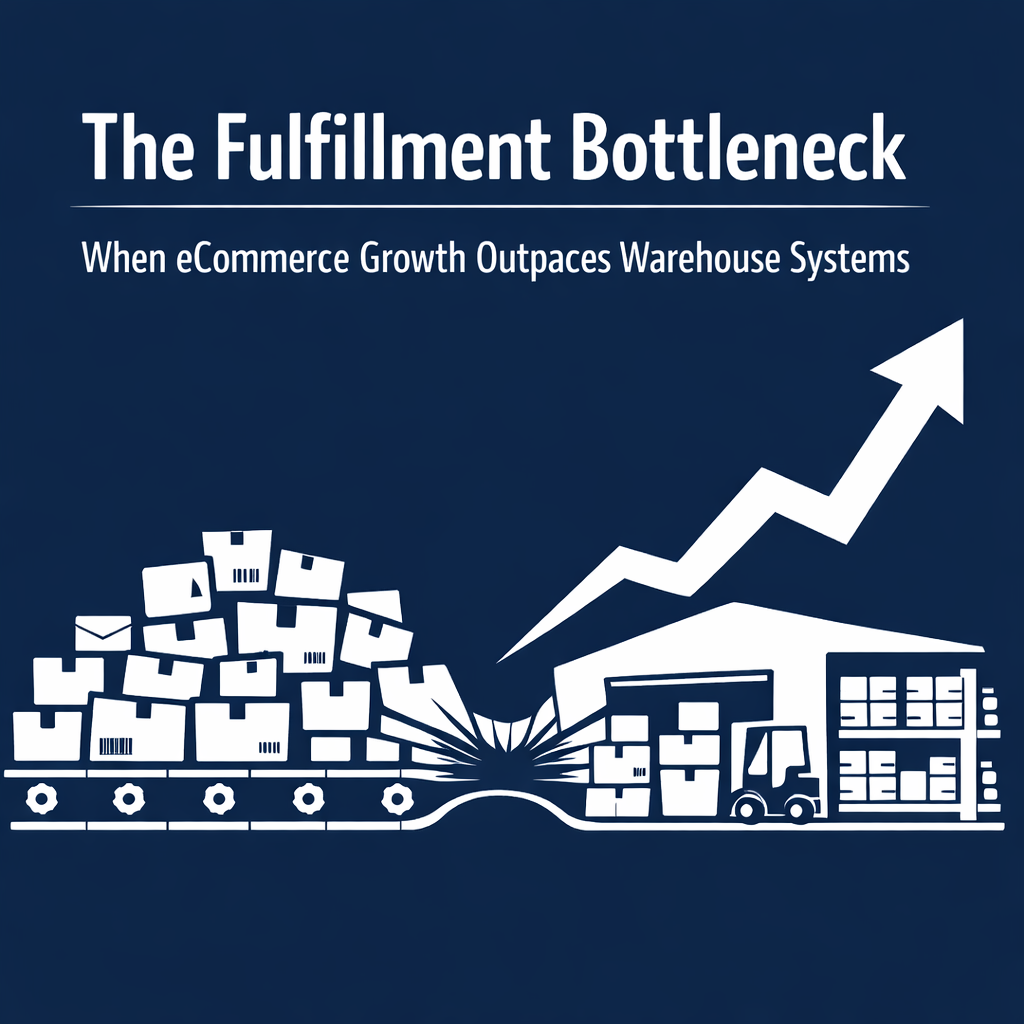
The Fulfillment Bottleneck: When eCommerce Growth Outpaces Warehouse Systems
Every eCommerce business dreams of the moment when orders start flooding in faster than expected. It’s validation that your product resonates, your marketing connects, and your brand momentum is building. But for many growing retailers, this exciting milestone quickly becomes an operational nightmare when warehouse systems can’t keep pace with order volume.
The fulfillment bottleneck doesn’t announce itself with a dramatic failure. Instead, it reveals itself through a pattern of small problems that compound into major operational challenges: picking errors that triple during peak periods, shipping delays that extend from 24 hours to 72 hours, inventory discrepancies that make your available-to-promise numbers unreliable, and labor costs that scale faster than revenue.
This breaking point typically occurs when daily order volume crosses 200-500 units—far earlier than most retailers anticipate. At this threshold, manual warehouse processes and disconnected software systems transform from “good enough” solutions into fundamental constraints on growth. Understanding why this happens, and how modern warehouse management capabilities solve these challenges, can mean the difference between capitalizing on growth momentum and losing customers to fulfillment failures.
The Anatomy of a Fulfillment Bottleneck
The fulfillment bottleneck emerges from a fundamental mismatch between order complexity and system capability. Early-stage eCommerce operations often begin with straightforward workflows: orders arrive, warehouse staff pick products from shelves, pack them into boxes, print shipping labels, and send them out. This linear process works remarkably well at lower volumes because human adaptability can compensate for lack of automation.
But as order volume increases, three distinct failure modes emerge simultaneously. First, the cognitive load on warehouse staff overwhelms their ability to make accurate decisions quickly. Second, the lack of systematic routing and prioritization creates inefficient movement patterns across the warehouse floor. Third, disconnected systems require manual data entry and reconciliation that consumes exponential time as volume scales.
Consider the experience of a typical growing eCommerce retailer processing 300 orders daily without integrated warehouse management. Each order requires a picker to read through multiple line items, locate products across potentially hundreds of bin locations, verify quantities, consolidate items for packing, and update inventory records. Without directed picking paths, staff might traverse the warehouse five to seven times for orders that could be consolidated into single efficient routes. Without automated inventory deduction, discrepancies between what the system shows and what’s physically available grow by 2-3% weekly.
These operational inefficiencies compound during the most critical business moments. A flash sale that generates 1,000 orders in 48 hours—normally a cause for celebration—becomes an operational crisis when your fulfillment capacity maxes out at 400 orders daily. The backlog creates cascading problems: customer service inquiries spike as shipping notifications don’t arrive on time, picking errors increase as staff rush to catch up, and inventory availability becomes unpredictable as the lag between physical picks and system updates widens.
The true cost of the fulfillment bottleneck extends beyond immediate operational chaos. Shipping delays directly impact customer retention, with studies showing that 84% of shoppers won’t return after a poor delivery experience. Picking errors require expensive returns processing and replacement shipments. Inventory inaccuracy leads to overselling, which damages brand reputation and requires customer service interventions. Most significantly, labor costs scale disproportionately to volume, as you need progressively more staff to handle the same incremental order growth.
When Manual Warehouse Processes Break Down
The transition from manageable to chaotic warehouse operations rarely happens overnight. Instead, retailers experience a gradual erosion of operational efficiency that accelerates as volume grows. Understanding the specific failure points helps identify when you’ve outgrown manual processes.
The Picking Accuracy Crisis
In low-volume operations, experienced warehouse staff develop intimate familiarity with product locations and can pick orders with 98-99% accuracy. This performance creates false confidence that manual processes scale effectively. However, accuracy degrades predictably as variables multiply: more SKUs to remember, higher pick volumes that increase fatigue, new temporary staff who lack location knowledge, and seasonal products that occupy different warehouse positions.
By the time daily orders reach 300 units with 50+ active SKUs, picking accuracy without directed systems typically drops to 92-95%. This might seem like a minor degradation, but the operational impact is dramatic. At 5% error rates across 300 daily orders with an average of 2.5 items per order, you’re processing 37-38 picking corrections daily. Each correction requires identifying the error, locating the right product, potentially recalling shipped orders, processing returns, and managing customer communications. This correction workload alone can consume 6-8 staff hours daily.
The error patterns reveal system inadequacy. Multi-item orders experience disproportionately higher error rates because staff must remember multiple product locations and quantities simultaneously. Similar-looking products get confused when warehouse bins place them near each other without systematic separation. Fast-moving items in high-traffic areas face more picking errors as staff rush through congested aisles. These patterns indicate that human memory and attention—no matter how skilled the staff—cannot reliably scale beyond certain complexity thresholds.
Inventory Visibility Collapses
Manual inventory management works through periodic cycle counts and adjustment entries that reconcile physical stock with system records. This approach maintains reasonable accuracy when order volume is low and product movement is predictable. However, as transaction velocity increases, the lag between physical changes and system updates creates an expanding accuracy gap.
The mechanics of this collapse are straightforward but devastating. In a typical manual process, warehouse staff pick products and either update inventory immediately in a separate system or batch updates at shift end. Immediate updates disrupt picking productivity, while batch updates create hours-long gaps where the system shows inventory that’s already been picked. During high-volume periods, this lag means your eCommerce platform might display products as available for 6-8 hours after physical stock is exhausted.
The downstream consequences ripple through your entire operation. Your eCommerce site continues accepting orders for out-of-stock items, creating overselling situations that require customer service intervention. Your purchasing team makes reorder decisions based on inaccurate stock levels, either over-ordering products that haven’t actually sold or failing to reorder fast-movers that need replenishment. Your financial reporting shows inventory values that don’t match physical reality, complicating cash flow management and profitability analysis.
This inventory inaccuracy accelerates during the most critical business periods. Holiday peaks, promotional campaigns, and new product launches all create order volume spikes that widen the gap between system records and physical availability. The very moments when accurate inventory visibility matters most are precisely when manual processes fail most dramatically.
The Labor Efficiency Trap
One of the most insidious aspects of the fulfillment bottleneck is that labor costs scale faster than revenue. This happens because manual warehouse processes contain hidden inefficiencies that become more pronounced at higher volumes.
Unoptimized picking routes create massive productivity waste. Without systematic zone assignment and wave picking, warehouse staff make redundant trips across the facility. An order requiring items from receiving, mid-warehouse shelving, and finished goods storage might require a picker to traverse 500-800 feet rather than the 200-300 feet that optimized routing would achieve. Multiply this across 300 daily orders, and you’re adding 4-6 miles of unnecessary walking to your warehouse operations.
Search time compounds inefficiency. When products lack fixed bin locations or when warehouse organization follows ad-hoc patterns, staff spend significant time locating items. Industry data shows that unoptimized warehouses spend 30-35% of picking time searching for products rather than physically retrieving them. This means that for every 8-hour shift, nearly 3 hours are lost to search rather than productive picking.
Task switching further degrades productivity. Manual operations typically require warehouse staff to alternate between picking, packing, inventory updates, and exception handling without systematic prioritization. This constant context switching reduces efficiency by 20-30% compared to optimized workflow that batches similar tasks and maintains focus.
The labor trap becomes apparent when you calculate fully-loaded fulfillment costs. A warehouse processing 300 orders daily with an average 2.5 items per order (750 line items) might require 4-5 full-time staff in a manual operation. With fully-loaded labor costs of $22-25 per hour, that’s $176,000-200,000 in annual labor just for picking and packing. An optimized warehouse management system can reduce this to 2-3 staff for the same volume, saving $70,000-100,000 annually while improving accuracy and speed.
The Technology Gap: Spreadsheets, Basic Software, and Why They Fail
Many growing retailers attempt to bridge the fulfillment gap with technology solutions that seem adequate for their current scale but ultimately compound rather than solve the problem. Understanding why these intermediate solutions fail helps clarify what’s required for sustainable growth.
The Spreadsheet Mirage
Spreadsheets represent the first attempt to bring structure to warehouse operations. They’re familiar, flexible, and immediately available, making them the default choice for retailers who’ve outgrown purely manual processes but aren’t ready to invest in dedicated systems. The initial results seem promising: you can track inventory levels, create pick lists, monitor SKU performance, and generate reports that provide unprecedented visibility into warehouse operations.
However, spreadsheet-based warehouse management contains fundamental limitations that become apparent within months. The first is the data synchronization problem. Spreadsheets exist as static files that must be manually updated from other systems—your eCommerce platform, your accounting software, your shipping carriers. Every data transfer introduces lag time and potential errors. When an order arrives at 10 AM but doesn’t appear in the warehouse spreadsheet until the next manual update at 2 PM, you’ve created a 4-hour processing delay.
The second limitation is the lack of real-time validation. Spreadsheets accept whatever data you enter without checking if it’s logically consistent with other information. You can record a pick that reduces inventory below zero. You can assign the same bin location to multiple products. You can create orders that reference SKUs that don’t exist. These errors only surface when they cause downstream problems—often after products have been shipped incorrectly or inventory has been oversold.
The third critical failure is the inability to support concurrent operations. In a growing warehouse, you need multiple staff members working simultaneously: some picking orders, others receiving inventory, others processing returns. Spreadsheets either require exclusive access (one person editing at a time) or create version control nightmares where multiple copies diverge and must be manually reconciled. This single-threaded operation artificially limits your capacity regardless of how many staff you employ.
The cognitive overhead of spreadsheet management also scales poorly. Someone must maintain formulas, update references when products change, troubleshoot broken calculations, and train new staff on the custom spreadsheet structure. This institutional knowledge becomes concentrated in one or two people, creating key-person risk where vacation, illness, or turnover can paralyze operations.
Basic Inventory Software Limitations
Recognizing spreadsheet limitations, many retailers adopt basic inventory management software designed for small businesses. These tools typically offer product tracking, order management, and basic reporting—a significant upgrade from spreadsheets. However, they lack the warehouse-specific functionality that growing fulfillment operations require.
The most significant gap is the absence of directed picking. Basic inventory software can tell you what products are in an order, but it can’t optimize the sequence in which those products should be picked, assign orders to specific warehouse zones, or direct pickers along efficient routes. You’re still relying on staff knowledge and intuition to determine the best way to fulfill orders, which reintroduces the labor inefficiency problems that technology should solve.
Second, these systems typically lack sophisticated inventory location management. They might track total quantities available but not which specific bin, shelf, or pallet holds each unit. This limitation forces warehouse staff to rely on institutional knowledge of product placement rather than systematic bin assignments. When product locations change, when new staff join, or when temporary seasonal workers help during peaks, this knowledge gap creates significant inefficiency.
Third, basic software rarely offers wave picking or batch processing capabilities. Each order is treated as an independent task requiring complete attention from a single picker. This approach maximizes flexibility but minimizes efficiency. Professional warehouse operations batch similar orders together, assign them to zone specialists, and coordinate picking sequences to minimize warehouse travel. Without these capabilities, you process orders 40-60% slower than optimized operations.
Integration limitations create additional friction. Basic inventory software often requires manual export/import processes to communicate with eCommerce platforms, shipping carriers, and accounting systems. Each integration point requires staff time and introduces potential errors. An order might be marked “fulfilled” in your inventory system but not automatically transmitted to your shipping carrier, requiring manual label generation. Inventory deductions might not flow back to your eCommerce platform in real-time, creating overselling situations.
The reporting and analytics in basic systems also fall short of growing business needs. You might see total order counts and SKU movement, but not picking productivity metrics, accuracy rates by picker, or fulfillment cost per order. Without these operational metrics, you can’t identify improvement opportunities or measure the impact of process changes.
The Point Solution Proliferation Problem
Faced with limitations in basic software, some retailers adopt multiple specialized tools: one for inventory management, another for shipping label generation, a third for warehouse mobility, perhaps a fourth for barcode scanning. This best-of-breed approach seems logical—each tool excels at its specific function and addresses a particular pain point.
However, point solution proliferation creates an integration tax that often exceeds the benefits of specialized functionality. Each system requires its own data entry, maintenance, and training. Staff must switch between applications constantly, entering order information in one system, retrieving product locations from another, generating shipping labels in a third, and updating inventory in a fourth. This context switching consumes 25-35% of productive time and increases error rates as data is manually transferred between systems.
The maintenance burden scales exponentially with the number of systems. Each vendor releases updates on their own schedule, potentially breaking integrations with other tools. Each system has its own user authentication, access control, and security requirements. Each generates its own reports in different formats that must be manually consolidated to understand overall warehouse performance.
Most critically, no single system owns the complete operational picture. Your shipping software knows when orders ship but not what warehouse locations were picked. Your inventory system tracks stock levels but not picking productivity. Your mobility solution knows picker movements but not order profitability. This fragmented data makes it nearly impossible to optimize holistically or identify root causes when problems emerge.
What Modern Warehouse Management Actually Solves
The transition from manual or basic processes to comprehensive warehouse management represents a fundamental capability upgrade rather than incremental improvement. Modern cloud ERP platforms with integrated warehouse management solve the fulfillment bottleneck through several interconnected capabilities that work together to transform operations.
Directed Picking and Task Optimization
Modern warehouse management systems eliminate the guesswork and inefficiency of manual picking through comprehensive task direction. When orders arrive, the system automatically evaluates all pending picks, analyzes warehouse geography, considers current inventory locations, and generates optimized pick sequences that minimize travel and maximize productivity.
This optimization happens across multiple dimensions simultaneously. Wave picking batches orders with similar characteristics together—all orders requiring cold storage items, all orders shipping to the same region, all orders containing fragile products. Zone assignment directs pickers to their designated warehouse areas rather than sending everyone across the entire facility. Route optimization sequences picks within zones to follow efficient paths that eliminate backtracking.
The system provides explicit direction through mobile devices or fixed terminals. Pickers receive instructions showing the exact bin location, required quantity, and next destination in their optimized route. They scan barcodes to confirm they’ve retrieved the correct product and quantity, with the system flagging any discrepancies immediately. This directed approach eliminates search time, reduces picking errors to under 1%, and increases picking productivity by 40-60% compared to manual operations.
Task prioritization ensures that time-sensitive orders receive appropriate handling. The system can flag orders that need to ship today for same-day delivery, batch bulk orders for efficient processing during lower-demand periods, and automatically escalate orders approaching shipment deadlines. This intelligent prioritization means staff always work on the highest-value tasks without requiring manual coordination or supervision.
Real-Time Inventory Accuracy
The foundation of efficient fulfillment is knowing exactly what inventory you have, where it’s located, and what’s available to promise customers. Modern warehouse management maintains perpetual inventory accuracy through automated deduction and comprehensive location tracking.
When a picker scans a product during fulfillment, the system immediately deducts that quantity from available inventory and updates allocations across all sales channels. Your eCommerce platform sees reduced availability within seconds, preventing overselling even during high-volume periods. Your purchasing system receives accurate available-to-order quantities that reflect both on-hand stock and committed allocations. Your financial reporting shows inventory values that match physical reality.
Lot and serial number tracking extends this accuracy to individual units. For products requiring batch control—food and beverages, health and beauty products, items with expiration dates—the system tracks which specific lot is in each warehouse location and automatically applies FEFO (first-expired, first-out) picking logic. This capability ensures compliance with industry regulations while minimizing waste from expired inventory.
Multi-location visibility becomes seamless when you operate multiple warehouses or storage facilities. The system maintains unified inventory across all locations while respecting location-specific rules and allocations. You can route orders to the warehouse closest to the customer, balance inventory across facilities to optimize shipping costs, or reserve specific quantities at designated locations for retail store fulfillment or wholesale orders.
Cycle counting becomes continuous rather than disruptive. Instead of closing warehouse sections for periodic full counts, the system prompts regular counts of small inventory subsets during normal operations. This rolling approach maintains accuracy without operational disruption and quickly identifies any discrepancies that require investigation.
Automated Workflow and Exception Handling
Beyond individual task optimization, modern warehouse management orchestrates complete fulfillment workflows from order receipt through shipping confirmation. This automation eliminates manual coordination and ensures consistent execution regardless of order volume or complexity.
Order allocation and release happens automatically based on configurable rules. The system can hold orders until all items are available, release partial shipments when customers approve them, or reserve inventory for high-priority customers. During high-volume periods, intelligent release prevents overwhelming the warehouse floor with more work than staff can handle, maintaining steady throughput rather than chaotic backlogs.
Packing optimization ensures efficient material usage while protecting products during shipping. The system suggests appropriate box sizes based on item dimensions and fragility, calculates required dunnage, and flags orders that need special handling. Integrated shipping rate shopping selects the most cost-effective carrier and service level based on package characteristics, destination, and delivery requirements.
Exception handling converts problems that previously required manual intervention into systematic resolution processes. When inventory is unavailable for an allocated order, the system automatically suggests substitute products or alerts purchasing to expedite replenishment. When a picker scans an unexpected product, the system flags the discrepancy and creates a verification task rather than allowing the error to progress through packing and shipping. When carrier systems reject shipping labels due to address validation failures, the system queues orders for customer service review rather than delaying entire batches.
Returns processing integrates with forward fulfillment to maintain inventory accuracy and customer satisfaction. When returns arrive, staff scan products to automatically identify the original order, verify return eligibility, and update inventory availability. The system can flag items requiring quality inspection before restocking, route returns to different warehouse locations than new inventory, and trigger automatic refund or replacement processes based on return reasons.
Performance Visibility and Continuous Improvement
Operational transformation requires visibility into what’s actually happening on the warehouse floor and how performance compares to targets. Modern warehouse management provides comprehensive analytics that expose inefficiencies and quantify improvement opportunities.
Picking productivity metrics show orders per hour, lines per hour, and units per hour for individual pickers and teams. This granular visibility helps identify top performers whose techniques can be standardized, struggling staff who need additional training, and operational constraints that limit everyone’s productivity. You can track productivity trends over time to measure the impact of process changes or new equipment investments.
Accuracy tracking monitors error rates across multiple dimensions: by picker, by product category, by warehouse zone, by time of day. This detail reveals patterns that wouldn’t be apparent from aggregate statistics. If errors spike during the afternoon shift, perhaps staff need additional break periods. If certain product types show consistent confusion, maybe warehouse layout needs adjustment. If accuracy degrades during peak periods, perhaps wave sizes need tuning to prevent staff overload.
Labor cost analysis connects operational activities to financial impact. The system tracks labor hours against orders fulfilled to calculate cost per order, cost per unit, and cost as a percentage of revenue. These metrics provide essential context for evaluating process changes and automation investments. When you can demonstrate that optimized picking reduced cost per order from $3.20 to $1.90, the ROI of warehouse management technology becomes undeniable.
Inventory turnover and carrying cost reporting helps optimize stock levels and product mix decisions. You can identify slow-moving products that consume warehouse space without generating proportional revenue, fast-moving items that need more frequent replenishment, and seasonal patterns that should inform purchasing decisions. The system calculates inventory age to flag products approaching expiration or obsolescence, enabling proactive discounting or donation before value is completely lost.
Fulfillment speed tracking measures time from order receipt to shipment, revealing bottlenecks in your process. If orders consistently spend 6-8 hours between allocation and picking, perhaps wave release schedules need adjustment. If packing represents a disproportionate percentage of fulfillment time, perhaps automated packing stations would improve throughput. These insights enable targeted improvement investments rather than broad, unfocused technology spending.
Integration: Where Warehouse Management Meets Your Broader Business
The most significant advantage of modern cloud ERP platforms over standalone warehouse management systems is comprehensive integration that connects fulfillment operations to your entire business. This integration eliminates the data fragmentation and manual reconciliation that plague best-of-breed technology stacks.
Unified Order Management
When warehouse management operates within an integrated ERP platform, order information flows seamlessly from initial customer transaction through fulfillment and financial settlement. Orders originating from your eCommerce website, Amazon and marketplace integrations, wholesale customers, or retail store transfers all enter a unified order management system that coordinates fulfillment regardless of channel.
This unification eliminates duplicate data entry and the errors that manual transfers introduce. When a customer places an order online, the warehouse automatically receives complete fulfillment instructions including product requirements, shipping preferences, and any special handling notes. Changes to orders—address updates, item cancellations, expedited shipping upgrades—flow automatically to the warehouse before picking begins, preventing expensive reshipping or customer service complications.
Order prioritization becomes channel-aware and customer-centric. The system can elevate wholesale orders from major accounts, flag VIP customers for special handling, or expedite orders containing time-sensitive products. This intelligent prioritization happens automatically based on configurable business rules rather than requiring manual coordinator intervention.
Return order processing integrates with forward fulfillment to maintain accurate inventory and customer account status. When customers initiate returns through your eCommerce platform, the system generates return authorizations that warehouse staff use to receive and process returned products. Inventory becomes available again only after quality inspection confirms the product can be resold, preventing customer complaints about receiving damaged or used items.
Financial and Inventory Accounting Integration
Warehouse operations generate significant financial transactions that must be accurately recorded for management reporting, tax compliance, and profitability analysis. Integrated ERP platforms automatically translate physical warehouse activities into financial postings without requiring manual journal entries or month-end reconciliation.
Cost of goods sold (COGS) is automatically calculated and posted when orders ship. The system retrieves product costs from inventory accounting, applies any allocated freight or overhead charges, and generates financial transactions that reduce inventory asset values while recording expense. This real-time posting provides accurate gross margin visibility immediately after fulfillment rather than waiting for month-end closing processes.
Inventory adjustments from cycle counts, damage write-offs, or shrinkage detection generate corresponding financial postings that keep your balance sheet accurate. When warehouse staff mark damaged products as unsaleable, the system reduces both physical inventory quantities and the financial asset values, creating an audit trail that connects physical events to financial impact.
Multi-location cost tracking becomes transparent when inventory moves between warehouses or from storage to production. The system maintains location-specific inventory values and automatically posts transfer transactions, ensuring that your financial statements accurately reflect where inventory assets reside and how operational decisions affect profitability.
Purchasing and Vendor Management Coordination
Effective inventory replenishment requires tight coordination between what’s actually in the warehouse, what’s committed to customer orders, and what needs to be ordered from vendors. Integrated ERP platforms connect warehouse management to purchasing systems to automate this coordination and optimize stock levels.
Available-to-promise calculations consider both on-hand inventory and inbound receipts from pending purchase orders. This visibility prevents emergency rush orders when adequate inventory is already scheduled to arrive. Your eCommerce platform can promise delivery dates that reflect incoming stock, enabling you to sell against future receipts rather than just current warehouse quantities.
Reorder point calculations leverage actual consumption patterns rather than static forecasts. The system analyzes order history, identifies trends and seasonality, and suggests purchase quantities that optimize inventory investment against stockout risk. During peak seasons, reorder points automatically increase to maintain service levels. During slower periods, they decrease to prevent excess inventory accumulation.
Vendor performance tracking connects warehouse receiving data to purchasing decisions. If a vendor consistently delivers partial shipments or products that fail quality inspection, the system quantifies this impact through metrics like fill rate, defect rate, and on-time delivery percentage. This data enables informed vendor negotiations and helps identify when alternative suppliers should be considered.
Customer Service Enablement
Nothing frustrates customers more than contacting support and receiving conflicting information about their order status. Integrated ERP platforms give customer service representatives complete visibility into fulfillment operations so they can provide accurate, helpful responses to inquiries.
Real-time order tracking shows exactly where each order is in the fulfillment process. Representatives can see if orders are waiting for inventory allocation, currently being picked, in packing, or shipped with tracking information. This transparency enables proactive communication when issues arise rather than reactive damage control after customers complain.
Inventory availability for future orders becomes reliable when customer service representatives access the same real-time data that controls actual fulfillment. They can confidently promise delivery dates based on current inventory plus scheduled receipts, preventing the overselling situations that damage customer trust and require expensive service recovery.
Return and exchange processing becomes seamless when customer service systems integrate with warehouse management. Representatives can initiate return authorizations that automatically generate warehouse receiving tasks, trigger refund processing when returns are received and inspected, or create replacement orders that expedite fulfillment to recover from initial shipping errors.
Implementation Realities: Timeline, Process, and Team Involvement
Moving from manual or basic warehouse operations to modern integrated warehouse management represents significant operational change. Understanding realistic implementation timelines and requirements helps set appropriate expectations and ensures successful adoption.
The Typical Implementation Journey
Most mid-market eCommerce businesses can implement comprehensive warehouse management capabilities within 8-12 weeks from contract signing to production go-live. This timeline assumes moderate complexity—a single warehouse location, 200-1000 active SKUs, and integration with common eCommerce platforms and shipping carriers.
The first 2-3 weeks focus on system configuration and data preparation. Your implementation team works with the ERP provider to configure warehouse zones and bin locations, establish picking strategies and wave rules, set up product master data with dimensions and handling requirements, define shipping rules and carrier preferences, and create user roles and security permissions. Simultaneously, you’re preparing data for migration: cleaning product information, documenting current bin locations, finalizing SKU consolidation decisions, and validating customer and order history.
Weeks 4-6 center on integration development and testing. Technical teams build and validate connections between the ERP system and your eCommerce platform, shipping carriers, any existing systems that will remain operational, and external marketplaces if applicable. This phase includes extensive testing to ensure order flow, inventory updates, and shipping notifications work correctly under various scenarios.
The final 4-6 weeks involve user training, process documentation, and cutover preparation. Warehouse staff receive hands-on training in directed picking, inventory receiving, returns processing, and exception handling. Supervisors learn reporting and analytics capabilities. Customer service teams understand new visibility and tools. You conduct parallel operations where possible—running orders through both old and new systems to validate results. Finally, you execute cutover during a planned window, typically selecting a slower business period to minimize risk.
Team Involvement Requirements
Successful implementation requires dedicated time from multiple roles across your organization. The implementation team typically includes a project sponsor—usually your operations director or COO—who makes final decisions and removes organizational obstacles, a project manager who coordinates activities and maintains timeline, warehouse manager and key staff who provide operational expertise, an IT representative who manages technical integration, and representatives from finance, customer service, and sales to ensure all functional requirements are addressed.
Time commitments vary by role but are substantial enough to require planning. The warehouse manager typically dedicates 40-50% of their time during implementation, participating in configuration decisions, reviewing and approving process changes, training staff, and overseeing cutover. Warehouse staff need 8-12 hours of training time spread across multiple sessions, plus additional practice time to build confidence with new systems. IT staff may need 60-80 hours for integration work depending on complexity and technical environment.
The ERP provider typically assigns an implementation consultant who guides the process, provides best practice recommendations, and ensures system configuration aligns with your business requirements. This consultant becomes a valuable resource for questions and problem-solving throughout implementation and into early production operation.
Common Implementation Challenges
Even well-planned implementations encounter predictable challenges that can be mitigated with awareness and preparation. Data quality issues represent one of the most common obstacles. Your new warehouse management system requires accurate product dimensions, weights, warehouse locations, and inventory quantities. If this data doesn’t exist or contains errors in your current systems, extensive cleanup becomes necessary before migration.
Change resistance from warehouse staff can undermine implementation success. Employees comfortable with manual processes may view new systems as threats rather than enablement. Overcoming this resistance requires involving warehouse staff early in implementation, addressing concerns directly, demonstrating how new systems make their work easier rather than harder, and celebrating early successes that validate the change.
Integration complexity often exceeds initial estimates, particularly when connecting to custom or legacy systems. If your eCommerce platform uses proprietary APIs, if your shipping carrier requires unusual data formats, or if you need to maintain connections to systems you’re not replacing, technical work can extend timelines. Building buffer time into the project plan and engaging technical resources early helps manage this risk.
Process documentation and standardization sometimes reveals that current operations are less consistent than assumed. Different warehouse shifts might follow different procedures, product location logic might exist only in people’s heads, or handling rules might vary based on individual judgment. Implementing structured warehouse management requires documenting and standardizing these processes, which can be time-consuming but ultimately improves operations beyond the technology itself.
Post-Implementation Optimization
Go-live marks the beginning of warehouse management value realization rather than the end of the project. The first 4-6 weeks after cutover focus on stabilization: monitoring system performance, addressing user questions as they arise in real-world operation, refining configuration based on actual usage patterns, and building staff confidence with new capabilities.
After initial stabilization, a 3-6 month optimization period enables progressive enhancement. You analyze picking productivity data to identify improvement opportunities, review accuracy metrics to refine exception handling, evaluate inventory turnover to adjust reorder points and safety stock, test alternative wave strategies or zone configurations, and expand capability utilization as teams build competency.
Many organizations discover that their initial “go-live” configuration represents just 60-70% of the system’s potential capability. As teams become comfortable with core functionality, they progressively adopt advanced features like sophisticated wave strategies, automated replenishment, integrated quality control, and detailed performance analytics. This phased value realization continues for 12-18 months as the system becomes embedded in daily operations.
The Strategic Impact: How Warehouse Operations Enable Growth
Modern warehouse management’s value extends beyond operational efficiency to enable strategic capabilities that would be impossible with manual or basic systems. Understanding these strategic benefits helps frame warehouse management as a growth investment rather than mere cost reduction.
Scalable Fulfillment Capacity
The most immediate strategic benefit is eliminating fulfillment capacity as a constraint on business growth. With optimized processes and comprehensive automation, your warehouse can handle 2-3x current order volume without proportional staff increases. This scalability means you can pursue aggressive marketing campaigns, enter new sales channels, or launch major promotional events without worrying whether your warehouse can keep pace.
The scalability extends beyond just order volume to order complexity. As you expand product lines, add personalization options, or enter new market segments, warehouse management systems adapt without requiring process redesign. The system handles increased SKU counts, manages more complex kitting and bundling requirements, and coordinates multi-location fulfillment without degrading performance.
This capacity creates strategic optionality. You can experiment with new business models—subscription boxes, wholesale expansion, retail store fulfillment—knowing your warehouse operations can support them. You can respond quickly to market opportunities rather than having to delay while building fulfillment capacity. This agility provides significant competitive advantage in fast-moving eCommerce markets.
Customer Experience Enhancement
Fulfillment excellence directly impacts customer satisfaction and retention. Modern warehouse management enables service levels that exceed customer expectations and differentiate your brand from competitors relying on manual processes.
Shipping speed improves dramatically when efficient processes reduce order-to-ship time from 48-72 hours to 4-8 hours. This acceleration enables same-day or next-day delivery options that customers increasingly expect. During peak periods when competitors struggle with backlogs, your optimized operation maintains consistent service levels that build customer loyalty.
Order accuracy improvements eliminate the frustration and inconvenience of wrong shipments. When picking accuracy reaches 99%+, customers receive exactly what they ordered, when they expect it, in perfect condition. This reliability reduces return rates, decreases customer service inquiries, and generates positive word-of-mouth that drives organic growth.
Proactive communication becomes possible when systems provide real-time visibility into fulfillment status. You can automatically notify customers when orders ship, when packages are delayed, or when backorders will be available. This transparency manages expectations and reduces anxiety, even when problems occur.
Multi-Channel Expansion Support
As eCommerce businesses mature, they typically expand beyond direct-to-consumer websites into marketplaces, wholesale channels, retail stores, or international markets. Modern warehouse management provides the foundation for this multi-channel growth by maintaining unified inventory across all sales channels while respecting channel-specific requirements.
Marketplace integration enables selling on Amazon, eBay, Walmart, or specialty platforms without inventory fragmentation. The system maintains single source inventory while dynamically allocating available quantities across channels based on sales velocity, profitability, or strategic priorities. When products sell on any channel, inventory automatically updates everywhere, preventing overselling while maximizing total sales.
Wholesale fulfillment requires different operational capabilities than direct-to-consumer orders: larger order quantities, pallet rather than parcel shipping, different documentation requirements, flexible payment terms. Warehouse management systems accommodate these variations while maintaining unified inventory and shared warehouse resources.
Retail store fulfillment—whether for store stock replenishment or direct ship from warehouse to customer—integrates seamlessly when your ERP platform connects warehouse management to retail point-of-sale systems. Stores can view and sell warehouse inventory, customers can order online and pick up in store, and stores can fulfill online orders using their local inventory. This omnichannel capability enhances customer convenience while optimizing inventory investment across your entire operation.
Data-Driven Decision Making
Perhaps the most transformative strategic impact is the operational intelligence that modern warehouse management provides. When you have accurate, comprehensive data about fulfillment operations, you can make informed decisions about product mix, pricing, vendor selection, and growth investments.
Fulfillment cost by SKU enables true profitability analysis. When you know that certain products require special handling that costs $4.50 per order while others cost $1.20, you can make informed decisions about pricing, discounting, and product line expansion. Products that appear profitable based on cost of goods sold might be marginal or unprofitable when fulfillment costs are accurately allocated.
Productivity trending reveals whether operational efficiency is improving or degrading over time. If picking productivity drops from 45 lines per hour to 38 lines per hour over three months, you can investigate root causes: warehouse layout changes, new product introductions, seasonal staff with less experience, or system configuration issues. Without this data, performance degradation remains invisible until it creates obvious crises.
Capacity planning becomes precise rather than guesswork. You can model how changes in order volume, SKU count, or order complexity affect warehouse staffing needs. This forecasting enables proactive hiring during growth periods and helps justify expansion investments by quantifying when you’ll outgrow current facilities.
Vendor performance analysis connects operational impact to purchasing decisions. When you can demonstrate that Vendor A’s products arrive with 99.2% accuracy while Vendor B’s require 8% corrections, you have concrete data to drive vendor discussions or inform sourcing decisions. This operational lens complements traditional vendor metrics like cost and lead time.
When It’s Time to Move Beyond Basic Systems
Recognizing the right time to implement comprehensive warehouse management prevents both premature investment and costly delays. Several clear signals indicate that your business has reached the inflection point where advanced capabilities deliver immediate, substantial ROI.
Volume and Complexity Thresholds
The clearest indicator is order volume crossing the 200-300 daily orders threshold, particularly when those orders contain multiple items. At this volume, the labor inefficiency of manual picking and the error rate of unoptimized processes become financially material. If you’re processing 300 orders daily with 2.5 items per order at $3.50 per order in labor costs versus an optimized $1.80, you’re spending an excess $153,000 annually—enough to fund comprehensive warehouse management implementation in a single year while building capacity for 2-3x growth.
SKU count provides another clear signal. Managing 100-200 SKUs with human memory and basic location tracking is feasible. Managing 500+ SKUs with reasonable accuracy requires systematic location management and directed picking. If your product catalog is expanding and warehouse staff increasingly struggle to locate products efficiently, you’ve reached this threshold.
Multi-location operations nearly always justify comprehensive warehouse management. If you operate warehouses in multiple cities, rent overflow storage space, or maintain separate facilities for different product categories, you need unified inventory visibility and coordinated fulfillment capabilities that basic systems can’t provide.
Operational Pain Points
Beyond volume thresholds, several operational symptoms clearly indicate the need for advanced capabilities. Persistent picking errors despite staff training and process improvements signal that human capability limits have been reached. If accuracy remains below 97% despite your best efforts, directed picking with barcode verification will deliver immediate improvement.
Inability to fulfill orders within target timeframes reveals capacity constraints. If orders consistently age 48-72 hours from receipt to shipment when your target is 24 hours, or if backlogs develop during modest volume increases, you need the efficiency gains that warehouse management provides.
Frequent overselling and stockouts despite apparent inventory availability indicate the lag between physical operations and system visibility. If customer service regularly deals with frustrated customers who ordered products that turn out to be unavailable, your inventory accuracy gap has become a customer experience problem.
Disproportionate labor cost scaling signals process inefficiency. If your fulfillment labor as a percentage of revenue has increased from 8% to 12% over 18 months despite stable processes, you’re likely experiencing the exponential inefficiency of unoptimized operations. This trend will accelerate unless addressed systemically.
Growth Constraints and Strategic Limitations
Sometimes the need for warehouse management emerges from strategic rather than operational pressures. If you’re unable to run promotional campaigns because fulfillment capacity can’t handle volume spikes, you’re leaving revenue on the table and ceding competitive ground to more operationally capable competitors.
If expansion into new sales channels—marketplaces, wholesale, retail—is constrained by inventory fragmentation or fulfillment complexity, you’re limiting growth opportunities. Modern warehouse management removes these constraints and enables channel diversification.
If you’re considering additional warehouse locations to support geographic expansion but worried about inventory visibility and coordination, comprehensive warehouse management is a prerequisite. Building a multi-site operation on manual processes or basic software is a recipe for operational chaos.
If customer service is becoming consumed by order status inquiries, shipping problems, and inventory questions, indicating that operational visibility gaps are creating customer experience issues, you need the transparency and accuracy that modern systems provide.
Making the Business Case: ROI and Investment Considerations
Implementing comprehensive warehouse management within a cloud ERP platform represents significant investment in software, implementation services, and organizational change. Building a solid business case requires quantifying both hard savings and strategic benefits while being realistic about costs and timelines.
Quantifiable Cost Reductions
Labor efficiency improvements typically provide the largest and most immediate ROI component. If you’re currently processing 300 orders daily with 5 full-time warehouse staff (including receiving, picking, packing, and shipping) at fully-loaded costs of $25 per hour, your annual labor cost is approximately $260,000. Optimized warehouse management typically reduces fulfillment labor by 35-45%, saving $90,000-115,000 annually. These savings result from directed picking that eliminates search time, optimized routes that reduce warehouse travel, wave strategies that batch similar orders, and exception handling that reduces coordination time.
Accuracy improvements deliver measurable savings through reduced returns, customer service costs, and expedited shipping for correction shipments. If 5% of 300 daily orders experience picking errors requiring correction at an average cost of $25 per incident (return shipping, replacement picking and packing, customer service time), you’re spending $137,500 annually on accuracy problems. Reducing error rates to 1% saves approximately $110,000 annually.
Inventory optimization reduces carrying costs and minimizes obsolescence. More accurate inventory enables you to operate with 15-20% lower safety stock while maintaining service levels. For a business carrying $500,000 in inventory with a 25% annual carrying cost, this reduction saves $18,750-25,000 annually while freeing up working capital for growth investments.
Shipping cost optimization through intelligent carrier selection and packing efficiency can reduce shipping expenses by 8-12%. For a business shipping 300 orders daily at an average shipping cost of $8.50 per order, total annual shipping is approximately $930,000. A 10% reduction saves $93,000 annually through better rate shopping, reduced dimensional weight charges from optimized packing, and fewer correction shipments.
Strategic Value Creation
Beyond direct cost savings, warehouse management enables revenue growth and competitive positioning that’s harder to quantify but potentially more valuable. Improved customer experience through faster shipping, higher accuracy, and better communication drives customer lifetime value increases that compound over time.
Increased fulfillment capacity enables you to pursue growth opportunities without operational constraints. If optimized warehouse operations enable you to handle 3x current volume without proportional cost increases, and you can convert that capacity to revenue growth, the impact far exceeds direct cost savings. A business currently at $5 million in annual revenue that grows to $12 million over three years partly due to eliminated fulfillment constraints creates dramatically more value than $300,000 in annual cost savings.
Multi-channel expansion capability opens new revenue streams. If comprehensive warehouse management enables you to launch Amazon FBA alternative fulfillment, expand into wholesale channels, or support retail store operations, these growth opportunities might generate millions in incremental revenue that would be impossible with manual warehouse operations.
Operational agility provides competitive advantage in fast-moving markets. The ability to quickly launch promotional campaigns, test new product lines, or respond to competitor actions without being constrained by fulfillment capacity creates strategic options that are valuable even before they’re exercised.
Investment Requirements
Cloud ERP platforms with integrated warehouse management typically price based on user count and order volume. For a mid-market eCommerce business processing 300-500 orders daily, expect annual subscription costs of $25,000-45,000 covering unlimited warehouse users, standard integrations with major eCommerce platforms and shipping carriers, regular updates and enhancements, and technical support.
Implementation services vary based on complexity but typically range from $15,000-40,000 for mid-market businesses. This includes configuration and setup, data migration and cleanup, integration development beyond standard connectors, user training and documentation, and go-live support. The wide range reflects complexity differences: businesses with clean data, standard processes, and common platform integrations fall toward the lower end, while those requiring custom integrations, extensive data cleanup, or complex multi-location setups require more implementation investment.
Internal costs primarily involve staff time during implementation. Expect 300-500 hours of internal effort across warehouse management, IT, finance, and operations teams. At fully-loaded costs, this represents $15,000-30,000 in internal investment.
Total first-year investment typically ranges from $55,000-115,000 including subscription, implementation, and internal costs. Subsequent years require only the annual subscription fee, making this largely a one-time investment rather than ongoing expense.
ROI Timeframe and Breakeven Analysis
For most mid-market eCommerce businesses, warehouse management implementation achieves breakeven within 8-14 months. Using conservative assumptions—a $75,000 first-year investment generating $200,000 in annual savings and efficiency gains—breakeven occurs in approximately 4.5 months of operation.
Year two forward, the ROI becomes compelling. With only the annual subscription cost of $35,000 against ongoing savings of $200,000, you’re generating 470% annual return on invested capital. Over a five-year period, cumulative value exceeds $900,000 from a one-time implementation investment of $75,000.
The strategic benefits—growth enablement, competitive positioning, customer experience improvements—are harder to quantify but potentially larger than direct operational savings. If better fulfillment operations contribute to just 5% higher revenue retention through improved customer satisfaction, the lifetime value impact for a growing eCommerce business quickly reaches millions of dollars.
Taking the Next Step: Evaluation and Selection Process
If you’ve recognized the signs that your fulfillment operations need transformation, evaluating solutions systematically ensures you select the platform that best fits your business requirements and growth trajectory.
Defining Your Requirements
Start by documenting your current state and future needs across several dimensions. Quantify your current operational metrics: daily order volume and average items per order, active SKU count and product characteristics, warehouse size and layout configuration, current labor requirements and costs, picking accuracy and fulfillment speed, returns volume and processing requirements, and current integration landscape.
Articulate your growth plans and how they affect warehouse operations. If you expect to triple order volume over 24 months, you need confidence that the system scales economically. If you plan to expand into international markets, you need multi-currency and multi-warehouse capabilities. If you’re considering wholesale expansion, you need bulk order handling and flexible allocation.
Identify your operational pain points specifically. Rather than general statements like “we need better inventory management,” document concrete issues: “we experience 40-50 instances of overselling monthly due to inventory lag,” or “picking errors average 5.2% and cost approximately $8,500 monthly in corrections.” This specificity helps evaluate whether proposed solutions actually address your problems.
Evaluating Platform Capabilities
When assessing cloud ERP platforms with warehouse management, evaluate several core capability areas. Warehouse operation functionality should include directed picking with mobile devices or fixed terminals, wave and batch picking strategies, zone-based warehouse organization, lot and serial number tracking, cycle counting and inventory adjustment, and returns processing with quality inspection.
Integration capabilities determine how well the system connects to your broader technology environment. Look for native integrations with major eCommerce platforms (Shopify, BigCommerce, Magento, custom platforms), shipping carriers (UPS, FedEx, USPS, regional carriers), marketplaces (Amazon, eBay, Walmart), and accounting systems if you’re not adopting full financial ERP capabilities.
Reporting and analytics distinguish basic systems from platforms that enable continuous improvement. Evaluate the availability of picking productivity metrics, accuracy and quality reporting, labor cost analysis, inventory turnover and aging, fulfillment speed tracking, and customizable dashboards for different roles.
Scalability considerations ensure you won’t outgrow the platform as your business expands. Understand system limits on order volume, SKU count, and concurrent users. Evaluate multi-warehouse capabilities even if you currently operate a single location. Confirm that pricing scales reasonably with growth rather than creating painful step-function increases.
Implementation Partnership Evaluation
The vendor’s implementation methodology and support model significantly affects project success. Assess their implementation approach: Do they provide dedicated implementation consultants? How involved are you expected to be versus relying on their expertise? What does the typical project timeline look like? How do they handle scope changes or unexpected complications?
Evaluate post-implementation support availability and quality. Understand what’s included in standard support versus requiring additional fees. Determine typical response times for different issue priorities. Ask about ongoing training resources as you add staff or expand system usage.
Reference checking with similar businesses provides valuable reality testing. Speak with customers in similar industries and growth stages about implementation experience, system performance and reliability, vendor responsiveness, and hidden costs or limitations they discovered after implementation.
Making the Decision
Once you’ve evaluated options, making the final decision requires balancing several factors. Functional fit matters most—does the system solve your specific problems and support your growth plans? Implementation feasibility considers whether you have the internal resources and organizational readiness for the required change. Total cost of ownership includes not just subscription and implementation but ongoing support, integration maintenance, and staff training.
Vendor viability and roadmap alignment ensure you’re partnering with a stable company investing in continued platform development. Evaluate their financial stability, customer base size, and product innovation trajectory. A platform that’s perfect for your current needs but stagnating in development may become a constraint in 3-5 years.
The Path Forward: Transforming Fulfillment Operations
The fulfillment bottleneck represents a natural but critical growth milestone that every scaling eCommerce business encounters. The question isn’t whether you’ll face this challenge but how quickly you recognize it and how decisively you respond. Businesses that proactively address warehouse operational constraints before they become crises position themselves for sustainable growth. Those that delay until fulfillment problems damage customer relationships, constrain revenue growth, and consume executive attention face more difficult and costly transformations.
Modern cloud ERP platforms with integrated warehouse management eliminate the fulfillment bottleneck through directed picking that increases productivity by 40-60%, real-time inventory accuracy that prevents overselling and improves availability, automated workflows that scale without proportional labor increases, and comprehensive visibility that enables continuous operational improvement. These capabilities transform warehouse operations from growth constraints into competitive advantages.
The implementation investment—typically $55,000-115,000 for mid-market eCommerce businesses—delivers breakeven within 8-14 months through labor savings, accuracy improvements, inventory optimization, and shipping cost reductions. Beyond direct ROI, warehouse management enables strategic capabilities including multi-channel expansion, seasonal volume flexibility, customer experience enhancement, and operational agility.
If your business processes 200+ orders daily, manages 300+ SKUs, experiences picking accuracy below 97%, or finds warehouse capacity constraining growth opportunities, you’ve reached the inflection point where comprehensive warehouse management delivers immediate, substantial value. The operational pain and strategic limitations you’re experiencing won’t resolve through incremental improvements to manual processes or basic software. They require the systematic capabilities that modern cloud ERP platforms provide.
Bizowie brings these capabilities together in a unified cloud platform that connects warehouse management to order processing, financial management, inventory control, and customer service. Our distribution-focused approach ensures that fulfillment operations receive the depth and sophistication that growing eCommerce businesses need, while comprehensive integration eliminates the data fragmentation and manual reconciliation that plague best-of-breed technology stacks.
Ready to transform your fulfillment operations and eliminate the warehouse bottleneck that’s constraining your growth? Schedule a demo to see how Bizowie’s integrated cloud ERP platform can optimize your warehouse operations, improve accuracy and efficiency, and build the fulfillment capacity your business needs to scale confidently.
Related Reading
- Why ‘Real-Time Inventory’ Breaks Down in High-Volume eCommerce (And How ERP Fixes It)
- ERP for eCommerce COOs: Turning Fulfillment Complexity into Competitive Advantage
- Why Large eCommerce Brands Need ERP-Level Inventory Commit Logic
- Why Large eCommerce Brands Need Accounting Built Into Operations—Not Bolted On
- Distribution ERP Software: A Buyer’s Guide