
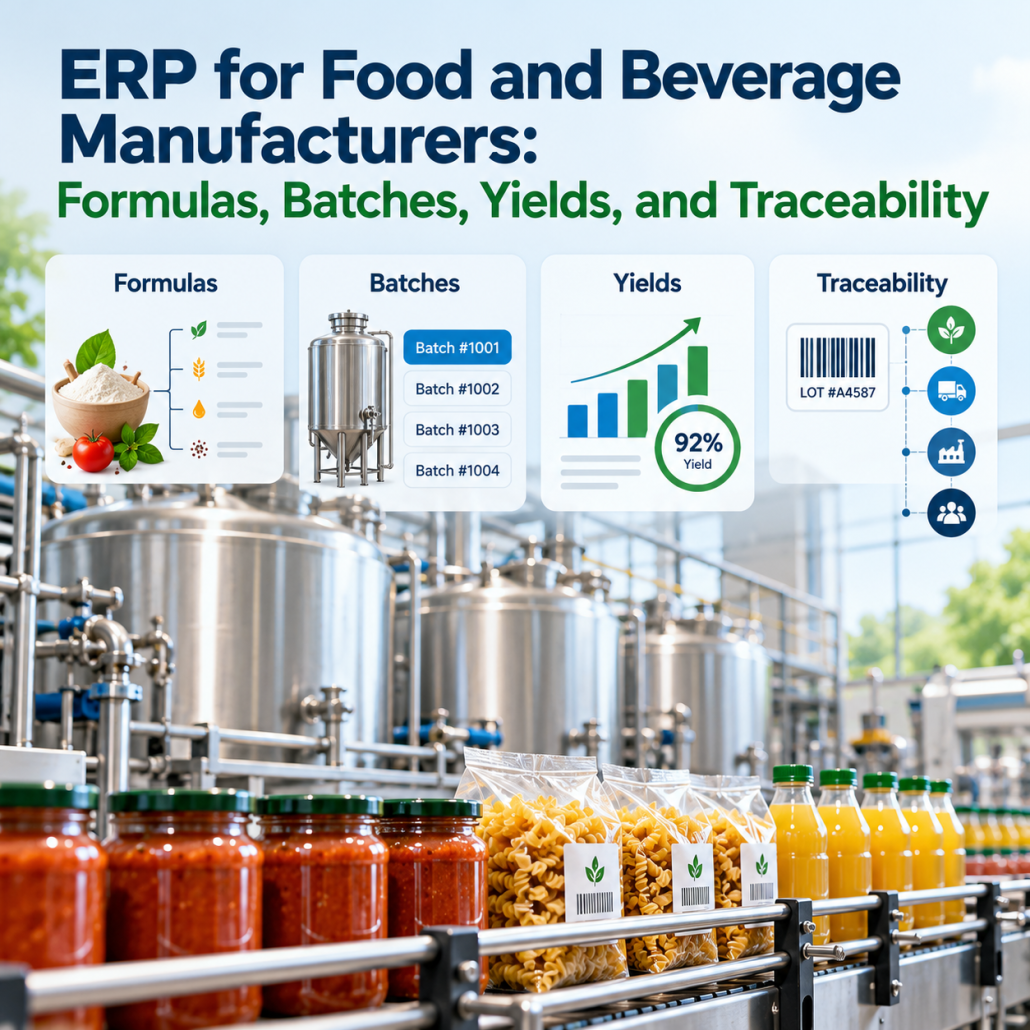
ERP for Food and Beverage Manufacturers: Formulas, Batches, Yields, and Traceability
Food and beverage manufacturing does not behave like assembling a product from parts.
A bicycle factory never makes 7.25 bicycles. A bakery, a dairy, or a beverage plant routinely produces a batch that yields a little more or less than expected, substitutes an ingredient when a lot runs short, splits one run across several lot numbers, and has to trace every ingredient lot to every customer who received the finished product.
General-purpose manufacturing software is usually built around discrete assumptions: fixed quantities, rigid bills of material, and parts that do not expire. Food manufacturers who run on it end up tracking the real process somewhere else, usually in spreadsheets and binders, and then reconciling the two before every audit.
This guide explains what food and beverage manufacturers actually need from ERP: formulas and batches, yield and loss, units of measure, lot traceability and recalls, FSMA traceability requirements, shelf life, quality holds, costing, and how to evaluate a system against your own production.
Why Food Manufacturing Needs Different ERP
Food and beverage production is usually process manufacturing: ingredients are combined, mixed, cooked, fermented, or blended, and the result cannot be disassembled back into its inputs. That changes almost everything the ERP has to do:
- Products are defined by formulas, not just parts lists.
- Output is measured against an expected yield, not a fixed count.
- Ingredients and finished goods carry lot numbers and expiration dates.
- Customers, auditors, and regulators expect fast, complete traceability.
- The same ingredient is bought, stored, and used in different units of measure.
- Quality decisions can put entire lots on hold.
Many food companies also run a discrete step at the end, such as packaging a batch into cases on a filling line. The ERP has to handle both in one flow. Our guide to discrete vs. process manufacturing ERP explains the difference in more depth.
Formulas and Recipes vs. Bills of Material
A bill of materials says “one frame, two wheels, one handlebar.” A formula says “for a 500-pound batch, use 62% flour, 30% water, 5% sugar, 2% yeast, 1% salt,” and may also specify process steps, temperatures, and times.
The differences matter:
- Formulas scale. A 500-pound batch and a 2,000-pound batch use the same proportions.
- Formulas allow substitution. An approved alternate ingredient can replace another, sometimes at a different ratio.
- Formulas change at the batch level. Moisture, protein content, or Brix of an incoming lot may require adjusting the formula for that batch only.
- Formulas carry versions. Product development, regulatory labeling, and customer specifications all depend on knowing which version was used.
An ERP that forces a formula into a rigid BOM leaves the real recipe on a clipboard, and the system’s ingredient usage and costs never match what happened.
Batch Production and Scaling
Batch production organizes work around a defined quantity made in one run, often limited by equipment: a mixer, a kettle, a tank, an oven.
The ERP should let you:
- Plan production in batch sizes that match your equipment.
- Scale ingredient requirements automatically to the batch size.
- Record the actual ingredient lots and quantities used in each batch.
- Split a production run across multiple batch or lot numbers when needed.
- Record actual output for each batch, not just the planned quantity.
Yield, Loss, and Co-Products
Yield
Yield is the ratio of good output to input. If a batch with 1,000 pounds of input is expected to yield 940 pounds of finished product, a 94% yield, and actually yields 910, the 30-pound shortfall is real cost that needs to be visible.
Tracking actual vs. expected yield by product, line, shift, and batch is one of the fastest ways to find margin in a food plant. Small yield losses repeated across hundreds of batches add up to significant money. See our guide to manufacturing cost variances for how yield variances are measured.
Process Loss
Evaporation, trim, spillage, and testing samples reduce output. Expected loss belongs in the formula’s yield. Unexpected loss should be recorded as it happens, not discovered at inventory count.
Co-Products and By-Products
Some processes produce more than one output. Milling produces flour and bran. Cheesemaking produces cheese and whey. A co-product is a primary output with significant value; a by-product is a secondary output with lower value. The ERP needs to record all outputs from a batch and allocate cost among them on a defined basis.
Units of Measure
Food manufacturers commonly buy, stock, use, and sell the same item in different units:
- Flour purchased by the 50-pound bag or by the bulk truckload
- Stocked in pounds
- Used in a formula in kilograms or by percentage
- Finished product sold by the each, the case, or the pallet
Conversions also need to work at the item level. A gallon of honey and a gallon of water do not weigh the same. If conversions are wrong or handled outside the system, both inventory and cost are wrong.
Products sold by actual weight rather than a fixed unit, often called catch weight, add another layer: a case may be priced by the pound, with each case weighing slightly differently. If you sell meat, seafood, cheese, or produce by weight, test this specifically.
Lot Traceability and Recall Readiness
Traceability is the ability to follow a lot in both directions:
- Backward (one step back): from a finished-goods lot to every ingredient lot and supplier that went into it.
- Forward (one step forward): from an ingredient lot to every batch it was used in and every customer who received those batches.
In a recall, speed and precision determine cost. A company that can identify exactly which lots are affected, and exactly who received them, can limit the recall to those lots. A company that cannot often has to recall far more product than necessary.
For traceability to be reliable, lot numbers need to be captured at every step: receiving, put-away, transfers, issue to production, batch output, and shipping. Barcode scanning at each step is what makes this practical without slowing the plant down.
Run mock recalls. Pick a random ingredient lot and time how long it takes to produce a complete list of affected finished lots and customers. If the answer takes days, the system is not doing its job.
FSMA Section 204 Traceability Requirements
Under the FDA’s Food Safety Modernization Act (FSMA), the Food Traceability Rule (Section 204) sets additional recordkeeping requirements for companies that manufacture, process, pack, or hold foods on the FDA’s Food Traceability List. The list includes foods such as certain cheeses, shell eggs, nut butters, fresh-cut fruits and vegetables, leafy greens, finfish, and shellfish.
The rule is built around:
- Critical tracking events (CTEs): points in the supply chain where records are required, such as harvesting, cooling, initial packing, first land-based receiving, shipping, receiving, and transformation, which includes manufacturing and processing.
- Key data elements (KDEs): the specific information required at each event, including the traceability lot code, quantity and unit of measure, location, and dates.
- Traceability lot codes: assigned when a food is initially packed or transformed, and passed along the supply chain.
- A traceability plan describing how the company maintains these records.
- Fast retrieval: providing records to the FDA, including an electronic sortable spreadsheet when requested, within 24 hours.
The original compliance date was January 20, 2026. The FDA has since said it will not enforce the rule before July 20, 2028, following direction from Congress. That is extra time, not an exemption, and customers and retailers may ask for traceability data sooner. Check the FDA’s current guidance for your products.
For manufacturers, transformation records are the hardest part, because they require linking every input lot to every output lot. That is exactly what batch-level lot tracking in an ERP is designed to do.
Shelf Life, Expiration, and FEFO
Ingredients and finished products expire. The ERP should:
- Capture expiration or best-by dates at receiving and at production.
- Calculate expiration automatically from a standard shelf life when appropriate.
- Pick by first expired, first out (FEFO), not just first in, first out.
- Prevent expired material from being used in production or shipped.
- Report what is expiring soon, so it can be used, sold, or donated before it becomes waste.
- Support customer-specific minimum remaining shelf life on shipments.
Quality Control and Holds
Quality in food manufacturing is a gate, not a report. The ERP should support:
- Quarantine on receipt, so incoming ingredients cannot be used until they pass inspection or a certificate of analysis is reviewed.
- Mandatory QA checks at defined points in receiving, production, and shipping.
- Lot holds and releases, so a suspect lot is blocked everywhere at once.
- Test results recorded against lots, creating an audit trail.
- Allergen and sequencing controls that affect scheduling and cleaning between runs.
Food safety programs such as HACCP and GFSI-benchmarked certifications define what has to be controlled. The ERP’s job is to make the controls part of the transaction, so they cannot be skipped. See also our article on building quality into manufacturing processes.
Costing in Food Manufacturing
Food margins are often thin, and costs move:
- Ingredient prices are volatile. Commodity ingredients change price frequently, so standard costs can drift quickly.
- Yield drives cost. A 2% yield loss on a high-volume product can matter more than a price increase.
- Packaging is a large share of cost for many products, and it is consumed in a discrete step.
- Co-product allocation affects the reported margin of every output.
- Batch-level actual cost shows which runs, lines, or shifts are profitable.
See our guides to inventory costing methods and work in process inventory.
Scheduling Food Production
Food production schedules have constraints most discrete plants do not:
- Allergen sequencing: run allergen-free products before allergen-containing ones, with validated cleaning between them.
- Sanitation and changeover time that depends on what ran before.
- Equipment capacity that sets batch sizes.
- Fixed process times such as fermentation, proofing, curing, or cooling.
- Shelf life that limits how far ahead you can produce.
See our guide to production scheduling.
How to Evaluate ERP for Food Manufacturing
Ask every vendor to run your own scenarios, live:
- Create a batch from a formula and scale it to a different batch size.
- Substitute an ingredient on one batch because a lot ran short, and show the effect on cost.
- Record actual output below expected yield and show where the loss appears.
- Split one production run across two lot numbers.
- Receive an ingredient into quarantine, then release it after a QA check.
- Run a mock recall from one ingredient lot to every affected customer, and time it.
- Produce the batch records you would need for an FSMA 204 transformation event.
- Purchase by the bag, stock by the pound, use by the kilogram, and sell by the case.
- Ship a pallet with customer-specific minimum shelf life requirements.
- Show batch-level actual cost compared with standard.
A vendor that can only demonstrate this with its own sample data has not shown that it can run your plant. For a broader evaluation framework, see our manufacturing ERP software buyer’s guide.
How Bizowie Supports Food and Beverage Manufacturers
Bizowie Cloud ERP provides food and beverage manufacturers and distributors with batch production, adjustable formulas, lot traceability, and yield tracking in the same platform as purchasing, inventory, warehouse management, and financials. Food and beverage companies in verticals including bakery, dairy, confectionery, and milled products use it.
Specifically, Bizowie supports:
- Full traceability of raw materials and finished product, from receipt to sale, with barcoding, expiration management, and quality triage.
- Ingredients in multiple units of measure across different recipes and formulations, and selling products individually, by the case, or by the pallet.
- Splitting production activity across multiple batch numbers.
- Substituting and adjusting formulations at the batch level.
- Monitoring actual production vs. expected yield.
- Quarantining inbound receipts and requiring mandatory QA checks throughout the supply chain, production, and shipping processes.
- Make-to-stock, make-to-order, and process manufacturing in any combination, so a process batch and a packaging step can run in one system.
Every production event updates inventory, costing, and the general ledger at the same time. Learn more about Bizowie for food and beverage, or, if you also distribute, see our guide to ERP for food and beverage distributors.
Frequently Asked Questions
What is food manufacturing ERP?
Food manufacturing ERP is an ERP system that supports the way food and beverage producers work: formulas and batches, yield and loss, lot traceability, expiration dates, quality holds, and multiple units of measure, connected to purchasing, inventory, sales, and accounting.
What is the difference between a recipe and a bill of materials?
A bill of materials lists fixed quantities of components per unit. A recipe or formula defines proportions that scale with batch size, often with process steps, approved substitutions, and an expected yield, and it may be adjusted for an individual batch.
Does FSMA 204 apply to food manufacturers?
It applies to companies that manufacture, process, pack, or hold foods on the FDA’s Food Traceability List. Manufacturers that transform listed foods, or use them as ingredients, generally need to keep transformation records linking input lots to output lots. Check the FDA’s guidance for your specific products.
When is the FSMA 204 compliance date?
The original compliance date was January 20, 2026. The FDA has said it will not enforce the rule before July 20, 2028, following direction from Congress. Customers and retailers may require traceability data earlier.
How fast should a food manufacturer be able to trace a lot?
FSMA 204 requires providing records to the FDA within 24 hours of a request for covered foods. Operationally, many manufacturers aim to complete a forward and backward trace in minutes, and test it with regular mock recalls.
What is FEFO?
First expired, first out. It means picking the inventory with the earliest expiration date first, rather than the oldest receipt. For perishable products, FEFO reduces waste and helps meet customer shelf-life requirements.
Bring Us Your Hardest Batch
If your real recipes, yields, and lot records live outside your system, bring us a real scenario:
- A batch with an ingredient substitution.
- A run that yielded below expectations.
- A lot you need to trace to every customer, fast.
- A process batch that feeds a packaging line.
We’ll show you how Bizowie would handle it, and if the platform is not a good fit for your operation, we’ll tell you that too.
See if Bizowie is right for your food or beverage operation.