
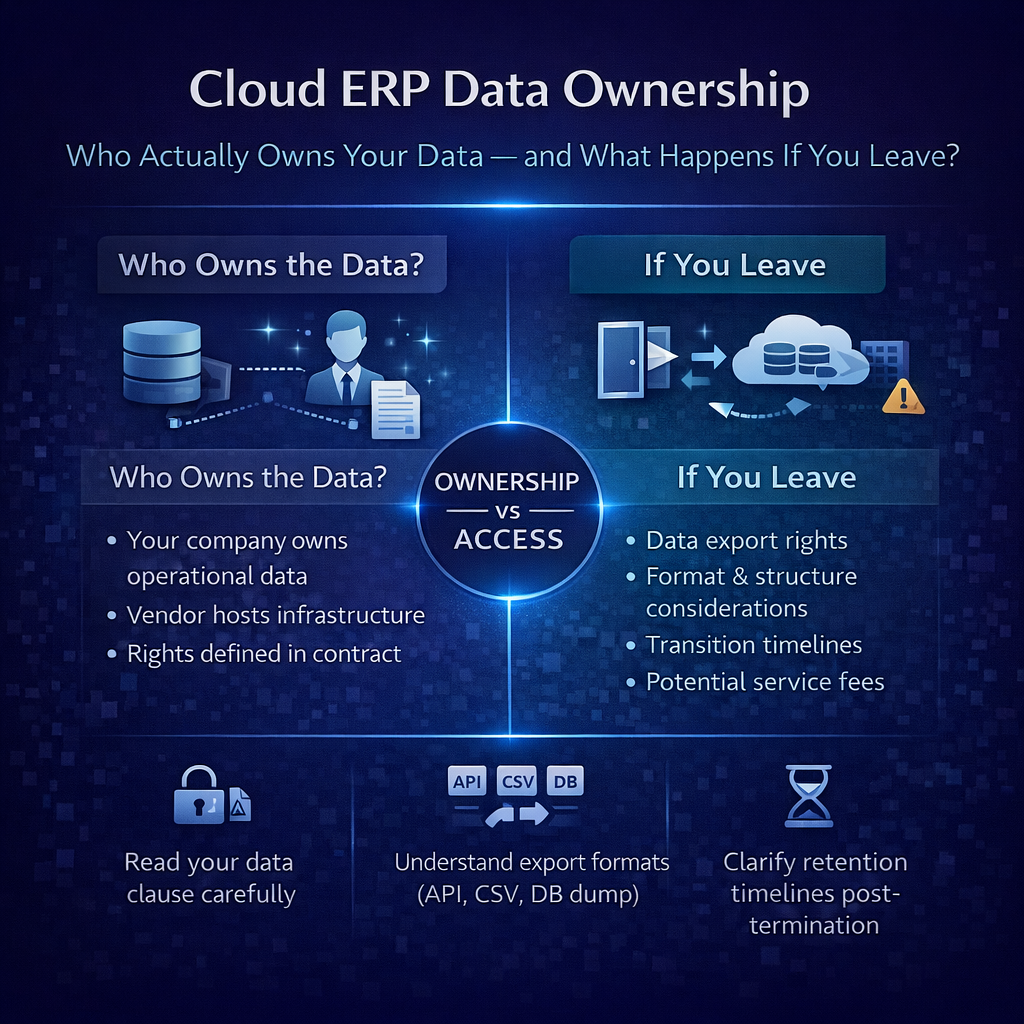
Cloud ERP Data Ownership: Who Actually Owns Your Data and What Happens If You Leave
When your ERP ran on a server in your building, data ownership was simple. The data lived on your hardware, in your facility, managed by your people. You could see it, touch the machine that stored it, and back it up to a drive you locked in a safe. Ownership wasn’t a legal question. It was a physical fact.
Cloud ERP changed the physical reality without changing the legal one — but the perception gap between where the data lives and who owns it creates anxiety that vendors exploit in both directions. On-premise advocates use it to scare companies away from cloud adoption: “you’re handing your data to someone else.” Cloud vendors use vague assurances to avoid substantive conversations about portability, retention, and exit rights: “of course you own your data” — without specifying what that ownership actually means in practice.
The truth is more nuanced and more important than either side lets on. Data ownership in cloud ERP isn’t a single concept. It’s a set of specific rights — access, portability, retention, deletion, and control — that are defined by your contract, governed by applicable law, and only as meaningful as the vendor’s technical ability and willingness to honor them.
For distribution companies whose ERP contains the operational history of their business — every customer relationship, every transaction, every financial record, every inventory movement — understanding exactly what data ownership means, what your rights are, and what happens to your data in every scenario isn’t paranoia. It’s due diligence.
What “You Own Your Data” Actually Means
Every cloud ERP vendor says you own your data. It’s on their website, in their sales presentations, and in the opening clauses of their service agreements. And in the broadest legal sense, it’s true. Your business data — customer records, transaction history, inventory data, financial records, vendor information — is your intellectual property. Moving it to a cloud platform doesn’t transfer ownership.
But ownership is only as valuable as the rights that come with it. Owning data you can’t access, can’t export, can’t move, and can’t delete isn’t meaningful ownership. It’s a legal technicality attached to a practical hostage situation.
What matters isn’t whether the contract says you own the data. What matters is whether the contract — and the vendor’s technical infrastructure — gives you these specific rights:
The Right to Access
You should be able to access all of your data at any time during the term of your agreement. Not just through the application’s user interface — which shows you a curated view of your data through screens and reports — but through programmatic access that lets you retrieve the underlying records in their complete form.
API access is the standard mechanism. A well-documented API gives you the ability to extract any data the system stores — customer records, transaction details, inventory positions, financial entries, configuration data — in standard formats through automated processes. This access should be available continuously, not gated behind support requests or limited to scheduled export windows.
The distinction between UI access and data access matters because the application interface shows you your data filtered through the vendor’s design decisions about what to display and how to organize it. Programmatic access gives you the raw data itself, in a form you can use independently of the vendor’s application.
The Right to Export
Access and export aren’t the same thing. Access means you can retrieve data through the vendor’s interfaces. Export means you can extract a comprehensive copy of your data in formats that are usable outside the vendor’s ecosystem — CSV, JSON, XML, or other standard formats that any other system can ingest.
The export right should cover all data, not just the data the vendor considers “yours.” Transaction history, configuration data, audit logs, document attachments, custom field values, integration logs — everything the system stores that relates to your business should be exportable. If the vendor draws a line between “your data” and “system data” and only allows export of the former, important information — configuration settings, workflow rules, historical audit trails — may be trapped on the platform.
Export should be self-service. You shouldn’t need to file a support ticket, wait for a data extraction team, or pay a professional services fee to get a copy of your own data. If the vendor treats data export as a service engagement rather than a self-service capability, they’ve built friction into a process that should be frictionless.
The Right to Portability
Portability goes beyond export. Export gives you a copy of the data in a standard format. Portability means that data is structured and documented well enough that it can be meaningfully imported into another system.
A CSV dump of 10 million rows with no schema documentation, no field definitions, no relationship mappings, and no data dictionary isn’t portable — it’s a puzzle. Genuine portability means the vendor provides documentation of the data model, the relationships between entities, the meaning of fields and codes, and enough context that a competent technical team can map the data into a new platform’s structure.
This is where the difference between theoretical ownership and practical ownership becomes starkest. A vendor can truthfully say you own your data and can export it at any time while making the exported data so poorly documented that using it outside their platform requires weeks of reverse-engineering. That’s technically compliant and practically obstructive.
The Right to Deletion
When you leave a platform, you should have the right to require the vendor to delete your data from their systems within a defined timeframe. This right has become more explicit with the expansion of data privacy regulations, but it should be a standard contract term regardless of regulatory requirements.
Deletion should be comprehensive — not just the production database, but backups, replicas, logs, and any other storage where your data persists. The vendor should be able to certify deletion and provide a timeline for when all copies will be purged. Backup retention policies may mean that copies persist in backup archives for some period after deletion from production systems, but this should be disclosed and bounded.
The Right to Control
You should control who within the vendor’s organization can access your data and under what circumstances. Role-based access controls within the application limit what your own users can see. But vendor-side access — support engineers troubleshooting issues, operations teams managing the platform, development teams analyzing system behavior — also touches your data.
A responsible vendor has clear policies about who can access customer data, under what authorization, for what purposes, and with what audit trail. SOC 2 compliance, which most reputable cloud ERP vendors maintain, requires documented access controls and audit procedures. But the specifics vary, and understanding what your vendor’s access policies look like — before you need to care about them — is part of informed data ownership.
What Your Contract Should Say
The service agreement is where data ownership rights become enforceable. Marketing claims and sales assurances are meaningful only insofar as the contract reflects them. Here’s what to look for — and what to insist on if it’s missing.
Explicit Ownership Clause
The contract should state plainly that all data you input into the system, and all data generated by the system from your business operations, is your property. This should be unambiguous and unconditional — not qualified by exceptions for “aggregated data,” “derived insights,” or “system-generated metadata” that the vendor claims ownership of.
Watch for clauses that grant the vendor a license to use your data for purposes beyond operating the service — analytics, product development, benchmarking, training machine learning models, or sale to third parties. Some of these uses may be acceptable to you. Others may not. But you should know what you’re consenting to and have the option to opt out.
Data Export Provisions
The contract should specify your right to export data, the formats available, the mechanism (API, bulk export, support-assisted extraction), and any associated costs. Ideally, data export is a self-service capability included in the subscription at no additional charge. If the vendor charges for data extraction, that cost should be defined in the contract — not discovered when you actually need it.
Post-Termination Data Handling
The contract should define what happens to your data after the agreement ends. Typical provisions include a data retrieval period — usually 30 to 90 days after termination — during which you can export your data, followed by deletion from the vendor’s systems. The contract should specify the deletion timeline and whether the vendor will provide written certification of deletion upon request.
If the contract is silent on post-termination data handling, assume the worst. You may lose access immediately upon termination. Your data may persist on the vendor’s systems indefinitely. And retrieval after the fact may require negotiation from a position of zero leverage.
Data Residency and Jurisdiction
For companies with regulatory requirements around where data is physically stored — and this is increasingly common across industries — the contract should specify the geographic regions where data will be hosted and processed. If the vendor uses cloud infrastructure with data centers in multiple regions, you should know which region your data lives in and whether it’s replicated to other jurisdictions.
This matters because data stored in different countries is subject to different legal frameworks. Data hosted in the EU is subject to GDPR. Data hosted in the US is subject to US law enforcement access provisions. If your industry or your customers require data residency in a specific jurisdiction, the contract should guarantee it.
Security and Breach Notification
The contract should specify the vendor’s security obligations — encryption standards, access controls, audit certifications — and the breach notification procedures. If your data is compromised, how quickly will the vendor notify you? What information will they provide about the scope and nature of the breach? What remediation responsibilities do they accept?
Data ownership without data security is a hollow right. You own the data, but if the vendor’s security practices are inadequate and your customer information is exposed in a breach, the ownership right doesn’t protect you from the business consequences. Security provisions in the contract establish minimum standards and accountability.
What Happens When You Leave: The Exit Scenario
The exit scenario is where data ownership either works or fails. Understanding what happens — practically, not just contractually — when you decide to leave a cloud ERP platform is essential to evaluating the relationship you’re entering.
The Transition Period
Most contracts provide a transition period after termination during which you retain read access to the platform and can export your data. This period is your window to extract everything you need, verify its completeness, and confirm that the data is usable in its exported form.
Thirty days is common but tight for a distribution company with years of transaction history, complex data relationships, and dozens of integrated systems that need their data flows redirected. Ninety days provides more realistic breathing room. Negotiate for the longest transition period the vendor will agree to, and don’t assume you’ll be able to extend it after the fact — once you’ve given notice of termination, your leverage diminishes.
During the transition period, plan for a comprehensive data extraction that includes not just current records but historical data — transaction archives, completed order histories, historical financial records, prior-year inventory data, and audit logs. If you’re migrating to a new platform, the implementation team for the new system should be involved in defining what data they need and in what format, so the extraction from the old system is shaped by the requirements of the new one.
What Comes With You
Your operational data — customer records, vendor records, item masters, bills of material, pricing structures, inventory positions, open orders, open purchase orders, accounts receivable, accounts payable, and general ledger balances — will come with you. This is the data that populates your new system.
Your transaction history — completed orders, historical shipments, closed purchase orders, paid invoices, historical inventory movements, and financial transaction details — should come with you for regulatory compliance, audit requirements, and business continuity. How much history you need depends on your industry’s retention requirements and your own business needs, but plan on extracting everything available rather than trying to determine minimum requirements under time pressure.
Your documents and attachments — if the ERP system stores documents, images, or files associated with transactions or records, these should be exportable. Verify during evaluation whether the export capability includes attachments or only structured data.
What Doesn’t Come With You
The system configuration — your workflow rules, your approval chains, your business logic settings, your screen layouts, your report designs — is typically not portable in a technical sense. These configurations are expressed in the vendor’s proprietary framework. They represent your business logic, but in a format that only works within the vendor’s platform.
This is why documenting your business rules independently of the system is so important. The configuration settings themselves don’t transfer, but the business logic they implement — “orders over $10,000 require manager approval,” “allocate from the nearest warehouse first,” “apply customer Group A pricing for accounts in this category” — is business knowledge that transfers to any platform if it’s documented outside the system.
Your integrations — the connections between the ERP and your other systems — don’t transfer. Each integration was built against the current vendor’s API, using the current vendor’s data structures and event model. On the new platform, each integration will need to be rebuilt against the new vendor’s interfaces. If the integrations were vendor-maintained, the current vendor’s connectors stop working when you leave. If they were custom-built, the code is specific to the current platform and doesn’t port.
Your team’s system knowledge — the expertise your people have built in navigating, configuring, and troubleshooting the current platform — doesn’t transfer. This is an organizational cost of switching that’s real and significant, even though it’s not a data ownership issue. It’s worth naming because it’s part of the total switching calculus.
The Data Verification Step Most Companies Skip
Before you terminate your agreement and lose access, verify the exported data. Don’t assume that because the export ran successfully, the data is complete and accurate.
Check record counts against known totals. Verify that historical transactions match financial records. Confirm that attachments and documents are included. Test-import a sample into the new platform to verify that the formats are compatible and the mappings are correct. Identify gaps before you lose access to the source system, when filling them is straightforward rather than impossible.
Companies that skip verification — and most do, because the transition period feels rushed and there are a hundred other things demanding attention — sometimes discover data gaps months later when they need a historical record that didn’t make it into the export. By then, the old vendor has deleted their data per the contract terms, and the gap is permanent.
How Vendor Models Affect Data Ownership in Practice
Not all cloud ERP platforms handle data ownership the same way, and the vendor’s business model and architecture significantly influence how meaningful your ownership rights are in practice.
Multi-Tenant SaaS
On multi-tenant platforms, your data lives in a shared database with logical isolation separating it from other customers’ data. The vendor manages the infrastructure, the database, and the application layer. Your access to the data is through the application’s APIs and export tools.
The advantage of multi-tenant platforms for data ownership is standardization. Because every customer runs on the same platform, the API, the export tools, and the data structures are consistent and well-documented. The vendor has strong incentive to maintain clean, accessible data interfaces because every customer depends on them.
The consideration is that you’re relying on the vendor’s access tools entirely. You don’t have direct database access. You can’t run SQL queries against the underlying database. Your view of the data is mediated by the vendor’s API and export capabilities. If those tools don’t expose a particular data element, you may not be able to extract it without vendor assistance.
Evaluate the API coverage during your selection process. Can the API access every data entity in the system? Are there data elements visible in the UI that aren’t accessible through the API? Is the API documentation comprehensive enough for a developer to build a complete data extraction without vendor guidance?
Single-Tenant Cloud
On single-tenant platforms, your data lives in a dedicated database instance. In some arrangements, you may have direct database access — the ability to run queries against the underlying database outside the application. This provides a level of data access that multi-tenant platforms typically don’t offer.
Direct database access is a genuine advantage for data ownership, but it comes with the trade-offs inherent in single-tenant architecture — higher cost, version fragmentation, and upgrade complexity. It’s also not universal among single-tenant vendors. Some maintain the same API-mediated access model as multi-tenant platforms, keeping the database layer behind the application regardless of the deployment model.
Hosted Legacy
Hosted legacy ERP — on-premise software running on a hosting provider’s infrastructure — presents the most variable data ownership landscape. Your access rights depend on the hosting arrangement, the software vendor’s license terms, and whether you have administrative access to the hosted environment.
In some arrangements, you effectively own the hosted instance and have the same data access you’d have on-premise — full database access, direct file system access, and the ability to extract data through any mechanism the platform supports. In others, the hosting provider mediates access and you’re dependent on their tools and cooperation for data extraction.
The risk specific to hosted legacy is that the data may be stored in proprietary formats that require the vendor’s software to interpret. If your license expires and you lose access to the application, the raw database files may not be usable without the application to read them. This is a legacy-era lock-in mechanism that modern cloud platforms have largely moved past, but it still affects companies running hosted versions of older ERP systems.
The Regulatory Dimension
Data ownership intersects with regulatory requirements in ways that matter for distribution companies, particularly those handling customer information, financial records, or products subject to traceability requirements.
Data Retention Requirements
Financial record retention requirements — typically seven years for tax-related records in the US, varying by jurisdiction — mean you need access to historical data long after the transactions occurred. If you leave a cloud ERP platform after five years, you need to take seven years of financial history with you to maintain compliance. Your export plan needs to account for the full retention period, not just current data.
For distribution companies handling regulated products — food, pharmaceuticals, chemicals, medical devices — lot traceability and recall data may need to be retained for the life of the product plus additional years. This data must come with you when you leave, in a format that’s searchable and auditable, not just a bulk archive.
Privacy Regulations
If you store personal data in your ERP — customer contact information, employee records, any data that identifies an individual — data privacy regulations like GDPR, CCPA, and their evolving equivalents impose specific requirements on how that data is stored, processed, and transferred.
These regulations give individuals rights over their data that you must be able to honor regardless of where that data lives. The ability to locate, export, modify, and delete individual-level data in your ERP isn’t just good practice — it’s a legal requirement in many jurisdictions. Your cloud ERP vendor’s data handling capabilities need to support your compliance obligations, and your contract should address regulatory compliance responsibilities explicitly.
Audit and Discovery
Financial audits, regulatory examinations, and legal discovery proceedings may require you to produce data from your ERP with specific formatting, completeness, and chain-of-custody documentation. Your ability to respond depends on your data access rights and the platform’s export and reporting capabilities.
Understand how your vendor handles audit data requests. Can you produce the needed data independently, or do you need vendor involvement? If vendor involvement is required, what are the response times and costs? During litigation, discovery timelines can be tight and non-negotiable. A vendor whose data access model requires weeks-long support engagements to produce export files creates compliance risk that has nothing to do with the vendor’s intentions and everything to do with their platform’s accessibility limitations.
How Bizowie Handles Data Ownership
Bizowie’s position on data ownership is unambiguous: your data is yours. Fully. Without qualification, without asterisks, and without games.
You have comprehensive API access to your data at all times. The API is documented, covers every data entity in the system, and supports the kind of programmatic access that lets you extract, analyze, and integrate your data without depending on our cooperation for every request. Export capabilities are self-service and included in the subscription — no professional services fees, no support ticket queues, no artificial friction.
If you leave, we provide a transition period with full access to export your data in standard formats. We document our data model so your data is genuinely portable, not just technically exportable. And we delete your data from our systems according to a defined, documented process after the transition period ends.
We don’t use your data for anything beyond operating the service. We don’t sell it. We don’t mine it for insights we monetize elsewhere. We don’t train models on it. Your operational data exists for one purpose: running your business on our platform.
And we invest in making the platform good enough that data ownership is an academic concern rather than an exit strategy. The best protection against needing your data portability rights isn’t a better contract clause — it’s a platform you never want to leave.
Evaluate a vendor whose confidence is in the platform, not the lock-in. Schedule a demo with Bizowie and ask the data ownership questions directly. We’ll walk through the API access, the export capabilities, the contract terms, and the exit provisions — because a vendor that’s transparent about how you leave is a vendor that’s confident about why you’ll stay.