
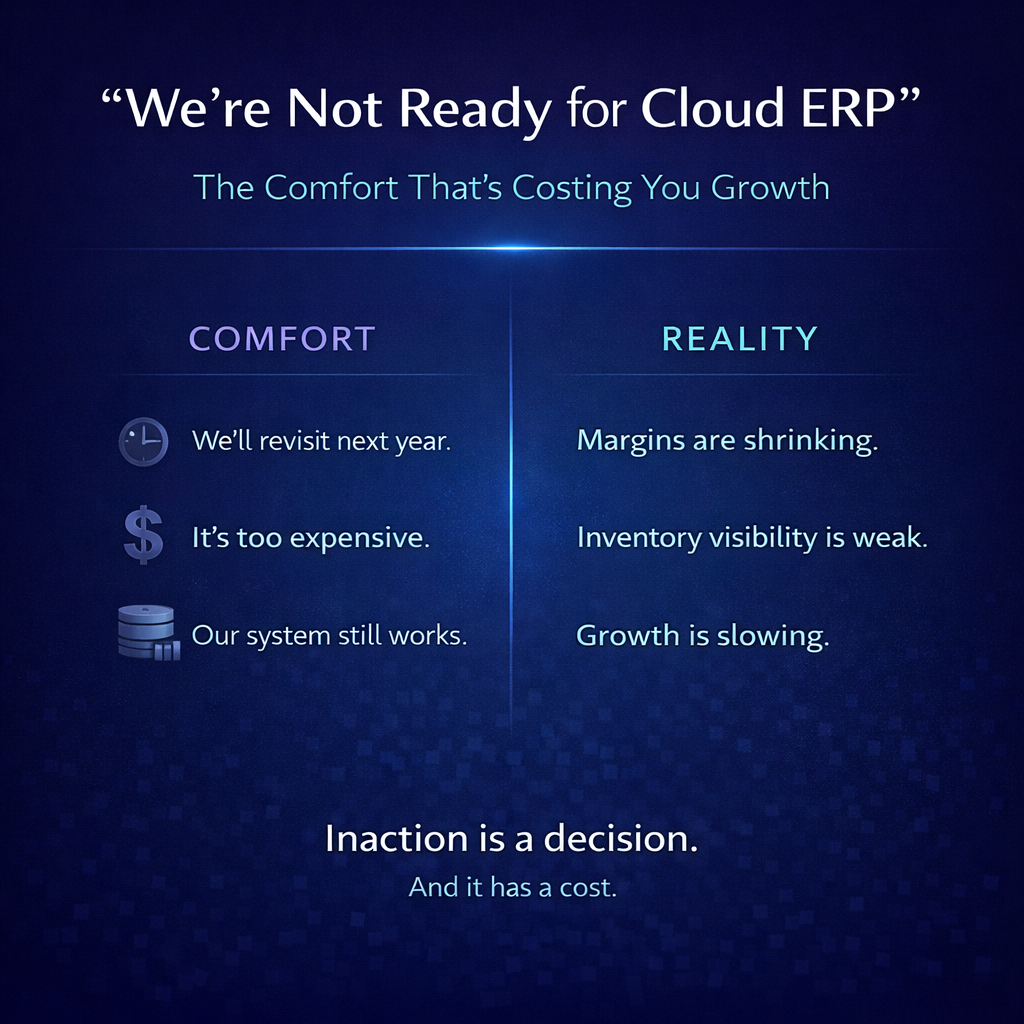
“We’re Not Ready for Cloud ERP” — And Other Lies That Keep Distributors Stuck
Every distribution company that’s stuck on an outdated ERP system has a reason for staying. Sometimes it’s a good reason. Usually, it isn’t. Usually, it’s a story the organization tells itself — repeated so often it starts to feel like analysis — that converts inaction into strategy and delay into prudence.
These stories aren’t malicious. Nobody sits in a conference room and decides to hold the company back on purpose. The stories emerge from legitimate anxieties — about cost, about disruption, about risk, about change — that metastasize into organizational paralysis when nobody challenges them with the same rigor applied to every other business decision.
The cost of these stories is invisible in any single quarter. It shows up over years — in the labor consumed by manual workarounds, in the customers lost to competitors who can ship faster and price smarter, in the decisions made on data that’s a day old instead of a second old, and in the slow erosion of competitive position that happens when your operational backbone can’t keep up with your operational ambition.
This article names the most common stories, explains why they persist, and makes the case that the riskiest thing a distribution company can do in 2026 isn’t moving to cloud ERP. It’s not moving.
“We’re Not Ready”
This is the most common and the most corrosive objection, because it’s unfalsifiable. No matter when you ask the question, there’s always a reason you’re not ready yet. The warehouse is in the middle of a reorganization. Q4 is coming. The new purchasing director hasn’t started yet. The company just went through an acquisition. There’s a system upgrade planned for the legacy platform that might address some of the problems. Next year will be calmer.
Next year is never calmer. There is no clean window in a distribution operation where everything stabilizes long enough for a technology transition to feel comfortable. Distribution is operationally intense by nature — there’s always a peak season approaching, a new customer onboarding, a warehouse project underway, or a staffing challenge consuming management attention. Waiting for the perfect moment is waiting for a moment that doesn’t exist.
“We’re not ready” also misunderstands what readiness means. It imagines ERP implementation as an all-consuming event that requires the entire organization to stop what it’s doing and focus exclusively on the transition. That may have been true in the era of 18-month enterprise implementations. It’s not true for modern cloud ERP deployed through vendor-direct implementation in weeks to months.
Readiness doesn’t require a clean slate. It requires three things: a clear understanding of the operational problems the current system creates, an executive sponsor who can maintain organizational momentum, and a vendor whose implementation model was designed for businesses that can’t stop operating while they transition. That’s it. The rest is planning and execution — things distribution companies are already very good at.
The real question isn’t whether you’re ready for cloud ERP. It’s whether you can afford another year of the system you’re running now.
“Our Current System Works Fine”
No it doesn’t. If it did, you wouldn’t be reading this article.
But more importantly, “works fine” is a dangerously low bar for a system that runs your entire operation. Legacy ERP systems “work” in the sense that they store data and process transactions. They “work” the way a 20-year-old truck “works” — it starts, it moves, it gets there eventually. But it burns more fuel, breaks down more often, can’t carry the load it used to, and costs more to maintain every year. And somewhere on the highway, your competitors are passing you in trucks that are faster, more efficient, and getting better every month while yours just gets older.
“Works fine” usually means the team has developed workarounds for every limitation — spreadsheets that supplement the system’s reporting, manual processes that compensate for missing automation, phone calls between warehouse and sales that substitute for real-time inventory visibility, and a collective institutional knowledge about the system’s quirks that exists in people’s heads rather than in the software.
These workarounds are so deeply embedded in daily operations that they feel like normal business activities rather than what they actually are: the hidden cost of running an inadequate system. The labor consumed by manual order reconciliation, the errors caused by batch-processed inventory data, the time spent building reports the system should generate automatically, the customer commitments missed because the available-to-promise calculation was hours behind reality — none of this shows up on a line item labeled “cost of bad ERP.” It’s distributed across payroll, across margin erosion, across opportunity cost so diffuse that nobody sees it as a single problem with a single cause.
Conduct an honest audit: how many hours per week does your team spend on activities that exist solely because the system can’t do its job? How many spreadsheets run parallel to the ERP because the ERP’s data isn’t real-time, accurate, or accessible enough? How many orders require manual intervention that should be automated? How many decisions are based on data that’s a day old?
The answers to these questions are the true cost of “works fine.” And the number is almost always larger than the cost of replacing the system.
“It’s Too Expensive”
This objection usually compares the wrong numbers. It takes the subscription cost of a cloud ERP platform and compares it to the current cost of the legacy system — which, because the license was purchased years ago and the hardware was capitalized long ago, feels like it’s running for nearly nothing.
That feeling is an accounting illusion. The legacy system costs more than the number on your income statement suggests. It costs you in IT labor maintaining servers, applying patches (or more likely, not applying patches), managing backups, troubleshooting hardware issues, and keeping an aging infrastructure running. It costs you in consultant fees for every configuration change, every report modification, every upgrade attempt. It costs you in the labor of every employee who spends part of their day compensating for the system’s limitations. And it costs you in the opportunities you can’t pursue because the system can’t support them — the new warehouse you can’t integrate efficiently, the e-commerce channel you can’t connect cleanly, the customer analytics you can’t generate because the data is locked in silos.
The honest comparison isn’t the cloud ERP subscription against the legacy system’s apparent operating cost. It’s the five-year total cost of ownership of the cloud platform — subscription, implementation, training, integration, and ongoing operation — against the five-year total cost of the legacy system — maintenance, IT labor, consultant fees, workaround labor, upgrade projects, and opportunity cost.
When you run that comparison honestly — and “honestly” means including every cost category, not just the ones that appear on the IT budget — cloud ERP is almost always less expensive. Often dramatically so. The companies that find the switch “too expensive” are the ones comparing a comprehensive cloud cost against an incomplete legacy cost.
“We Can’t Afford the Disruption”
This objection treats the implementation period as pure cost — weeks or months of reduced productivity while the organization transitions — without accounting for the productivity gained after. It’s like refusing to replace a broken piece of warehouse equipment because you can’t afford the half-day of downtime to install the new one, while losing hours of productivity every week to the equipment that doesn’t work right.
The disruption concern is also calibrated to the wrong implementation model. The 18-month enterprise ERP implementation is genuinely disruptive — it consumes enormous organizational attention for an extended period and carries real risk of budget overruns and timeline slippage. That’s not the only model.
Cloud ERP platforms designed for the mid-market, implemented directly by the vendor, deploy in weeks to months. The implementation doesn’t require your entire organization to stop and focus on the project. It requires a core team to invest meaningful time in configuration, data migration, testing, and training — while the rest of the organization continues normal operations until the transition.
The first few weeks after go-live involve a learning curve and an adjustment period — that’s real, and pretending otherwise would be dishonest. But the transition from “learning” to “more productive than before” happens faster than the disruption anxiety imagines, particularly when the new system eliminates the manual workarounds and data limitations that were consuming time on the old one.
And here’s the asymmetry the disruption objection ignores: the disruption of switching is temporary. The disruption of not switching — the daily grind of workarounds, manual processes, and operational limitations — is permanent. A few weeks of transition discomfort versus years of ongoing operational friction. The math isn’t close.
“We Need to Clean Up Our Data First”
This is the most sophisticated form of delay, because it sounds proactive. We can’t migrate to a new system with messy data, so we need to clean up our data first — standardize the customer records, reconcile the inventory, fix the duplicate items, archive the obsolete records. Then we’ll be ready.
Data cleanup is indeed necessary before migration. But using it as a prerequisite for starting the evaluation process is a stalling tactic, even when it doesn’t feel like one. Data cleanup without a target system is abstract work — you’re cleaning to an undefined standard because you don’t yet know what the new system needs. Data cleanup with a target system is purposeful work — you’re cleaning to specific requirements, with specific mapping templates, guided by a vendor who knows exactly what the destination system expects.
The most effective approach is to evaluate platforms and select a vendor while conducting data cleanup in parallel. The vendor’s implementation team can guide the cleanup effort, providing the data mapping templates and quality standards that make the cleanup targeted rather than open-ended. This collapses the timeline because cleanup and evaluation happen simultaneously rather than sequentially.
There’s also a deeper truth about the “clean up first” objection: the current system is often the reason the data is messy. Years of workarounds, manual entries, duplicate records created because the system made deduplication difficult, inconsistent data because the system didn’t enforce standards — the mess isn’t independent of the platform. It’s a product of the platform. Cleaning the data and then putting it back into the same system that made it messy is an exercise in futility. Clean it, move it to a platform that maintains data quality by design, and the cleanup investment actually sticks.
“Our Team Won’t Adopt a New System”
This objection treats user resistance as an immovable force rather than a manageable challenge. Yes, your team has invested years in mastering the current system. Yes, switching to a new platform means temporarily losing that mastery. Yes, some people will resist the change, particularly the ones who’ve built their daily effectiveness around deep knowledge of the legacy system’s quirks and shortcuts.
But user resistance isn’t fixed. It’s a function of how the transition is managed. Companies that impose a new ERP on their teams — selecting the platform in a conference room, implementing it behind a curtain, and announcing the switch over email — get maximum resistance. Companies that involve their operations team in the selection, include daily users in the configuration and testing process, invest in role-specific training that connects features to each person’s actual job, and acknowledge the learning curve openly get something different: investment.
When the warehouse manager participates in the demo and sees the system handle a fulfillment scenario that currently requires three workarounds and a phone call, resistance converts to anticipation. When the customer service team tests the new order entry process and discovers they can answer customer availability questions in real time instead of calling the warehouse, adoption accelerates. When the purchasing director sees demand-driven replenishment suggestions replacing the manual analysis they spend hours on each week, the old system stops feeling like a comfort zone and starts feeling like an anchor.
The teams that resist new ERP aren’t resistant to change. They’re resistant to change imposed on them without context, without involvement, and without evidence that the new system will make their specific job easier. Give them the context, the involvement, and the evidence, and resistance transforms into the strongest possible endorsement — because the people who use the system every day are the most credible advocates for replacing one that doesn’t work with one that does.
“We’re Waiting for the Next Version of Our Current System”
The vendor promised that Version 14 — or 2026 Release, or whatever they’re calling it — will address the limitations you’ve been living with. New warehouse functionality. Better reporting. Improved performance. Modern interface. It’s coming next year. Maybe the year after. But it’s coming.
Here’s what’s actually coming: a version upgrade that costs tens of thousands of dollars in consulting fees, takes months to plan and execute, carries risk of breaking your existing configurations and customizations, and delivers a fraction of the improvements that were promised. The new features will exist, technically. But they’ll be layered on top of the same architectural foundation that created the limitations in the first place. The data will still be modular. The updates will still be versioned. The implementation model will still depend on consultants. And within a year of upgrading, you’ll be in the same position — waiting for the next version to address the problems that the architectural foundation prevents the current version from solving.
Waiting for the next version of a legacy platform is waiting for incremental improvement within a model that’s fundamentally constrained. The version might be better. It won’t be different. The architectural limitations — batch-processed data, versioned updates, module silos, consultant dependency — are structural. They don’t change with a version number.
Meanwhile, a cloud-native platform is already delivering continuous improvements — not as a future promise, but as the current reality. Every week the platform gets better. Every customer benefits automatically. The improvements aren’t constrained by legacy architecture because the architecture was built for exactly this kind of continuous evolution.
The question isn’t whether Version 14 will be better than Version 13. It probably will be, marginally. The question is whether marginal improvement within a constrained model is worth waiting for when a fundamentally different model is available now.
“We Tried This Before and It Failed”
A previous failed ERP implementation is the most powerful driver of inaction, and it’s the hardest objection to counter because the pain is real and the scars are deep. The organization spent hundreds of thousands of dollars. The project ran months over schedule. The system didn’t work as promised. People were angry. The company may still be dealing with the fallout.
That experience deserves respect. It also deserves analysis — because the failure almost certainly wasn’t caused by the concept of replacing your ERP. It was caused by specific, identifiable factors that can be avoided.
Was the failed implementation consultant-led? Third-party consulting firms implementing enterprise ERP platforms produce the highest failure rates in enterprise software. The misaligned incentives — consultants profit from duration and complexity — the fragmented accountability, and the knowledge gap between the consulting firm’s generalized expertise and your specific operational reality are the most common causes of implementation failure. Vendor-direct implementation with a team that built the software and whose success depends on yours is a fundamentally different model.
Was the failed platform a general-purpose enterprise system? Enterprise ERP platforms designed for Fortune 500 companies and scaled down for the mid-market produce miserable results for mid-market distribution companies. The system is too complex, the implementation is too heavy, the cost is too high, and the platform isn’t designed for your specific operational requirements. A platform purpose-built for mid-market distribution is a different product entirely.
Were the requirements based on replicating the old system? Implementations that attempt to recreate every legacy process — including all the workarounds, all the customizations, and all the habits — in a new platform are the ones most likely to fail. They produce bloated configurations, extensive customization, and a system that’s just as complex as the one it replaced. An implementation that configures for genuine business requirements and adopts the platform’s native approach for everything else is leaner, faster, and more likely to succeed.
Was the implementation treated as an IT project? When IT leads the ERP initiative and operations receives the system as a finished product, the gap between what was configured and what the business actually needs can be enormous. Operations-led implementations — where the people who use the system every day define the requirements, participate in configuration, and drive acceptance — produce dramatically different outcomes.
The previous failure doesn’t predict the next outcome unless you repeat the same decisions. Different platform, different implementation model, different leadership, different approach — different result.
“We’ll Move When We Have To”
This is the most honest objection, and the most dangerous one. It acknowledges that the current system is inadequate but bets that the consequences of that inadequacy won’t become acute before some forcing function — a system failure, a vendor end-of-life announcement, a compliance requirement — makes the move unavoidable.
The problem with this strategy is that it hands the timeline to chance. When the forcing function arrives, you’ll be making one of the most important technology decisions your company faces under pressure, without the preparation time that a deliberate evaluation allows. You’ll select faster, negotiate from a weaker position, implement on a compressed timeline, and live with the consequences for years.
Companies that move proactively — before the crisis — evaluate thoroughly, negotiate deliberately, implement with adequate time for testing and training, and go live with confidence. Companies that move reactively — because they have to — take what they can get on the timeline they’re given.
There’s also the competitive dimension. Your competitors who are moving now — who are gaining real-time visibility, automating their workflows, accelerating their fulfillment, and eliminating their manual workarounds — are building operational advantages that compound with every month. Each month they operate on a system that’s getting better while you operate on a system that’s getting older is a month the gap widens. At some point, the gap stops being a technology issue and becomes a market position issue. Catching up is always harder than keeping up.
The Cost of Waiting: What Another Year Actually Costs
The objections above share a common feature: they all favor delay. And delay has a cost that’s easy to underestimate because it accrues gradually rather than arriving as a single invoice.
Here’s a framework for estimating what another year on your current system actually costs.
Labor consumed by workarounds. Identify every manual process that exists because the system can’t automate it — order reconciliation, inventory lookups across locations, manual pricing overrides, spreadsheet-based reporting, phone calls that substitute for system visibility. Estimate the hours per week. Multiply by 52. Multiply by the loaded labor cost. That’s the annual workaround tax.
Errors and their consequences. Estimate the frequency of errors caused by system limitations — mispicks from inaccurate inventory, pricing errors from manual overrides, missed shipments from delayed allocation data, customer service issues from lack of real-time information. Assign a cost to each category — returns processing, credits issued, expedited freight to fix mistakes, customer relationship damage. That’s the annual error tax.
Missed opportunities. Estimate the revenue you can’t capture because the system constrains your operation — the e-commerce channel you can’t integrate, the customer segment you can’t serve efficiently, the new warehouse you can’t bring online without a major IT project, the pricing strategies you can’t execute because the system can’t support them. This is the hardest cost to quantify and often the largest.
IT maintenance and consultant fees. Total the actual spending on maintaining the current system — IT labor, consultant engagements, hardware maintenance, software maintenance fees, backup and disaster recovery costs. This number is usually higher than anyone estimates before they add it up.
Sum these costs. Compare the total to the five-year investment in a cloud ERP platform. For most distribution companies running legacy systems, the annual cost of staying exceeds the total cost of switching — which means every year of delay isn’t saving money. It’s spending more money to remain in a worse position.
How Bizowie Addresses Every One of These Objections
“We’re not ready.” Bizowie implements in weeks to months, not years. The implementation is designed for distribution companies that can’t stop operating. You don’t need a clean window. You need a decision.
“Our current system works fine.” We’ll show you exactly where it doesn’t — in your pricing accuracy, your inventory visibility, your fulfillment speed, and the labor your team spends compensating for limitations that shouldn’t exist.
“It’s too expensive.” Run the five-year total cost comparison. Include the workaround labor, the consultant fees, the IT maintenance, and the opportunity cost. Then tell us it’s too expensive.
“We can’t afford the disruption.” Our vendor-direct implementation model is designed to compress the transition and minimize operational impact. The disruption is temporary. The improvement is permanent.
“We need to clean up our data first.” We’ll guide the cleanup as part of implementation, with specific templates and standards targeted at what the new system needs. Clean up with a destination in mind, not in the abstract.
“Our team won’t adopt it.” Involve them in the evaluation. Let them see the system handle their actual scenarios. The teams that resist ERP changes imposed on them become the strongest advocates for changes they chose.
“We’re waiting for the next version.” The next version of a legacy system is an incremental improvement within a constrained model. Bizowie is a fundamentally different model — one that’s already delivering continuous improvement rather than promising it in next year’s release notes.
“We tried this before.” We’re a different platform, a different implementation model, and a different kind of vendor. We implement directly. We build for distribution. And we succeed when you succeed — no consulting firm in between extracting value from the process.
“We’ll move when we have to.” Your competitors are moving now.
Stop waiting for the perfect moment. Schedule a demo with Bizowie and see what a cloud ERP platform built for distribution — implemented in weeks, not years, by the team that built the software — actually looks like. The best time to move was last year. The second-best time is now.