
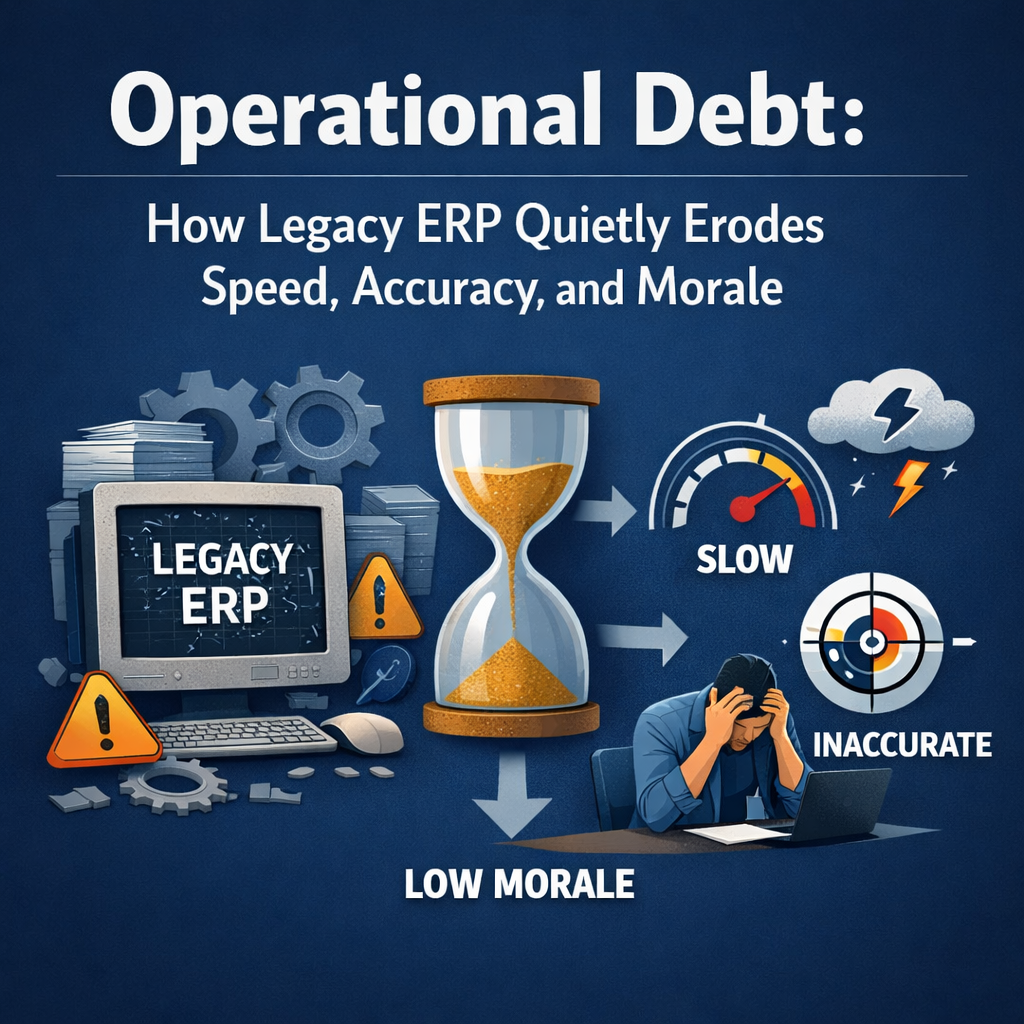
Operational Debt: How Legacy ERP Quietly Erodes Speed, Accuracy, and Morale
Most distributors understand technical debt—the accumulated cost of outdated code and patchwork systems. But fewer recognize operational debt: the compounding inefficiencies that legacy ERP systems impose on daily operations.
Unlike technical debt, which affects IT departments, operational debt touches every employee. It manifests in workarounds, manual processes, and the constant friction of working against rather than with enterprise software. Over time, this debt doesn’t just slow operations—it fundamentally limits what a distribution business can achieve.
This article examines how legacy ERP systems create operational debt, the hidden costs this debt imposes, and why addressing it requires more than incremental improvements.
Understanding Operational Debt in Distribution
Operational debt accumulates when systems force inefficient processes that compound over time. Each workaround, manual step, or data re-entry becomes standard practice. Teams adapt to limitations rather than questioning them.
Consider a typical scenario: A legacy ERP lacks native e-commerce integration, so orders from the web store arrive via email. Someone manually enters these orders into the system, checking inventory availability by switching between screens. If products are out of stock, they email the warehouse to confirm back-order timelines, then manually update the customer.
This process works—technically. Orders get fulfilled. But it’s slow, error-prone, and requires experienced staff who know all the workarounds. More importantly, it’s invisible to leadership as a cost center because “this is how we’ve always done it.”
That’s operational debt.
How Legacy ERP Systems Create Operational Debt
Rigid Workflows That Don’t Match Business Reality
Legacy ERP platforms were designed decades ago for different operational models. They assume linear processes: order entry, then inventory allocation, then picking, then shipping. But modern distribution is more dynamic.
The reality distributors face: Customer orders increasingly involve partial shipments, drop-shipping, cross-docking, and real-time inventory checks across multiple warehouses. Sales reps need to quote based on actual availability, not yesterday’s inventory snapshot.
What legacy systems force: Sequential processing that can’t accommodate these scenarios without manual intervention. Want to split a shipment between warehouses? That requires creating multiple orders manually. Need to confirm inventory before quoting? Someone must check each location separately.
The system becomes a constraint rather than an enabler. Employees develop elaborate workarounds, creating unofficial processes that exist only in institutional knowledge.
Information Silos That Prevent Real-Time Decision Making
Legacy ERP architectures typically separate functional modules—financials, inventory, purchasing, sales—with batch processing connecting them periodically. Data flows between modules overnight or at scheduled intervals.
The operational cost: Decisions get made on outdated information. A sales rep quotes a delivery date based on inventory levels from this morning, unaware that warehouse just allocated that stock to another order. Finance runs reports showing healthy margins on products that purchasing knows have increased in cost but haven’t updated yet.
When information isn’t synchronized in real-time, every department operates with slightly different versions of reality. The gaps between these versions create errors, delays, and customer disappointments.
User Interfaces Built for Experts, Not Efficiency
Many legacy ERP systems require extensive training because they were designed when software users were specialists. Screens display dozens of fields, most irrelevant to any specific task. Common actions require navigating through multiple menus or remembering obscure codes.
The hidden cost: New employees take months to become proficient. Experienced staff become bottlenecks because only they know the shortcuts and workarounds. Simple tasks like checking an order status or updating customer information require unnecessary expertise.
This complexity doesn’t add value—it adds friction. Every transaction takes longer than it should. Every new hire represents months of reduced productivity. Every experienced employee who leaves takes institutional knowledge with them.
Integration Fragility That Creates Constant Maintenance
As distributors adopt new technologies—e-commerce platforms, EDI connections, warehouse automation, shipping integrations—legacy ERP systems require custom integrations. These integrations are often fragile, breaking when either system updates.
The ongoing burden: IT teams spend more time maintaining existing integrations than implementing new capabilities. When an integration breaks, operations halt until someone manually bridges the gap. The fear of disruption discourages adopting new tools that could improve efficiency.
Distributors effectively become locked into their current toolset, unable to take advantage of innovations because integration complexity makes change too risky.
The Compounding Costs of Operational Debt
Productivity Loss Across the Organization
Operational debt doesn’t affect one department—it compounds across the entire organization. Consider a typical order-to-cash cycle in a distribution business operating on legacy ERP:
Order entry: Sales rep takes 8 minutes instead of 2 minutes because they must check inventory across locations manually, verify pricing in a separate spreadsheet (because the ERP pricing module doesn’t handle volume discounts correctly), and enter customer information that should auto-populate.
Order fulfillment: Warehouse receives pick list with errors because the system doesn’t validate inventory locations properly. Pickers spend 15 extra minutes per order reconciling what the system says versus what’s actually in bins. They write corrections on paper that someone enters later.
Invoicing: Finance waits for end-of-day batch processing to generate invoices. When customers call about invoice discrepancies, resolving them requires pulling information from multiple screens because the ERP doesn’t show a complete order history in one view.
Customer service: When customers inquire about order status, representatives can’t provide real-time tracking because the warehouse management system doesn’t sync with the ERP until overnight processing completes.
Across a 50-person distribution operation, these inefficiencies might represent 15-20 hours of lost productivity daily—equivalent to 2-3 full-time employees doing work that adds no value. At fully loaded labor costs of $75,000 annually per employee, that’s $150,000-$225,000 in pure waste.
Error Rates That Erode Customer Confidence
Manual processes and disconnected systems create errors. Data entry mistakes, inventory discrepancies, pricing errors, and shipping mistakes all increase when systems don’t automate and validate information flow.
Research from industry analysts suggests that distributors using legacy systems experience error rates 3-5 times higher than those on modern platforms. For a distributor processing 50,000 orders annually, the difference between a 2% error rate and a 0.5% error rate is 750 mistakes—each requiring time to identify, correct, and explain to customers.
The financial impact extends beyond correction costs: Errors damage customer relationships. A distributor that consistently ships incorrect quantities, misses delivery commitments, or invoices incorrectly becomes unreliable. Customers place smaller orders, demand more frequent confirmations, or simply switch to competitors who demonstrate better operational control.
The cost of losing a customer far exceeds the cost of fixing individual errors. For a distributor with average customer lifetime value of $50,000, losing just 10 customers annually to operational failures represents $500,000 in lost revenue.
Employee Morale Damage From Fighting the System
Operational debt affects more than efficiency metrics—it impacts the daily experience of working at the company. Employees who spend their days managing workarounds, correcting system errors, and explaining delays to frustrated customers become demoralized.
The manifestations are subtle but significant: Experienced employees leave for competitors with better tools. New hires struggle to understand why simple tasks are so complicated. Departments blame each other for problems that are actually system limitations. Innovation stagnates because everyone is too busy maintaining current operations to improve them.
Exit interviews at distribution companies often reveal that frustration with inadequate systems ranked among the top reasons for leaving. In a tight labor market, where replacing a warehouse manager or experienced customer service representative can take months and cost $30,000-$50,000 in recruitment and training, operational debt directly drives turnover costs.
Strategic Limitation From Operational Constraints
Perhaps the most insidious cost of operational debt is how it limits strategic options. When systems can’t support new business models, geographic expansion, or product line extensions, distributors remain constrained to their current approach regardless of market opportunities.
Examples of strategic limitations:
A distributor wants to expand e-commerce but their legacy ERP can’t provide real-time inventory visibility across warehouses, making them unable to confidently sell online without risk of overselling. They lose market share to competitors who can.
A distributor sees opportunity serving customers who require EDI ordering but their system requires extensive custom development to support it. By the time integration is complete, competitors have captured those customers.
A distributor considers acquiring a smaller competitor to expand territory but realizes their systems are incompatible and integration would take 18 months. The acquisition opportunity passes to a competitor with more flexible technology.
In each case, the limitation isn’t capital, market knowledge, or operational capability—it’s that legacy systems can’t support the change quickly enough to capitalize on the opportunity.
Why Operational Debt Is Often Invisible to Leadership
Systems Work “Good Enough” Until They Don’t
Legacy ERP systems don’t fail catastrophically—they gradually become more burdensome. Orders still get processed. Invoices still get sent. Inventory still gets tracked. Leadership sees functioning operations and may not recognize the inefficiency tax being paid daily.
The gradual nature of operational debt makes it particularly dangerous. By the time the pain becomes undeniable, competitors have already gained significant advantages. The distributor that upgraded their ERP three years ago is now processing orders 40% faster, with half the error rate, using the same headcount.
Employees Adapt Rather Than Escalate
When systems are difficult to use, employees develop workarounds rather than complaining. They keep spreadsheets to track information the ERP should provide. They build informal communication channels to route around system limitations. They become experts at “making it work.”
This adaptability is admirable but masks the underlying problem. Leadership sees employees getting work done and assumes operations are efficient. The true cost—the hours spent on workarounds, the errors from manual processes, the opportunities missed because operations can’t scale—remains hidden.
The Status Quo Bias Prevents Objective Assessment
Organizations naturally resist change, especially when change involves the system at the heart of operations. Leadership might acknowledge that the current ERP has limitations but believes those limitations are manageable or that all systems have similar issues.
“Every ERP requires workarounds” becomes accepted wisdom. “The devil you know is better than the devil you don’t” justifies inaction. “We’ve invested too much to change now” turns past costs into future constraints.
These beliefs prevent objective assessment of whether operational debt has reached the point where change would deliver ROI quickly enough to justify the disruption.
The False Economy of Incremental Improvements
When operational debt becomes undeniable, distributors often attempt incremental improvements: implementing a bolt-on warehouse management system, adding e-commerce integration through middleware, or training staff on advanced features they’ve never used.
These approaches rarely resolve underlying issues and sometimes make them worse.
More Integrations Mean More Fragility
Adding systems to compensate for ERP limitations increases complexity. Now instead of one system requiring workarounds, there are three systems with two integration points. Each integration represents a potential failure point and ongoing maintenance burden.
The warehouse management system might improve picking efficiency but creates new problems when inventory doesn’t sync properly with the ERP. The e-commerce platform enables online ordering but causes confusion when customers call about orders that haven’t appeared in the main system yet.
Training Can’t Fix Fundamental Design Problems
Better training helps employees use systems more efficiently within their constraints, but it doesn’t eliminate those constraints. If the ERP requires checking three different screens to verify order status, training makes employees faster at switching between screens—it doesn’t give them a single unified view.
Training also doesn’t address the fundamental user experience issues. A system designed 20 years ago for expert users won’t become intuitive through training. It will always require memorizing obscure codes, navigating complex menu structures, and understanding architectural limitations.
Customization Creates Technical Debt Alongside Operational Debt
Legacy ERP systems often allow extensive customization to address specific business needs. While customization seems attractive, it creates long-term problems that compound operational debt with technical debt.
Custom code breaks during system upgrades, forcing distributors to choose between staying on outdated versions or paying to re-implement customizations. The original developers may have left, making maintenance dependent on expensive consultants. Each customization makes the system more complex and harder to troubleshoot when problems arise.
Rather than reducing operational debt, customization often increases it by making the system more fragile and difficult to maintain.
The Path Forward: Eliminating Operational Debt
Recognizing When Incremental Improvement Isn’t Enough
Operational debt reaches a point where incremental improvements can’t resolve it. Several indicators suggest a distributor has crossed that threshold:
System limitations drive business decisions. When the company says “we can’t do that because the system won’t support it,” technology is constraining strategy rather than enabling it.
Workarounds have become standardized processes. When new employees are trained on elaborate workarounds rather than straightforward system use, the operational debt is embedded in operations.
Integration maintenance consumes IT resources. When IT teams spend more time keeping current systems working than implementing new capabilities, fragility has become the norm.
Employees leave citing system frustration. When exit interviews repeatedly mention inadequate tools, operational debt is affecting the company’s ability to retain talent.
Error rates remain high despite training. When mistakes persist despite employee competence, the systems are creating errors faster than training can prevent them.
Any of these indicators alone suggests significant operational debt. Multiple indicators together indicate that elimination, not reduction, is necessary.
Understanding the True Cost of Status Quo
Before evaluating alternatives, distributors should quantify their current operational debt. This assessment typically reveals costs far higher than leadership expected.
Productivity analysis: Track time spent on workarounds, manual data entry, error correction, and system navigation for representative tasks. Calculate the labor cost of inefficiency across the organization.
Error cost calculation: Document error rates, correction time, and customer impact. Include both direct costs (labor to fix mistakes) and indirect costs (customer dissatisfaction, lost orders, damaged relationships).
Opportunity cost assessment: Identify strategic initiatives that system limitations have prevented or delayed. Estimate the revenue impact of not being able to pursue these opportunities.
Employee turnover analysis: Calculate recruitment and training costs for positions with high turnover related to system frustration.
For a typical mid-market distributor, this analysis often reveals annual operational debt costs between $500,000 and $2 million—far more than the perceived cost of replacing legacy systems.
Evaluating Modern Distribution ERP Alternatives
Modern cloud-native ERP platforms eliminate operational debt by fundamentally rethinking distribution software architecture. Rather than bolting new capabilities onto decades-old foundations, they’re designed from the ground up for how distributors operate today.
Real-time data architecture: Modern systems maintain a single source of truth accessible by all modules simultaneously. When warehouse staff allocate inventory, sales reps see the change immediately. When purchasing updates costs, finance sees margin impacts in real-time. Information flows continuously rather than in batch processes.
Intuitive user interfaces: Modern ERP platforms are designed for actual users, not IT specialists. Common tasks require minimal clicks. Information displays in context rather than across multiple screens. New employees become productive in days rather than months.
Native integrations: Cloud-native platforms offer pre-built integrations with e-commerce platforms, shipping carriers, EDI networks, and warehouse automation. These integrations are maintained by the vendor, eliminating custom code fragility.
Flexible workflows: Modern systems accommodate the complexity of actual distribution operations—partial shipments, cross-docking, drop-shipping, multi-warehouse allocation—without requiring workarounds or manual intervention.
The difference isn’t incremental—it’s transformational. Distributors that migrate from legacy systems to modern platforms report 30-50% improvements in order processing speed, error rate reductions of 60-80%, and employee satisfaction scores that reflect the relief of finally having tools that work with them rather than against them.
Implementation as Operational Debt Elimination
Implementing modern ERP isn’t about adding capabilities—it’s about eliminating the accumulated inefficiencies that legacy systems created. The ROI comes not primarily from new features but from removing friction from existing processes.
Process cleanup: Migration forces documentation and examination of current workflows. Many “standard processes” turn out to be workarounds that modern systems make unnecessary. Implementation becomes an opportunity to eliminate operational debt rather than simply automating it.
Knowledge capture: When experienced employees demonstrate current workarounds, that institutional knowledge gets captured and formalized. Modern systems can often automate what previously required manual expertise.
Change management: Employees who’ve spent years fighting inadequate tools are typically eager to adopt systems that make their work easier. Resistance is lower than leadership expects because staff immediately recognize the operational improvements.
Rapid value realization: Unlike legacy implementations that took 18-24 months, modern cloud ERP platforms can go live in 3-6 months for typical mid-market distributors. The shorter timeline means operational debt elimination begins quickly rather than extending years into the future.
Moving Beyond Operational Debt
Distributors that continue relying on legacy ERP systems will face rising operational debt. Manual processes and fragile integrations slow down growth and increase errors. Employee frustration grows as competitors gain advantages through superior technology.
By adopting modern cloud-native distribution ERP software, companies eliminate accumulated operational debt and establish foundations for sustained efficiency. The result is faster order processing, higher accuracy, improved employee morale, and the agility to pursue strategic opportunities without system constraints.
For distributors, eliminating operational debt isn’t just an operational improvement—it’s a competitive necessity. Schedule a demo to see how modern distribution ERP eliminates the operational debt that legacy systems create.