
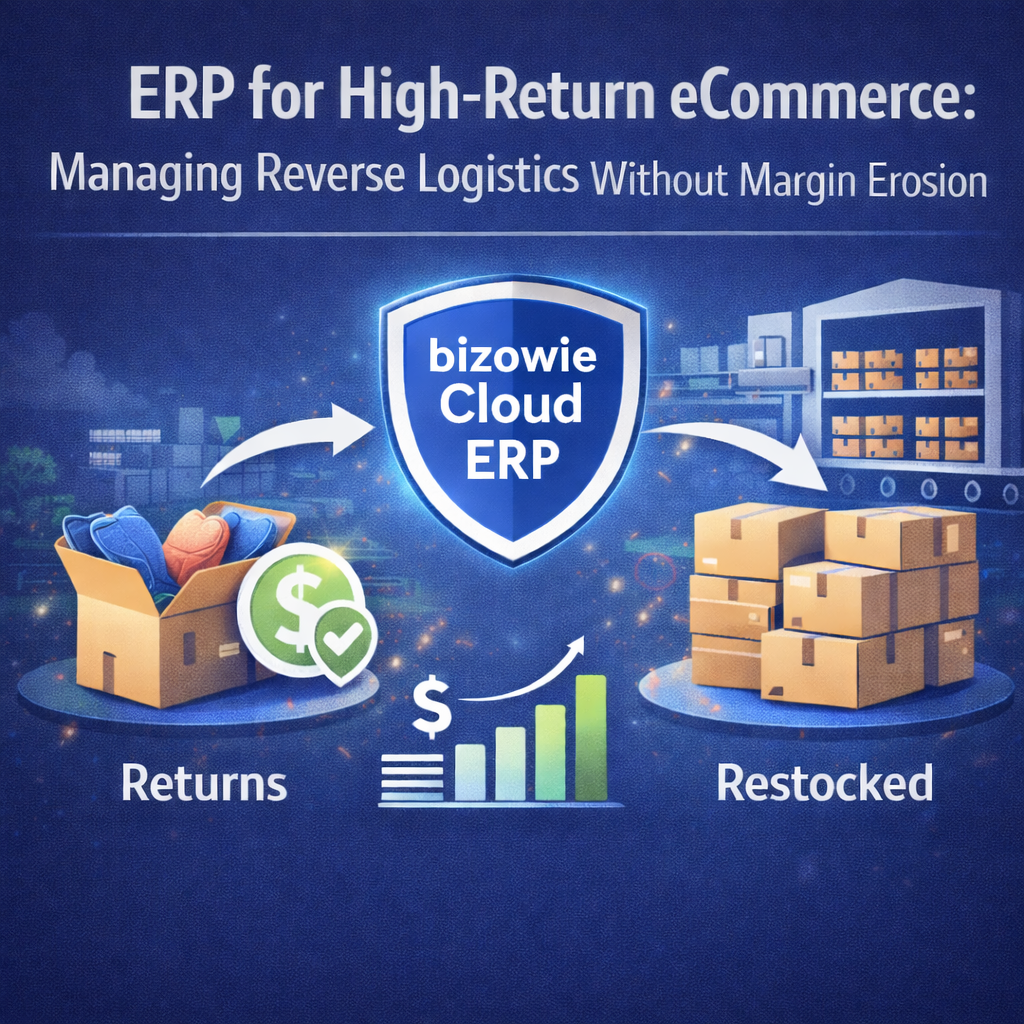
ERP for High-Return eCommerce: Managing Reverse Logistics Without Margin Erosion
In fashion, footwear, home goods, and beauty categories, return rates averaging 25-40% aren’t operational anomalies—they’re market realities driven by customer expectations around try-before-you-buy shopping experiences, fit uncertainty that online purchasing creates, and liberal return policies that competitive pressure demands. While these high return rates enable the customer experience that drives eCommerce conversion, they create profound challenges for profitability and operational efficiency.
The economics are sobering. A $100 product order that generates $45 gross margin looks healthy until you factor in the total cost of reverse logistics: return shipping ($8-12), warehouse receiving and inspection labor ($4-6), restocking and inventory management ($2-3), customer service time handling return inquiries ($3-5), payment processing fees on refunded amounts ($2-3), and markdown costs when returned products can’t be resold at full price ($8-15 on 20% of returns). Suddenly that $45 gross margin shrinks to $15-20 net contribution—a 55-65% margin erosion directly attributable to reverse logistics costs.
For businesses operating in high-return categories, the challenge isn’t whether to accept returns—competitive dynamics and customer expectations make liberal return policies mandatory. The challenge is managing reverse logistics efficiently enough that returns don’t destroy unit economics. This requires sophisticated operational capabilities that most eCommerce businesses lack: automated return authorization that validates eligibility and routes returns appropriately, intelligent receiving workflows that inspect, grade, and disposition returned products efficiently, restocking logic that returns saleable products to available inventory immediately, disposition automation for damaged or unsaleable returns, financial integration that accurately tracks return costs and margin impacts, and analytics that identify return patterns requiring operational or product interventions.
Basic eCommerce platforms and disconnected operational systems can’t deliver this sophistication. They treat returns as afterthoughts—manual processes layered onto forward fulfillment workflows that weren’t designed for reverse logistics complexity. Modern cloud ERP platforms purpose-built for distribution operations integrate reverse logistics into core operational workflows, providing the automation, visibility, and cost control that high-return businesses require to maintain profitability despite significant return volumes.
The Hidden Cost Structure of Returns
Most eCommerce businesses dramatically underestimate the total cost of processing returns because these costs are distributed across multiple departments and operational processes. Understanding the complete cost structure is essential for building the business case for better reverse logistics management.
Direct Return Processing Costs
The most visible costs are the direct labor and materials required to physically process returns. When a return arrives at your warehouse, staff must receive the package, locate the original order, verify return eligibility, inspect the product for condition, make restocking decisions, update inventory systems, process refunds, and handle packaging disposal. This workflow typically consumes 12-18 minutes of warehouse labor per return at fully-loaded costs of $25-30 per hour, translating to $5-9 per return in direct labor.
Return shipping costs add substantially to the total. If you offer free return shipping (increasingly standard in competitive categories), you’re absorbing $8-15 per return depending on package size, weight, and shipping distance. Some businesses shift this cost to customers through restocking fees or requiring customers to pay return shipping, but competitive pressure limits this option in many categories. Either way, return shipping represents real cost that must be managed.
Restocking materials and processing add additional direct costs. Returns require inspection supplies, repackaging materials when original packaging is damaged, condition-grading labels, and sometimes retagging or repackaging to return products to saleable condition. These materials costs typically add $1-3 per return. Quality inspection for returns requiring detailed evaluation (electronics, high-value items) can add another $3-8 per return when specialized inspection is required.
For a business processing 500 daily orders with a 30% return rate (150 daily returns), these direct costs total approximately $2,250-4,050 daily or $820,000-1,480,000 annually. This represents 4.5-8% of revenue for a business generating $18 million annually—a material operational expense that many businesses haven’t quantified precisely.
Opportunity Costs and Inventory Impacts
Beyond direct processing costs, returns create substantial opportunity costs through inventory unavailability during the return cycle and markdown costs when products can’t be resold at full price. These opportunity costs often exceed direct processing expenses but remain invisible in standard cost accounting.
The return cycle time—from customer initiating return to product being available for resale—typically spans 7-14 days in manual processes: 2-3 days for customer to ship the return, 1-2 days in carrier transit, 2-4 days in warehouse receiving queue before processing, 1-2 days for inspection and restocking decision, and 1-3 days to physically restock and update systems. During this entire period, the inventory unit exists in limbo—not available for sale despite being physically in your control.
For fast-moving products during peak selling seasons, this delay represents real revenue loss. That dress that’s in returns processing for 10 days during holiday shopping season might have generated 2-3 additional sales during that period. At $80 retail and 40% gross margin, each lost sale represents $32 in foregone contribution margin. Multiply across high-velocity returns and the opportunity cost becomes substantial—potentially $150,000-300,000 annually in lost margin for mid-size fashion retailers.
Markdown and write-off costs hit particularly hard. Industry data shows that 15-25% of returns can’t be resold at full price due to damage, wear, missing components, or obsolescence. These units require markdown (typically 30-50% off original price) or complete write-off if unsaleable. For products with $45 gross margin, a 40% markdown eliminates $18 of margin while a full write-off destroys all margin. At 20% of returns requiring markdown, you’re losing an additional $3-6 per return on average—adding another $164,000-328,000 annually to the true cost of returns for our example business.
Customer Service and Experience Costs
Return processing generates substantial customer service workload that most businesses haven’t quantified accurately. Customer inquiries about return policies, return authorization requests, return status tracking, refund timing questions, and resolution of return problems (missing items, incorrect refunds, restocking fee disputes) collectively consume significant service capacity.
Industry benchmarks suggest returns generate 2-3 customer service interactions per return on average—initial authorization request, potentially a status inquiry during processing, and sometimes refund confirmation or problem resolution. At 8-12 minutes per interaction and $35-45 per hour fully-loaded service costs, this represents $3-7 per return in customer service time. For our example business with 150 daily returns, this totals $450-1,050 daily or $164,000-383,000 annually in service costs directly attributable to returns.
The customer experience impact extends beyond immediate service costs. Returns that process slowly, refunds that take longer than expected, or products that receive incorrect restocking fees create customer dissatisfaction that damages lifetime value. Research consistently shows that 45-60% of customers with poor return experiences don’t return to that retailer. If poor returns experience causes just 5% of returning customers to churn, and those customers represent $350 average lifetime value, a business processing 54,000 annual returns could lose $945,000 in lifetime value annually from returns-related churn.
Payment Processing and Financial Costs
Returns create payment processing costs that many businesses overlook. When you refund a transaction, payment processors typically don’t refund their processing fees—you’ve paid 2.5-3.0% on the original transaction and you pay again on any new transaction when that customer repurchases. For returns that result in exchanges rather than net refunds, you’re effectively paying payment processing twice on the same revenue.
The financial impact accumulates quickly. At 30% return rates and $65 average order value with 2.7% payment processing fees, you pay $1.76 in processing fees on the original transaction. When 60% of returns result in exchanges (new orders), you pay another $1.76 on the replacement order. Across 54,000 annual returns with 32,400 exchanges, this represents $57,000 in duplicated payment processing fees directly attributable to returns.
Refund timing also creates working capital impacts. You’ve typically paid your supplier 30-60 days after receiving inventory. When products return within 30-90 days of sale, you’re refunding customers while still owing suppliers for the inventory. This timing creates working capital drag—you’re funding inventory that generated revenue that you then had to refund, leaving you out-of-pocket for the product cost during the return cycle.
Total Return Cost Reality
Aggregating these cost components reveals why returns erode margins so dramatically in high-return categories. For our example $100 product with $45 gross margin:
- Direct processing labor and materials: $8-12
- Return shipping (if absorbed): $10-13
- Customer service time: $3-7
- Payment processing duplication: $3-5
- Markdown/write-off allocation (20% at 40% markdown): $3-6
- Opportunity cost from inventory delay: $2-4
Total return cost: $29-47 per return, reducing the $45 gross margin to $-2 to $16 net contribution—margin erosion of 64-104%. While not every return incurs all these costs at maximum levels, the comprehensive cost structure explains why high-return businesses struggle with profitability despite healthy gross margins on initial sales.
How Basic Systems Fail Reverse Logistics
Most eCommerce platforms and basic operational systems treat returns as edge cases rather than core workflows. This architectural neglect creates manual processes, operational inefficiency, and lack of visibility that exacerbate return costs.
Manual Return Authorization and Routing
In basic systems, return authorization typically requires customers to contact customer service, wait for representative availability, explain their return reason, receive a manual return authorization number, get return shipping instructions, and wait for confirmation. This manual process creates several problems.
First is customer experience friction. Requiring customers to contact support for return authorization creates abandonment—customers who intended to return instead keep products because the return process seems too difficult. While preventing some returns, this friction damages customer satisfaction and lifetime value. Research shows customers rank return ease as the second most important factor (after price) in purchase decisions for categories with high return rates.
Second is operational inefficiency. Each return authorization requires 8-15 minutes of customer service time—time that scales linearly with return volume. At 150 daily returns, this consumes 20-37 staff hours daily just on authorization—equivalent to 3-5 full-time customer service representatives dedicated solely to return authorization. This labor could deliver far more value focused on sales support, proactive customer engagement, or complex problem resolution.
Third is lack of intelligent routing. Manual authorization can’t automatically route returns to optimal processing locations, flag returns requiring special handling, identify customers with problematic return patterns, or apply restocking fees consistently based on return reason and timing. These routing and policy decisions happen inconsistently based on individual representative judgment rather than systematic business logic.
Disconnected Returns Processing Workflows
When returns arrive at warehouses using basic systems, they enter manual workflows disconnected from forward fulfillment. Staff must find the physical return package among regular inbound shipments, manually search for the original order (often by reading handwritten notes or packing slips), determine what was returned versus what was ordered, inspect products without systematic grading standards, make restocking decisions without clear disposition rules, and manually update multiple systems to record the return, issue refunds, and restore inventory.
This disconnected workflow creates numerous failure modes. Returns sit in receiving areas for days awaiting processing because they’re not integrated into warehouse task management. Products get inspected inconsistently because grading standards aren’t systematically enforced. Restocking decisions vary based on which staff member processes the return rather than consistent business rules. Inventory updates lag by days or weeks because updating systems is a manual task that gets deferred during busy periods.
The operational inefficiency is substantial. Manual returns processing in disconnected workflows typically requires 15-25 minutes per return including receiving, inspection, decision-making, restocking, and system updates. Automated returns workflows in integrated ERP systems reduce this to 4-8 minutes per return through directed workflows and automatic system updates. For a business processing 150 daily returns, this efficiency difference represents 27-42 hours of daily labor savings—equivalent to 4-6 full-time warehouse staff.
Inventory Accuracy and Availability Problems
Perhaps the most damaging failure of basic systems is the inventory accuracy problems that manual returns processing creates. When returns processing is disconnected from inventory management, several systemic problems emerge.
First is the delay between physical return arrival and inventory system updates. Returns might arrive Monday but not get recorded in inventory systems until Friday’s batch update. During this 5-day lag, your systems show “out of stock” while returned units sit in your warehouse available for resale. This artificial stockout creates lost sales and customer frustration—exactly the opportunity cost discussed earlier.
Second is the inspection and disposition delay. Returns enter inventory as “returned” status but remain unavailable for sale until someone inspects them and confirms they’re resaleable. In manual processes, this inspection might not happen for days or weeks, keeping perfectly good inventory locked away from customers. Even worse, some businesses never formalize inspection—returns just sit indefinitely in a “returned products” area rather than being systematically evaluated and restocked.
Third is the lack of returns-specific inventory tracking. Basic systems don’t distinguish between new inventory from suppliers and returned inventory from customers. This creates problems for categories where returns have different characteristics than new inventory: returned apparel might need pressing or repackaging, returned electronics might need firmware updates or battery replacement, returned items might have minor cosmetic damage affecting pricing. Without systematic returns inventory tracking, these nuances get lost and returned products enter inventory with incorrect assumptions about their condition and value.
Financial Visibility and Cost Allocation Gaps
Most basic systems provide minimal visibility into returns financial impact beyond tracking refund amounts. They don’t capture the comprehensive costs—processing labor, return shipping, inspection time, restocking materials, markdown impacts—that determine true return profitability. This financial opacity prevents understanding which products, channels, or customer segments generate acceptable returns economics versus destroying margins.
The analytical blindness prevents strategic intervention. You can’t identify which products have return rates so high that their apparent profitability is illusory once return costs are allocated. You can’t determine whether certain customer segments or channels generate disproportionate return costs requiring policy or operational changes. You can’t evaluate whether investments in better product descriptions, sizing tools, or quality improvements would deliver positive ROI through reduced returns.
This lack of financial visibility means return costs remain hidden in aggregate operational expenses rather than being allocated to the products, channels, and customers that generate them. This cost allocation failure systematically distorts profitability analysis and leads to poor strategic decisions about product mix, channel allocation, and customer acquisition.
How Integrated ERP Transforms Reverse Logistics
Modern cloud ERP platforms purpose-built for distribution operations treat reverse logistics as a core workflow rather than an afterthought. This architectural integration delivers the automation, visibility, and cost control that high-return businesses require.
Automated Return Authorization and Intelligent Routing
Integrated ERP enables customer self-service return authorization through web portals or email automation that validates return eligibility, determines appropriate return routing, applies restocking fees based on configurable rules, and generates return shipping labels automatically. This automation eliminates customer service bottlenecks while ensuring consistent policy application.
The automation follows sophisticated logic: verify the order exists and is within the return window, check product return eligibility (some items may be final sale), evaluate return reason to determine if restocking fees apply, calculate appropriate refund amount including original shipping if applicable, determine optimal return destination if operating multiple receiving locations, generate return authorization with unique tracking number, and create return shipping label with appropriate carrier and service level. This entire workflow executes in seconds without human intervention.
The intelligent routing optimizes return processing costs and speed. For businesses operating multiple warehouse locations, the system can route returns to the facility closest to the customer (reducing return shipping costs), to facilities with capacity for return processing (balancing workload), or to specialized return centers if operating dedicated reverse logistics facilities. This routing happens automatically based on configurable business rules rather than requiring manual coordination.
Return authorization also captures rich data about return reasons that enables strategic analysis. When customers self-serve authorization, they select from standardized return reason codes (didn’t fit, quality issue, wrong item shipped, changed mind, etc.). This structured data enables analyzing return drivers by product, category, and time period—insights impossible to extract from unstructured notes in manual processes.
Integrated Return Receiving and Inspection Workflows
When returns arrive at warehouses, integrated ERP creates directed return processing workflows that guide staff through receiving, inspection, grading, and disposition with the same systematic approach used for forward fulfillment. The system provides mobile-device-directed workflows: scan return package barcode to identify which return authorization this represents, display original order details and expected return items, prompt inspection with product-specific grading criteria, capture condition assessment (new, like new, light wear, damaged), apply disposition rules based on condition (restock at full price, markdown, write-off), and automatically update inventory and trigger refund processing based on disposition.
This directed workflow delivers several benefits. First is processing speed—staff don’t waste time searching for order information, determining inspection criteria, or figuring out what to do with products of different conditions. The system provides explicit instructions at each step. This typically reduces per-return processing time by 60-70% compared to manual workflows.
Second is consistency—inspection and grading follow standardized criteria rather than individual judgment. This prevents the inconsistency where one staff member restocks items that another would markdown, ensuring uniform quality standards and accurate inventory value. The standardization also supports audit trails showing why disposition decisions were made.
Third is automatic system updates—as returns are processed, inventory quantities update in real-time, refunds trigger automatically based on disposition, financial postings reflect markdown or write-off costs, and customer service representatives gain visibility into return status. This automation eliminates the manual system updates that create lag and errors in disconnected workflows.
Intelligent Disposition and Restocking Logic
Perhaps the most value-creating capability is intelligent disposition logic that determines what to do with returned products based on condition, product characteristics, demand patterns, and business rules. Rather than making these decisions manually or inconsistently, integrated ERP applies systematic disposition rules.
The disposition logic evaluates multiple factors: product condition from inspection (new/like new → restock at full price, light wear → restock at discount, damaged → evaluate repair cost versus write-off), demand velocity (fast-moving products restock immediately, slow-moving might sell to liquidators, obsolete products write off), time since return (recent returns restock, old returns might have declined in value), and product category rules (apparel might accept light wear, electronics might require perfect condition, consumables might prohibit any returns). These factors combine to drive automatic disposition decisions that optimize value recovery.
The restocking process is equally automated. Products approved for restocking immediately update inventory availability (they become saleable again within minutes of disposition), update at appropriate price point (full price, markdown price, or clearance), post to appropriate warehouse location (returns might stock separately from new inventory), and potentially trigger listing updates across sales channels (particularly for marketplace integrations where returned units need reactivation). This automation dramatically reduces the inventory unavailability window that creates opportunity costs in manual processes.
For products requiring markdown, the system can implement sophisticated markdown strategies: create separate “open box” or “like new” SKUs that sell at discount without affecting new product pricing, automatically adjust pricing based on demand (aggressive discounts for slow-moving returns, modest discounts for high-demand items), or route to liquidation channels if markdown pricing still doesn’t move inventory quickly. These strategies maximize value recovery from returned products that can’t sell at full price.
Returns-Specific Financial Tracking and Cost Allocation
Integrated ERP captures comprehensive financial data about return costs and allocates these costs to products, channels, and customers with precision that disconnected systems can’t match. This financial visibility enables strategic decision-making about where returns are destroying value versus where returns are acceptable business costs.
The financial tracking captures all return cost components: direct processing labor from warehouse time tracking, return shipping costs from carrier integrations, inspection time for detailed product evaluation, restocking materials and labor, markdown costs when products sell below original price, write-off costs for unsaleable returns, and customer service time handling return inquiries and issues. These costs aggregate to product, customer, and channel dimensions enabling comprehensive profitability analysis.
Product-level return cost allocation reveals true profitability including reverse logistics. A product showing 42% gross margin might deliver just 18% net margin after allocating return costs. This visibility enables strategic decisions: discontinuing products where return costs destroy profitability, improving product descriptions or sizing guidance for products with high “didn’t fit” returns, and accepting higher return rates on products where margins remain healthy even after return costs.
Customer segment return profitability shows which customers generate acceptable returns economics versus abusing liberal return policies. Some customers maintain 5-10% return rates and generate strong lifetime value. Others return 60-80% of purchases and generate negative lifetime value when return costs are allocated. This visibility enables implementing customer-specific return policies: liberal policies for valuable customers, restocking fees for customers with problematic return patterns, and potentially declining to serve customers whose return behavior is consistently unprofitable.
Channel return economics vary dramatically based on return rates, product mix, and customer expectations. Marketplace channels might have 35% return rates versus 22% on DTC website due to customer shopping behavior differences. Wholesale channels might have 5% return rates but higher per-return costs due to larger shipment sizes. Understanding these channel differences enables optimizing channel strategy, allocating inventory appropriately, and setting channel-specific policies.
Returns Analytics and Pattern Identification
Beyond operational efficiency and financial visibility, integrated ERP provides analytical capabilities that identify return patterns requiring intervention. These analytics transform returns from a cost to be minimized into a data source that drives product, operational, and customer experience improvements.
Product return pattern analysis identifies specific items with problematic return characteristics: products with return rates 2-3x category average that might have quality issues or misleading descriptions, products with high “didn’t fit” returns that need sizing guidance improvements, products with “not as expected” returns that might have inadequate imagery or descriptions, and products with quality-related returns that need supplier discussions or discontinuation. These insights drive targeted interventions rather than generic return reduction efforts.
Seasonal and temporal return pattern analysis reveals timing dynamics: return rate spikes after promotional campaigns (suggesting customers buying speculatively), higher returns of certain products during specific seasons (sizing issues varying by product line), return rate increases around holidays (gift purchases have higher return likelihood), and day-of-week patterns that help plan return processing capacity. This temporal understanding enables predictive staffing and proactive policy adjustments.
Customer return behavior segmentation identifies different customer archetypes: low-return customers (sub-10% return rates) who value their time and keep most purchases, moderate-return customers (20-30% return rates) exhibiting normal category behavior, high-return customers (50%+ return rates) potentially engaging in “wardrobing” or selection shopping, and serial returners (80%+ return rates) who are systematically unprofitable. This segmentation enables tailored policies and targeted interventions.
The analytical sophistication extends to predictive returns modeling. By analyzing historical patterns, the system can predict expected return rates by product, customer segment, season, and channel. These predictions enable proactive inventory planning (ordering extra inventory for high-return products to maintain availability), financial forecasting (accurate return rate assumptions improve margin projections), and strategic planning (understanding true unit economics when launching new products or channels).
Integration: Connecting Returns to Your Complete Operation
The full value of sophisticated reverse logistics management emerges when returns processing integrates seamlessly with your broader operational and financial systems. Modern ERP platforms provide this integration depth that standalone returns management solutions can’t match.
Inventory Management Integration
Returns must integrate tightly with inventory management to ensure accurate availability, appropriate product placement, and optimal stock levels. Integrated ERP connects returns processing to core inventory workflows through automatic inventory updates when returns are dispositioned, appropriate inventory status tracking (returned awaiting inspection, inspected and approved, marked down, written off), lot and expiration date tracking for returned batch-controlled inventory, and multi-location inventory management when returns might restock at different facilities than original shipment.
This integration eliminates the inventory accuracy problems that plague disconnected systems. Returned products become available for sale within minutes of being dispositioned as restockable rather than sitting in limbo for days or weeks. Inventory quantities continuously reflect return activity rather than requiring periodic reconciliation. The system prevents selling returned products that haven’t been inspected or that failed quality checks—a critical control for maintaining customer satisfaction.
The inventory integration also enables sophisticated allocation of returned inventory. Products returned to your Nashville warehouse can fulfill orders across all sales channels, not just orders that would naturally ship from Nashville. Returned inventory participates in the same dynamic allocation logic as new inventory—it’s not segregated into separate “returned inventory” pools that have limited visibility and slower turn.
Order Management and Customer Communication Integration
Returns fundamentally connect to original orders—understanding what the customer bought enables processing what they’re returning. Integrated ERP maintains complete order-to-return traceability: linking return authorizations to specific original orders, tracking which items from multi-item orders are being returned, managing partial returns where some items are kept and others returned, and handling exchanges where returns accompany new orders. This traceability enables accurate refund calculation, appropriate restocking fee application, and comprehensive customer purchase history visibility.
The customer communication integration provides transparency that builds trust despite returns. Customers receive automatic notifications when returns are authorized (confirming return details and providing tracking), when returns are received at warehouse (acknowledging receipt and setting refund expectations), when returns are inspected (for high-value items where customers want disposition confirmation), and when refunds are processed (confirming refund amount and method). This proactive communication reduces customer service inquiries and anxiety about return status.
Customer service representatives gain complete visibility into return status and history. When customers call about returns, representatives see return authorization details, current processing status, expected refund timing, and any issues requiring resolution. This visibility enables confident, accurate responses rather than “let me check on that and call you back” deferrals that frustrate customers.
Financial Accounting Integration
Returns create significant financial activity that must be accurately recorded: refund transactions that reverse revenue, inventory value adjustments when products return at lower value, write-off expenses for unsaleable returns, return processing costs that need allocation, and potential sales tax refund implications. Integrated ERP handles all these financial postings automatically as returns are processed.
The revenue reversal posts automatically when refunds issue—crediting revenue accounts, debiting cash or accounts receivable, and potentially reversing sales tax collections. This automation ensures income statement accuracy without manual journal entries. The timing is precise—revenue reverses when the refund processes rather than when someone manually creates an adjustment weeks later.
Inventory value adjustments post automatically based on return disposition. Products returned in saleable condition restore full inventory value. Products requiring markdown reduce inventory value to reflect lower selling price. Products written off as unsaleable reduce inventory value to zero while posting write-off expenses. These adjustments happen automatically as disposition decisions are made, keeping balance sheet inventory values accurate in real-time.
The cost allocation discussed earlier—processing labor, return shipping, inspection time, materials—posts to cost of returns accounts that enable analyzing total reverse logistics costs. This cost visibility supports both operational management (monitoring return processing efficiency) and strategic analysis (understanding true product and channel profitability after return costs).
Supplier and Vendor Management Integration
Some returns stem from supplier quality issues, shipping damage, or product defects that should be charged back to suppliers. Integrated ERP connects returns processing to vendor management and accounts payable to facilitate these chargebacks.
When returns inspection identifies supplier-caused issues, the system can automatically create vendor return authorizations requesting credit or replacement inventory, track returned products being sent back to suppliers, process supplier credits against accounts payable, and maintain supplier quality metrics showing return rates by supplier and product line. This integration ensures you’re not absorbing costs that suppliers should bear and provides data for supplier performance discussions.
The supplier integration also enables strategic vendor management. Suppliers with consistently high return rates due to quality issues can be identified for improvement discussions or replacement. Products with high defect-related returns might need quality specifications strengthened or inspection processes enhanced. This visibility transforms returns from operational problems into strategic supplier management opportunities.
Strategic Approaches to Return Rate Management
While operational efficiency in processing returns is essential, the ultimate margin protection comes from reducing return rates where possible. Integrated ERP provides the data visibility and analytical capability to implement strategic return reduction initiatives.
Product-Specific Return Mitigation
Product return rate analysis reveals specific items requiring intervention. The strategic responses vary based on return drivers:
For products with high “didn’t fit” returns: enhance sizing information with detailed measurements, add fit guidance based on customer feedback, implement size recommendation tools using purchase history, and provide comparison to similar products that fit well. These interventions typically reduce fit-related returns by 20-35% when well-executed.
For products with “not as expected” returns: improve product photography showing multiple angles and details, enhance product descriptions with materials, construction, and features information, add customer review photos showing products in real-world use, and create product videos demonstrating use and characteristics. Rich product content typically reduces expectation mismatch returns by 15-25%.
For products with quality-related returns: identify whether issues are consistent defects requiring supplier discussions, assess whether products need stronger quality inspection upon receipt, determine if return rates justify discontinuation, or evaluate whether price adjustments reflect actual quality. This quality-driven analysis prevents continuing to sell products that systematically disappoint customers.
The return rate benchmarking also identifies products performing exceptionally well—products with return rates 40-60% below category average. Understanding what makes these products successful (accurate descriptions, consistent quality, strong value proposition) enables replicating success across product line expansion.
Customer Education and Expectation Management
Many returns stem from customer misunderstanding of products, inaccurate expectations, or lack of information at purchase time. Strategic content and educational initiatives can reduce these returns while improving customer satisfaction.
Virtual try-on and visualization tools help customers understand how products will look or fit before purchase. For apparel, augmented reality fitting tools reduce return rates by 15-30%. For furniture and home goods, room visualization tools showing products in customer spaces reduce “doesn’t fit my space” returns by 20-40%. These tools require investment but deliver strong ROI in return reduction.
Detailed sizing and measurement guidance helps customers select appropriate sizes initially rather than ordering multiple sizes with intent to return. Size charts with detailed measurements, fit guidance indicating whether items run large/small/true to size, and customer review aggregation showing sizing patterns all reduce fit-related returns. Businesses implementing comprehensive sizing guidance typically see fit returns decrease 18-28%.
Post-purchase content helps customers get value from products and reduces “not as expected” returns. Email sequences with setup instructions, usage tips, styling suggestions, and care guidance help customers successfully use products and develop product attachment. This reduces the “didn’t work for me” returns that often stem from lack of information about optimal use.
Policy Optimization and Customer Segmentation
Return policy optimization balances customer experience with margin protection. Rather than applying uniform policies, sophisticated approaches segment customers and apply policies appropriately.
For high-value customers with low return rates: offer extended return windows (90-120 days versus standard 30), waive restocking fees completely, provide free return shipping, and expedite return processing and refunds. These generous policies reinforce that their business is valued and deepen loyalty.
For moderate-return customers exhibiting normal category behavior: apply standard return policies with reasonable windows (30-60 days), minimal or no restocking fees, and standard return shipping terms. These customers represent core business and policies should be competitive with category norms.
For high-return customers with problematic patterns: implement progressively more restrictive policies including restocking fees on excessive returns (defined as >50% return rate over trailing 6 months), shortened return windows, requirement to pay return shipping, and potentially “use it or lose it” language around future purchase eligibility. While these restrictions might lose some customers, they protect margins from systematic abuse.
The customer segmentation requires data visibility that integrated ERP provides. Without comprehensive return rate tracking by customer, you can’t identify problematic patterns until they’ve destroyed substantial value. With customer return analytics, you can intervene early and tailor policies appropriately.
Channel Strategy and Return Economics
Different sales channels have dramatically different return characteristics. Understanding channel return economics enables strategic channel management and resource allocation.
DTC websites typically have 20-30% return rates for fashion, with customers able to thoroughly research products before purchase. Marketplace channels often see 30-40% return rates as customers browse less carefully and comparison-shop more aggressively. Wholesale channels typically have sub-10% return rates as B2B buyers purchase more deliberately. Retail store channels have higher initial return rates but lower reverse logistics costs as returns happen in-person.
Channel strategy should reflect these return economics. If marketplace channels have return rates so high that they destroy profitability even on apparent sales, you might limit marketplace presence to clearance inventory or test products before committing to wholesale buys. If DTC channels deliver healthy margins even after return costs, you might allocate more inventory there and invest in customer acquisition. The strategic decisions require return cost visibility by channel—exactly what integrated ERP provides.
The channel strategy also includes channel-specific return policies. Marketplace channels might have more restrictive policies (higher restocking fees, shorter windows) to offset higher return rates. DTC channels might have more generous policies to compete effectively for direct customer relationships. Wholesale channels might have tighter policies reflecting their lower baseline return rates. This policy segmentation by channel optimizes overall return economics while maintaining competitive positioning where it matters most.
Implementation for High-Return Businesses
Implementing comprehensive reverse logistics management requires particular attention to return workflow design, inspection process definition, and analytics configuration. The implementation approach differs somewhat from standard ERP deployments due to returns-specific requirements.
Return Workflow Design and Configuration
The implementation begins with mapping your ideal return workflows: how customers should initiate returns, what information you need from customers to process returns effectively, how returns should be routed to appropriate receiving locations, what inspection and grading procedures ensure consistent quality assessment, how disposition decisions should be made based on product condition and characteristics, and how inventory, refunds, and customer communications should be automated. This workflow design determines how the ERP return management will actually operate.
The configuration includes defining return reason codes that customers select during authorization (didn’t fit, quality issue, wrong item shipped, changed mind, no longer needed, etc.), establishing inspection grading criteria specific to your product categories (apparel has different criteria than electronics), creating disposition rules that determine restocking, markdown, or write-off based on condition and product, setting restocking fee policies based on return reason and customer segment, and configuring refund timing and method based on disposition outcome.
The mobile workflow design matters significantly for warehouse efficiency. Return receiving staff should scan packages and see explicit instructions, inspection should prompt for specific condition attributes, and disposition should apply automated rules rather than requiring manual decisions. The mobile interface design directly impacts processing efficiency—intuitive workflows can reduce per-return time by 50% compared to clunky interfaces requiring multiple screens and manual data entry.
Returns Analytics and Reporting Design
Perhaps the most value-creating implementation component is designing the analytics and reporting that will drive strategic return management. The analytics framework should include product return rate dashboards showing returns by SKU with trending and category benchmarking, customer return behavior segmentation identifying low/medium/high return customers, channel return economics comparing return rates and costs across sales channels, return reason analysis showing drivers by product and channel, and financial return cost allocation showing total reverse logistics costs by product, customer, and channel.
The reporting design should provide both operational and strategic visibility. Operations teams need daily return processing metrics (units processed, average processing time, disposition outcomes, inventory restocked). Strategic teams need monthly return pattern analysis (return rate trends, cost evolution, product/channel performance). Finance needs accurate return cost allocation for profitability reporting. The reporting framework serves all these constituencies with appropriate data at right intervals.
The predictive analytics—forecasting expected return rates by product and channel—requires historical data for model training. Many implementations begin with manual forecast inputs, then transition to statistical models once 3-6 months of comprehensive return data has accumulated. This progressive sophistication is normal and appropriate—better to start with simpler analytics that provide value immediately than delay implementation waiting for sophisticated predictive models.
Integration with Existing Systems
Returns processing must integrate with multiple existing systems: eCommerce platforms and marketplaces providing return authorization, shipping carriers providing return labels and tracking, payment processors handling refunds, customer service platforms providing agent visibility, and financial accounting systems recording return financial implications. The integration architecture determines how seamlessly these systems work together.
The integration priority should focus on customer-facing systems first—ensuring return authorization works smoothly from your website and marketplaces, that return shipping labels generate correctly, and that refunds process reliably. These integrations directly affect customer experience. Back-office integrations like financial posting and analytics can be validated during implementation but don’t need to be customer-perfect on day one.
The integration testing should include realistic return scenarios: normal returns that restock at full price, partial returns from multi-item orders, returns requiring markdown due to condition issues, exchanges where returns accompany new orders, and problematic returns that need manual intervention. Testing these scenarios ensures the system handles real-world complexity rather than just happy-path returns.
Change Management for Returns-Focused Operations
Warehouse teams familiar with forward fulfillment need training in return-specific workflows that differ significantly. Customer service teams accustomed to manually handling returns need to adapt to customer self-service and automated authorization. Finance teams used to periodically reconciling returns need to understand real-time return cost visibility. This change management spans multiple departments.
The training should be role-specific and hands-on. Warehouse staff need extensive practice with mobile return receiving workflows, inspection procedures, and disposition rules. Customer service representatives need to understand the customer return authorization portal, return status visibility, and when manual intervention is appropriate versus when automation should handle it. Finance staff need to understand return cost allocation methodology and how to interpret returns profitability reporting.
The communication should emphasize how better returns management benefits each team. Warehouse operations get more efficient workflows that reduce processing time. Customer service gets reduced inquiry volume as customer self-service and proactive communications handle routine questions. Finance gets accurate margin visibility that enables better strategic decisions. This benefits framing accelerates adoption by showing how each team gains from the change.
The Business Case: Investment and Returns
Implementing comprehensive reverse logistics management represents significant investment, but the ROI is compelling for businesses with high return rates where margins are being systematically destroyed.
Investment Components
Cloud ERP platforms with sophisticated reverse logistics capabilities typically cost $40,000-65,000 annually in subscription fees for mid-to-large eCommerce businesses in high-return categories. This subscription includes unlimited users across warehouse, customer service, and management, return workflow automation and mobile receiving, integration with eCommerce platforms and carriers, returns analytics and reporting, and technical support.
Implementation services for return-focused ERP deployment typically range $35,000-75,000 depending on complexity. This includes return workflow design and configuration, mobile receiving and inspection setup, integration with eCommerce platforms, carriers, and financial systems, returns analytics and reporting configuration, user training across warehouse and customer service, and go-live support during initial return processing. The range reflects differences in product complexity (apparel requires different inspection than electronics), channel complexity (multi-marketplace businesses need more integrations), and operational sophistication (businesses wanting advanced analytics require more configuration).
Internal resource costs include time from operations, customer service, IT, and finance teams during implementation. Expect 250-400 hours across teams, representing $15,000-30,000 in fully-loaded internal investment.
Total first-year investment typically ranges $90,000-170,000 for mid-to-large eCommerce businesses in high-return categories. Subsequent years require only the annual subscription fee of $40,000-65,000. This represents substantial investment but must be evaluated against current return costs and margin erosion.
Quantifiable Operational Returns
Return processing efficiency improvement represents the most immediate return. Automated workflows, directed inspection, and integrated system updates typically reduce per-return processing time by 60-70%—from 15-20 minutes in manual processes to 5-7 minutes in automated workflows. For a business processing 150 daily returns (54,000 annually), this efficiency improvement saves 13,500-20,250 hours annually. At $25-30 per hour fully-loaded warehouse labor costs, this represents $337,500-607,500 in annual labor savings.
Inventory availability improvement through faster return-to-restock cycles typically increases revenue by 2-4% on returned products by reducing the inventory unavailability window. For a business with $18 million annual revenue, 30% return rate ($5.4 million returned product value), and 3% revenue improvement, this represents $162,000 in incremental revenue. At 38% gross margin, this is $61,560 in additional gross profit.
Markdown and write-off reduction through better inspection and faster restocking typically reduces markdown rates from 20-25% of returns to 12-15% of returns—an absolute reduction of 8-10 percentage points. For a business processing $5.4 million in returned product value, this reduction saves $432,000-540,000 in markdown costs annually. Even conservatively, this improvement typically delivers $250,000+ in annual benefit.
Customer service efficiency improvement from automated authorization and proactive communications typically reduces return-related service time by 40-50%. For a business with 150 daily returns generating 2.5 service interactions each at 10 minutes per interaction (56,250 annual minutes or 938 hours), a 45% reduction saves 422 hours annually. At $40 per hour fully-loaded customer service costs, this represents $16,880 in annual savings.
Combined, these operational benefits typically total $666,000-935,000 annually for a mid-market business processing 54,000 annual returns—substantial returns on a $90,000-170,000 first-year investment.
Strategic Value from Return Pattern Insights
Beyond operational improvements, return analytics enable strategic initiatives that reduce return rates and improve product and channel profitability. These strategic benefits often exceed operational savings but are harder to precisely attribute to returns management capabilities.
Product return rate reduction through targeted interventions (improved content, sizing guidance, quality improvements) typically reduces overall return rates by 3-6 percentage points over 12-18 months. For a business with 30% baseline return rate dropping to 26%, the reduction in reverse logistics costs alone saves $190,000-340,000 annually (using comprehensive per-return costs of $30-40). More significantly, the reduced returns improve customer satisfaction and lifetime value.
Channel profitability optimization based on accurate return cost allocation typically improves operating margin by 2-4 percentage points through better resource allocation. For a business generating $18 million revenue, a 3 percentage point margin improvement adds $540,000 in annual operating profit. While not all of this stems from returns management, visibility into channel return economics is often the enabling factor.
Customer lifetime value improvement from better return experiences (faster processing, accurate refunds, proactive communication) typically reduces returns-related churn by 30-40%. If returns-related churn affects 5% of returning customers annually (2,700 customers at 54,000 returns), reducing this by 35% saves 945 customers annually. At $350 lifetime value, this preserves $330,750 in customer lifetime value annually.
ROI Timeline and Total Value
Using conservative assumptions—$130,000 first-year investment generating $750,000 annual operational benefits plus $500,000 annual strategic value—the business case is compelling. First-year breakeven occurs within approximately 1.5 months of operation. Year two forward, with only $52,500 annual subscription cost against $1.25 million annual benefits, you’re generating 2,280% annual return on invested capital.
Five-year cumulative value typically exceeds $5.5-7.0 million from a one-time implementation investment of $130,000. This calculation excludes strategic benefits from improved brand reputation, customer satisfaction improvements, and competitive positioning that become possible when returns are managed as strategic capabilities rather than operational burdens.
The value realization follows a predictable timeline. Month 1-2 post-implementation show stabilization with limited benefits as teams adapt to new workflows. Months 3-6 demonstrate operational efficiency gains as return processing time decreases and inventory availability improves. Months 7-18 capture strategic benefits as return rate reduction initiatives take effect and channel optimization decisions based on accurate cost visibility improve profitability. Year 2+ represents sustained value from both operational excellence and continuous strategic refinement.
The Path Forward: Transforming Returns from Cost to Capability
For eCommerce businesses in high-return categories—fashion, footwear, home goods, beauty—return rates of 25-40% are market realities that won’t disappear. Customer expectations around liberal return policies, competitive pressure preventing restrictive policies, and the fundamental uncertainty of online purchasing ensure that returns remain central to the business model. The strategic question isn’t whether to accept returns but how to manage reverse logistics efficiently enough that returns don’t destroy unit economics.
The total cost of returns—typically $29-47 per return when fully allocated—can erode 55-65% of gross margins on products that return. Manual reverse logistics processes compound these costs through operational inefficiency, inventory unavailability during return cycles, inconsistent disposition decisions, and lack of strategic visibility into return drivers and economics. Basic eCommerce platforms and disconnected operational systems can’t deliver the sophisticated reverse logistics management that high-return businesses require.
Modern cloud ERP platforms integrate reverse logistics into core operational workflows through automated return authorization with intelligent routing, directed return receiving and inspection workflows, automatic disposition and restocking based on business rules, comprehensive return cost tracking and allocation, and returns analytics identifying patterns requiring strategic intervention. This integration transforms returns from margin-destroying costs into managed processes that preserve profitability despite high return volumes.
The implementation investment—typically $90,000-170,000 first-year for mid-to-large businesses—delivers compelling returns through $666,000-935,000 in annual operational benefits from processing efficiency, inventory availability, markdown reduction, and customer service savings. Strategic value from return rate reduction, channel optimization, and customer lifetime value improvement often exceeds operational savings. First-year breakeven typically occurs within 1-2 months, with five-year value creation exceeding $5.5-7.0 million.
Bizowie delivers sophisticated reverse logistics management through our unified cloud ERP platform designed specifically for distribution and eCommerce operations. Our comprehensive returns capabilities include customer self-service return authorization with policy automation, mobile-directed return receiving and inspection, intelligent disposition and restocking logic, complete return cost tracking and product/channel allocation, and returns analytics identifying opportunities for strategic intervention. Returns management isn’t an add-on module—it’s integrated into our core operational workflows ensuring seamless processing and accurate financial visibility.
We’ve helped dozens of high-return eCommerce businesses transform reverse logistics from a margin-destroying cost center into a managed operational capability that preserves profitability. Our implementation methodology focuses on return workflow optimization, inspection consistency, and strategic analytics that drive return rate reduction and channel optimization.
If you operate in fashion, footwear, home goods, beauty, or other high-return categories and are experiencing return rates above 25%, struggling with manual return processing consuming excessive labor, lacking visibility into true return costs by product and channel, or seeing margins erode despite healthy gross margin on initial sales, you’ve reached the point where sophisticated reverse logistics management delivers immediate, substantial value.
Ready to transform returns from margin destroyer to managed capability? Schedule a demo to see how Bizowie’s integrated reverse logistics management can reduce processing costs, improve inventory availability, provide strategic visibility, and protect margins despite high return volumes.
Related Reading
- Why RMA Management Can’t Be an Afterthought: The Hidden Cost of Poor Returns Processing
- Why ‘Real-Time Inventory’ Breaks Down in High-Volume eCommerce (And How ERP Fixes It)
- ERP for eCommerce COOs: Turning Fulfillment Complexity into Competitive Advantage
- The Fulfillment Bottleneck: When eCommerce Growth Outpaces Warehouse Systems
- Distribution ERP Software: A Buyer’s Guide