
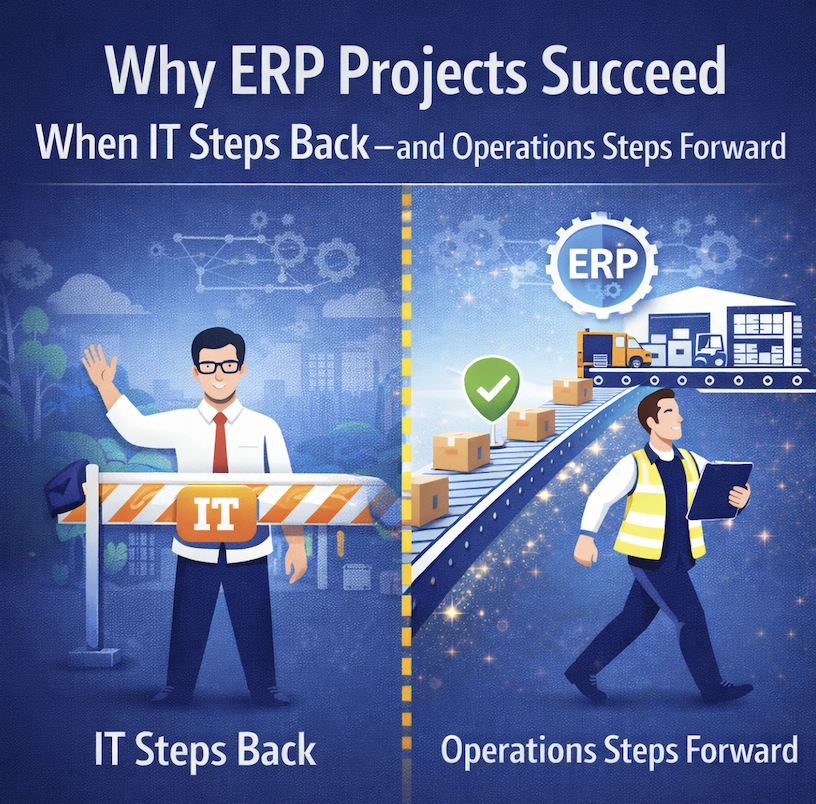
Why ERP Projects Succeed When IT Steps Back—and Operations Steps Forward
The Inconvenient Truth About ERP Implementation Leadership
There’s a fundamental misalignment at the heart of most ERP implementations that nobody wants to discuss openly. Companies invest millions in enterprise software designed to transform their operations, yet they consistently place IT departments—teams focused on infrastructure, security, and technical architecture—in the leadership position. The results speak for themselves: implementation timelines that stretch beyond reason, systems that don’t match actual workflows, and post-launch struggles that persist for years.
The statistics around ERP failure rates vary depending on who’s measuring and what constitutes “failure,” but the underlying pattern remains consistent. Projects run over budget, timelines extend well beyond initial projections, and businesses find themselves with functioning software that somehow fails to deliver the operational transformation they were promised. The usual explanations focus on scope creep, inadequate change management, or vendor shortcomings. But these are symptoms, not causes.
The actual problem is structural. When IT departments lead ERP implementations, the focus inevitably shifts toward technical considerations—system architecture, integration complexity, security protocols, and infrastructure requirements. These elements matter, certainly, but they’re not what determines whether an ERP system actually improves how your business operates. Operations leaders understand workflows, process bottlenecks, interdepartmental dependencies, and the practical realities of daily execution. They know where visibility gaps create problems, where manual workarounds waste time, and where process inefficiencies cost money.
This isn’t about diminishing IT’s importance. Technical expertise is essential for successful ERP implementation. But technical expertise should support operational objectives, not drive them. When the relationship inverts—when operational requirements must conform to IT preferences or technical limitations—you get systems that work perfectly from a technical standpoint while failing to deliver meaningful business value.
The Historical Context: How We Got Here
Understanding why IT-led implementations became the default requires looking at ERP’s evolution. Early enterprise systems emerged from manufacturing resource planning (MRP) software in the 1980s and 1990s. These were highly technical implementations requiring significant customization, complex integrations, and substantial infrastructure investments. They were installed on-premises, required dedicated servers, and demanded ongoing technical maintenance. IT leadership made sense in this context because the technical challenges genuinely dominated the implementation effort.
But the ERP landscape has fundamentally changed. Cloud-based platforms have eliminated most infrastructure complexity. Modern APIs have simplified integration challenges. User-friendly interfaces have reduced the technical barrier to system adoption. The technical aspects of ERP implementation, while still important, no longer represent the primary challenge or risk factor. Yet organizational habits persist, and IT departments continue leading implementations using frameworks designed for a different era.
This historical inertia creates a peculiar situation. Distribution companies invest in ERP systems specifically to improve operational efficiency, increase visibility, streamline workflows, and enhance decision-making capabilities. These are operational objectives requiring operational expertise to achieve. Yet they structure implementation teams with IT leadership, technical project managers, and governance frameworks focused primarily on system architecture rather than business process optimization.
The consequences manifest throughout the implementation lifecycle. Requirements gathering focuses on technical specifications rather than operational pain points. Configuration decisions prioritize system consistency over workflow efficiency. Testing emphasizes technical functionality rather than practical usability. Training centers on system features rather than process improvements. And post-implementation support addresses technical issues while operational challenges persist unresolved.
The IT Perspective: Why Technical Leadership Feels Right
Before exploring why operations leadership produces better outcomes, it’s worth understanding the IT perspective. From an IT standpoint, leading ERP implementations makes logical sense. These are complex software systems touching every department, requiring integrations with existing technologies, and creating security, data management, and compliance responsibilities that ultimately fall on IT teams. When implementations go wrong technically—data corruption, integration failures, security breaches, performance issues—IT faces the consequences.
IT departments also bring valuable capabilities to ERP implementations. They understand system architecture, can evaluate vendor technical claims realistically, know how to assess integration complexity, and have experience managing large-scale technology projects. They think systematically about dependencies, have frameworks for testing and validation, and understand the technical risks that can derail implementations.
Furthermore, IT teams often possess institutional knowledge about past technology projects, including what went wrong and why. They’ve seen vendors overpromise and underdeliver. They’ve experienced the consequences of inadequate testing or rushed timelines. They’ve dealt with the aftermath of implementations that prioritized speed over stability. This experience creates understandable caution and a preference for methodical, technically-sound approaches.
But this perspective contains a fundamental limitation: IT departments optimize for technical success, not operational transformation. A technically perfect implementation can still fail to improve how your business actually operates. And when forced to choose between technical elegance and operational practicality, IT teams naturally gravitate toward technical considerations—not because they don’t care about operational outcomes, but because technical challenges are what they’re trained to solve and ultimately responsible for maintaining.
What Operations Leaders See That IT Doesn’t
Operations leaders approach ERP implementations from an entirely different vantage point. They’re focused on the actual work: how products move through your facilities, how orders flow from entry to fulfillment, how inventory decisions get made, how customer service resolves issues, how purchasing coordinates with demand, how accounting closes periods efficiently. They understand the human dimension of operations—how people actually use systems, where workflows break down under pressure, what information matters during critical decisions.
This operational perspective reveals implementation considerations that technical frameworks miss entirely. Operations leaders know which reports actually get used versus which exist merely to satisfy perceived requirements. They understand the informal communication networks that supplement formal systems. They recognize when standardized processes clash with practical business realities. They can identify which process variations represent legitimate business differences versus which stem from historical inertia or individual preferences.
More importantly, operations leaders understand context. They know why that seemingly illogical manual step exists in your current workflow—because it catches errors that would otherwise cause significant downstream problems. They understand why your warehouse team needs specific information earlier in the process than your current system provides—because they’re making make-or-break decisions about order consolidation or shipment scheduling. They recognize why your purchasing team routes certain orders through different processes—because vendor relationships, payment terms, or quality considerations create meaningful differences.
This contextual understanding shapes how operations leaders evaluate configuration decisions. Where IT teams ask whether something is technically feasible or systemically consistent, operations leaders ask whether it actually improves how work gets done. They’re less concerned with architectural elegance and more focused on practical outcomes: Does this reduce errors? Does this speed decision-making? Does this eliminate manual workarounds? Does this provide visibility where it currently doesn’t exist?
Operations leaders also understand change management from a fundamentally different perspective. IT teams think about change management primarily in terms of training—teaching users how the new system works. Operations leaders understand that successful adoption requires addressing why people resist change, how new processes affect their daily work, what fears or concerns need acknowledgment, and how to demonstrate value quickly enough to overcome initial resistance.
The Critical Difference: Process Ownership vs. System Management
The fundamental distinction between IT-led and operations-led implementations comes down to ownership. IT teams own the system—its technical health, security, performance, and maintainability. Operations teams own the processes—how work actually gets done, how departments coordinate, how decisions get made, how value gets created for customers. ERP implementations that succeed transform processes using systems. Implementations that struggle focus on implementing systems while hoping processes somehow improve.
When IT leads implementations, governance structures reflect this system-ownership perspective. Steering committees discuss technical milestones, integration challenges, customization requests, and testing protocols. Configuration decisions get evaluated based on technical best practices, vendor recommendations, and system capabilities. Issues get prioritized based on technical risk rather than operational impact. Success metrics focus on technical outcomes like system uptime, transaction processing times, or integration reliability.
This approach isn’t wrong, exactly—it’s just insufficient. Distribution businesses don’t implement ERP systems to achieve technical excellence. They implement ERP systems to improve operational performance: fulfill orders faster, manage inventory more efficiently, make better purchasing decisions, provide superior customer service, close financial periods more quickly. These operational outcomes require operational leadership to achieve.
When operations leads implementations, governance structures reflect process-ownership priorities. Discussions focus on how new workflows improve performance, where visibility gaps get addressed, how departmental coordination improves, and what operational metrics the system enables. Configuration decisions get evaluated based on operational impact rather than technical elegance. Issues get prioritized based on business consequences rather than technical severity. Success metrics measure operational improvements like order cycle times, inventory turns, or customer service response rates.
This shift in perspective transforms how teams approach every implementation decision. Consider a simple example: your warehouse team needs to scan items during picking to confirm accuracy. An IT-led implementation might configure this based on vendor recommendations, focusing on technical reliability and system consistency. An operations-led implementation would start by understanding how picking actually happens—the physical layout, the typical order complexity, the peak volume periods—and configure scanning to support efficient warehouse workflows rather than theoretically optimal processes.
Where IT Leadership Creates Implementation Pathologies
IT-led implementations develop predictable patterns that undermine operational outcomes. These aren’t failures of competence or effort—they’re natural consequences of having the wrong leadership perspective guiding critical decisions.
The Overengineering Pattern
IT teams naturally gravitate toward comprehensive, robust solutions. They think systematically about edge cases, exception handling, scalability, and future flexibility. This engineering mindset produces technically sophisticated systems that handle complex scenarios elegantly. But operational reality is messier than technical frameworks accommodate.
Real businesses have practical processes that work despite technical inelegance. They have workarounds that exist for good reasons. They have inconsistencies that reflect legitimate business differences rather than process failures. When IT teams lead implementations, the instinct is to eliminate these inconsistencies, standardize everything, and create systematic solutions to every scenario.
The result is overengineered systems that require more steps, more validation, more oversight than operations actually needs. Simple processes become complex workflows. Straightforward decisions require multiple approvals. Standard transactions trigger exception handling logic. Operations teams find themselves spending more time satisfying system requirements than actually doing operational work.
The Customization Paradox
IT departments understand that customizations create long-term technical debt. They increase upgrade complexity, create maintenance burdens, and introduce failure points. This understanding leads to strong resistance against customization requests, encouraging teams to adopt standard functionality even when it doesn’t match operational requirements.
This position makes sense technically but fails operationally. Standard functionality exists because vendors designed it for broad applicability, not optimal fit with your specific business. When your operations genuinely differ from vendor assumptions, forcing them into standard processes doesn’t eliminate complexity—it just pushes that complexity onto operations teams who must work around system limitations.
The paradox emerges when IT’s success in minimizing technical complexity creates operational complexity. Operations teams develop manual workarounds, maintain parallel spreadsheets, or execute multi-step processes to accomplish what should be straightforward. The system remains technically clean, but operational efficiency suffers. And because this operational complexity doesn’t show up in IT metrics, it persists unaddressed.
The Integration Obsession
IT teams rightfully prioritize integration because disconnected systems create data inconsistencies, manual rework, and technical fragmentation. When leading ERP implementations, they focus extensively on ensuring all systems connect properly, data flows seamlessly, and technical architecture remains coherent.
But integration complexity isn’t distributed equally across operational processes. Some integrations matter critically for business operations, delivering immediate value and eliminating significant pain points. Others matter primarily for technical consistency, delivering marginal operational value while consuming substantial implementation resources. IT-led implementations struggle to differentiate between these categories because the technical perspective treats all integrations with similar priority.
The result is implementation timelines extended by integration efforts that don’t significantly improve operational outcomes. Meanwhile, high-impact operational improvements get delayed while teams perfect technically sophisticated but operationally marginal integrations. The implementation succeeds technically—everything connects properly—but fails to deliver operational value quickly enough to maintain stakeholder confidence.
The Testing Tunnel Vision
IT departments approach testing systematically, developing comprehensive test plans covering all functionality, edge cases, and integration points. They test for technical correctness: Does the system behave as designed? Do all features function properly? Do integrations pass data accurately? This testing approach identifies technical defects effectively.
But technical correctness doesn’t equal operational suitability. A feature can work exactly as designed while being practically unusable. A workflow can function perfectly while being unnecessarily complex. An integration can pass data accurately while not providing information when operations actually needs it. These operational deficiencies don’t show up in technical testing because they’re not technical failures—they’re design problems that emerge only when real users attempt real work under real conditions.
Operations-led implementations approach testing differently. They focus on operational validation: Does this support how we actually work? Does this reduce errors? Does this speed decision-making? Can we realistically expect our team to use this effectively? This testing approach surfaces usability problems, workflow inefficiencies, and practical limitations that technical testing misses entirely.
The Operations Leadership Model: What Changes
When operations leads implementations, the fundamental structure shifts from system-centric to process-centric. This isn’t merely semantic—it changes how teams make decisions, prioritize efforts, measure success, and ultimately whether implementations deliver meaningful business value.
Requirements Discovery That Reflects Reality
Operations-led implementations start with process understanding rather than feature documentation. Instead of cataloging desired system capabilities, teams map actual workflows: How does work flow through departments currently? Where do bottlenecks occur? What information do people need but currently lack? Where do errors typically happen? What decisions get delayed because of visibility gaps?
This process-focused discovery reveals requirements that feature-focused approaches miss. Operations leaders understand that the “official” process documented in procedures often differs substantially from how work actually happens. They know to talk with frontline staff who execute processes daily, not just managers who design them theoretically. They recognize when manual workarounds indicate genuine business needs rather than mere user resistance to proper procedures.
The requirements that emerge from operations-led discovery look different than those from IT-led approaches. Instead of listing desired features or functional capabilities, they describe operational outcomes: “We need to know immediately when inventory falls below safety stock levels, not after our weekly review cycle.” “We need purchasing to see actual warehouse space constraints before approving inbound shipments.” “We need customer service to access complete order history without navigating through multiple screens.”
These outcome-focused requirements guide better configuration decisions because they explicitly connect system capabilities to operational improvements. Configuration teams can evaluate options by asking whether they achieve the stated operational outcome, rather than merely whether they utilize best practices or vendor recommendations.
Configuration That Supports Actual Workflows
IT-led implementations typically configure systems based on vendor best practices, industry standards, or technical optimization. Operations-led implementations configure systems based on how your business actually operates—including the idiosyncrasies, special cases, and practical considerations that generic best practices miss.
This doesn’t mean blindly replicating existing processes. Operations leaders understand which current practices stem from system limitations, historical inertia, or individual preferences versus which reflect genuine business requirements. They’re willing to challenge existing processes when new system capabilities enable better approaches. But they distinguish between process improvements that genuinely enhance operations versus changes that merely conform to vendor assumptions.
The configuration philosophy shifts from “configure the system properly” to “configure the system to support effective operations.” This distinction matters more than it might seem. Proper configuration focuses on technical correctness, data integrity, and systematic consistency. Operations-focused configuration prioritizes practical usability, workflow efficiency, and real-world effectiveness—even when this requires compromises in technical elegance.
Consider inventory management as an example. IT-led implementations might configure sophisticated lot tracking, comprehensive traceability, and rigorous validation rules because these represent best practices. Operations-led implementations would start by understanding when lot tracking actually matters for your business (perhaps only for regulated products or customer-specific requirements), configuring sophisticated tracking where it provides value and simpler approaches elsewhere. The result is a system that matches operational reality rather than theoretical ideals.
Testing That Validates Operational Effectiveness
Operations-led implementations expand testing beyond technical validation to include operational effectiveness. Test scenarios reflect real business situations rather than merely exercising system functionality. Testers include frontline operations staff who will actually use the system daily, not just technical specialists or power users.
This operational testing surfaces different issues than technical testing. Teams discover that certain workflows require too many steps for practical execution during peak periods. They find that critical information isn’t visible without excessive navigation. They identify where system response times create bottlenecks during high-volume processing. They recognize when required data entry interrupts natural workflow patterns.
More importantly, operational testing provides early feedback about adoption challenges. When warehouse staff struggle with scanning workflows, operations leaders recognize this as an implementation issue requiring configuration adjustments, not merely a training need. When customer service representatives can’t access order status quickly enough for live customer calls, operations leaders prioritize this as a critical deficiency, not an edge case or nice-to-have enhancement.
The testing philosophy shifts from “does it work correctly” to “does it improve how we operate.” Both questions matter, but the second question determines whether your implementation delivers business value. Technical correctness is necessary but insufficient for implementation success.
Prioritization Based on Operational Impact
IT-led implementations typically prioritize based on technical dependencies, risk management, or sequential logic: integrate the accounting system before configuring financial workflows, establish data governance before migrating historical information, complete testing before training begins. These priorities make sense technically but often delay operational value.
Operations-led implementations prioritize based on operational impact and value realization speed. Which capabilities eliminate the most significant pain points? Which workflows deliver immediate efficiency gains? Which visibility gaps cause the greatest operational challenges? Teams focus implementation efforts on high-impact operational improvements, delivering value quickly enough to build stakeholder confidence and demonstrate real business benefits.
This prioritization approach might seem riskier from a technical perspective—it means going live with partial functionality, deferring some integrations, or implementing in phases that aren’t technically optimal. But it significantly improves implementation success rates because it maintains stakeholder engagement, demonstrates value progressively, and allows teams to learn and adjust before committing fully to configuration decisions.
The prioritization philosophy shifts from “implement everything properly before going live” to “deliver operational value progressively while maintaining technical integrity.” This requires balancing technical considerations with business urgency—exactly the kind of judgment operations leaders exercise routinely in their regular responsibilities.
The Structural Changes Required
Moving from IT-led to operations-led implementations requires more than changing project leadership titles. It demands structural changes to governance, decision-making authority, and organizational accountability.
Steering Committee Composition
Traditional ERP governance places IT leadership at the helm, with operations represented but ultimately subordinate to technical judgment. Operations-led implementations invert this structure. The steering committee is chaired by senior operations leadership—typically a COO, VP of Operations, or equivalent role. IT leadership participates as a critical contributor but doesn’t drive strategic direction.
This committee composition change signals organizational priorities clearly. Configuration disputes get resolved based on operational impact rather than technical preferences. Timeline pressures get evaluated against business urgency, not just technical risk. Budget discussions balance system capabilities against operational value delivered.
The committee’s mandate shifts from “implement the system successfully” to “improve operational performance using the new system.” This distinction affects every decision. When timeline pressures emerge, operations-led committees might choose to go live with partial functionality that delivers immediate operational value rather than delaying for technical completeness. When configuration debates arise, they’re resolved by asking which approach better supports actual operations, not which follows vendor best practices.
Decision Authority Frameworks
Clear decision authority prevents the ambiguity that often plagues cross-functional implementations. In operations-led implementations, operational leadership holds final authority over process design, configuration decisions affecting workflows, prioritization of features and capabilities, and go-live timing and readiness. IT leadership holds authority over technical architecture, security and compliance protocols, integration approaches and methods, and infrastructure and performance requirements.
This authority division recognizes that both perspectives are essential but serves different purposes. Operations drives what the system must accomplish; IT ensures it’s accomplished reliably and securely. When these priorities conflict—and they will—operations-led implementations default to operational requirements unless technical limitations genuinely prevent them.
Decision frameworks should explicitly address common conflict scenarios: What happens when operations wants flexibility that creates security concerns? How are trade-offs between customization and upgrade complexity resolved? Who decides when technical best practices conflict with operational efficiency? Having predetermined frameworks prevents these conflicts from derailing implementations.
Project Management Philosophy
IT-led implementations typically follow structured project management methodologies—waterfall or agile variations focused on deliverables, milestones, and technical phases. Operations-led implementations adopt more adaptive approaches that prioritize operational outcomes over methodological rigor.
This doesn’t mean abandoning project discipline. It means recognizing that operational transformations don’t follow linear paths. Requirements evolve as teams understand new capabilities. Configuration decisions require adjustment after operational testing. Training needs become clear only when users engage with actual workflows. Rigid adherence to predetermined plans prevents the adaptation required for successful operational transformation.
Project management in operations-led implementations focuses on operational milestones: When can we start processing orders through the new system? When can we trust inventory data enough to inform purchasing decisions? When can customer service access complete customer history? These operational milestones matter more than technical completion percentages or phase gate approvals.
IT’s Essential Role in Operations-Led Implementations
Arguing for operations leadership doesn’t diminish IT’s essential contributions. But it redefines IT’s role from driver to enabler—a shift that actually allows IT to contribute more effectively.
Technical Architecture and Infrastructure
Operations leaders aren’t system architects. They need IT expertise to design technical infrastructure that supports operational requirements reliably. This includes evaluating cloud platform options, designing integration architecture, establishing security protocols, ensuring scalability and performance, and planning for disaster recovery and business continuity.
IT teams freed from operational leadership can focus more effectively on these technical responsibilities. Rather than balancing operational concerns with technical considerations, they can optimize technical architecture to support operations-defined requirements. This clarity of purpose typically produces better technical outcomes because IT teams aren’t distracted by operational decisions outside their expertise.
Risk Assessment and Mitigation
IT departments bring valuable risk management capabilities. They understand technical risks that operations leaders might underestimate: security vulnerabilities, data integrity challenges, integration complexity, performance limitations under scale, and technical debt implications. Operations-led implementations benefit enormously from rigorous IT risk assessment—not to prevent operational priorities but to address them safely.
The relationship changes from IT gatekeeping operational decisions to IT partnership in achieving operational objectives safely. When operations wants capabilities that create technical risks, IT’s role is identifying those risks clearly and proposing mitigation approaches, not simply refusing the requirement. This partnership typically surfaces creative solutions that satisfy both operational needs and technical constraints.
Vendor Management and Technical Due Diligence
IT teams excel at evaluating vendor technical claims, assessing system capabilities realistically, and identifying technical limitations that vendors might minimize. Operations-led implementations leverage this expertise during vendor selection and ongoing vendor management. IT provides the technical scrutiny that ensures operational requirements are actually achievable, not merely promised by vendors eager to close deals.
This technical due diligence proves especially valuable during configuration and customization discussions. Vendors often propose approaches that sound operationally attractive but introduce technical complexity, maintenance burdens, or upgrade challenges. IT teams identify these trade-offs, allowing operations leadership to make informed decisions about whether operational benefits justify technical costs.
Ongoing System Stewardship
After go-live, IT assumes primary responsibility for system health, performance monitoring, security management, and technical maintenance. Operations-led implementations don’t change these responsibilities. But they establish clearer accountability: IT ensures the system runs reliably; operations ensures the system delivers operational value. When operational deficiencies emerge post-implementation, operations owns the business analysis and requirements definition, while IT owns the technical solution implementation.
Common Objections and Counterarguments
Proposing operations-led ERP implementations triggers predictable concerns, particularly from IT departments accustomed to leading these efforts. These objections deserve serious consideration.
“Operations doesn’t understand technical complexity”
This objection is simultaneously true and irrelevant. Operations leaders indeed don’t understand technical complexity at IT’s level of depth. But ERP implementations aren’t primarily technical challenges anymore—they’re operational transformation initiatives with significant technical components. Operations leaders don’t need to understand system architecture; they need IT partners who can translate operational requirements into technical solutions.
The more fundamental question is whether technical leaders understand operational complexity. Do they grasp the nuanced interdependencies between departments? Can they recognize when standardized processes clash with legitimate business requirements? Do they understand the human factors affecting system adoption? Technical expertise without operational understanding produces technically sound systems that fail operationally.
“We tried this before and operations couldn’t manage the complexity”
Past failures of operations-led implementations typically stem from one of two causes: operations leaders attempting to manage technical complexity they didn’t understand, or inadequate IT support for operations-defined requirements. Neither validates IT leadership as the solution.
Successful operations-led implementations require strong IT partnership, not IT subordination. Operations leads strategic direction, defines requirements, and makes configuration decisions. IT provides technical expertise, manages risks, and ensures reliable implementation of operations-defined requirements. This partnership model fails when either party exceeds their expertise or when organizational culture prevents genuine collaboration.
“IT gets blamed when implementations fail regardless of who leads them”
True, and this creates understandable caution from IT departments. But IT accountability for technical failures doesn’t justify IT control over operational decisions. The solution is clearer accountability frameworks that distinguish technical failures from operational shortcomings.
When implementations fail under operations leadership due to technical issues—poor performance, integration failures, data corruption—IT owns those failures. But when implementations fail due to operational issues—poor workflow design, inadequate process consideration, misaligned requirements—operations owns those failures. This clarity actually protects IT by distinguishing technical accountability from operational outcomes.
“Operations will demand customizations that create technical debt”
Operations-led implementations do risk excessive customization if operations leaders don’t understand long-term technical implications. This risk requires IT partnership in configuration decisions—not IT control, but IT advisory input that makes trade-offs transparent.
When operations requests customizations, IT’s role is clarifying long-term costs: upgrade impacts, maintenance requirements, technical debt implications. Operations can then make informed decisions weighing operational benefits against technical costs. This transparency typically produces better outcomes than IT simply declining customization requests based on technical preferences.
The Practical Implementation Path
Transitioning to operations-led implementations requires deliberate organizational change. Companies can’t simply announce “operations is leading our next ERP implementation” and expect different results. The transition requires specific structural changes and capability development.
Executive Alignment
Operations-led implementations require executive recognition that ERP systems are operational tools, not IT infrastructure. This means C-suite commitment to operations leadership, willingness to restructure governance and accountability, budget authority aligned with operations control, and support for operations-IT partnership models.
Without this executive alignment, structural changes lack organizational backing. IT departments continue holding de facto authority regardless of formal governance structures. Operations leaders hesitate asserting authority over what’s traditionally been IT’s domain. The partnership model fails because organizational culture continues reinforcing IT-led approaches.
Operations Capability Development
Operations leaders accustomed to traditional roles may lack some capabilities required for effective implementation leadership. Companies should invest in developing operations understanding of ERP capabilities and limitations, project governance and decision-making frameworks, change management and adoption strategies, and basic technical literacy around system architecture and integration.
This capability development doesn’t transform operations leaders into technical experts. It provides enough understanding to partner effectively with IT, make informed configuration decisions, and navigate implementation challenges. The goal is operations leaders who can evaluate technical advice critically while respecting genuine technical constraints.
IT Cultural Shift
IT departments must embrace advisory rather than controlling roles. This cultural shift proves challenging for teams accustomed to leading technology implementations. It requires developing consulting mindsets focused on enabling rather than controlling, communication approaches that inform rather than dictate, and risk management frameworks that make trade-offs transparent rather than simply declining requests.
This cultural change requires time and deliberate effort. IT leaders should explicitly redefine the department’s value proposition: enabling operational excellence through technology rather than implementing technical solutions. Performance metrics should emphasize operational outcomes rather than just technical metrics. Recognition should reward partnership and enabling rather than control and gatekeeping.
Pilot and Learn Approaches
Rather than immediately transitioning major implementations to operations leadership, companies can pilot the approach with smaller initiatives. Select a manageable implementation scope, establish clear operations-IT partnership frameworks, implement with operations leadership and explicit IT support, and evaluate outcomes before expanding the approach.
These pilots provide organizational learning about what works, where challenges emerge, and how to structure operations-IT partnerships effectively. They build confidence among stakeholders skeptical about changing long-established approaches. And they create internal case studies demonstrating the value of operations-led implementations.
How Cloud ERP Enables Operations Leadership
The transition to operations-led implementations has become more viable largely because cloud ERP platforms have fundamentally changed implementation dynamics. Many technical complexities that justified IT leadership in legacy implementations simply don’t exist anymore.
Modern cloud platforms eliminate infrastructure decisions that previously required deep IT involvement. There are no servers to specify, no database architectures to design, no network configurations to plan. The vendor manages technical infrastructure, allowing implementation teams to focus on operational configuration rather than technical setup.
Integration complexity has decreased dramatically with modern APIs and pre-built connectors. Where legacy integrations required custom development, extensive testing, and ongoing maintenance, cloud platforms typically offer standardized integration approaches that operations teams can configure with minimal IT involvement. Technical complexity hasn’t disappeared, but it’s moved largely to vendor-managed infrastructure rather than customer responsibility.
User interface design has evolved from technical configuration to intuitive visual tools. Operations leaders can often directly configure workflows, design reports, and customize screens without requiring technical intermediaries. This doesn’t eliminate IT’s role in ensuring consistency and governance, but it allows operations to drive configuration decisions more directly.
The cloud delivery model also enables iterative approaches that align with operations-led implementations. Rather than massive cutover events requiring everything work perfectly from day one, cloud platforms allow progressive rollouts, phased adoption, and continuous refinement. Operations teams can implement high-value capabilities quickly, learn from actual usage, and expand progressively—an approach that matches operational reality better than traditional big-bang implementations.
Why This Matters for Your Implementation
If you’re evaluating ERP systems or planning implementations, the leadership question matters more than most technical considerations. You can select the most capable platform, engage the most experienced consultants, and invest in comprehensive training, yet still achieve mediocre outcomes if governance structures place technical considerations above operational improvement.
Ask potential vendors and implementation partners how they structure project governance. Who chairs steering committees? What authority do operations leaders hold over configuration decisions? How are operations-IT conflicts resolved? If the answers emphasize technical leadership, strong IT involvement, or “best practice” approaches without acknowledging operational context, recognize that you’re likely heading toward IT-led implementation with all its attendant challenges.
Look for partners who understand that ERP systems exist to improve operations, not showcase technical sophistication. They should ask detailed questions about your current workflows, pain points, and operational challenges before discussing technical capabilities. They should propose governance structures that give operations leadership while leveraging IT expertise. They should emphasize operational outcomes in their success metrics rather than technical milestones or system utilization rates.
Most importantly, be willing to structure your own organization for operations-led success. This means operations executives claiming authority over implementation direction, not deferring to IT by default. It means investing in operations leaders’ understanding of ERP capabilities. It means establishing clear decision frameworks that respect both operational and technical perspectives while keeping operational improvement as the primary objective.
The Platform That Supports Operations Leadership
At Bizowie, we designed our cloud ERP platform specifically to enable operations-led implementations. Our architecture deliberately simplifies technical complexity so operations teams can focus on operational improvement rather than technical configuration.
We provide intuitive tools that allow operations leaders to configure workflows, design reports, and customize processes without requiring technical intermediaries. Our integration capabilities use modern APIs that operations teams can manage with minimal IT involvement. Our user interface prioritizes practical usability over technical sophistication, recognizing that the best system is one your team actually uses effectively.
But more importantly, we structure our implementation approach around operations leadership. Our methodology starts with deep operational discovery—understanding how your business actually works, not just what features you think you need. Our governance frameworks position operations leadership at the center of decision-making while ensuring appropriate IT involvement in technical considerations. Our success metrics emphasize operational outcomes: faster order processing, better inventory visibility, improved customer service, more efficient workflows.
We recognize that you’re not implementing an ERP system to achieve technical excellence. You’re implementing an ERP system to improve how your distribution business operates. That fundamental understanding shapes everything about how we’ve built our platform and how we partner with customers through implementations.
The Bottom Line
ERP implementations succeed when operations leads and IT enables, not the reverse. This isn’t about diminishing IT’s importance—technical expertise remains essential. But technical expertise should support operational objectives, not define them. Operations leaders understand what needs to improve; IT leaders ensure those improvements happen reliably and securely.
The structural changes required aren’t trivial. They challenge organizational habits, traditional authority patterns, and long-established implementation approaches. But the alternative—continuing to structure implementations around technical perspectives while hoping for operational outcomes—produces the disappointing results that characterize most ERP initiatives.
Your distribution business deserves better. You deserve implementations that improve how you actually operate, not just technically functional systems that somehow fail to deliver business value. Achieving that requires placing operations leadership where it belongs: at the center of implementation governance, configuration decisions, and success definition.
The question isn’t whether your IT department can implement ERP systems technically. The question is whether technical implementation produces the operational transformation you need. In most cases, it doesn’t. And recognizing that distinction is the first step toward implementation approaches that actually deliver the operational improvements you’re investing millions to achieve.
Ready to explore ERP implementation that prioritizes operational improvement over technical complexity? Schedule a demo to see how Bizowie’s platform enables operations-led success through intuitive configuration, practical workflows, and genuine partnership throughout implementation.