
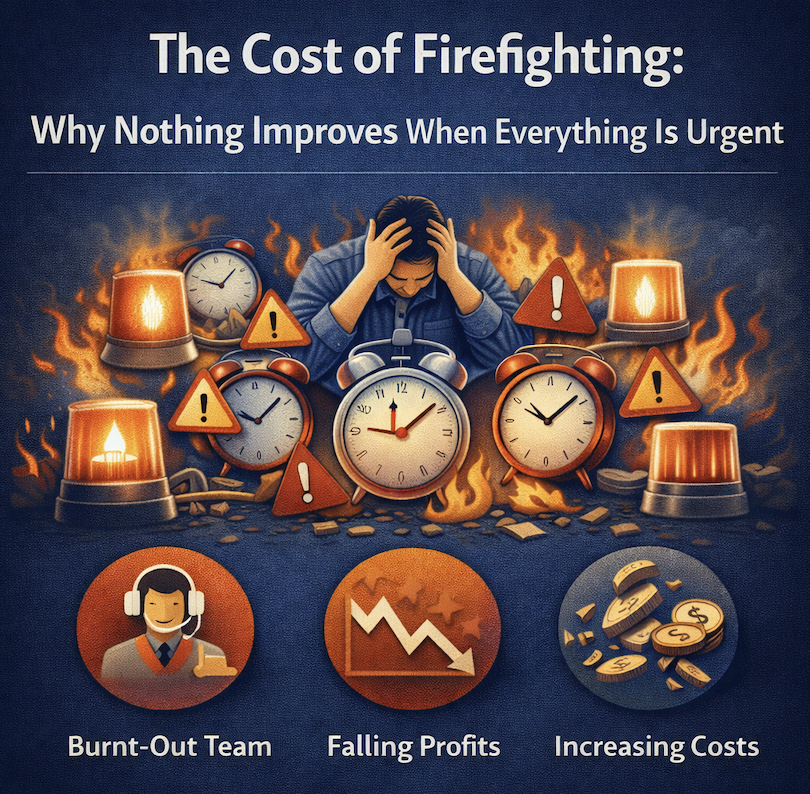
The Cost of Firefighting: Why Nothing Improves When Everything Is Urgent
It’s 9:47 AM on a Tuesday. Your warehouse manager bursts into your office because a key customer’s order can’t ship—half the items show available in the system but can’t be located on the floor. Your purchasing manager needs immediate approval for expedited freight on a supplier shipment that’s running late. Customer service is fielding calls about a delivery that never arrived because the tracking number was entered incorrectly. Your CFO wants to know why yesterday’s sales report doesn’t match the numbers from the warehouse system.
By 10:15 AM, you’ve addressed three crises. By noon, five more have emerged. The strategic planning session you scheduled for this afternoon will be postponed again—for the third consecutive week—because operational emergencies demand immediate attention. The process improvements you’ve been meaning to implement remain on the “someday” list. The system optimizations that could prevent these recurring issues never get prioritized because you’re too busy fighting fires.
This is the firefighting trap that plagues distribution operations. And the brutal reality is that most of these emergencies aren’t random bad luck—they’re predictable outcomes of systems and processes that lack the visibility, automation, and proactive management capabilities that modern operations require. You’re not unlucky. You’re under-automated.
The Firefighting Trap: Why Urgent Crowds Out Important
Distribution operations exist in a state of perpetual urgency where immediate problems consistently trump strategic improvements. This isn’t a time management failure—it’s a systemic pattern that emerges when operational infrastructure lacks the capabilities to prevent issues rather than just react to them.
Reactive operations become self-reinforcing. When systems don’t provide early warning of potential problems, issues remain invisible until they become crises requiring immediate intervention. The customer whose order can’t ship today demands attention right now. The process improvement that would prevent tomorrow’s shipping crisis can wait—it’s not urgent yet. This pattern repeats daily until the entire organization operates in permanent reactive mode.
Management attention becomes the bottleneck. In firefighting cultures, operational issues escalate to leadership because front-line staff lack the information and authority to resolve problems themselves. Warehouse supervisors can’t make allocation decisions because they don’t have visibility into sales order priorities. Customer service can’t commit accurate delivery dates because they don’t know actual inventory availability across locations. Purchasing managers can’t prioritize urgent orders because they don’t understand downstream impact. Every decision requires management intervention, creating bottlenecks that multiply as the organization scales.
Learning doesn’t occur when you’re always fighting the next fire. Root cause analysis requires time and focus that constant urgency prevents. You fix the immediate problem—reallocate inventory to cover the urgent order, expedite the delayed shipment, manually correct the data error—but never address why these issues keep recurring. The warehouse location system that creates constant item searches, the supplier reliability problems that require frequent expediting, the data entry errors that corrupt order information—all remain unresolved because investigation and improvement compete with firefighting for attention.
Strategic initiatives stall indefinitely. The operations review that would identify systemic improvements gets rescheduled. The warehouse layout optimization that would reduce pick times never starts. The supplier scorecard implementation that would improve purchasing decisions remains a draft. The customer segmentation analysis that would inform inventory investments stays on the backlog. Each individual postponement seems reasonable—today’s crisis legitimately demands attention. But collectively, these delays mean strategic improvements never happen.
Staff morale deteriorates as heroic firefighting becomes exhausting routine. The warehouse supervisor who stays late to find inventory, the customer service rep who cajoles carriers into expedited delivery, the purchasing manager who negotiates emergency shipments—these efforts feel valued initially. But when the same emergencies recur weekly, heroics become burdens. The best staff eventually leave for environments where their talents drive improvement rather than just containing chaos.
Operational costs increase as firefighting creates expenses that proactive management would prevent. Expedited freight charges for late supplier shipments, overtime for warehouse staff searching for misplaced inventory, customer credits for missed commitments, premium payments for urgent supplier deliveries, additional carrying costs from safety stock buffers compensating for poor visibility—each individually seems like a necessary cost of doing business. Collectively, they represent 8-15% of operational expenses that proactive management would eliminate.
The insidious aspect of firefighting culture is that it feels productive. You’re solving problems. Customers get their orders. Crises get resolved. But the organization never progresses because all energy goes toward maintaining the status quo rather than improving it. You’re running faster just to stay in place.
The Root Causes: Why Firefighting Becomes Inevitable
Organizations don’t choose firefighting culture deliberately—it emerges from system and process limitations that make reactive operations inevitable. Understanding these root causes reveals what must change to escape the trap.
Lack of operational visibility ensures problems remain hidden until they become urgent. When your ERP updates inventory in daily batches rather than real-time, you don’t know you’re about to run out of a critical item until a customer order can’t be filled. When supplier delivery tracking exists in spreadsheets rather than your purchasing system, you don’t know a shipment is delayed until the promised date passes. When warehouse bin locations live in the warehouse supervisor’s memory rather than the system, you don’t know items are misplaced until someone searches for them unsuccessfully. Insufficient visibility guarantees problems will surprise you.
Manual data entry and handoffs introduce errors that create downstream crises. Order quantities transcribed incorrectly from customer emails, purchase orders keyed manually from vendor quotes, inventory adjustments written on paper then entered hours later, customer addresses copied from one system to another—each handoff creates error opportunities. A transposed digit in an order quantity doesn’t cause problems when entered but creates a crisis when the warehouse tries to fulfill it. The cumulative error rate from manual processes generates constant firefighting.
Disconnected systems fragment information needed for proactive decision-making. Your inventory system shows stock levels but doesn’t know sales order commitments. Your purchasing system tracks supplier lead times but doesn’t see warehouse receipts that reveal actual performance. Your customer service system shows order history but doesn’t access real-time shipping status. Making informed proactive decisions requires information scattered across multiple systems—by the time you assemble the complete picture manually, the decision has become urgent.
Inadequate automation forces manual monitoring that scales poorly. Someone must remember to check if critical supplier shipments are on track, manually review inventory levels for upcoming stockouts, verify that customer orders shipped as promised, confirm that warehouse cycle counts revealed no major discrepancies. As operations scale, the number of items requiring monitoring grows faster than staff capacity to track them. Things fall through cracks not because staff are incompetent but because manual monitoring can’t scale to match operational complexity.
Poor master data quality creates constant operational friction. Item descriptions that don’t match customer nomenclature cause order entry confusion. Supplier lead times in the system that don’t reflect actual performance lead to stockouts. Customer addresses that haven’t been validated generate failed deliveries. Inaccurate reorder points trigger unnecessary expediting or excessive inventory. Each data quality issue generates downstream problems that require urgent intervention.
Insufficient business intelligence prevents pattern recognition that would enable proactive management. Which suppliers consistently deliver late? Which items frequently run out of stock despite adequate reorder points? Which customers generate disproportionate returns? Which warehouse locations cause most picking errors? These patterns exist in your operational data but remain invisible without analytical capabilities that surface them. You fight the same fires repeatedly because you can’t see the underlying patterns.
Organizational knowledge trapped in individuals rather than systems creates brittleness. Your experienced warehouse supervisor knows which suppliers are reliable, which items are frequently backordered, which customers need special handling—but that knowledge exists only in their memory. When they’re on vacation or leave the company, the organization loses critical decision-making capability. Institutional knowledge should live in systems that guide decisions, not solely in individual expertise.
The common thread across these root causes is that firefighting becomes inevitable when systems lack the visibility, automation, and intelligence required for proactive management. You can’t prevent problems you can’t see coming. You can’t automate decisions when critical information is fragmented. You can’t improve processes you don’t have time to analyze. Escaping firefighting requires infrastructure that enables proactive operations.
The Hidden Costs That Never Appear on P&Ls
The financial impact of firefighting culture vastly exceeds the obvious costs of expedited freight and overtime hours. The real damage occurs in operational efficiency erosion and strategic opportunities foregone—costs that remain invisible on standard financial reports.
Productivity loss from constant context switching affects every role in the organization. Warehouse staff interrupted mid-pick to search for urgent items lose 10-15 minutes not just on the interruption but recovering their place in the original task. Customer service representatives bouncing between urgent customer calls and routine order entry require extra time to re-orient with each switch. Purchasing managers pulled from strategic supplier negotiations to handle expedite requests need mental warm-up time returning to complex discussions. Research consistently shows that worker productivity drops 25-40% in high-interruption environments compared to focused work periods.
Decision quality degradation occurs when urgency eliminates time for informed analysis. Allocating scarce inventory based on who’s yelling loudest rather than customer value, approving expedited freight without validating whether the urgency is legitimate, committing to delivery dates without confirming availability across all order components—rushed decisions made under pressure consistently prove less optimal than deliberate choices made with complete information. The cumulative cost of suboptimal decisions compounds significantly but remains invisible in standard accounting.
Customer relationship damage from service inconsistency creates long-term revenue impact. Customers experiencing repeated delivery failures, frequent order changes due to inventory issues, or constant promises that aren’t kept eventually seek more reliable suppliers. The revenue loss doesn’t appear as a firefighting cost—it shows up as gradually eroding sales that seem unrelated to operational chaos. Yet research indicates that 68% of customers switch suppliers primarily due to poor service experiences, not pricing issues.
Employee turnover costs accelerate in high-firefighting environments. Beyond obvious recruitment and training expenses, turnover in key operational roles disrupts institutional knowledge, creates training burden on remaining staff, and reduces overall productivity during transition periods. When your experienced warehouse manager leaves after three years of constant crisis management, the true cost includes 6-12 months of reduced efficiency while their replacement learns the operation—costs that dwarf the direct replacement expenses.
Innovation opportunity cost represents perhaps the largest hidden expense. The warehouse automation project that would reduce labor costs by 30%, the customer portal that would deflect 40% of service calls, the supplier scorecard that would improve purchasing decisions, the inventory optimization that would reduce working capital by 15%—these improvements deliver substantial ROI but never get implemented because firefighting consumes the capacity required for strategic projects. The cost isn’t the absence of these specific projects but the cumulative impact of never improving.
Technical debt accumulation in systems and processes creates escalating maintenance burden. Workarounds implemented during crises become permanent “solutions”—the spreadsheet tracking actual inventory because the system can’t, the manual process compensating for integration failures, the special procedure for rush orders that bypasses normal workflows. Each workaround seems justified individually but collectively they create fragile processes that require constant manual intervention and resist improvement.
Management capacity waste means leadership attention spent on operational firefighting isn’t available for strategic thinking. The CEO reviewing why yesterday’s shipments didn’t match forecasts rather than analyzing market expansion opportunities, the COO investigating warehouse location problems rather than optimizing distribution network design, the CFO reconciling system discrepancies rather than improving financial planning—this misallocation of executive capacity has enormous strategic cost that never appears in operational expense categories.
For a mid-sized distributor with $100 million in annual revenue, these hidden costs typically total $3-5 million annually: $800K in productivity loss from interruptions, $600K in suboptimal decision impacts, $900K in customer churn from service inconsistency, $400K in excess turnover costs, $1.2M in foregone improvement benefits, and immeasurable strategic opportunity cost from leadership distraction. Yet because these costs disperse across standard expense categories rather than concentrating in visible “firefighting” line items, they remain largely invisible to executive teams making decisions about operational infrastructure investment.
How Modern ERP Prevents Firefighting Before It Starts
The transition from reactive firefighting to proactive management doesn’t happen through better time management or organizational discipline—it requires operational infrastructure that prevents problems rather than just responding to them. Modern cloud-native ERP platforms designed specifically for distribution provide capabilities that fundamentally change operational dynamics.
Real-time visibility eliminates blind spots that turn minor issues into crises. When inventory updates instantly across all locations and channels, you see potential stockouts days before they impact customer orders. When supplier shipments track with live status rather than promised dates, you identify delays early enough to source alternatives or notify affected customers proactively. When warehouse bin locations update in real-time, you never lose items in the facility. Visibility doesn’t prevent all problems but provides lead time for planned responses rather than urgent reactions.
Automated exception detection surfaces issues proactively rather than waiting for them to become urgent. The system flags orders at risk because committed inventory isn’t actually available, alerts purchasing when supplier delivery patterns deviate from expected performance, notifies customer service when carrier tracking indicates potential delivery failures, identifies inventory below reorder points before stockouts occur. Automated monitoring scales infinitely—the system can track thousands of potential issues simultaneously, something manual processes never achieve.
Intelligent workflows guide decision-making with complete context rather than requiring management escalation. When inventory allocation becomes necessary, the system presents options with full visibility into customer priorities, order profitability, delivery commitments, and alternative fulfillment options. The warehouse supervisor makes informed decisions within their authority rather than escalating to management. When supplier shipments delay, purchasing staff see downstream impact and can make sourcing decisions without executive involvement. Distributed decision-making eliminates the management bottleneck that firefighting creates.
Predictive analytics identify patterns that manual observation misses. Machine learning analyzes historical data to predict which items are likely to stock out despite adequate reorder points, which suppliers consistently underperform expectations, which customers are trending toward churn based on service issues, which warehouse locations generate excessive picking errors. These insights enable proactive improvements rather than reactive fixes. You address supplier reliability problems before they create urgent shortages, not after.
Process automation eliminates manual tasks that introduce errors and consume capacity. Automated order entry from e-commerce, EDI, and customer portals eliminates transcription errors. Automated purchase order generation based on reorder points eliminates delay between identifying need and initiating procurement. Automated customer notifications about order status eliminate service calls asking “where’s my shipment?” Each automated process frees staff capacity while reducing error rates that create downstream firefighting.
Integrated business intelligence provides visibility into operational patterns that guide continuous improvement. Dashboards showing supplier performance trends, customer order fill rates, inventory turnover by category, warehouse productivity metrics, order profitability analysis—this visibility enables data-driven management rather than intuition-based firefighting. You invest time improving the most impactful areas rather than firefighting whichever issue happens to erupt today.
System-enforced data quality prevents poor master data from generating operational problems. Validation rules ensure addresses are complete before orders save, require item numbers to match existing inventory, flag duplicate customer records, enforce proper unit-of-measure relationships. Data quality issues surface at entry time when correction is simple rather than during fulfillment when they create urgent problems. Clean data doesn’t guarantee perfect operations but eliminates an entire category of self-inflicted wounds.
Mobile enablement provides operational staff with real-time information and decision support wherever they work. Warehouse staff using mobile apps see current inventory locations, order priorities, and picking instructions without walking to desktop terminals. Delivery drivers access customer information and signature capture without paper manifests that require manual processing. Sales representatives check real-time inventory availability and commit accurate delivery dates from customer locations. Mobile access eliminates information delays that create urgency.
The cumulative effect of these capabilities transforms operational dynamics. Problems that would have escalated to urgent crises in legacy environments get addressed proactively in modern platforms. Management attention shifts from constant firefighting to strategic improvement. Staff productivity increases because they work with complete information rather than fighting system limitations. Customer service improves because commitments match capabilities. Firefighting transitions from daily reality to occasional exception.
The Organizational Transformation: From Reactive to Proactive
Moving beyond firefighting culture requires more than implementing better systems—it demands organizational changes in how work is planned, decisions are made, and performance is measured. But these changes only become sustainable when supported by infrastructure that enables proactive operations.
Planning becomes possible when visibility extends beyond the immediate crisis. Weekly operational reviews can focus on trend analysis rather than explaining yesterday’s failures. Monthly planning sessions can address strategic improvements rather than rehashing recurring problems. Quarterly business reviews can evaluate performance against goals rather than documenting fire-fighting heroics. The ability to plan requires confidence that daily operations won’t constantly derail longer-term thinking—confidence that only reliable systems provide.
Distributed decision authority moves from theoretical aspiration to operational reality. Customer service representatives can commit delivery dates with confidence because they see actual available-to-promise inventory across all locations. Warehouse supervisors can prioritize picking based on order value and urgency because they have visibility into full context. Purchasing managers can adjust reorder points based on supplier performance because they access reliable historical data. Authority delegation works only when decision-makers have the information and tools to make good decisions independently.
Performance metrics shift from firefighting activity to strategic outcomes. Instead of measuring how many urgent issues got resolved, you track order fill rates, on-time delivery percentages, inventory turnover, and forecast accuracy. Instead of celebrating heroic weekend work sessions, you recognize process improvements that eliminate recurring problems. Instead of rewarding whoever fights fires most effectively, you value staff who prevent problems from emerging. The metrics transition only works when systems provide the data to measure strategic outcomes accurately.
Continuous improvement becomes operationally feasible. The warehouse layout optimization that’s been on the “someday” list for two years actually gets scheduled because daily operations no longer consume all available capacity. The supplier performance analysis that would inform better purchasing decisions gets completed because purchasing managers have time for strategic work. The customer segmentation project that would guide inventory investments moves forward because the data required for analysis is accessible and accurate. Improvement requires surplus capacity that firefighting eliminates—proactive systems create that capacity.
Root cause analysis becomes standard practice rather than luxury reserved for catastrophic failures. When quality issues emerge, you investigate why rather than just fixing the immediate problem. When supplier deliveries consistently delay, you address relationship issues rather than constantly expediting. When certain items repeatedly stock out, you examine whether reorder points reflect actual demand patterns rather than just increasing safety stock. Addressing root causes requires time and analytical capability that reactive operations never provide.
Knowledge institutionalization moves from individual memory to organizational systems. Customer handling preferences get documented in the CRM rather than existing only in veteran sales reps’ minds. Supplier reliability patterns inform automated purchasing decisions rather than depending on purchasing manager experience. Warehouse picking optimization comes from analyzing productivity data rather than relying on supervisor intuition. Systems capture and operationalize institutional knowledge, making the organization more resilient to individual departures.
Strategic capacity emerges as executive attention shifts from operational firefighting to business development. Leadership can focus on market expansion opportunities, acquisition integration, new channel development, and competitive positioning rather than investigating why yesterday’s shipments didn’t match forecasts. The strategic thinking that drives business growth requires mental space that constant operational crises consume. Proactive operations create that space.
The organizational transformation follows a consistent pattern across companies that successfully escape firefighting culture: initial system implementation creates visibility and automation that reduce daily crises, declining urgency allows staff to engage in process improvement, improvements further reduce firefighting need, freed capacity enables strategic thinking, and strategic initiatives drive business growth that justified the infrastructure investment. The virtuous cycle only begins when systems enable proactive rather than reactive operations.
Firefighting in Specific Distribution Scenarios
Different distribution environments experience characteristic firefighting patterns that reveal whether operational infrastructure adequately supports proactive management. Recognizing these patterns helps identify where system capabilities most critically need improvement.
Multi-location distributors fight constant allocation fires when visibility across locations is inadequate. Customer orders arrive for items showing available in aggregate but concentrated in the wrong location. Fulfillment requires emergency transfers or split shipments with premium freight. Inventory rebalancing between locations happens reactively rather than proactively. Stock-outs occur in one branch while another carries excess. Modern ERP eliminates these fires through real-time multi-location visibility, intelligent order routing, automated transfer recommendations, and unified available-to-promise logic that considers all locations.
High-velocity operations experience overwhelming urgency when systems can’t scale to transaction volumes. Order entry backlogs develop during peak periods. Warehouse picking falls behind schedule. Customer service can’t keep up with status inquiries. Purchasing scrambles to expedite delayed shipments while managing hundreds of concurrent orders. Cloud-native platforms eliminate volume-driven firefighting through elastic scalability, automated workflows, mobile enablement, and real-time visibility that reduces status inquiries.
Project-based distributors fight fires coordinating deliveries across multiple suppliers. Construction site deliveries require materials from five suppliers arriving the same day, but each supplier ships independently based on their schedule. One delayed shipment holds up the entire project. Change orders require updating multiple purchase orders and coordinating revised delivery dates. Native project management capabilities with supplier coordination, delivery scheduling, and change management eliminate the manual heroics that project logistics currently demand.
Technical distributors with complex products fight constant configuration and compatibility fires. Customer orders include items that aren’t compatible despite appearing individually available. Special order items require supplier engineering consultation before ordering. Technical specifications get lost in handoffs between sales, purchasing, and warehouse. Returns require disposition decisions based on technical assessment. Product information management integrated with order processing, purchasing, and inventory eliminates the fragmentary information that creates technical firefighting.
Import-heavy distributors experience freight and customs firefighting. Containers delayed at port create downstream allocation crises. Customs documentation errors hold shipments requiring urgent resolution. Landed cost calculations prove inaccurate after goods clear customs, affecting profitability analysis. Currency fluctuations impact purchasing decisions but aren’t reflected in real-time. International trade capabilities with freight visibility, customs management, landed cost automation, and multi-currency support eliminate import-related urgency.
Omnichannel distributors fight fires synchronizing inventory across sales channels. Stock sells on your website while you’re updating Amazon listings. A customer buys in-store then wants delivery from the nearest warehouse. Returns from one channel need to restock inventory available to all channels. Pricing promotions on one channel need to coordinate with others. Unified commerce capabilities with real-time inventory sync, channel-agnostic fulfillment, and centralized promotion management eliminate multi-channel firefighting.
The pattern across scenarios is consistent: firefighting emerges when operational infrastructure lacks the specific capabilities needed for proactive management in your distribution model. Generic ERP platforms designed for manufacturing or retail create constant urgency in distribution environments. Distribution-specific platforms with native capabilities for your operational model eliminate scenario-specific firefighting.
Measuring the Cost of Firefighting in Your Operation
Most distribution executives intuitively know their organizations operate in firefighting mode but struggle to quantify the cost in ways that justify infrastructure investment. Systematic assessment reveals both the magnitude of current firefighting burden and the potential value of moving to proactive operations.
Time allocation analysis across key roles exposes how much capacity firefighting consumes. Track executive calendars for one month, categorizing time as strategic planning, process improvement, or firefighting. Most organizations discover 50-70% of leadership time addresses urgent operational issues. Similarly, track warehouse supervisors, customer service managers, and purchasing leads. When 60%+ of operational management time goes to urgent problems rather than planned improvements, firefighting has become the primary activity.
Root cause frequency tracking reveals whether you’re addressing underlying issues or repeatedly fighting the same fires. Document each operational crisis over a quarter: what happened, root cause, resolution, whether this specific issue has occurred before. Most distributors discover 70-80% of urgent problems are recurring issues never addressed at root cause level. This pattern definitively indicates reactive rather than proactive operations.
Decision escalation patterns show whether operational staff have information and authority for independent decisions. Count how many times daily warehouse supervisors, customer service representatives, and purchasing staff escalate decisions to management. High escalation rates indicate either insufficient authority delegation or inadequate decision-support information—typically both. Organizations should target 80%+ of operational decisions handled without management escalation.
Expedite frequency and cost quantifies one visible firefighting expense. Track premium freight charges, expedited supplier fees, overtime for urgent warehouse work, and rush order surcharges over a quarter. For most distributors, these expenses represent 2-4% of revenue—$2-4 million annually for a $100 million company. Proactive operations should reduce expedite costs by 60-80% as visibility and planning eliminate most urgency.
Customer service issue patterns reveal operational friction creating firefighting. Categorize customer service contacts: order status inquiries, delivery date questions, inventory availability requests, order modifications, problem escalations. High volumes in these categories indicate customers lack self-service visibility and processes don’t accommodate normal variations without intervention. Mature operations should see 50-70% reduction in these contact types through automation and visibility.
Strategic initiative completion rates measure whether firefighting crowds out improvement. List strategic projects intended for the past year: warehouse optimization, customer portal implementation, supplier scorecard development, process automation initiatives. What percentage completed on schedule versus deferred repeatedly? Completion rates below 40% definitively indicate firefighting consuming improvement capacity. Healthy organizations complete 70-80%+ of planned strategic initiatives.
Staff turnover in key operational roles suggests firefighting exhaustion. Track annual turnover rates for warehouse supervisors, customer service leads, purchasing managers, and operations directors. Rates exceeding 20% often indicate burnout from constant crisis management. Exit interviews typically reveal frustration with inability to improve processes and constant operational urgency as primary departure drivers.
System workaround prevalence indicates infrastructure inadequacy driving firefighting. Document unofficial processes: spreadsheets supplementing ERP data, manual tracking systems, email-based workflows, paper-based handoffs, external databases created by staff. Each workaround represents capability gap in official systems. Organizations with 10+ significant workarounds operate despite their ERP rather than with it—guaranteed firefighting generator.
The quantification exercise typically reveals firefighting costs exceeding $2-5 million annually for mid-sized distributors—far more than infrastructure improvements would cost. But beyond direct costs, the assessment exposes opportunity costs from strategic initiatives never completed, customer relationships damaged by service inconsistency, and organizational capacity consumed by urgency rather than improvement.
The Implementation Path from Firefighting to Proactive Operations
Escaping firefighting culture requires both system capabilities that enable proactive management and organizational changes that capitalize on those capabilities. The transition follows predictable phases with clear milestones indicating progress.
Phase 1: Establish operational visibility through real-time data access across all operational areas. Implementation priority focuses on inventory accuracy, order status visibility, supplier performance tracking, and customer communication. The goal isn’t yet preventing problems but seeing them early enough for planned responses rather than urgent reactions. Success metrics: reduction in “surprise” crises, earlier awareness of potential issues, decrease in emergency escalations.
Phase 2: Automate exception detection so systems identify potential problems before they become urgent. Configure alerts for inventory approaching reorder points, orders at risk due to availability issues, supplier shipments tracking behind schedule, customer orders showing delivery risk. Automated monitoring provides lead time for proactive response. Success metrics: increasing percentage of issues addressed before urgency, declining expedite frequency, improving on-time delivery rates.
Phase 3: Enable distributed decision-making by providing operational staff with information and tools for independent action. Customer service representatives gain visibility to commit accurate delivery dates. Warehouse supervisors access prioritization criteria for allocation decisions. Purchasing managers see downstream impact of supplier delays. Decision authority moves closer to operations. Success metrics: declining management escalations, faster issue resolution, improving decision quality measures.
Phase 4: Implement process automation for routine decisions and workflows that currently require manual intervention. Automated order routing based on inventory location, automated purchase order generation from reorder points, automated customer notifications about order status, automated inventory allocation using business rules. Automation frees capacity while improving consistency. Success metrics: reduction in manual decision volume, declining error rates, increasing staff capacity for improvement work.
Phase 5: Establish continuous improvement as standard practice rather than occasional initiative. Regular analysis of operational patterns, systematic root cause investigation for recurring issues, scheduled process optimization reviews, data-driven decision-making replacing intuition. Improvement becomes ongoing rather than project-based. Success metrics: increasing rate of process improvements, declining frequency of recurring problems, measurable operational efficiency gains.
Phase 6: Drive strategic initiatives using capacity freed from firefighting. Warehouse automation projects, customer portal implementation, supplier relationship optimization, inventory strategy refinement, market expansion planning. Leadership attention shifts from daily operational oversight to business development. Success metrics: strategic initiative completion rates, revenue growth, market share expansion, operational cost reduction.
The timeline for full transition typically spans 12-18 months from initial implementation through sustained proactive operations. Early phases show rapid improvement as visibility and automation eliminate the most obvious firefighting. Middle phases require organizational adjustment as decision patterns and performance expectations change. Later phases deliver strategic value as freed capacity enables growth initiatives.
Common obstacles that stall transitions include underestimating change management needs—staff accustomed to firefighting heroics may resist systematic proactive approaches; inadequate training on new capabilities—tools that enable proactive work don’t help if staff don’t know they exist; incomplete data migration—poor master data quality in new systems perpetuates old firefighting patterns; and leadership regression—executives must resist urge to intervene in operational decisions that staff now handle.
Critical success factors include executive sponsorship that reinforces cultural change toward proactive operations, comprehensive training that builds capability to use new tools effectively, disciplined data governance that maintains quality enabling proactive decisions, and patience to allow organizational adaptation before expecting full transformation.
The organizational payoff extends beyond operational efficiency to strategic capability. Companies successfully transitioning from firefighting to proactive operations consistently report they can respond to market opportunities faster, integrate acquisitions more smoothly, enter new markets more quickly, and scale operations more efficiently—competitive advantages that compound over time.
The Strategic Choice: Accept Firefighting or Eliminate It
Distribution executives face a fundamental strategic choice: accept firefighting as inevitable reality of distribution operations or invest in infrastructure that enables proactive management. The decision shapes not just daily operations but long-term competitive position.
The acceptance path involves acknowledging firefighting as inherent to distribution complexity and investing accordingly—larger staff to handle urgent issues, premium compensation for employees willing to work in high-stress environments, buffer inventory compensating for poor visibility, excess capacity absorbing inefficiency. This path works operationally but creates permanent cost disadvantages and limits strategic agility. Companies accepting firefighting as inevitable rarely grow beyond mid-market scale because the operational model doesn’t scale economically.
The elimination path requires infrastructure investment enabling proactive operations—modern ERP platforms with real-time visibility, automated exception management, intelligent workflows, and integrated analytics. This path involves short-term disruption implementing new systems but delivers permanent operational advantages that compound over time. Companies eliminating firefighting consistently achieve superior operational efficiency, better customer service, higher employee retention, and faster strategic execution than competitors trapped in reactive mode.
The financial analysis consistently favors elimination over acceptance. The annual cost of firefighting—including direct expenses like expedited freight plus hidden costs like productivity loss, customer churn, and foregone improvements—typically totals $3-5 million for a $100 million distributor. Infrastructure investment enabling proactive operations requires $300-500K with 18-24 month ROI. The payback is rapid and the ongoing benefit substantial.
But beyond financial returns, the strategic implications prove even more significant. Companies operating proactively can pursue growth opportunities reactively firefighting companies cannot: multi-location expansion becomes manageable rather than overwhelming, acquisition integration completes in months rather than years, new channel development happens quickly rather than requiring extended projects, and international expansion proceeds smoothly rather than creating chaos.
The distribution industry has accepted firefighting for too long, treating constant urgency as an inevitable reality rather than a solvable problem. Modern cloud-native ERP platforms designed specifically for distribution eliminate the information gaps, manual processes, and system limitations that make firefighting inevitable. Real-time visibility, automated exception management, intelligent workflows, and integrated analytics transform operations from reactive firefighting to proactive management.
The question isn’t whether firefighting creates costs—it demonstrably does, often exceeding $3-5 million annually for mid-sized distributors. The question is whether to continue bearing those costs indefinitely or invest in infrastructure that permanently eliminates them while enabling strategic capabilities that reactive operations cannot support.
For distributors ready to escape firefighting culture and implement platforms that enable proactive management, Bizowie delivers the visibility, automation, and intelligence that modern distribution demands. Our cloud-native unified platform provides real-time operational visibility, automated exception detection, intelligent decision support, and integrated analytics that transform operations from constant urgency to proactive management—without the integration complexity or architectural limitations that legacy systems impose.
Schedule a demo to see how Bizowie eliminates firefighting through systematic visibility and automation, or explore how our platform enables the proactive operations that sustainable growth requires.