
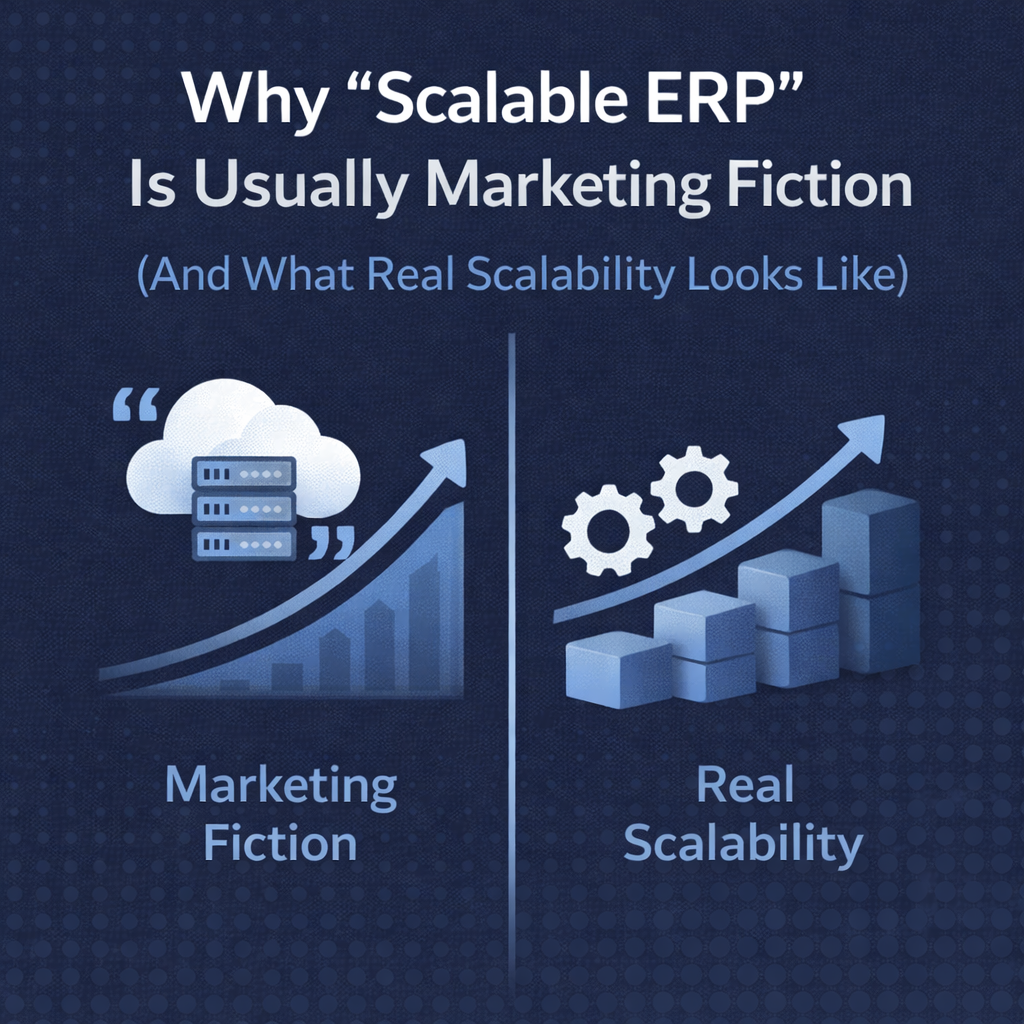
Why ‘Scalable ERP’ Is Usually Marketing Fiction (And What Real Scalability Looks Like)
Every ERP vendor claims their system is “scalable.” Browse enough websites, attend enough demonstrations, and you’ll encounter this promise repeatedly: “Our platform scales seamlessly with your business,” “Built to grow from startup to enterprise,” “Unlimited scalability for businesses of any size.”
The term has become so universal and so vague that it’s essentially meaningless. It’s the enterprise software equivalent of a restaurant claiming their food is “delicious”—technically a value proposition, but so generic it communicates nothing specific.
Yet for growing distribution businesses, scalability is genuinely critical. The difference between systems that truly scale and those that merely claim to can determine whether your business grows profitably or hits growth ceilings that require expensive, disruptive system replacements.
The uncomfortable truth is that most “scalable” ERP systems are nothing of the sort. They handle increased transaction volumes, which vendors conflate with true scalability, but they fail on numerous other dimensions that growing businesses actually need. Real scalability—the kind that enables a $10M business to grow to $100M without replacing core systems—is rare, requires specific architectural characteristics, and has little to do with most vendor scalability claims.
Understanding what real scalability looks like, how to distinguish it from marketing fiction, and what questions to ask during evaluation can save growing businesses from making investments that don’t actually support their growth trajectory.
The Marketing Fiction: How Vendors Define “Scalability”
ERP vendors use “scalability” to mean something much narrower than what growing businesses actually need:
The Transaction Volume Fallacy
When vendors claim scalability, they’re almost always referring to transaction volume handling—the ability to process more orders, manage more inventory transactions, handle more users. The implicit promise: “You can process 100 orders per day today and 10,000 orders per day in five years on the same system.”
This capability is certainly necessary. But transaction volume is actually the easiest scalability dimension to achieve and the least likely to constrain growing businesses. Modern databases, server infrastructure, and cloud architecture have largely solved the transaction volume problem. Even modestly capable systems can handle enormous transaction volumes when properly resourced.
Transaction volume is table stakes, not differentiation. Yet vendors emphasize it precisely because it’s easy to demonstrate and sounds impressive. “Our system handles 10 million transactions daily for Fortune 500 clients!” says absolutely nothing about whether the system will support a business growing from $20M to $100M in revenue over five years.
What vendors don’t mention is that the Fortune 500 client might have spent $10M on implementation, maintains a team of 15 IT professionals dedicated to the ERP system, and hasn’t upgraded in seven years because their customizations make upgrades prohibitively expensive. That’s not scalability—that’s enterprise resource commitment that small and mid-sized businesses can’t replicate.
The “Enterprise Edition” Illusion
Many vendors offer tiered product lines—small business edition, professional edition, enterprise edition—presenting this as a scalability path: “Start on Professional, upgrade to Enterprise as you grow!”
This approach is actually the opposite of scalability. It means you’ll eventually face a forced migration between products, requiring re-implementation, data migration, new integrations, revised business processes, and extensive training. You haven’t scaled—you’ve changed systems, with all the disruption and expense that entails.
True scalability means you never outgrow the platform. You add capabilities, expand usage, increase transaction volume, but the core system remains constant. Your investment compounds rather than becoming obsolete.
The tiered edition approach exists primarily because vendor architectures can’t truly scale. Rather than admitting this, they frame forced migration as a feature: “A clear upgrade path as your business grows!” In reality, it’s a limitation disguised as a benefit.
The Customization Trap
Some vendors claim scalability through extensive customization capabilities: “Our platform can be customized to support any business size or complexity!”
Infinite customization isn’t scalability—it’s the opposite. Every custom modification creates:
Technical debt that accumulates over time and becomes increasingly expensive to maintain.
Upgrade complications where each new version requires retesting and potentially rewriting customizations.
Knowledge concentration in the few people who understand how everything has been customized, creating key person risk.
Support limitations where vendors can’t help with issues in customized areas, forcing reliance on consultants.
Performance degradation as custom code inefficiently performs tasks the platform wasn’t optimized for.
Businesses that “scale” through heavy customization often find that their system becomes increasingly fragile, expensive, and difficult to change precisely when agility matters most. They’ve scaled complexity, not capability.
What Growing Businesses Actually Need to Scale
When distribution companies talk about growth, they’re not just talking about processing more transactions. They’re describing multi-dimensional evolution that requires corresponding system capabilities:
Geographic Expansion
A business operating from a single warehouse in California decides to open distribution centers in Texas and New Jersey to serve Eastern markets more efficiently. Real scalability means:
Multi-location inventory management that provides unified visibility while accommodating location-specific practices and requirements.
Inter-location transfer capabilities that enable efficient stock balancing without excessive administrative burden.
Location-specific business rules for pricing, tax calculation, shipping methods, and fulfillment prioritization.
Unified reporting that consolidates multi-location operations for management while providing location-specific views for operational teams.
Access control that gives location managers appropriate authority while maintaining central oversight.
Many “scalable” systems technically support multiple locations but make multi-location operations so cumbersome that businesses end up running semi-independent operations at each facility, defeating the purpose of a unified platform.
Product Line Expansion
Distribution businesses grow partly by expanding what they sell. A company distributing electrical supplies might add HVAC equipment, then plumbing supplies, then industrial safety products. Real scalability means:
Flexible product attributes that accommodate diverse product characteristics without database schema changes or custom development.
Specialized inventory handling for products with unique requirements—serialized tracking, lot control, expiration dating, hazmat handling.
Category-specific pricing and rules without forcing everything into a single rigid structure.
Varied supplier relationships reflecting different commercial models—drop ship, consignment, buy/resell, distribution agreements.
Product-specific workflows for quotes, orders, and returns that reflect how different product categories are actually sold.
Systems that claim scalability but force all products into identical structures create operational friction that compounds as product diversity increases.
Business Model Evolution
Growing companies often evolve business models. A traditional distributor might add e-commerce direct-to-consumer sales alongside B2B distribution. A wholesaler might launch a marketplace connecting suppliers with customers. A regional distributor might pursue national accounts requiring consistent pricing and service nationwide.
Real scalability means supporting business model evolution:
Multi-channel order management handling different sales channels (direct sales, e-commerce, marketplace, EDI, inside sales) through unified processes.
Flexible pricing models accommodating different commercial relationships—list pricing, contract pricing, volume tiers, promotional pricing, dynamic pricing.
Varied fulfillment patterns including warehouse fulfillment, drop shipping, cross-docking, and hybrid approaches.
Different customer relationship types from one-time retail customers to managed enterprise accounts with complex requirements.
Revenue recognition flexibility supporting various business models from simple buy/resell to consignment, subscriptions, and services.
Most ERP systems were designed for specific business models. They may technically accommodate alternatives through customization, but they don’t naturally support business model evolution.
Organizational Complexity
As businesses grow, organizational structure typically becomes more sophisticated:
Departmental specialization emerges—instead of everyone doing everything, teams specialize in purchasing, customer service, warehouse operations, finance, etc.
Management hierarchy develops—team leads, department managers, directors, vice presidents—each needing different information access and decision authority.
Process formalization replaces informal coordination—approval workflows, documented procedures, quality controls, audit trails.
Role specialization increases—instead of generalists, you have specialists in vendor relations, inventory planning, credit management, logistics coordination.
Real scalability means supporting this organizational evolution:
Role-based access control that’s granular enough to reflect actual job responsibilities without excessive administration burden.
Workflow automation that routes decisions, approvals, and exceptions to appropriate people based on business rules.
Information access tailored to each role—executives see strategic dashboards, managers see departmental metrics, specialists see transaction details.
Audit capabilities that track who did what when, supporting both compliance and operational accountability.
Training scalability where new employees can become productive quickly despite increasing system sophistication.
Systems designed for small teams where everyone knows everything struggle when organizational complexity increases.
Market Complexity
Successful growth often means serving more diverse markets:
Customer segmentation increases—retail, contractor, industrial, government, export—each with different requirements and economics.
Geographic diversity brings varying tax jurisdictions, regulatory requirements, shipping considerations, and language needs.
Payment complexity grows—credit cards, ACH, wire transfers, letters of credit, payment terms varying by customer risk and relationship.
Compliance requirements multiply—industry-specific regulations, international trade rules, tax reporting, industry certifications.
Customer service sophistication needs to scale from “answer the phone” to SLA management, customer portals, returns management, and service analytics.
Real scalability means handling this complexity without proportional increases in administrative burden or system modification.
Acquisition Integration
Many businesses grow partially through acquisition. Real scalability means efficiently integrating acquired businesses:
Data migration capabilities that enable bringing acquired company data into the platform without massive consulting projects.
Multi-entity support that can maintain separate legal entities, financial reporting, and operations while providing consolidated management visibility.
Process harmonization tools that enable adopting best practices across combined organizations without forcing complete uniformity.
Transition management that allows acquired businesses to continue operating during integration rather than facing immediate conversion crisis.
The ability to efficiently integrate acquisitions dramatically affects M&A strategy and value creation potential.
The Architecture That Enables Real Scalability
True scalability isn’t achieved through marketing claims or feature lists—it’s a function of fundamental architectural decisions:
Cloud-Native Infrastructure
Cloud-native systems built specifically for cloud deployment possess inherent scalability advantages:
Elastic resource allocation that automatically adjusts computing, storage, and bandwidth as demand changes, without capacity planning or infrastructure investment.
Geographic distribution that can serve users efficiently regardless of location without implementing and maintaining infrastructure in each region.
Automatic updates that deliver new capabilities and performance improvements without disruptive upgrade projects that prevent adoption of enhancements.
Infrastructure expertise from cloud providers who invest billions in security, performance, and reliability that individual businesses can’t replicate.
Rapid provisioning that enables activating new locations, business units, or capabilities in hours or days rather than weeks or months.
Legacy on-premise systems retrofitted for cloud hosting (often called “cloud-washed”) lack these architectural advantages. They may run in data centers rather than customer server rooms, but they don’t provide genuine cloud scalability.
Flexible Data Models
The ability to grow without constant database schema changes and custom development requires flexible data architecture:
Configurable fields and attributes that let businesses define data elements they need without modifying database structures or writing custom code.
Extensible data relationships that accommodate various product, customer, and transaction types without forcing everything into rigid categories.
Metadata-driven architecture where the system understands what data represents, not just how to store it, enabling intelligent behavior without custom coding.
API-first design where every data element and operation is programmatically accessible, enabling integration and extension without database access.
Version-compatible data structures that enable seamless upgrades without complex data migration projects.
Systems built on rigid database schemas require custom development for each variation from original design, creating scalability barriers.
Configuration Over Customization
Real scalability comes from extensive configuration capabilities that eliminate most customization needs:
Business rules engines that let users define complex logic through configuration rather than custom code.
Workflow design tools that enable process definition through visual interfaces without programming.
Report and dashboard builders that empower business users to create custom views without IT assistance.
Pricing rule configuration that supports sophisticated strategies through settings rather than code.
Approval routing configuration that adapts to organizational changes through administration tools rather than development.
When configuration handles most needs, businesses can adapt systems as they grow without accumulating technical debt or creating upgrade complications.
Modular Capability Activation
Truly scalable platforms enable activating capabilities as needed rather than implementing everything upfront:
Core modules provide foundational capabilities—inventory, orders, purchasing, financials—that every business needs.
Optional capabilities like advanced planning, warehouse management, e-commerce, or CRM can be activated when business needs them.
Integration ecosystem provides pre-built connections to specialized systems, enabling best-of-breed approaches without custom integration.
Activation simplicity where new capabilities are enabled through configuration and training, not new implementation projects.
This modularity enables businesses to start simply and add sophistication as needs evolve, avoiding both inadequate initial systems and overwhelming complexity.
Multi-Tenancy Architecture
For cloud ERP, true multi-tenancy (where all customers run on shared infrastructure with isolated data) provides scalability advantages:
Continuous improvement where platform enhancements benefit all customers immediately rather than requiring individual upgrade projects.
Shared innovation where capabilities developed for one customer segment often benefit others.
Efficient operations where provider expertise and investment benefit all customers proportionally.
Rapid deployment where new instances can be provisioned in hours rather than weeks.
Predictable performance where the provider manages infrastructure optimization across all customers.
Single-tenant “cloud” systems (each customer has dedicated infrastructure) lack these advantages and often face the same scalability limitations as on-premise systems.
Red Flags: Spotting False Scalability Claims
During ERP evaluation, several patterns indicate that “scalability” claims may not hold up:
Implementation Timeline Inflation
If a vendor’s typical implementation timeline increases dramatically with business size or complexity, that’s a scalability red flag:
- Small business: 3 months
- Mid-market: 9-12 months
- Enterprise: 18-24 months
Real scalability means implementation complexity increases gradually, not exponentially. If deployment duration triples as business size doubles, the system doesn’t truly scale—it requires proportionally more configuration and customization at each tier.
Customization Dependency
When vendors respond to scalability questions with “yes, we can customize that,” be skeptical:
“Can the system handle multiple pricing strategies?” → “Yes, we can custom code pricing logic for you.”
“How does it support complex approval workflows?” → “We’ll build custom workflows during implementation.”
“What about multi-location inventory optimization?” → “Our development team can create that functionality.”
Real scalability means the platform handles diverse needs through configuration, not custom development for each customer.
Version Lock-In Patterns
If reference customers are running various system versions—some on current, many on older releases—that indicates upgrade difficulty:
“We’re still on version 6.2 because upgrading would break our customizations.”
“We’d like to upgrade but our implementation partner says it’s a 6-month project.”
“We skip every other release because upgrades are so disruptive.”
True scalability includes upgrade scalability—the ability to adopt new platform capabilities without massive projects or disruption.
Reference Customer Limitations
Pay attention to what reference customers actually say about growth:
“The system worked great until we added our third location—then things got complicated.”
“We initially chose this because it was affordable, but we’re outgrowing it and evaluating alternatives.”
“It handles our transaction volume fine, but we need consultants for any process changes.”
“We’re concerned about whether the platform will support our next phase of growth.”
These patterns indicate systems that handled initial needs but aren’t truly scaling with customer growth.
Add-On Proliferation
If the path to “scalability” involves continuously adding third-party solutions, question the platform strategy:
- Basic system for core ERP
- Separate warehouse management system
- Third-party reporting tool
- Different e-commerce platform
- Another tool for advanced analytics
- Additional system for CRM
- Separate planning software
While best-of-breed approaches have merits, if “scaling” means constantly integrating new tools to compensate for platform limitations, you’re not scaling—you’re adding complexity.
Resource Escalation
If vendor references reveal that system maintenance requires dramatically increasing IT investment as businesses grow, that’s a scalability problem:
“We started with one IT person supporting the ERP. Now we have five.”
“We need consultants on retainer because the system requires specialized expertise.”
“Our IT budget has tripled because the ERP demands so much attention.”
Real scalability means system administration effort increases moderately with business growth, not exponentially.
Questions That Reveal Real Scalability
During vendor evaluation, specific questions help distinguish real scalability from marketing fiction:
Architecture Questions
“Is this cloud-native architecture or on-premise software hosted in data centers?”
“Do all customers run the same version or are there multiple versions in production?”
“How does the system handle increased transaction volume—vertical scaling, horizontal scaling, or manual capacity planning?”
“What percentage of customer-requested features get incorporated into the platform versus remaining custom code?”
Growth Path Questions
“Show me a customer who started at our size and has grown 5x—are they still on the same platform without reimplementation?”
“What capabilities do we need to configure versus custom develop?”
“How do customers typically handle multi-location expansion? What’s involved in adding a new location?”
“Walk me through what’s required to add new product categories that don’t fit current structures.”
Upgrade Questions
“What’s the typical upgrade cycle? What’s involved in upgrades?”
“How many customers skip upgrades? What are the most common reasons?”
“Show me customizations that required rewriting during upgrades.”
“What happens to our configuration and data during major version upgrades?”
Resource Questions
“How does IT resource requirement typically scale with business growth on your platform?”
“What internal expertise do successful customers maintain versus depending on external consultants?”
“Show me a customer successfully maintaining the system with business users, not just IT staff.”
“What’s involved in training new employees as the system becomes more sophisticated?”
Business Evolution Questions
“How do customers typically handle business model changes—new sales channels, different fulfillment models, pricing strategies?”
“What’s required to add capabilities you don’t need initially but might need later?”
“How do customers integrate acquisitions into the platform?”
“Show me examples of customers expanding internationally—what was required?”
Bizowie: Architected for Real Scalability
At Bizowie, we don’t just claim scalability—we’ve architected our platform specifically to support businesses as they grow from millions to hundreds of millions in revenue:
Cloud-Native Foundation
Bizowie was built from the ground up as a cloud-native platform:
True multi-tenancy where all customers benefit from platform improvements immediately without upgrade projects.
Elastic infrastructure that automatically scales resources as your business grows without capacity planning or infrastructure investment.
Geographic distribution that delivers fast performance regardless of where your business operates or expands.
Continuous enhancement delivering new capabilities quarterly without disruptive upgrade projects.
Security and reliability from enterprise-grade infrastructure that individual businesses can’t cost-effectively replicate.
This cloud-native architecture provides genuine scalability advantages that retrofitted legacy systems can’t match.
Growth Without Complexity
Bizowie scales capability without proportionally scaling complexity:
Intelligent defaults that work for most businesses, eliminating thousands of configuration decisions while still allowing customization where needed.
Configuration over customization where extensive business rules, workflow, and reporting capabilities eliminate most custom development.
Modular activation where you implement core capabilities initially and easily activate additional features as business needs evolve.
Intuitive interface that remains navigable as system sophistication increases, preventing “expert user” dependency.
Business user empowerment where operational teams can manage workflows, create reports, and adapt processes without IT assistance.
Multi-Location Excellence
Bizowie was designed for businesses operating or expanding across multiple locations:
Unified inventory visibility across all locations with intelligent allocation and transfer management.
Location-specific rules for pricing, tax, fulfillment, and operations that accommodate local requirements within centralized framework.
Consolidated reporting that provides both enterprise-wide and location-specific views.
Simple expansion where adding locations involves configuration, not implementation projects.
Inter-location coordination that optimizes inventory positioning and order fulfillment across your entire network.
Business Model Flexibility
Bizowie supports diverse and evolving business models:
Multi-channel order management handling B2B, B2C, marketplace, EDI, and direct sales through unified processes.
Flexible pricing accommodating any pricing strategy—list pricing, contracts, dynamic pricing, customer-specific, promotional.
Varied fulfillment supporting warehouse fulfillment, drop ship, cross-dock, and hybrid approaches seamlessly.
Diverse customer relationships from one-time retail to complex enterprise accounts with sophisticated requirements.
Model evolution where businesses can test new approaches without system constraints or major reconfiguration.
Real-Time Visibility That Scales
As businesses grow, information needs become more sophisticated. Bizowie provides:
Role-based dashboards that give each person the information relevant to their responsibilities without overwhelming complexity.
Drill-down capability that lets users investigate details when needed without losing context.
Customizable reporting where business users create views they need without IT assistance or waiting for custom development.
Embedded analytics that provide insights without requiring separate business intelligence tools.
Mobile access ensuring visibility regardless of location as operations become geographically distributed.
Efficient Workflows at Any Scale
Bizowie’s workflow capabilities grow with organizational sophistication:
Approval routing that adapts to organizational hierarchy and business rules without custom coding.
Exception management that escalates issues appropriately based on type and value.
Process automation that reduces manual work as transaction volume increases.
Quality controls that maintain accuracy and compliance as operations become more complex.
Audit trails providing visibility into who did what when, supporting both compliance and continuous improvement.
Seamless Integration Ecosystem
As businesses grow, they typically need specialized tools. Bizowie facilitates this:
Open API providing programmatic access to all data and operations for custom integrations.
Pre-built connectors for common business applications—CRM, e-commerce, shipping, 3PL, payment processing.
Integration platform partnerships extending connectivity to hundreds of additional applications.
Webhook support enabling event-driven integrations that are efficient and maintainable.
Clear integration patterns so adding new tools doesn’t create fragile, custom integration architecture.
Predictable Economics
Bizowie’s pricing scales reasonably with business growth:
Transparent pricing based on clear metrics—users, transaction volume, locations—not complex formulas.
Predictable costs where monthly expenses are known and manageable, not surprise bills for overages or peak usage.
No version penalties where platform enhancements are included in subscription, not expensive upgrade projects.
No hidden fees for standard capabilities, support, or reasonable usage increases.
Value alignment where you pay more as you derive more value from the platform, not arbitrary price increases.
Making the Right Choice for Your Growth Trajectory
Selecting an ERP platform is fundamentally a decision about your business’s future. The system you choose will either enable or constrain your growth trajectory for the next 5-10 years.
Assess Your Growth Reality
Be honest about growth expectations:
Revenue trajectory: What’s realistic growth over the next five years? 50%? 100%? 300%?
Geographic expansion: Will you operate from single location or expand regionally/nationally?
Product evolution: Will product lines expand significantly or remain relatively stable?
Business model: Might you add sales channels, fulfillment models, or service offerings?
Organizational growth: How will headcount, structure, and sophistication evolve?
Acquisition strategy: Is inorganic growth part of the plan?
These answers determine what scalability characteristics actually matter for your business.
Test Scalability Claims
Don’t accept vendor scalability claims at face value:
Demand reference customers who’ve experienced growth similar to your expectations.
Ask specifically about what changed in their system usage as they grew—implementation, resource requirements, limitations encountered.
Request demonstrations of how the system handles multi-location, diverse product types, or complex workflows—not just simple examples.
Understand upgrade reality from customers, not just vendor promises.
Calculate total cost of ownership including implementation, operation, and enhancement costs as your needs evolve.
Consider Implementation Approach
How you implement matters as much as what you implement:
Start appropriately: Implement capabilities you need now, not everything you might need eventually.
Plan for expansion: Ensure architecture supports adding capabilities without reimplementation.
Maintain simplicity: Resist customization that creates technical debt and scalability problems.
Build expertise: Develop internal capability to manage and adapt the system rather than creating consultant dependency.
Measure and learn: Track whether the system is delivering expected scalability as your business evolves.
Conclusion: Scalability Is Architectural, Not Marketing
“Scalable ERP” has become meaningless marketing-speak precisely because every vendor claims it while meaning something different—and usually something narrower than growing businesses actually need.
Real scalability is rare because it requires specific architectural characteristics that most legacy ERP systems, even when “cloud-washed,” don’t possess. It means systems grow with your business across multiple dimensions—transaction volume, yes, but also geographic expansion, product diversity, business model evolution, organizational complexity, and market sophistication.
True scalability means you never outgrow the platform. You add capabilities, expand usage, and increase sophistication, but the core system remains constant. Your investment compounds rather than becoming obsolete. Your business can pursue opportunities without asking, “Can our ERP handle this?”
For growing distribution businesses, distinguishing real scalability from marketing fiction is critical. The wrong choice means hitting growth ceilings that require expensive system replacements precisely when you can least afford the disruption. The right choice means technology that enables and accelerates growth rather than constraining it.
The question isn’t whether vendors claim their systems are scalable—they all do. The question is whether the underlying architecture, deployment approach, and business model actually deliver scalability across the dimensions that matter for your specific growth trajectory.
Ready to Experience Real Scalability?
Bizowie’s cloud-native platform is architected specifically for growing distribution businesses that need genuine scalability, not marketing promises. Our approach enables businesses to start at appropriate sophistication levels and grow seamlessly as needs evolve. Schedule a demo to see how Bizowie’s architecture delivers real scalability across all dimensions that matter.
Bizowie is an enterprise cloud ERP platform that brings clarity and control to every aspect of your business. Our all-in-one platform delivers real-time visibility, efficient workflows, and an unmatched, seamless experience—built on cloud-native architecture that genuinely scales with growing businesses, not just marketing claims.