
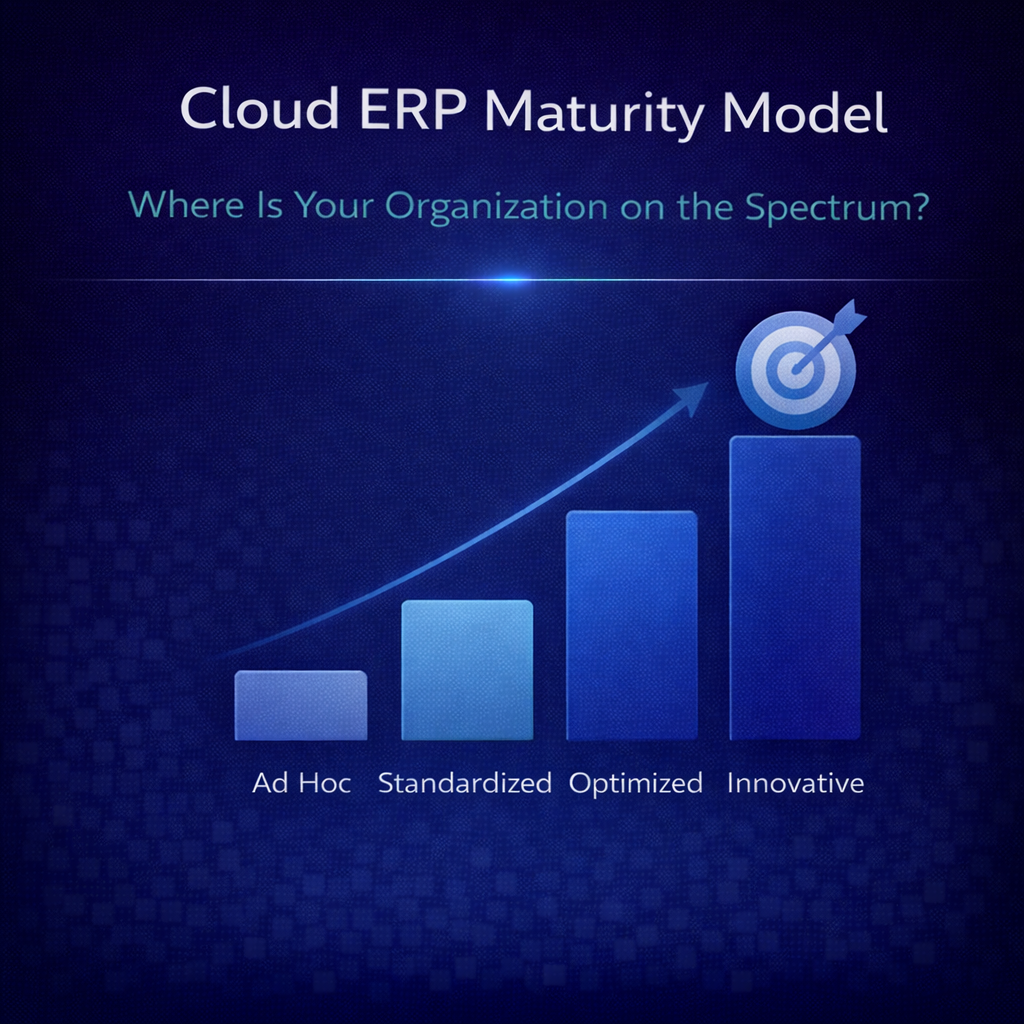
Cloud ERP Maturity Model: Where Is Your Organization on the Spectrum?
There’s a question that precedes every ERP decision but rarely gets asked with precision: where are we right now?
Not in the abstract sense of “we need a better system.” In the specific, measurable sense of how mature your organization is in its use of technology to run the business. Because the answer determines everything — which platform you need, what the implementation should focus on, how fast you can move, what results are realistic in the first year, and what the five-year trajectory should look like.
Companies at different maturity levels need different things from their ERP. A company that’s running its entire operation on spreadsheets and QuickBooks needs a fundamentally different implementation approach than one that’s been on a legacy ERP for ten years and understands its processes deeply but has outgrown the platform. A company where the team has never used mobile devices in the warehouse needs different training and change management than one where mobile is already the norm but the current system is too slow.
And the most expensive mistakes in ERP happen when companies select and implement platforms mismatched to their maturity — buying an enterprise system for an organization that hasn’t defined its processes, or implementing an advanced platform with a barebones configuration that doesn’t leverage its capabilities.
This maturity model defines five levels. Each one describes a specific operational reality, identifies the ERP-related strengths and limitations at that level, and prescribes the path to the next level. Find where you are. Then plan the move from there — not from where you wish you were or where the vendor’s demo assumes you are.
Level 1: Manual and Fragmented
What It Looks Like
The business runs on a collection of disconnected tools. QuickBooks or a basic accounting package handles financials. Spreadsheets manage inventory — maybe one per warehouse, maintained by whoever has the most patience. Orders come in by phone, email, and fax, and are entered into whichever system needs them — the accounting system for invoicing, a spreadsheet for tracking, maybe a whiteboard in the warehouse for picking.
Pricing lives in someone’s head, supplemented by a price list document that’s updated quarterly if anyone remembers. Customer information is scattered across email inboxes, contact lists, and the institutional memory of the sales team. Purchasing is reactive — someone notices a shelf is empty and calls the supplier.
Reporting is manual assembly. The monthly financial picture is constructed from the accounting system’s output, adjusted for things the accounting system doesn’t know about — pending orders, inventory in transit, commitments made by sales that haven’t been entered anywhere. The picture is approximate, and everyone knows it.
Strengths at This Level
Simplicity. The people who run these systems understand them completely because there isn’t much to understand. Decision-making is fast because it’s based on judgment and experience rather than system analysis. And the overhead is minimal — no licensing fees, no IT infrastructure, no maintenance burden.
Limitations
Everything depends on people. Institutional knowledge lives in individuals’ heads, and when those individuals are unavailable — vacation, illness, departure — the knowledge goes with them. Error rates are high because manual processes have manual error rates. Visibility is limited to whoever assembled the latest spreadsheet. Scalability is nonexistent — the approach that works for 50 orders a day collapses at 200. And the business can’t pursue opportunities that require operational sophistication — EDI-compliant retailers, high-volume accounts, multi-location fulfillment — because the systems can’t support them.
The Path to Level 2
The move from Level 1 to Level 2 is the most transformative step in the entire maturity model — and the one most likely to be delayed because the current approach “works.” It works the way a bicycle works for a cross-country journey: it’ll get you there eventually, but not at the speed or scale your destination requires.
The trigger is usually a growth event that exposes the fragmentation — a customer requiring EDI, a second warehouse that can’t be managed by spreadsheet, a hiring event that reveals how much knowledge walks out when someone leaves, or simply the accumulated weight of manual processes consuming more labor than the business can afford.
The implementation at this level should focus on fundamentals: consolidating financial management, establishing systematic inventory tracking, creating a structured order management workflow, and building the data foundation that every subsequent maturity level depends on. Don’t try to implement everything at once. Get the core running, get the team comfortable, and build from there.
Level 2: Basic ERP — System of Record
What It Looks Like
The business runs on an ERP — possibly a legacy on-premise system, possibly an entry-level cloud platform. The core functions are centralized: financial management, basic inventory tracking, order entry, and purchasing all happen within the same system. Data enters once and flows between functions without re-entry.
The system is primarily a recording tool. It captures what happened — orders placed, inventory received, invoices generated, payments collected — and produces reports based on that historical data. But the system doesn’t drive decisions or direct work. It records the decisions people made and the work people did.
Inventory management tracks quantities by location but doesn’t direct warehouse operations. The system says there are 500 units in Warehouse A; it doesn’t tell the associate where to find them or how to pick them efficiently. Pricing is configured at a basic level — list prices, maybe customer groups with discount percentages — but the full complexity of distribution pricing exceeds the system’s capabilities. The overflow goes to spreadsheets.
Reporting is available but rigid. Pre-built reports cover standard scenarios. Custom reporting requires a consultant or an IT resource with specialized knowledge. Ad-hoc questions — the ones that arise in meetings, in customer conversations, in decision moments — wait for someone to build a report, which means they often go unanswered.
Strengths at This Level
Data centralization. The business has a single system of record for core functions, which eliminates the data fragmentation of Level 1. Basic process automation — orders flow from entry to invoice without manual re-entry. Financial management is systematic and auditable. And the team has developed ERP literacy — they understand what the system does, how to use it for daily tasks, and what its limitations are.
Limitations
The system records but doesn’t optimize. It’s a digital filing cabinet, not an operational engine. The gap between what the system can do and what the operation needs produces workarounds — spreadsheets that supplement the system’s reporting, manual processes that compensate for missing automation, phone calls that substitute for real-time system visibility.
The workarounds are the telltale sign of Level 2. If your team maintains parallel systems — spreadsheets for pricing, for inventory analysis, for customer tracking, for purchasing decisions — alongside the ERP, the ERP isn’t serving its purpose as the operational backbone. It’s serving as the recording layer while the actual operational management happens outside it.
The Path to Level 3
The move from Level 2 to Level 3 is often a platform decision — because the limitations at Level 2 are frequently architectural. A legacy system that was adequate as a system of record may lack the data architecture, the configuration depth, or the integration capabilities to become an operational engine.
The evaluation at this transition should focus on whether the current platform can be configured to deliver real-time visibility, distribution-specific pricing depth, warehouse execution direction, and operational automation — or whether a platform change is required to reach those capabilities. If the platform has the capabilities but they haven’t been deployed, the path is optimization. If the platform’s architecture limits what’s possible, the path is migration.
Level 3: Operational ERP — The System Runs the Business
What It Looks Like
This is where the ERP transforms from a recording tool to an operational engine. The system doesn’t just capture what happened — it directs what should happen, enforces business rules, and provides real-time visibility that enables proactive management rather than reactive firefighting.
Inventory is real-time across all locations. The available-to-promise calculation reflects current allocations, and sales can quote delivery dates with confidence. Purchasing is driven by system-generated replenishment suggestions based on actual demand and actual stock positions, not by memory and intuition. The pricing engine handles the full complexity of distribution pricing natively — customer-specific, volume-tiered, contract-based, matrix, cost-plus — and the correct price appears automatically on every order without manual intervention.
Warehouse operations are directed by the system. Mobile devices guide receiving, putaway, picking, and packing. The system optimizes pick sequences, manages lot and serial tracking if applicable, and confirms every task in real time. Cycle counting is systematic and continuous rather than annual and disruptive.
Financial management is integrated at the data level. Every operational transaction — receipt, shipment, adjustment, transfer — posts financial entries in real time. The monthly close is a verification exercise rather than a reconciliation marathon. Margin is visible at the transaction level, not just in month-end reports.
Order-to-cash flows end to end with minimal manual intervention. Orders enter through multiple channels — EDI, web, phone — and process through pricing, allocation, fulfillment, shipping, and invoicing as a continuous automated workflow. Exceptions are surfaced for human attention. Routine transactions flow through without anyone touching them.
Strengths at This Level
The system runs the business. Operational visibility is real-time and comprehensive. Decision-making is informed by current data rather than historical approximation. Labor that was consumed by workarounds at Level 2 is redirected to value-creating activities. Scalability improves because the system handles volume that would overwhelm manual processes. And the business can pursue opportunities — EDI-compliant accounts, multi-location fulfillment, complex pricing relationships — that Level 2 couldn’t support.
Limitations
Level 3 delivers operational excellence within the system’s current configuration. What it typically doesn’t deliver is the analytical intelligence to optimize the operation beyond its current performance. The system tells you what’s happening right now. It doesn’t tell you what should change to make tomorrow better than today.
The other limitation is that Level 3 capability depends on the organization’s discipline in using the system as designed. If the team reverts to workarounds — entering transactions outside the system, overriding automated decisions, maintaining side processes that bypass the ERP — the operational engine degrades back toward Level 2 regardless of the platform’s capability.
The Path to Level 4
The move from Level 3 to Level 4 doesn’t usually require a platform change — it requires leveraging the platform’s analytical capabilities that may not have been fully deployed during the initial implementation. Demand planning, predictive replenishment, customer analytics, margin optimization, and operational performance analysis are features that many platforms offer but that implementations often defer in favor of getting the operational core running first.
The transition is also organizational. Level 4 requires the business to shift from using the system to manage today’s operations to using the system’s data to optimize future operations. That shift requires analytical skills, a willingness to trust system-generated recommendations over intuition, and management practices that institutionalize data-driven decision-making rather than treating it as an occasional exercise.
Level 4: Analytical ERP — The System Optimizes the Business
What It Looks Like
Everything at Level 3 is in place and running. The system is the operational backbone, and it’s working well. What Level 4 adds is intelligence — the ability to analyze operational data, detect patterns, predict outcomes, and recommend actions that optimize performance beyond what well-executed standard processes can achieve.
Demand planning operates inside the ERP, analyzing historical sales patterns, detecting seasonal trends, identifying demand shifts by product and location, and generating replenishment recommendations that are smarter than static reorder points. Purchasing doesn’t just respond to what’s needed — it anticipates what will be needed and positions inventory ahead of demand.
Customer analytics identify ordering pattern changes proactively. A key account’s order frequency is declining — the system surfaces it before anyone in sales notices. A customer segment’s product mix is shifting — the system identifies the trend and its margin implications. New customers are evaluated against similar customer profiles to predict their ordering trajectory and inform stocking decisions.
Margin optimization operates at the transaction level and at the portfolio level. The system identifies products, customers, and pricing structures that are eroding margin and surfaces them for review. Pricing adjustments are informed by real-time cost data, competitive positioning analysis, and customer-specific profitability metrics.
Warehouse analytics track productivity by associate, by zone, by shift — identifying efficiency variations, staffing optimization opportunities, and process improvements that incrementally improve throughput and reduce cost per order. Supplier performance analytics inform purchasing decisions with actual vendor data — on-time rates, fill rates, quality metrics, cost trends — rather than anecdotal assessments.
Operational dashboards don’t just display metrics — they surface exceptions, highlight trends, and connect observations to actions. The Monday morning experience described in earlier articles — 60 seconds to understand the business and know what needs attention — is the daily reality at Level 4.
Strengths at This Level
The business operates on evidence rather than instinct. Decisions are informed by system analysis that considers more variables, more history, and more current data than any individual could hold in their head. Continuous improvement isn’t a management initiative — it’s a system-supported practice. The analytical layer identifies opportunities for improvement and provides the data to execute them.
Limitations
Level 4 requires data maturity. The analytical outputs are only as good as the operational data feeding them. If inventory accuracy is 93% instead of 99%, demand forecasts based on consumption data will be imprecise. If pricing overrides are common — because the pricing engine wasn’t fully configured — margin analysis will reflect the overrides rather than the pricing strategy. Analytical ERP amplifies the quality of the data underneath it, for better or worse.
The organizational limitation is analytical capacity. Having the data available doesn’t automatically create the organizational capability to use it. Level 4 requires people — in purchasing, in sales management, in operations, in finance — who can interpret analytical outputs, distinguish signal from noise, and translate insight into action. The system provides the intelligence. The organization has to act on it.
The Path to Level 5
The move from Level 4 to Level 5 is about extending the analytical capability beyond operational optimization to strategic decision-making and organizational transformation. It requires the highest level of data maturity, the deepest analytical capabilities, and leadership that treats the ERP not as a technology system but as the intelligence platform that shapes business strategy.
Level 5: Strategic ERP — The System Shapes the Business
What It Looks Like
At Level 5, the ERP is no longer just running and optimizing the business. It’s informing strategic decisions about where the business goes next.
Market expansion analysis uses operational data to identify geographic regions, customer segments, and product categories where demand patterns suggest growth opportunities. The system shows where order density is increasing, where customer acquisition is accelerating, and where competitive gaps in service capability exist — all derived from transactional data that’s already in the platform.
Network optimization uses inventory, fulfillment, and shipping data to evaluate whether the current warehouse network is optimally positioned — whether adding a location would reduce freight costs and improve delivery times enough to justify the investment, or whether consolidating locations would improve efficiency without sacrificing customer service.
Acquisition evaluation leverages operational data to assess potential acquisition targets. If a target’s customer base overlaps with yours, the system can model the revenue impact. If their product catalog complements yours, the cross-selling opportunity can be estimated from existing demand patterns. If their warehouse footprint fills a geographic gap, the fulfillment optimization can be modeled before the deal closes.
Customer lifetime value analysis goes beyond current period profitability to project the long-term value of customer relationships — informing pricing decisions, service level investments, and sales team resource allocation with a strategic lens rather than a transactional one.
Product portfolio strategy is informed by comprehensive data on margin contribution, demand trajectory, competitive positioning, and operational cost by product line — enabling data-driven decisions about which products to invest in, which to phase out, and which to reprice.
Strengths at This Level
The ERP transcends its operational role and becomes a strategic asset. Business decisions that were previously based on market intuition and executive experience are now informed by comprehensive operational intelligence. Strategy and operations are connected through a common data platform — which means strategic decisions are grounded in operational reality, and operational execution is aligned with strategic direction.
Limitations
Very few organizations reach Level 5 fully, and it’s not always necessary. Level 5 capability is most valuable for distribution companies in active growth mode — expanding geographically, acquiring competitors, diversifying product lines, or entering new market segments — where strategic decisions have significant financial consequences and data-driven analysis materially improves outcomes.
For stable distribution businesses that aren’t pursuing aggressive growth, Level 4 — operational optimization driven by analytical intelligence — may be the appropriate target. The maturity model isn’t a ladder where every organization must reach the top. It’s a spectrum where each company should target the level that matches their strategic ambition and operational reality.
Assessing Your Current Level
The maturity level isn’t a label you assign subjectively. It’s a diagnosis based on observable characteristics. Here’s how to assess where your organization sits.
Diagnostic Questions
How does your team check product availability? If they call the warehouse or check a spreadsheet, you’re at Level 1 or 2. If they check the ERP and trust the number, you’re at Level 3. If the system proactively alerts them when availability is low, you’re at Level 4.
How does pricing get applied to orders? If it’s from memory, a spreadsheet, or a manual override, you’re at Level 1 or 2. If the system calculates it automatically and correctly for complex scenarios, you’re at Level 3. If the system also analyzes pricing effectiveness and suggests optimization, you’re at Level 4.
How does the warehouse receive work direction? If it’s paper pick lists or verbal instructions, you’re at Level 1 or 2. If mobile devices direct the work with real-time confirmation, you’re at Level 3. If the system optimizes work sequences based on performance analytics, you’re at Level 4.
How does your monthly close work? If it requires days of reconciliation between operations and finance, you’re at Level 1 or 2. If it’s a verification exercise that completes in a day or two, you’re at Level 3. If financial analytics run in real time and the close is essentially continuous, you’re at Level 4.
How do you identify operational improvement opportunities? If it’s observation, intuition, and experience, you’re at Level 1 through 3. If the system surfaces opportunities through pattern analysis and trend detection, you’re at Level 4. If operational data informs strategic decisions about market expansion, network optimization, and portfolio strategy, you’re at Level 5.
How many spreadsheets run parallel to your ERP? This is the single most revealing question. Every parallel spreadsheet represents a gap between what the ERP delivers and what the business needs. Zero spreadsheets means the ERP is serving every function. Twenty spreadsheets means the ERP is a system of record that the business works around rather than within. Count them honestly.
Where Most Distribution Companies Sit
In our experience, the majority of mid-market distribution companies operate between Level 2 and Level 3 — they have an ERP, it handles core functions, but significant operational management still happens outside the system through workarounds, spreadsheets, and manual processes.
The companies at the lower end of that range are typically on legacy platforms whose architectural limitations prevent advancement. The system can’t deliver real-time data, can’t handle pricing complexity, can’t direct warehouse operations, and can’t integrate financial and operational management. These companies need a platform change to advance.
The companies at the upper end are often on capable platforms that were underimplemented — features that exist weren’t activated, configurations that would eliminate workarounds weren’t completed, and training that would shift user behavior from “work around the system” to “work within the system” wasn’t invested in. These companies need optimization, not replacement.
Distinguishing between these two situations — platform limitation versus configuration gap — is the most important diagnostic in the maturity assessment, because the remedy is completely different.
Planning the Advancement
Maturity advancement isn’t a project with a start date and an end date. It’s a sustained organizational commitment to leveraging technology more fully over time. Here’s how to plan it.
Set the Target Level
Not every organization needs to reach Level 5. Most mid-market distribution companies should target Level 3 as their baseline — the system runs the business — and Level 4 as their three-to-five-year objective. Level 5 is appropriate for companies in aggressive growth mode where strategic decision-making benefits from deep operational intelligence.
Setting the target level focuses the investment. A company targeting Level 3 needs an operational platform with real-time data, distribution-specific depth, and workflow automation. A company targeting Level 4 needs those same capabilities plus analytical tools, demand planning, and the organizational capacity to use them. The target determines the platform requirements, the implementation scope, and the organizational change management needed to get there.
Sequence the Capabilities
Advancement happens in a sequence that respects organizational capacity for change. Trying to jump from Level 1 to Level 4 in a single implementation overwhelms the team, extends the timeline, and increases the risk of failure.
The proven sequence for distribution companies: first, establish the operational core — orders, inventory, purchasing, finance — at Level 3 capability. Get the team comfortable and productive with the operational engine. Then extend to warehouse execution — mobile devices, directed work, systematic cycle counting. Then activate analytical capabilities — demand planning, customer analytics, margin optimization. Each stage builds on the previous one and gives the organization time to absorb the change before the next expansion.
Measure Progress
Each maturity level has observable characteristics. Track them. At Level 3, measure the percentage of orders that process without manual intervention. Measure inventory accuracy through regular cycle counts. Measure the time to monthly close. Measure the number of parallel spreadsheets — which should be declining toward zero.
At Level 4, measure forecast accuracy against actual demand. Measure whether system-generated replenishment suggestions are being followed or overridden. Measure whether customer analytics are informing sales team behavior. Measure whether margin visibility is changing pricing decisions.
Progress that isn’t measured isn’t managed. And advancement that isn’t tracked will stall when the organizational energy that launched it fades — which it always does without sustained measurement and accountability.
How Bizowie Supports Maturity Advancement
Bizowie is designed to serve distribution companies across the maturity spectrum — and to support advancement from wherever you start.
For companies at Level 1 or early Level 2, Bizowie provides the operational foundation: consolidated financial management, real-time inventory, systematic order management, and the distribution-specific pricing depth that entry-level systems can’t deliver. The implementation is focused on getting the core running quickly and building organizational comfort with the platform.
For companies at Level 2 ready to advance to Level 3, Bizowie delivers the operational engine: real-time unified data across every function, automated order-to-cash workflows, system-directed warehouse execution through advanced distribution capabilities, native EDI processing, and integrated financial management that eliminates reconciliation. The platform’s architecture makes Level 3 a configuration achievement rather than a technology project.
For companies at Level 3 targeting Level 4, Bizowie provides demand planning within the unified data layer, customer analytics built on real-time transactional data, margin visibility at the transaction level, and the reporting and dashboard capabilities that surface operational intelligence proactively. The analytical capabilities operate on the same data as the operational engine — no separate tools, no data imports, no reconciliation between the analytical view and the operational reality.
And because Bizowie is continuously updated on a multi-tenant platform, the capabilities available to support your advancement grow over time. Features that enhance analytical depth, operational automation, and strategic intelligence deploy to the platform incrementally — available when your organization is ready to leverage them, without an upgrade project to access them.
The maturity model isn’t a theoretical framework. It’s a practical roadmap for extracting more value from your ERP investment over time — advancing from a system that records the business to one that runs it, from one that runs it to one that optimizes it, and from one that optimizes it to one that shapes its future.
Find where you are. Plan where you’re going. Schedule a demo with Bizowie and bring your maturity assessment — your current capabilities, your parallel spreadsheets, your workarounds, your aspirations. We’ll show you what the next level looks like on a platform designed for distribution, and we’ll map the path from where you are to where the business needs to be.
Related Reading
- From Reporting to Strategy: Why ERP Is the C-Suite’s Most Undervalued Tool
- Cloud ERP for Wholesale Distribution: Why Generic Cloud Systems Fall Short
- From Visibility to Velocity: How ERP Enables Faster, Better Decisions in Distribution
- Cloud ERP and Demand Planning: Why Forecasting from Inside Your ERP Beats Every Standalone Tool
- Distribution ERP Software: A Buyer’s Guide