
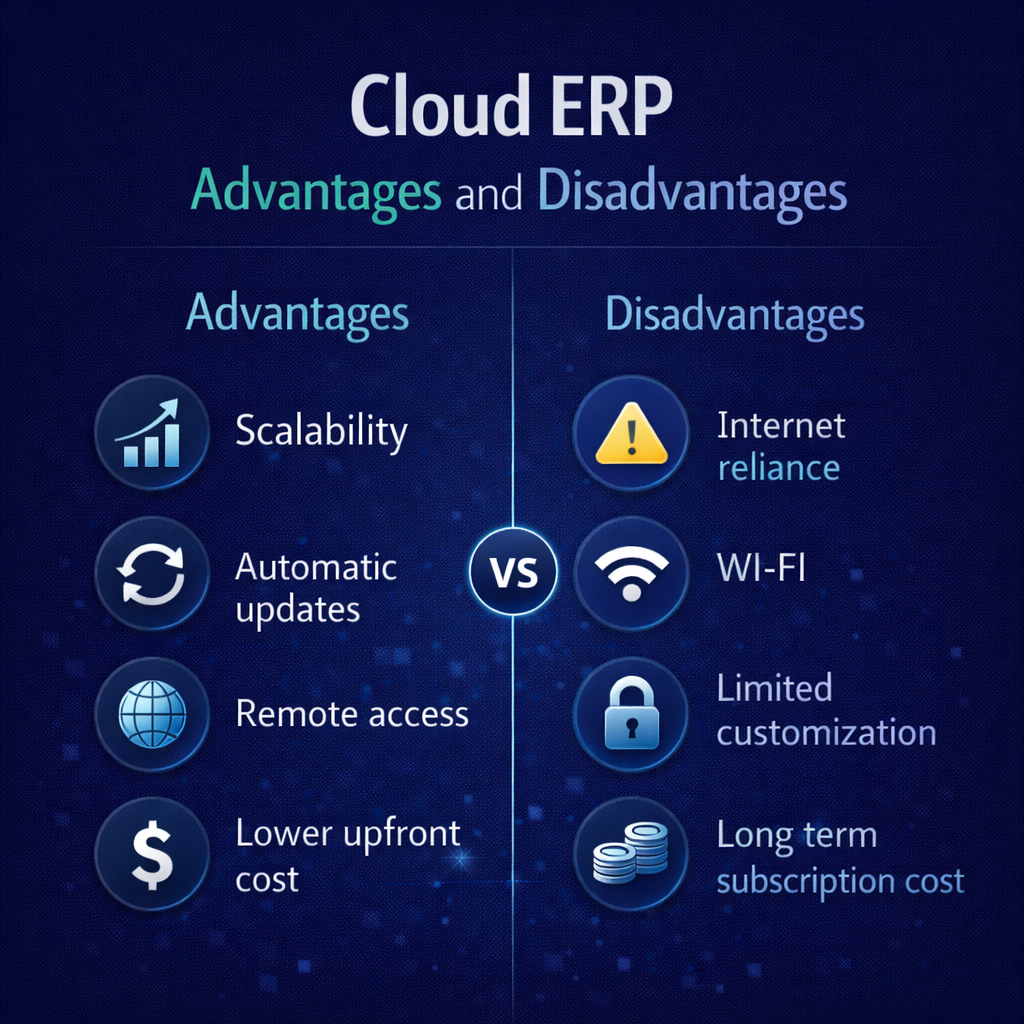
Cloud ERP Advantages and Disadvantages: An Honest Assessment From Someone Who Builds One
Most “advantages and disadvantages” articles about cloud ERP follow the same formula. The advantages section is a vendor brochure. The disadvantages section is a list of concerns from 2011 that have been copy-pasted across the internet for the past fifteen years. Neither one helps you make an actual decision.
Here’s the problem: the advantages of cloud ERP are real, but they’re conditional. They depend entirely on the architecture of the platform, the vendor’s implementation model, and whether the product you’re evaluating is genuinely cloud-native or just a legacy system that’s been relocated to a data center. And the disadvantages — some are real constraints you need to plan for, some are outdated fears that no longer apply, and some are actually advantages in disguise that the enterprise software establishment has reframed as risks because they threaten the old business model.
This is an honest assessment. We build a cloud ERP platform, so we obviously believe the advantages outweigh the disadvantages for the distribution companies we serve. But we’d rather help you evaluate clearly than pretend every concern is unfounded. The companies that make the best ERP decisions are the ones that go in with their eyes open.
The Real Advantages
Real-Time Visibility Across the Entire Operation
This is the advantage that changes how a distribution business runs on a daily basis — and the one that’s most frequently overstated by vendors who can’t actually deliver it.
True real-time visibility means that every transaction — every inventory receipt, every order allocation, every shipment, every financial posting — is reflected across the entire system the moment it occurs. Not after a batch process runs. Not after a nightly sync. Immediately. Your warehouse team, your sales team, your purchasing team, and your finance team all work from the same current data at the same time.
For distribution companies, this translates directly into better decisions. Purchasing buys based on actual demand signals rather than weekly snapshots. Sales promises delivery dates based on real inventory positions rather than optimistic estimates. Finance closes faster because transactions are already posted. Operations spots problems in real time instead of discovering them in a report three days later.
The conditional part: this advantage only materializes on platforms built with unified data architectures. Cloud ERP systems that were migrated from on-premise origins often retain batch-processing patterns and modular data silos that introduce the same latency the cloud was supposed to eliminate. If the vendor says “real-time” but the architecture still syncs data between modules on a schedule, you’re getting a faster version of the old problem — not a solution to it.
Lower and More Predictable Total Cost of Ownership
Cloud ERP shifts the cost structure from large, unpredictable capital expenditures to manageable, predictable operating expenses. No hardware to buy. No server room to maintain. No IT staff dedicated to keeping the infrastructure running. The subscription covers the platform, and the vendor handles the rest.
More importantly, true SaaS cloud ERP eliminates entire categories of cost that traditional models carry: upgrade projects that require consulting engagements, infrastructure scaling that requires capital investment, disaster recovery systems that require separate procurement, and the ongoing labor cost of system administration that on-premise deployments demand.
The conditional part: these savings only materialize with true multi-tenant SaaS architecture. Single-tenant cloud deployments and hosted legacy systems carry dedicated infrastructure costs, customer-specific upgrade fees, and many of the same administrative burdens as on-premise systems. “Cloud” on the vendor’s website doesn’t guarantee cloud economics on your P&L. You have to verify the architecture to verify the cost model.
Continuous Innovation Without Disruption
On a legacy system, new features arrive in version upgrades — large, infrequent, disruptive events that many companies delay for years because the cost and risk of upgrading outweigh the perceived benefit. The result is a system that falls further behind with every deferred upgrade.
True multi-tenant cloud ERP inverts this. Updates deploy to the platform continuously. Every customer runs the current version at all times. New capabilities, performance improvements, and security patches arrive without requiring action from you — no downtime, no testing, no consulting engagement, no migration project.
This means the platform you’re running today is the worst version you’ll ever use. Tomorrow’s will be better. Next month’s will be better still. The compounding effect of continuous improvement is one of the most powerful and least discussed advantages of true cloud ERP.
The conditional part: this advantage is exclusive to multi-tenant architecture. Single-tenant cloud deployments still require customer-by-customer updates, which means the same version fragmentation and upgrade hesitation that plague on-premise systems. Ask the vendor what version their oldest customer is running. If the answer is anything other than “the same version as everyone else,” continuous innovation isn’t what you’re getting.
Scalability That Matches Business Reality
Distribution businesses don’t grow in straight lines. Volume spikes seasonally. New warehouses come online. Customer bases expand and contract. Acquisitions add complexity overnight.
Cloud ERP built on elastic infrastructure absorbs these changes at the platform level. Adding users, processing higher transaction volumes, expanding to new locations — these are configuration events, not infrastructure projects. Your system scales with your business without requiring you to forecast computing capacity, negotiate hardware procurement, or pray that your servers can handle the holiday rush.
The conditional part: elasticity is an infrastructure capability, not a given. Single-tenant deployments sized for your current load may struggle with significant volume spikes. Verify that the platform actually scales dynamically rather than requiring manual infrastructure provisioning when your business outgrows the current allocation.
Universal Access Without Infrastructure Complexity
Your team can access the system from any location, on any device, through a standard web browser. No VPN. No remote desktop. No client software installation. For distribution companies with multiple warehouses, field sales teams, remote leadership, or operations that simply don’t stop at 5 PM, this accessibility is foundational.
It also simplifies IT management dramatically. There’s no client software to deploy, update, or troubleshoot across dozens or hundreds of devices. A browser and an internet connection are the only prerequisites for a fully functional ERP workstation.
Security That Improves Passively
This advantage is counterintuitive to many buyers but becomes obvious once you understand the economics.
True cloud ERP vendors invest in security infrastructure, monitoring, and expertise at a scale that no individual mid-market company could justify. Dedicated security teams. Continuous threat monitoring. Automated patch management. Regular penetration testing. Compliance certifications — SOC 2, ISO 27001 — maintained at the platform level for all customers simultaneously.
Security patches deploy to the entire platform instantly. There’s no window of vulnerability while individual customers schedule and test upgrades. Every customer benefits from the same current security posture at all times.
For mid-market distribution companies where “IT security” often means one person handling security alongside six other responsibilities, the cloud ERP security model isn’t a compromise. It’s a significant upgrade over what you could build and maintain on your own.
Business Continuity as a Platform Feature
Cloud ERP platforms running on hyperscale infrastructure — AWS, Azure, Google Cloud — deliver redundancy and disaster recovery that would cost six or seven figures to replicate independently. Data replicates across geographically distributed data centers in real time. Automated failover handles outages transparently. Backup is continuous, not scheduled.
For distribution operations where every hour of downtime means orders that don’t ship and customers that don’t get served, this level of business continuity isn’t a nice-to-have feature — it’s a fundamental operational requirement that cloud ERP satisfies inherently.
The Real Disadvantages
Here’s where most articles get lazy. They list “internet dependency” and “data security concerns” as though it’s still 2010 and the cloud is a novelty. Some of those concerns were valid a decade ago. Some were never valid. And some are legitimate constraints that deserve honest discussion.
Internet Dependency Is Real — but Manageable
Cloud ERP requires an internet connection. If your connection goes down, your team can’t access the system. This is a genuine dependency that doesn’t exist with on-premise software running on a local server.
However, the practical risk is lower than the concern suggests. Modern internet infrastructure is reliable enough that outages affecting business-grade connections are infrequent and typically brief. And the comparison isn’t between “always available” on-premise and “sometimes unavailable” cloud — it’s between the risk of an internet outage and the risk of a local server failure, a power outage at your facility, a failed hard drive, or any of the other infrastructure events that take on-premise systems offline without the redundancy and failover that cloud platforms provide.
The practical mitigation is straightforward: invest in redundant internet connectivity. A backup cellular or secondary ISP connection provides failover for a few hundred dollars a month — a fraction of the cost of maintaining on-premise server infrastructure. Most distribution companies operating at any meaningful scale already have redundant connectivity because their operations depend on it for e-commerce, EDI, email, and every other internet-dependent function they’ve been running for years.
Internet dependency is a real constraint that requires a real plan. It’s not a reason to avoid cloud ERP.
You’re Dependent on the Vendor — and That’s Actually the Point
Vendor dependency is listed as a disadvantage in every cloud ERP comparison ever written, and it deserves a more nuanced treatment than it usually gets.
Yes, you’re dependent on your cloud ERP vendor. Your data lives on their platform. Your operations run on their software. If they go out of business, raise prices dramatically, or let the product stagnate, you have a problem.
But let’s be honest about the alternative. On-premise ERP creates dependency too — on the hardware vendor, on the consulting firm that configured the system, on the one IT person who understands how the customizations work, on a software vendor who may stop supporting your version, and on an upgrade path that’s so painful you avoid it for years. The dependency isn’t eliminated. It’s just distributed across more parties, which makes it harder to see and harder to manage.
Cloud ERP consolidates that dependency into a single vendor relationship. Whether that’s an advantage or a disadvantage depends entirely on the vendor. A vendor that’s financially stable, transparent about their roadmap, actively investing in the platform, and aligned with your market segment makes that consolidation a strength — one relationship to manage, one organization accountable for your outcomes, one partner whose success depends on your renewal.
The risk is real when the vendor is private-equity-owned and optimizing for margin extraction, when your market segment isn’t their priority, or when the platform isn’t being actively developed. The mitigation isn’t to avoid cloud ERP — it’s to choose your vendor carefully and evaluate their viability and alignment as seriously as you evaluate their features.
Less Customization — Which Is Almost Always a Good Thing
If you’re coming from an on-premise environment where custom code has been layered onto the system for years, cloud ERP will feel more constrained. True multi-tenant platforms don’t allow individual customers to modify the underlying codebase because doing so would compromise the shared architecture that makes continuous updates possible.
Most articles list this as a straightforward disadvantage. It’s more complicated than that.
Customization in traditional ERP is the primary reason upgrades are painful, expensive, and frequently deferred. Every custom modification creates a dependency that must be tested, validated, and potentially rebuilt with each new version. Over time, the accumulation of customizations makes the system increasingly fragile, increasingly expensive to maintain, and increasingly difficult to evolve.
Cloud ERP replaces customization with configuration — flexible business rules, workflow engines, user-defined fields, configurable processes, and open APIs that let you adapt the system without modifying the core platform. The constraint is real: if your requirement genuinely can’t be met through configuration, you can’t write custom code to force a solution. But in practice, the vast majority of “customization requirements” on legacy systems exist because the platform lacked the configurability to handle them natively. Modern cloud ERP platforms designed with deep configuration capabilities handle the same requirements without the technical debt that custom code creates.
The honest assessment: if your business has truly unique requirements that can’t be addressed through configuration — not “we’ve always done it this way” requirements, but genuinely unique operational needs — you should verify that the platform’s configuration capabilities can accommodate them before committing. For most mid-market distribution companies, they can. And the long-term benefits of staying on a continuously updated, upgrade-free platform vastly outweigh the short-term adjustment of adapting to configuration over customization.
Data Migration Is a Real Project That Requires Real Effort
Moving from a legacy system to cloud ERP means extracting, cleaning, transforming, and loading your data into a new platform. This is not a trivial exercise, and minimizing it does buyers a disservice.
Legacy systems accumulate years of data — much of it redundant, outdated, inconsistently formatted, or simply wrong. Migrating that data without cleaning it transfers every data quality problem into your new system, where real-time visibility makes those problems more visible and more damaging than they were in the legacy environment.
A proper data migration requires planning, effort, and time. It requires decisions about what to bring, what to archive, and what to leave behind. It requires standardization, validation, and reconciliation. It’s not the most exciting part of an ERP implementation, but it’s one of the most consequential.
The disadvantage isn’t that data migration is hard — it’s hard regardless of whether you’re moving to cloud, on-premise, or another legacy system. The disadvantage is that many buyers underestimate the effort required, and many vendors understate it to keep the implementation timeline attractive. An honest vendor will tell you that data migration needs dedicated attention and build the appropriate time and support into the implementation plan.
Regulatory and Compliance Constraints May Affect Some Industries
For most mid-market distribution companies, cloud ERP compliance capabilities meet or exceed what they could maintain on their own infrastructure. But certain industries and certain contracts carry specific requirements — data residency mandates that restrict where data can be geographically stored, regulatory frameworks that require particular infrastructure certifications, or government contracts that mandate specific security architectures.
If your business operates under these kinds of constraints, verify that the cloud platform meets them before proceeding. Most major cloud ERP vendors can accommodate common regulatory requirements, but the specifics matter — and assuming compliance without verifying it is a risk that’s easily avoided by asking the right questions early in the evaluation.
For distribution companies without unusual regulatory requirements, this disadvantage is largely irrelevant. Standard cloud security and compliance — SOC 2, encryption at rest and in transit, role-based access controls, audit logging — provides a security and compliance posture that’s more robust than what most mid-market companies maintain independently.
You’re Sharing a Platform — and That Requires Trust
Multi-tenant architecture means your data lives on the same platform as every other customer’s data. Logical isolation keeps it completely separate — you can’t see their data and they can’t see yours — but it’s not physically separated on dedicated hardware.
For some organizations, this creates a psychological discomfort that no amount of technical explanation fully resolves. If your leadership team or your customers require physical infrastructure separation as a matter of policy rather than security, multi-tenant cloud ERP may not satisfy that requirement regardless of its technical merit.
For the vast majority of businesses, logical isolation in a well-architected multi-tenant platform provides equal or superior data protection compared to dedicated infrastructure. The vendor’s security investments protect all customers simultaneously, patches deploy universally, and the shared model is what makes the economics of continuous updates and elastic scalability possible. But trust is a factor, and it’s worth acknowledging that multi-tenancy requires trusting the vendor’s architecture in a way that dedicated infrastructure doesn’t.
How to Weigh the Trade-Offs
The advantages of cloud ERP are structural — they’re built into the delivery model and the economics of the platform. The disadvantages are largely situational — they depend on your specific infrastructure, your regulatory environment, your comfort level with vendor dependency, and how much customization debt your legacy system has accumulated.
For mid-market distribution companies, the calculus is usually clear. The operational advantages — real-time visibility, continuous improvement, scalability, reduced IT burden — address daily pain points that legacy systems create and can’t solve. The disadvantages — internet dependency, reduced customization, data migration effort — are manageable constraints that require planning, not avoidance.
The critical variable isn’t whether to move to cloud ERP. It’s which cloud ERP to move to. An honestly built, cloud-native, multi-tenant platform with vendor-direct implementation delivers on the advantages while minimizing the disadvantages. A cloud-washed legacy system with a consulting ecosystem attached delivers fewer of the advantages while introducing costs and complexities that don’t appear in the brochure.
Evaluate the architecture. Evaluate the vendor. Evaluate the implementation model. The answers to those questions determine whether the advantages you’re reading about are the advantages you’ll actually experience.
Where Bizowie Stands
Bizowie is a cloud-native, multi-tenant ERP platform built specifically for distribution businesses. We’re transparent about what that means — and what it requires.
The advantages we’ve described aren’t theoretical for our customers. Real-time visibility across the entire operation works because our unified data architecture eliminates batch processing and module silos. Continuous updates work because multi-tenant architecture means every customer runs the same current platform. Cost predictability works because per-active-user pricing with core distribution functionality included means the subscription reflects what you actually pay. And vendor-direct implementation works because the people who built the software are the same people who deploy it, train on it, and support it.
The disadvantages we’ve described are ones we address directly. We guide data migration with clear protocols and validation checkpoints because we know it’s the highest-risk workstream in any implementation. We provide deep configuration capabilities — workflow rules, user-defined fields, configurable processes, and open APIs — because we know that customization-dependent platforms create long-term problems. And we build the kind of vendor relationship that makes dependency a strength rather than a liability — because our business model depends on your renewal, not on your implementation consulting fees.
Weigh the trade-offs for yourself. Schedule a demo with Bizowie and see a cloud ERP platform that’s honest about what it does, how it works, and what it costs — built for distribution businesses that are ready for real-time visibility and operational control without the enterprise overhead.
Related Reading
- Cloud ERP FAQ: Answers to the 30 Most Common Questions Buyers Ask
- Cloud ERP Benefits: What Actually Changes When You Move Your Operation to the Cloud
- Multi-Tenant vs. Single-Tenant Cloud ERP: Why the Architecture Behind Your System Matters More Than You Think
- SaaS ERP vs. Cloud ERP vs. Hosted ERP: The Differences That Actually Matter to Your Business
- Distribution ERP Software: A Buyer’s Guide