
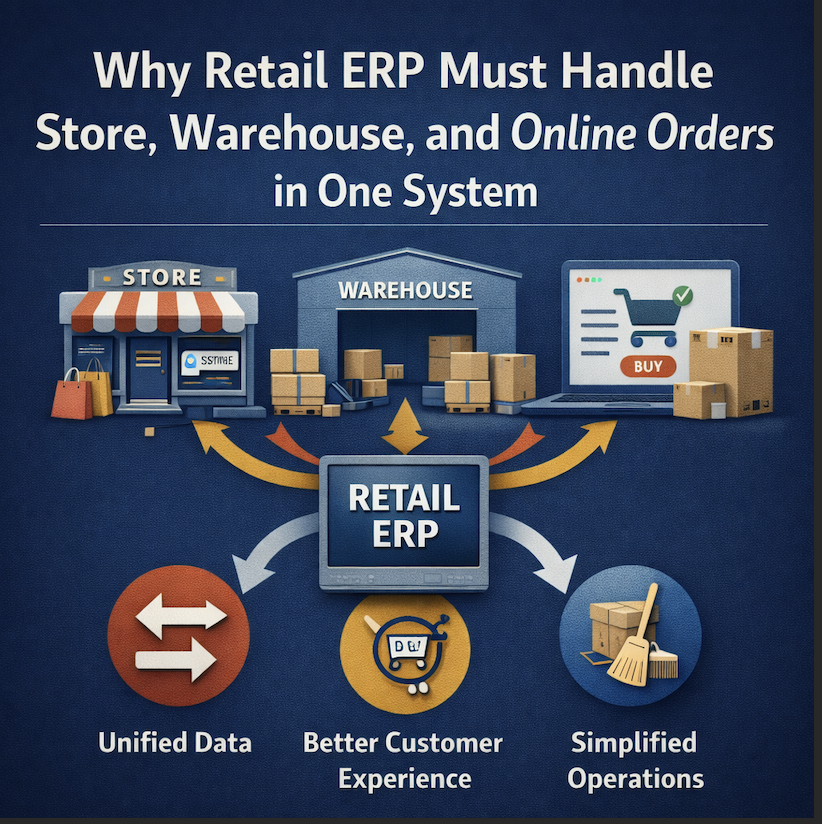
Why Retail ERP Must Handle Store, Warehouse, and Online Orders in One System
The phone call always starts the same way: “The customer is standing in our store right now, and the system says we have six units, but we can’t find them anywhere.” Your store manager is frustrated. Your warehouse team blames a system sync delay. Your ecommerce director points to inventory that was already committed to online orders. And somewhere in this chaos, a customer walks out empty-handed while the product they wanted sits in a different location entirely.
This isn’t a system failure—it’s the inevitable result of managing store orders, warehouse fulfillment, and online sales through separate platforms that don’t actually talk to each other in real time. For retailers processing 300+ daily orders across multiple channels, the question isn’t whether this fragmentation will cause problems, but how much revenue you’re losing before you notice.
The Multi-Channel Order Management Problem Nobody Discusses
Most retailers evolve their technology infrastructure based on immediate needs rather than architectural planning. You start with a point-of-sale system for stores. Add a warehouse management system when fulfillment volume grows. Bolt on an ecommerce platform when online sales take off. Implement a third-party logistics integration when you expand to marketplaces.
Each addition makes sense in isolation. The problem emerges in the spaces between these systems—in the batch synchronization delays, the manual reconciliation processes, and the split-second timing gaps that create inventory discrepancies nobody can explain.
Consider what happens when a customer places an online order at 2:47 PM:
Your ecommerce platform checks inventory and shows three units available. The order processes successfully. But at 2:45 PM, a customer in your Boston store purchased two of those units. The POS system recorded the sale locally, but the inventory sync to your ecommerce platform runs every five minutes. For those three minutes, your online store is selling inventory that no longer exists.
Your warehouse receives the fulfillment request at 3:15 PM. They pull the last unit from the shelf and ship it. The automated system sends a “shipped” notification to the ecommerce platform and attempts to update inventory counts. But the POS system already sold two units that the ecommerce platform doesn’t know about yet, and the warehouse just shipped the last one. Your inventory count shows negative one unit—a mathematical impossibility that requires manual investigation.
This scenario repeats dozens of times per day across hundreds of SKUs. Each incident consumes 15-20 minutes of staff time to investigate, reconcile, and resolve. Multiply those minutes across your team, and you’re spending thousands of dollars monthly on reconciliation work that shouldn’t exist.
Why Batch Synchronization Creates Perpetual Fire Drills
The fundamental limitation of multi-system order management isn’t poor software quality—it’s architectural impossibility. When order data lives in separate databases that synchronize on schedules rather than instantaneously, you’re always working with outdated information.
Retailers typically implement synchronization in 5-15 minute intervals, trading system performance for data freshness. This compromise seems reasonable until you calculate the exposure window. A 10-minute sync interval means every inventory figure in every system could be 10 minutes stale. During peak sales periods processing 50+ orders per hour across all channels, that staleness window contains numerous transactions that create divergent reality between your systems.
The math compounds quickly. Store POS systems process in-person sales and update local inventory instantly. But ecommerce platforms won’t see those updates until the next sync cycle. Warehouse management systems ship orders and adjust counts, but retail stores continue selling based on pre-shipment figures. Each system maintains its own version of inventory truth, and those versions converge only during successful synchronization.
When sync jobs fail—which happens more frequently than most retailers acknowledge—the divergence accelerates. A failed 2 PM sync means the 2:15 PM sync is now reconciling 30 minutes of transactions instead of 15. If that job times out due to data volume, the gap widens to 45 minutes. By the time your technical team notices the failure, you might have an hour or more of unsynchronized transaction data creating discrepancies across your entire inventory.
The operational cost extends beyond inventory accuracy. Customer service teams field calls about order status, but they’re looking at data that might be 15 minutes behind actual fulfillment progress. Marketing teams launch flash sales based on inventory reports that don’t reflect real-time channel performance. Buyers make replenishment decisions using availability figures that exclude in-flight orders not yet synchronized across systems.
The Hidden Complexity Tax of Order Routing Logic
Managing orders across store, warehouse, and online channels requires sophisticated routing logic that determines fulfillment location based on inventory position, shipping costs, delivery timeframes, and customer preferences. When this logic lives outside your order management system—in middleware, manual processes, or separate business intelligence tools—every routing decision becomes a coordination exercise.
Your online orders need intelligent allocation between warehouse fulfillment and ship-from-store based on real-time inventory. A customer in Chicago ordering a jacket shouldn’t receive shipment from your California warehouse when your Michigan Avenue store has six units in stock. But implementing this logic requires your ecommerce platform to query POS inventory, compare warehouse availability, calculate shipping costs from multiple locations, and execute fulfillment routing—all while maintaining inventory accuracy across systems that don’t share the same database.
Most retailers solve this with periodic inventory exports, business rules built into ecommerce platforms, and manual intervention for edge cases. This approach works at 200 daily orders but collapses at 1,000+ when the volume of routing decisions exceeds human supervision capacity.
The failure modes are expensive. Orders ship from distant warehouses incurring unnecessary freight costs when nearby stores had inventory. Ship-from-store orders get routed to locations with insufficient stock, creating backorders that require re-routing and delayed delivery. Buy-online-pickup-in-store orders arrive at locations that just sold the item locally, forcing customer service to find alternative stores or refund purchases.
Each routing error represents both immediate cost (expedited shipping, customer service time, lost sale) and long-term impact (customer dissatisfaction, negative reviews, reduced repeat purchase likelihood). Retailers processing 5,000+ monthly orders across multiple channels typically experience hundreds of routing inefficiencies monthly, representing five-figure hidden costs that never appear in software vendor invoices.
Why Store Fulfillment Fails Without Unified Visibility
Ship-from-store programs promise inventory productivity improvement by treating retail locations as distributed fulfillment nodes. The concept is sound: utilize store inventory to fulfill online orders, reduce warehouse shipping distances, and improve delivery speed. The execution requires operational sophistication that fragmented systems can’t deliver.
When online orders route to stores, retail associates need visibility into committed inventory—not just physical counts. That leather jacket hanging on the sales floor might be physically present, but if a customer reserved it for pickup yesterday and hasn’t collected it yet, it’s committed inventory that can’t fulfill a new online order. Your POS system knows about the pickup reservation, but if your ecommerce platform only sees the inventory count, it treats the jacket as available and creates a fulfillment conflict.
Store associates handling ship-from-store orders need integrated workflows that span both retail and fulfillment operations. Pick the item, pack it appropriately, print shipping labels, update inventory, mark the online order shipped, and hand off to carrier—all while maintaining store customer service responsibilities. When these workflows require switching between POS, shipping software, and manual order management tools, completion time extends and error rates increase.
The inventory complexity multiplies for retailers with store transfer capabilities. If your Boston store is low on a popular item but your Philadelphia store has excess, you want to enable store-to-store transfers to optimize inventory distribution. But executing transfers requires updating inventory in both store POS systems, the warehouse management system, your ecommerce platform, and any marketplace integrations. A transfer initiated at 10 AM might not reflect across all systems until 11 AM, creating a 60-minute window where both locations show incorrect inventory that could lead to overselling or underselling.
Retailers attempting ship-from-store without unified order management typically process only 10-20% of potential store fulfillment opportunities due to operational friction and error risk. The remaining 80-90% ship from warehouses at higher cost and longer delivery times, negating the financial benefits that justified the program investment.
The Real-Time Inventory Truth Problem
Inventory accuracy isn’t just about counting products correctly—it’s about maintaining synchronized truth across every system that makes decisions based on available-to-promise quantity. When your retail ERP handles only warehouse inventory while separate systems manage stores and online sales, nobody has complete visibility into actual availability.
Your warehouse management system shows 50 units on hand. Your POS systems across six stores collectively show 30 units. Your ecommerce platform reports 42 units available for online sale. Which number is correct? The answer is none of them—because none of these systems know about the committed inventory in the others.
Those 50 warehouse units include 15 that are already picked and packed for orders not yet shipped. The 30 store units include 8 reserved for buy-online-pickup-in-store orders not yet collected. The 42 units shown online don’t account for 5 units sold in stores during the last sync interval. Your actual available-to-promise inventory is somewhere around 45 units, but no single system can calculate that figure because the data lives in silos.
This fragmentation creates systematic overselling during high-volume periods. A popular product with thin inventory margins might show as available across all channels while actually being committed three times over. You discover the overselling hours or days later when fulfillment teams pull inventory reports and realize you’ve sold 75 units of a product with only 45 units actually available.
The resolution process consumes significant resources. Customer service cancels orders, issues refunds, and fields complaints. Operations teams investigate discrepancies to understand what happened. Management reviews policies to prevent recurrence. But without unified inventory management, the same pattern repeats during the next high-volume event because the architectural limitation remains unchanged.
Why Order Visibility Requires Unified Data Architecture
Customer service quality in multi-channel retail depends on complete order visibility regardless of fulfillment source. When a customer calls asking about their order status, your team needs to see whether it’s shipping from a warehouse, fulfilling from a store, or available for pickup—with real-time progress information.
Fragmented systems create visibility gaps that destroy customer confidence. Your customer service representative looks at the ecommerce platform, which shows the order placed yesterday with “processing” status. But they don’t see that the order routed to a store for fulfillment, and the store hasn’t updated shipping status yet. The customer is told “your order is processing,” when in reality it shipped this morning from the store location—information that exists in the POS system but hasn’t synchronized to ecommerce yet.
These visibility gaps extend to returns and exchanges across channels. A customer who purchased online wants to return an item to a physical store. Your store associate processes the return in the POS system, but the ecommerce platform shows the order as delivered and unpaid. The financial reconciliation requires manual intervention to credit the online order, adjust store sales figures, and update inventory across all systems.
For retailers offering buy-online-return-in-store, buy-in-store-ship-to-home, and other cross-channel services, these visibility limitations erode the seamless experience that differentiates modern retail. Customers expect unified commerce—the ability to interact with your brand across any channel with consistent information and service quality. Delivering that experience requires unified order data that transcends channel-specific systems.
The Financial Reconciliation Nightmare
Month-end close for retailers managing orders across separate systems involves extensive reconciliation to ensure revenue, inventory, and fulfillment costs align across channels. Your accounting team exports data from ecommerce platforms, POS systems, warehouse management, and shipping software, then manually reconciles discrepancies that shouldn’t exist.
Online orders fulfilled from stores create split revenue attribution that requires careful tracking. The ecommerce channel generated the sale, but the store fulfilled it and incurred associated labor costs. Your POS system recorded the inventory reduction, but your ecommerce platform recorded the revenue. Shipping costs might flow through a separate system entirely. Assembling a complete picture of order economics requires combining data from multiple sources with different transaction timestamps and record structures.
Returns amplify the reconciliation complexity. An online order returned to a store creates a transaction in the POS system that needs to credit the ecommerce channel, adjust inventory across both warehouse and retail locations, and potentially trigger restocking decisions based on the return reason. If the return happens in a different month than the original purchase, the accounting impact spans multiple periods requiring careful tracking.
Most retailers dedicate multiple full-time staff members to order and inventory reconciliation—work that exists solely because order data doesn’t live in a unified system. This represents thousands of dollars monthly in accounting labor that provides zero strategic value beyond preventing financial reporting errors created by system fragmentation.
What Unified Order Management Actually Means
True unified order management means all orders—store, warehouse, online, marketplace, B2B, and any other channel—write to the same database with real-time inventory impact. A sale in your store at 2:47 PM instantly updates available-to-promise inventory for online orders at 2:47 PM. An online order placed at 3:15 PM immediately reflects in store inventory visibility so retail associates can accurately inform customers about availability.
This architectural approach eliminates synchronization delays because there’s nothing to synchronize. Every order transaction updates the single source of truth for inventory, and every channel reads from that same source. The 5-15 minute staleness window disappears, replaced by subsecond data propagation that maintains accuracy regardless of transaction volume or system load.
Unified order management extends beyond inventory synchronization to encompass the entire order lifecycle. Order routing logic lives within the ERP, enabling sophisticated fulfillment decisions based on complete inventory visibility, customer location, carrier rates, store capacity, and business rules you define. Your system can automatically route online orders to the optimal fulfillment location based on real-time inventory, associate workload, and delivery commitments—without custom middleware or manual intervention.
Customer service teams access complete order information regardless of channel or fulfillment source through a single interface. Store associates see online order details when customers arrive for pickup. Warehouse teams see store transfer requests alongside direct fulfillment orders. Management views consolidated order metrics across all channels without stitching together reports from disparate systems.
Financial reporting becomes straightforward because all order transactions record in the same system using consistent accounting logic. Revenue, cost of goods sold, fulfillment expenses, and inventory adjustments automatically maintain accuracy across channels. Month-end close requires hours instead of days because there’s nothing to reconcile between systems that share the same transaction database.
The Implementation Reality for Multi-Channel Retailers
Moving from fragmented order management to a unified ERP platform requires careful migration planning and operational adjustment. The technical migration—moving order data, integrating with existing systems like payment processors and shipping carriers, configuring workflows—typically spans 8-12 weeks depending on order complexity and channel diversity.
The operational adjustment matters more than technical implementation. Staff accustomed to checking multiple systems for order information need training on unified workflows. Store associates learn new ship-from-store processes that integrate with retail responsibilities. Warehouse teams adapt to fulfillment requests from multiple channels presented through consistent interfaces. Customer service develops new protocols for handling cross-channel inquiries using complete order visibility.
Most retailers adopt phased rollouts that gradually shift order channels to the unified platform. Start with one channel—typically warehouse fulfillment since it has the most structured processes—and validate data accuracy and workflow efficiency before adding stores and marketplaces. This approach limits risk while building organizational confidence in the new system.
The immediate benefits emerge during the first month of full operation. Inventory accuracy improves by 40-60% as synchronization delays disappear. Overselling incidents drop by 70-80% as all channels work from real-time availability. Customer service resolution time decreases by 30-40% as representatives access complete order information without system switching. Month-end close accelerates by 50-60% as manual reconciliation becomes unnecessary.
Why Your Growth Depends on Architectural Unity
Scaling multi-channel retail from 500 to 5,000 daily orders isn’t about processing more transactions—it’s about managing exponentially more complexity without exponentially more staff. Fragmented order management creates linear complexity increase where every new channel, store location, or marketplace integration adds synchronization overhead, reconciliation work, and failure modes that require human intervention.
Unified order management creates logarithmic complexity growth where additional channels integrate into existing infrastructure without multiplying reconciliation burdens. Your 20th store connects to the same order database as your first, requiring identical synchronization work (none) and equivalent operational overhead. Your fifth marketplace integration follows the same pattern as your second, using established workflows and proven logic.
This architectural advantage compounds as you scale. At 10,000+ daily orders across multiple channels, the difference between unified and fragmented order management represents dozens of full-time employees dedicated to reconciliation versus redeploying those resources to strategic initiatives like customer experience enhancement, channel expansion, or supply chain optimization.
The retailers dominating multi-channel commerce aren’t winning through superior marketing or better products—they’re winning through operational excellence enabled by unified technology architectures that eliminate artificial complexity. Their order management doesn’t require reconciliation because there’s nothing to reconcile. Their inventory accuracy remains high regardless of transaction volume because every sale instantly updates shared availability. Their customer service delivers consistent experiences because order visibility transcends channel boundaries.
Moving Forward with Unified Order Management
If you’re managing store, warehouse, and online orders through separate systems, the operational limitations aren’t theoretical future problems—they’re current revenue constraints and cost centers you’re already experiencing. The inventory discrepancies, overselling incidents, reconciliation workload, and customer service challenges represent measurable financial impact that unified ERP eliminates.
Bizowie’s cloud ERP platform provides genuine unified order management where store, warehouse, and online orders write to the same transactional database with real-time inventory impact. Our distribution-focused architecture handles multi-channel complexity through purpose-built workflows for ship-from-store, buy-online-pickup-in-store, cross-channel returns, and intelligent fulfillment routing—all within a single platform that eliminates synchronization delays and reconciliation overhead.
For retailers processing 300+ daily orders across multiple channels, the technical and operational requirements for unified order management are well-defined and achievable within 8-12 weeks. The financial impact—improved inventory accuracy, reduced overselling, accelerated month-end close, and eliminated reconciliation labor—typically delivers ROI within six months of full deployment.
Ready to eliminate the operational complexity of fragmented order management? Schedule a demo to see how Bizowie’s unified ERP platform handles store, warehouse, and online orders through real-time, single-database architecture that scales with your growth.