
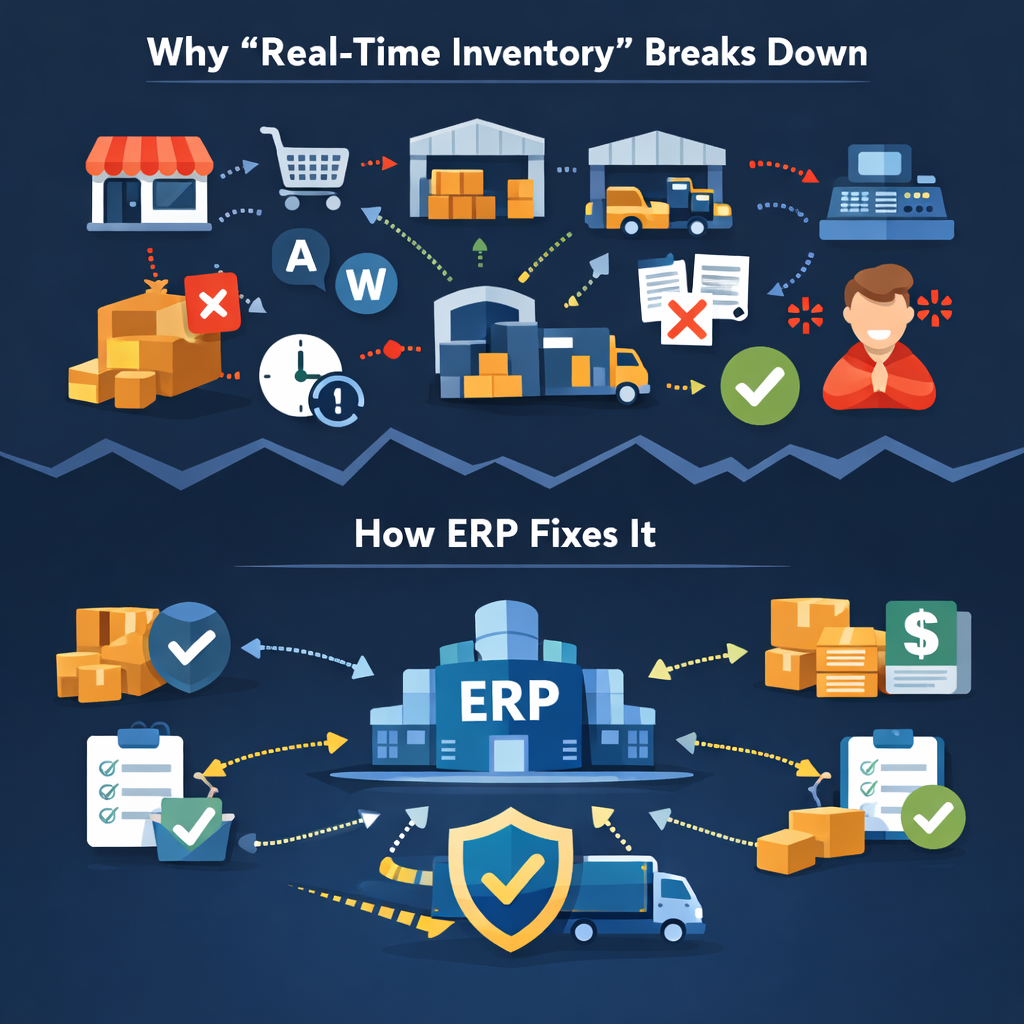
Why ‘Real-Time Inventory’ Breaks Down in High-Volume eCommerce (And How ERP Fixes It)
Every eCommerce retailer claims to offer real-time inventory visibility. It’s featured prominently on product pages, touted in customer communications, and listed as a core capability of their technology stack. But for businesses processing hundreds or thousands of orders daily across multiple channels, the promise of real-time inventory often diverges sharply from operational reality.
The breakdown typically announces itself through a cascade of customer-facing problems: product pages showing items in stock that are actually unavailable, orders placed successfully in the morning but canceled by afternoon due to inventory shortages, overselling that requires embarrassing apology emails and rushed expedited shipping from alternative suppliers, and customer service teams spending hours daily managing inventory discrepancy complaints. These symptoms point to a fundamental truth: what most growing retailers call “real-time inventory” is actually a patchwork of systems with delays, gaps, and inconsistencies that become more pronounced as volume and complexity increase.
The gap between perception and reality isn’t just an operational nuisance—it’s a strategic vulnerability that directly impacts revenue, customer satisfaction, and operational efficiency. Research shows that 70% of online shoppers have experienced buying a product only to learn it’s out of stock, and 40% of those customers never return to that retailer. When your inventory accuracy falls below 95%, you’re not just creating isolated fulfillment problems; you’re systematically eroding customer trust and limiting growth potential.
Understanding why inventory visibility breaks down at scale—and how modern cloud ERP platforms solve these challenges—is essential for any eCommerce business experiencing rapid growth or planning multi-channel expansion.
The Illusion of Real-Time Inventory
The term “real-time inventory” suggests instantaneous accuracy: a customer views a product page, the system checks current stock levels, and the displayed availability reflects actual warehouse reality at that precise moment. This ideal represents what retailers aspire to deliver and what customers increasingly expect. But the operational reality behind most eCommerce inventory systems reveals multiple points where “real-time” becomes “reasonably current” or “hopefully accurate.”
The Data Flow Deception
Most eCommerce businesses operate multiple software systems that must communicate inventory information: an eCommerce platform that displays availability to customers, a warehouse management system or spreadsheet that tracks physical stock, an order management system that allocates inventory to orders, shipping software that confirms fulfillment, and accounting software that records inventory values. Each system maintains its own inventory records, and synchronization between them happens through data transfers—exports from one system, imports to another—that introduce inherent delays.
Consider the typical order-to-fulfillment data flow. A customer places an order on your Shopify store at 10:00 AM. The eCommerce platform immediately reduces displayed inventory, but this change doesn’t automatically propagate to your warehouse management system. Warehouse staff working from printed pick lists or a separate inventory application don’t see the new order until the next scheduled export runs at 10:30 AM. They pick and pack the order at 11:15 AM, but the inventory deduction isn’t recorded in your master inventory system until the end-of-shift batch update at 2:00 PM. Your accounting system doesn’t reflect the change until the nightly financial reconciliation at midnight.
In this scenario, your eCommerce platform might show “real-time” inventory from its perspective, but it’s operating on data that lags actual warehouse reality by 30 minutes to 4 hours depending on the transaction. During high-volume periods when you process hundreds of orders daily, this lag creates expanding discrepancies. The morning might begin with system inventory matching physical stock, but by early afternoon, the gap widens to dozens of units across multiple SKUs.
Multi-Channel Complexity Amplification
Inventory synchronization challenges multiply exponentially when you sell across multiple channels. A business selling through its own website, Amazon, eBay, and a few specialty marketplaces operates five or more separate storefronts, each with its own inventory record that must stay synchronized with central warehouse stock.
The typical approach involves periodic inventory pushes from a central system to each channel—often every 15-30 minutes to balance accuracy against API rate limits and system performance. When a product sells on Amazon at 10:05 AM, Amazon’s inventory decrements immediately, but your Shopify store won’t reflect this change until the next synchronization cycle at 10:30 AM. During that 25-minute window, customers shopping on your website see availability that doesn’t account for the Amazon sale. If you’re moving dozens of units per hour during a promotional campaign, these synchronization windows create consistent overselling.
The problem compounds when each channel maintains its own allocation rules and buffer stock. To prevent overselling on Amazon, you might hold back 20% of available inventory. Your wholesale portal reserves another 30% for B2B customers. Your retail stores get priority access to 100 units. These overlapping allocations, managed across disconnected systems, create labyrinthine logic that’s nearly impossible to maintain accurately. The result is either overselling (when allocations overlap) or underselling (when excessive buffers leave inventory unavailable despite physical availability).
The Hidden Inventory States
Physical inventory isn’t a simple binary of “in stock” or “out of stock”—it exists in multiple states simultaneously, and most basic inventory systems struggle to track these distinctions accurately. Available inventory represents what’s physically present and unallocated. Allocated inventory has been assigned to specific orders but not yet picked. In-transit inventory is moving between locations or from vendors. Quarantined inventory awaits quality inspection. Reserved inventory is held for specific customers or purposes. Damaged inventory occupies warehouse space but can’t be sold.
When your inventory system treats all warehouse stock as a single undifferentiated quantity, it inevitably shows availability that doesn’t match what can actually be fulfilled. A product might show 50 units available when the reality is: 30 units already allocated to orders being picked, 10 units in quality inspection following customer returns, 5 units damaged and awaiting disposal, and only 5 units actually available for new orders. Customers see “50 in stock” and place orders that create overselling situations requiring intervention.
The time dimension adds another layer of complexity. Your system might show zero available units today while 500 units are en route from your supplier, arriving in three days. Should your eCommerce platform allow backorders? Communicate expected availability? Remove the product from search results? Different channels might handle this differently, creating inconsistent customer experiences and difficult allocation decisions when orders exceed immediate availability.
The Breaking Points: When Volume Exposes Inventory Gaps
Inventory visibility challenges exist at all volume levels, but they transform from manageable nuisances to business-threatening crises when daily transaction velocity crosses certain thresholds. Understanding these breaking points helps identify when your current inventory management approach has become a constraint rather than a solution.
The Transaction Velocity Threshold
Most inventory synchronization problems remain hidden or manageable when order volume stays below 100-150 daily transactions. At this level, periodic updates between systems (even hourly) are sufficient because the absolute number of inventory changes remains small. If you sell 120 units across 30 SKUs daily with hourly inventory syncs, your maximum exposure is 4-5 units per SKU per hour—unlikely to cause significant overselling.
But transaction velocity increases non-linearly with growth. A business scaling from 150 to 300 daily orders doesn’t just double transactions—order complexity typically increases too, with more multi-item orders, more returns requiring restocking, and more inventory movements. Suddenly you’re processing 600-800 inventory-impacting transactions daily across 50-75 active SKUs. Hourly synchronization means potential discrepancies of 25-35 inventory movements per cycle, creating frequent overselling.
The breaking point typically occurs around 200-300 daily orders for businesses using disconnected inventory systems. At this volume, synchronization lag causes 3-7 overselling incidents daily—enough to require dedicated staff time for resolution but not catastrophic enough to force immediate system changes. Businesses adapt by building manual processes: someone checks inventory across systems multiple times daily, customer service proactively contacts buyers of recently oversold items, purchasing rushes emergency replenishment for popular products. These workarounds mask the underlying problem while consuming substantial operational capacity.
The crisis fully emerges during peak periods. A Black Friday promotion that drives 1,000 orders in 48 hours—a growth opportunity that should be celebrated—becomes an operational nightmare when synchronization lag creates 40-60 overselling situations requiring resolution. Customer service is overwhelmed, fulfillment teams waste time processing cancellations and partial shipments, and the reputation damage from failed holiday orders persists long after the promotional period ends.
Multi-Channel Collision Points
The collision between channels selling from shared inventory creates particularly visible failures. Consider a product with 5 units remaining in physical inventory. Your Shopify store shows 5 available, Amazon shows 5 available (with last sync 20 minutes ago), and eBay shows 5 available (with last sync 15 minutes ago). Within a 10-minute window, customers place 3 orders on Shopify, 2 orders on Amazon, and 2 orders on eBay—a total of 7 units against 5 available.
Each channel immediately confirms the orders to customers because its own inventory records showed availability at the moment of purchase. But when the next synchronization cycle runs, the conflict becomes apparent. Now you must choose which customers receive their orders and which get cancellation emails—a no-win decision that damages relationships regardless of which channel you prioritize.
The standard workaround—maintaining separate inventory pools for each channel—solves the overselling problem but creates inefficiency and lost revenue. If you allocate 40% of inventory to your website, 40% to Amazon, and 20% to eBay, you might show “out of stock” on Amazon while units sit unsold in the website allocation. This artificial scarcity limits sales and creates customer frustration when they see the same product available through different channels at different times.
Dynamic reallocation between channels requires sophisticated logic and true real-time visibility. Most businesses lack both, so they either tolerate regular overselling or accept the revenue loss from conservative allocations. Either choice represents a significant strategic disadvantage against competitors with better inventory management.
Returns and Restocking Chaos
Returns processing exposes inventory gaps with particular severity. When a customer returns a product, it moves through several states before becoming available for resale: return received but not inspected, inspected and approved for restocking, physically moved to active inventory location, and system updated to reflect availability. Each transition creates an opportunity for inventory records to diverge from reality.
In disconnected systems, returns often create negative inventory spirals. A product returns to the warehouse on Monday, gets inspected and approved Tuesday, physically restocked Wednesday, but the inventory system update doesn’t happen until the weekly reconciliation Friday. Meanwhile, customer service has already promised restocked availability to customers asking about the out-of-stock item. When those customers place orders Thursday, they’re buying from visibility that doesn’t match physical reality—creating another round of disappointment and cancellation.
High return rates—common in apparel, footwear, and other size-dependent categories—amplify these problems. A fashion retailer with 25% return rates processes 75 return units daily for every 300 orders shipped. Managing these returns through disconnected systems with batch updates means substantial phantom inventory: products physically present but systemically invisible, or vice versa. The result is simultaneous overselling of actually available inventory and underselling of returned but not yet system-updated inventory.
Promotional Campaign Inventory Crises
Promotional campaigns and flash sales compress normal daily volume into hours or minutes, exposing every weakness in inventory synchronization. A 24-hour promotion that drives 800 orders against normal daily volume of 200 creates a 4x spike in transaction velocity. Inventory synchronization cycles designed for steady-state operations simply can’t keep pace.
The typical outcome: the promotion starts at midnight, performs exceptionally well for the first 4-6 hours, then collapses into overselling chaos as inventory records diverge from warehouse reality. By mid-morning, you’ve sold 120% of available inventory on popular items. Customer service starts receiving angry calls about cancellations. You scramble to source emergency replacement inventory at premium pricing. The promotion that should have been a revenue win becomes a profitability disaster and customer satisfaction crisis.
The downstream consequences extend beyond the immediate event. Customers who experienced cancellations during the promotion develop lasting skepticism about your inventory reliability. They’re less likely to purchase future promotions quickly, knowing they might face cancellation. This learned caution reduces the effectiveness of time-limited offers—a key eCommerce revenue driver—creating long-term strategic impact from short-term inventory failures.
The Technical Reasons Real-Time Breaks Down
Understanding why inventory synchronization fails at scale requires examining the technical architecture behind typical eCommerce inventory management. The problems aren’t primarily about software quality but about fundamental limitations in how disconnected systems communicate and maintain data consistency.
Batch Processing and Scheduled Synchronization
Most inventory management implementations rely on scheduled batch processes to transfer data between systems. Your eCommerce platform exports order data every 15 minutes, your warehouse system imports these files and updates internal records, then exports inventory adjustments every 30 minutes, which your eCommerce platform imports to update displayed availability. This architecture developed because it’s technically simpler and more resource-efficient than maintaining continuous real-time connections.
Batch processing made sense in earlier eCommerce eras when order volumes were lower and system performance constraints more severe. It’s also easier to implement: scheduled file exports and imports require less sophisticated programming than real-time API integrations or database synchronization. Many small businesses still successfully operate batch-based inventory management because their transaction volume stays within the architecture’s inherent limitations.
However, batch processing creates fundamental accuracy constraints. Even with aggressive scheduling (syncs every 5 minutes), you introduce 5-minute windows where systems diverge. At high transaction velocity, significant inventory changes occur within these windows. The architecture can’t eliminate the accuracy gap; it can only minimize it—and minimizing requires progressively more frequent syncs that eventually hit practical limits around API rate limits, system performance, and data processing overhead.
The compounding effect of multiple batch cycles further degrades accuracy. An order placed at 10:00 enters your eCommerce system immediately but doesn’t reach your warehouse until the 10:15 export. Warehouse staff pick it at 10:40 but don’t record the inventory deduction until the end-of-shift batch update at 2:00. This deduction doesn’t propagate back to your eCommerce platform until the 2:15 import cycle. From customer purchase to your website showing updated availability, 4 hours and 15 minutes have elapsed—during which dozens or hundreds of additional inventory transactions occurred.
API Rate Limits and Throttling
Even businesses that implement API-based integrations rather than batch file transfers encounter technical constraints that prevent true real-time inventory. Most platforms impose rate limits on API calls to prevent system overload—typically 1,000-2,000 requests per hour for standard plans, sometimes higher for enterprise tiers but never unlimited.
These rate limits force strategic compromises in inventory management. If you sell across your website, Amazon, eBay, and two specialty marketplaces, maintaining real-time inventory across all channels would require an API call for every inventory change to every channel. At 300 daily orders with 2.5 items average (750 inventory transactions), plus returns, receiving, and adjustments, you’re looking at 1,000+ required API calls daily. Distributed across channels and bidirectional synchronization, this easily exceeds hourly rate limits.
The standard workaround—prioritizing which inventory changes propagate in real-time versus batch—introduces exactly the inconsistency real-time inventory aims to prevent. You might push inventory decreases immediately to prevent overselling but batch inventory increases to stay within rate limits. This asymmetry means your eCommerce site removes availability quickly when products sell but slowly reflects restocking, creating artificial scarcity that limits sales.
More sophisticated approaches implement queue-based systems that buffer inventory changes and transmit them as rapidly as rate limits allow. These systems improve on simple batch processing but still introduce lag during high-volume periods when the queue grows faster than rate limits allow depletion. During flash sales or peak shopping days, inventory updates might lag by 15-30 minutes even with optimized queue management—enough delay to cause significant overselling.
Database Synchronization Challenges
Some businesses attempt to achieve real-time inventory by synchronizing databases directly rather than using API integrations or file transfers. This approach eliminates scheduled batch delays and API rate limits by maintaining continuous database replication between systems. However, it introduces different technical challenges that often make it impractical for growing businesses.
Database synchronization requires that all systems use compatible database platforms and grant each other low-level access—rarely feasible when combining commercial eCommerce platforms, warehouse management systems, and accounting software from different vendors. Building and maintaining database replication between incompatible systems requires substantial technical expertise and ongoing maintenance as each system releases updates.
Even when technically feasible, database synchronization creates coupling between systems that reduces flexibility and increases fragility. Changes to database schema in one system can break synchronization, causing inventory records to silently diverge. System updates require careful coordination to prevent sync failures. Debugging problems becomes complex because issues might originate in any connected system and propagate in non-obvious ways.
The performance overhead of continuous synchronization also becomes problematic at scale. Maintaining real-time database replication between three or four systems generates substantial database load, potentially degrading performance of the primary systems themselves. This creates a painful tradeoff: perfect inventory accuracy at the cost of slower order processing and page load times, or faster performance with periodic sync delays.
The Eventual Consistency Problem
Even sophisticated distributed systems that appear to offer real-time inventory actually operate on a principle called “eventual consistency”—systems converge toward accurate inventory over time but may show temporary discrepancies. This approach represents a reasonable engineering compromise in distributed computing, but it creates precisely the problems eCommerce businesses hope to avoid.
Consider what happens when a customer adds a product to cart on your website while simultaneously another customer purchases the same product on Amazon. Both systems check inventory simultaneously, both see one unit available, both allow the transaction to proceed. Only after both transactions complete does each system notify the other, creating a conflict that requires resolution. Eventual consistency means that over the next few minutes to hours, the systems will reconcile to accurate inventory—but the immediate accuracy gap has already caused overselling.
Solving this requires distributed locking mechanisms where checking inventory and committing a transaction happen atomically across all systems. This level of coordination requires sophisticated architecture rarely available in eCommerce technology stacks. Most platforms prioritize transaction completion over inventory accuracy—better to occasionally oversell than to delay orders or show “out of stock” due to distributed locks.
The Hidden Costs of Inaccurate Inventory
Inventory inaccuracy isn’t just an operational inconvenience—it creates measurable costs that compound across multiple business functions. Quantifying these impacts helps build the business case for comprehensive inventory management solutions.
Direct Revenue Loss from Underselling
Counterintuitively, one of the largest costs of inaccurate inventory is showing “out of stock” when products are actually available. This happens when inventory system lags cause physical restocking to precede system updates, when excessive channel allocation buffers hold back available inventory, or when damaged/returned inventory awaiting disposition prevents the system from showing actually available units.
The revenue impact is immediate and substantial. If inventory inaccuracy causes you to show “out of stock” on 5% of product views when inventory is actually available, and your product pages convert at 3%, you’re losing 0.15% of potential revenue to false stockouts. For a business with $5 million in annual revenue and 500,000 product page views monthly, this represents $7,500 in monthly lost revenue—$90,000 annually—from sales you could have captured with accurate inventory.
The loss amplifies during peak shopping periods when conversion rates are higher and inventory turn is faster. Holiday shopping periods might see product page views triple and conversion rates increase to 5-6%. False stockouts during these high-value periods cost proportionally more, potentially representing 25-30% of annual revenue impact despite being just 20% of the calendar year.
The opportunity cost extends beyond immediate transactions. Customers who encounter stockouts often research competitors’ availability and may never return to check if your inventory has been restocked. This customer loss has lifetime value implications that dwarf the immediate transaction value. Losing a customer worth $500 lifetime value over a $50 false stockout represents 10x impact beyond the immediate sale.
Customer Service and Cancellation Costs
Overselling creates direct operational costs through customer service time, expedited shipping for replacement orders, and the administrative burden of cancellations and refunds. These costs are quantifiable and substantial even before considering reputation damage.
Each overselling incident requires 15-30 minutes of customer service time: contacting the customer, explaining the situation, processing a refund or offering alternatives, and documenting the interaction. At 5-10 overselling incidents daily (typical for businesses processing 300 orders with inventory inaccuracy issues), this represents 1.25-5 hours of daily customer service capacity—equivalent to 15-60% of a full-time role depending on incident frequency.
The fully-loaded cost of this customer service time, including wages, benefits, software, and overhead, ranges from $25-35 per hour. At 3 hours daily average, overselling-related service costs $75-105 daily or $27,000-38,000 annually. This represents avoidable expense directly attributable to inventory inaccuracy—not including the opportunity cost of service staff handling stockout inquiries instead of revenue-generating activities like upselling or proactive customer retention.
When businesses attempt to fulfill oversold orders through expedited shipping or alternative suppliers, costs escalate dramatically. Shipping a product 2-day air instead of ground adds $15-25 per order. Sourcing emergency inventory from alternative suppliers might cost 20-40% more than standard wholesale pricing. If you resolve 25% of overselling incidents this way (attempting to preserve the customer relationship), these recovery costs add another $15,000-25,000 annually to the inventory inaccuracy expense.
Inventory Carrying Cost Inefficiency
Inaccurate inventory creates two opposing cost pressures. To prevent stockouts, businesses maintain higher safety stock than would be necessary with accurate visibility—increasing carrying costs and tying up working capital. Simultaneously, inaccurate demand visibility leads to poor purchasing decisions that create overstock of slow-moving items—further increasing carrying costs while reducing capital available for fast-moving inventory.
Inventory carrying costs typically range from 20-30% of inventory value annually, including cost of capital, storage expense, insurance, obsolescence risk, and shrinkage. For a business carrying $500,000 in inventory with 25% carrying cost, total annual carrying expense is $125,000. If inventory inaccuracy causes you to hold 15% more inventory than optimal (a conservative estimate for businesses with significant accuracy problems), you’re spending an unnecessary $18,750 annually in carrying costs.
The capital efficiency impact extends beyond direct carrying costs. Working capital tied up in excess inventory isn’t available for marketing investments, technology improvements, or strategic opportunities. This opportunity cost is harder to quantify but potentially more significant than direct carrying costs. The difference between investing $75,000 in inventory versus deploying it in growth marketing could represent $300,000-500,000 in incremental revenue potential.
Obsolescence and markdown costs hit particularly hard in fashion, seasonal products, and technology categories. Inaccurate inventory visibility leads to poor end-of-season decisions: products you thought were sold out requiring deep discounts, products you thought were well-stocked actually depleted months ago. If 5% of inventory ultimately sells at 50% markdown due to inventory visibility failures, this represents 2.5% of inventory value—$12,500 annually for a business with $500,000 inventory—directly attributable to inaccuracy.
Operational Complexity and Reconciliation Labor
Perhaps the most insidious cost of inventory inaccuracy is the operational labor required to manually manage discrepancies, conduct frequent cycle counts, reconcile system differences, and make inventory allocation decisions that compensate for system inadequacy. This labor represents pure operational overhead that contributes nothing to customer value or business growth.
Frequent cycle counting becomes necessary to maintain even marginal accuracy when automated systems can’t be trusted. Businesses with significant inventory problems often conduct partial cycle counts weekly or even daily, consuming 10-20 staff hours weekly. At fully-loaded warehouse labor costs of $25-30 per hour, this represents $13,000-31,000 in annual labor devoted exclusively to compensating for inventory system inadequacy.
Manual inventory reconciliation between systems adds additional overhead. Someone must regularly compare inventory records across your eCommerce platform, warehouse system, marketplaces, and accounting software, identify discrepancies, investigate root causes, and make manual adjustments. This detective work might consume 5-10 hours weekly—another $6,500-15,600 annually in administrative labor addressing problems that shouldn’t exist with proper inventory management.
The coordination burden extends to purchasing, customer service, and management roles. Buyers make purchasing decisions based on inventory data they don’t fully trust, requiring additional research and validation time. Customer service staff spend time investigating inventory availability for customer inquiries rather than relying on system data. Managers review inventory reports knowing they contain inaccuracies, requiring time-consuming reconciliation before making strategic decisions.
How Modern ERP Creates True Real-Time Inventory
Moving from fragmented, eventually-consistent inventory to genuinely real-time visibility requires fundamental architectural differences in how systems manage and synchronize inventory data. Modern cloud ERP platforms solve the real-time inventory challenge through unified data architecture, event-driven updates, and sophisticated allocation logic that legacy multi-system approaches can’t match.
Single Source of Truth Architecture
The foundational difference between cloud ERP and disconnected systems is the single, unified database that serves all functions—eCommerce, warehouse management, order processing, financial accounting, and purchasing. Rather than maintaining separate inventory records in each system that must be synchronized, every function reads from and writes to the same inventory data in real-time.
This unified architecture eliminates synchronization lag entirely. When a warehouse picker scans a product during fulfillment, the inventory deduction happens immediately in the database that your eCommerce platform queries to display availability. There’s no export to queue, no import to process, no reconciliation to perform. The inventory change is instantly visible to every system component because there’s only one inventory record, not multiple records that must stay aligned.
The practical impact is transformative. A customer viewing a product page at 10:15:30 sees inventory that reflects all transactions through 10:15:29—including orders placed on other channels, returns processed in the warehouse, and inventory adjustments from quality inspection. The “real-time” descriptor becomes accurate rather than aspirational because there’s no structural lag between physical events and system visibility.
This architecture also eliminates the proliferation of manual adjustments required to reconcile divergent records. In disconnected systems, regular “correction” entries compensate for accumulated synchronization errors—entries that themselves introduce accuracy questions and audit trail confusion. Unified inventory means adjustments only occur for actual physical events: damage, theft, cycle count corrections, not system reconciliation.
Event-Driven Inventory Updates
Beyond unified data storage, modern ERP platforms implement event-driven inventory management where transactions trigger immediate, cascading updates across all affected records. When a picking event completes, the system instantly updates available inventory, allocated quantities, order status, shipping queue, financial inventory accounts, and purchasing available-to-order calculations—all within milliseconds of the triggering event.
This event-driven architecture contrasts sharply with batch processing where inventory changes accumulate and process in scheduled cycles. In batch systems, there’s always a queue of pending changes awaiting processing. In event-driven systems, inventory accuracy is continuous rather than periodic—the system is always current because updates happen immediately as events occur.
The coordination complexity that makes real-time updates difficult in disconnected systems becomes straightforward in unified ERP. When systems share a database and business logic layer, ensuring that picking events trigger appropriate downstream updates requires configuration rather than complex integration programming. The ERP platform maintains referential integrity, ensures transaction atomicity, and coordinates concurrent updates automatically.
Event-driven updates also enable sophisticated inventory rules that would be impractical in batch-oriented systems. You can implement FEFO (first-expired, first-out) picking that automatically selects the oldest lot for allocation, cross-location inventory balancing that maintains optimal stock distribution across warehouses, automatic safety stock recalculation based on recent demand patterns, and dynamic channel allocation that responds to real-time sales velocity. These advanced capabilities require instant inventory visibility and immediate update propagation—impossible with scheduled batch synchronization.
Sophisticated Multi-Channel Allocation
Real-time inventory is necessary but not sufficient for preventing overselling in multi-channel environments. You also need intelligent allocation logic that reserves inventory appropriately while maximizing total sales. Modern ERP platforms implement allocation engines that treat inventory as a constrained resource requiring strategic distribution across competing demands.
The allocation engine maintains distinct inventory states: physically on-hand quantity, allocated to orders being processed, reserved for specific customers or purposes, available for immediate sale, available to promise (considering scheduled receipts), and channel-specific allocations when configured. These distinctions enable precise control over what each sales channel can access while preventing double allocation.
Dynamic allocation rules respond to real-time conditions rather than static channel splits. If your Shopify store is selling product X at 5 units per hour while Amazon moves just 1 unit per hour, the system can progressively reallocate inventory toward the higher-velocity channel. This dynamic rebalancing maximizes total sales by ensuring inventory is accessible where demand exists, rather than locked in low-performing channel allocations.
Priority-based allocation enables strategic inventory management when supply is constrained. You might configure the system to prioritize wholesale orders from major accounts, then direct-to-consumer sales, then marketplace sales. During stockouts, the system automatically reserves remaining inventory for higher-priority channels until replenishment arrives. This prevents valuable wholesale relationships from being compromised by marketplace overselling while maintaining transparent policies that treat all orders fairly within their priority tier.
Backorder and pre-order capabilities extend allocation sophistication to future inventory. The system can allocate products against scheduled purchase order receipts, allowing you to accept orders today for inventory arriving next week. Customers receive accurate delivery dates based on expected receipt timing, you capture revenue earlier, and you avoid false stockouts when replenishment is imminent. This capability requires tight integration between purchasing and inventory allocation—exactly what unified ERP provides.
Perpetual Inventory Through Automated Reconciliation
Maintaining inventory accuracy requires continuous validation that system records match physical reality. Modern ERP platforms implement perpetual inventory through automated cycle counting, exception monitoring, and reconciliation workflows that identify and resolve discrepancies in real-time rather than through periodic physical counts.
Cycle counting becomes a continuous background process rather than disruptive periodic event. The system automatically schedules counts based on configurable rules: high-value items counted weekly, fast-moving items counted monthly, slow-moving items quarterly. Warehouse staff receive count requests integrated into their normal workflows—when they’re already in the relevant warehouse zone, picking nearby items. This opportunistic counting maintains accuracy without dedicated counting labor or operational disruption.
Exception detection flags potential accuracy problems immediately rather than allowing them to accumulate. When a picker scans an unexpected product during fulfillment, the system creates an investigation task immediately. When cycle counts reveal discrepancies, the system calculates the financial impact and escalates significant variances for management review. When returns are received without matching outbound orders, the system alerts customer service to potential fraud or data entry errors. These proactive alerts prevent small accuracy problems from compounding into major discrepancies.
Lot and serial number tracking extends perpetual inventory to individual units. For products requiring batch control—food, beverages, health and beauty, anything with expiration dates—the system tracks which specific lot occupies each warehouse location. Picking automatically applies FEFO logic to minimize waste. Returns are matched to specific lots for quality tracking. Recalls can be executed with precision, identifying and quarantining affected inventory within minutes rather than hours or days.
Multi-location inventory accuracy becomes manageable through centralized visibility with distributed control. Each warehouse location maintains its own physical processes and cycle counting schedule, but all inventory rolls up to unified corporate visibility. Transfers between locations are tracked in-transit as distinct inventory states, preventing the double-counting or phantom inventory common when locations operate independent systems. You can confidently implement ship-from-store or distributed fulfillment knowing that inventory accuracy is maintained across the network.
Integration Depth: Connecting Inventory to Your Entire Business
The full value of real-time inventory emerges not just from accuracy itself but from how accurate inventory integrates with and enables other business functions. Modern cloud ERP platforms connect inventory management to the complete business system, creating compounding benefits that far exceed isolated inventory accuracy improvements.
Order Management and Fulfillment Orchestration
Real-time inventory transforms order management from a reactive process to an intelligent orchestration system. When orders enter the system, sophisticated available-to-promise calculations determine the optimal fulfillment approach considering current inventory across all locations, in-transit inventory from pending receipts, customer delivery expectations, and shipping costs from each potential fulfillment location.
Multi-location order routing becomes strategically valuable with accurate inventory. An order from a customer in Atlanta might be fulfilled from your Nashville warehouse despite lower inventory at your Dallas facility because real-time visibility shows that Dallas inventory is allocated to other orders while Nashville has available capacity. The system automatically selects the location that minimizes shipping cost and delivery time while respecting inventory constraints—decisions that require current, accurate data across the warehouse network.
Split shipment optimization balances customer experience against operational efficiency. When a multi-item order can be partially fulfilled from current inventory with remaining items shipping when replenishment arrives, the system can automatically propose this to the customer or execute based on pre-configured preferences. These decisions require knowing not just current inventory but future availability with confidence—impossible without integrated purchasing and inventory systems.
Backorder management becomes transparent and automatic. When inventory is unavailable at order time but scheduled to arrive soon, the system can accept the order, communicate expected delivery dates based on actual purchase order timing, and automatically allocate inventory when it’s received. Customers receive accurate expectations, you capture revenue earlier, and fulfillment happens automatically when stock arrives—no manual intervention or follow-up required.
Financial Integration and Inventory Accounting
Inventory represents significant financial value on your balance sheet, and inaccurate inventory creates financial reporting problems that extend far beyond operational inconvenience. Real-time inventory integrated with financial accounting ensures that your balance sheet, income statement, and cash flow reporting reflect actual business performance.
Automatic COGS calculation and posting happens immediately when orders ship. The system retrieves product cost from inventory records, calculates total COGS including allocated freight and overhead, and posts financial transactions that reduce inventory asset accounts while recording expense. This real-time posting provides accurate gross margin visibility immediately after fulfillment—essential for daily business decisions about pricing, promotions, and channel strategy.
Inventory valuation methods—FIFO, LIFO, weighted average—are applied consistently and automatically. The system maintains the detailed transaction history required to calculate costs under your chosen method, handles complexities like lot tracking and landed cost allocation, and ensures that financial inventory values reconcile to perpetual physical counts. Month-end closing becomes a validation process rather than extensive reconciliation work because inventory accounting is already current.
Multi-location inventory accounting maintains location-specific values and automatically posts transfer transactions. When inventory moves from your primary warehouse to a satellite facility, the system creates intercompany or inter-location transfer postings that keep your financial statements accurate. These transfers are often invisible to eCommerce operations but essential for accurate financial reporting and management decision-making.
Write-offs, adjustments, and shrinkage are tracked with complete audit trails. When damaged products are removed from inventory, the system creates financial postings that reduce both physical inventory and balance sheet values. When cycle counts reveal variances, the system calculates the financial impact and creates adjustment entries with full documentation of investigation results. This audit trail supports both internal management and external financial audits.
Purchasing and Vendor Management Optimization
Real-time inventory visibility transforms purchasing from reactive firefighting to strategic inventory optimization. Integrated ERP systems connect current inventory, demand forecasts, and supplier performance to automate reordering decisions and optimize stock levels across your product portfolio.
Reorder point calculations leverage actual consumption patterns rather than static forecasts. The system analyzes order history, identifies trends and seasonality, calculates optimal reorder points and quantities that balance carrying costs against stockout risk, and automatically generates purchase requisitions when inventory falls below reorder thresholds. During peak seasons, reorder points automatically increase to maintain service levels. During slower periods, they decrease to prevent excess inventory accumulation.
Available-to-promise calculations consider not just on-hand inventory but scheduled receipts from pending purchase orders. This future visibility enables more aggressive selling while maintaining customer satisfaction. You can promise delivery dates that reflect expected receipt timing rather than just current warehouse stock, capturing revenue earlier and reducing false stockouts when replenishment is imminent.
Vendor performance tracking connects warehouse receiving data to purchasing decisions. The system tracks fill rates (ordered quantity versus received quantity), on-time delivery percentage, quality acceptance rates, and lead time variance. This operational data enables informed vendor negotiations and helps identify when alternative suppliers should be considered. Poor vendor performance that creates inventory shortages and emergency reorders becomes quantifiable and manageable.
Multi-location purchasing optimization balances inventory across your warehouse network. The system can identify when total inventory is adequate but poorly distributed—excess stock at one location while another experiences stockouts. Automated distribution requirements planning suggests inventory transfers or location-specific purchase orders that optimize total inventory investment while maintaining service levels everywhere.
Customer Service Enablement and Experience
Nothing frustrates customers more than contacting support and receiving conflicting information about their order status or product availability. Real-time inventory integrated with customer service systems provides representatives with accurate, complete information for every inquiry.
Order status visibility shows exactly where each order is in the fulfillment process. Representatives can see if orders are waiting for inventory allocation, currently being picked, in packing, or shipped with tracking information. This transparency enables proactive communication when issues arise rather than reactive damage control after customers complain. Representatives can confidently answer “where’s my order” inquiries with specific, accurate information.
Inventory availability for future orders becomes reliable when customer service representatives access the same real-time data that controls actual fulfillment. They can confidently promise delivery dates based on current inventory plus scheduled receipts, preventing the overselling situations that damage customer trust and require expensive service recovery. When customers call asking about out-of-stock products, representatives can provide accurate restock dates based on actual purchase order timing.
Return and exchange processing becomes seamless when customer service systems integrate with warehouse management and inventory. Representatives can initiate return authorizations that automatically generate warehouse receiving tasks. When returns are received and inspected, the system triggers automatic refund processing or creates replacement orders. This closed-loop process ensures consistent customer communication and prevents returns from creating inventory accuracy problems.
Proactive customer communication becomes possible with real-time inventory visibility. When products customers have shown interest in (through wish lists, abandoned carts, or previous purchases) come back in stock, automated notifications can drive additional revenue. When orders are delayed due to inventory allocation issues, proactive outreach manages expectations before customers contact support. This transparency builds trust even when operational problems occur.
Implementation Realities: Moving from Fragmented to Unified Inventory
Transitioning from disconnected inventory systems to unified ERP-based real-time inventory represents significant operational change. Understanding realistic implementation approaches, timelines, and requirements helps ensure successful adoption.
Assessment and Planning Phase
Before implementing comprehensive inventory management, you need clear understanding of your current state and future requirements. This assessment typically requires 2-4 weeks and involves documenting your current inventory processes, technology landscape, accuracy problems, and business goals.
Current state documentation captures how inventory moves through your business today: how many systems maintain inventory records, synchronization frequency and methods between systems, typical accuracy levels across different product categories, peak transaction volumes and patterns, and specific accuracy problems you’re trying to solve. This documentation helps identify which problems stem from system limitations versus process deficiencies—important for setting appropriate expectations about what technology can solve.
Integration requirements assessment identifies all systems that need to connect to unified inventory: eCommerce platforms (Shopify, custom sites, etc.), marketplaces (Amazon, eBay, specialty platforms), shipping carriers and 3PL partners, retail POS systems if operating stores, and any existing systems that will remain operational. Understanding these connections early prevents timeline surprises and ensures implementation budgets include necessary integration work.
Data cleanup and preparation often represents the most time-consuming implementation task. Your new system requires accurate product master data including product dimensions and weights for shipping, product categories and attributes, vendor information and lead times, warehouse location assignments, and current inventory quantities by location and lot. If this data doesn’t exist or contains errors, substantial cleanup becomes necessary before migration.
The Implementation Journey
Most mid-market eCommerce businesses can implement comprehensive inventory management within 8-14 weeks from contract signing to production go-live. This timeline assumes moderate complexity—one to three warehouse locations, 200-1,000 active SKUs, and integration with common eCommerce platforms and marketplaces.
Weeks 1-3 focus on system configuration and setup. Your implementation team works with the ERP provider to configure warehouse locations and zones, set up product categories and attributes, establish reorder points and safety stock rules, configure channel allocation strategies, and define user roles and permissions. Simultaneously, you’re finalizing data migration: cleaning product master data, documenting current inventory by location, reconciling financial inventory values, and preparing historical order data if required.
Weeks 4-7 center on integration development and testing. Technical teams build connections between the ERP system and your eCommerce platform, implement marketplace integrations (Amazon, eBay, others), connect shipping carriers, integrate financial systems if not included in ERP, and test order flow, inventory updates, and reporting. This phase requires iterative testing to ensure all scenarios work correctly—simple orders, multi-item orders, backorders, returns, and exceptions.
Weeks 8-10 involve user training and process documentation. Warehouse staff receive training in inventory receiving, cycle counting, and adjustment processes. Purchasing teams learn reorder point management and purchase order creation. Customer service representatives understand new visibility tools and workflows. Operations managers learn reporting and analytics capabilities. You conduct parallel operations where feasible, processing orders through both old and new systems to validate results.
Weeks 11-14 focus on cutover preparation and execution. You finalize cutover timing (typically selecting a slower business period to minimize risk), conduct final data synchronization from legacy systems, execute cutover during a planned window (often over a weekend), validate that all integrations are functioning correctly, and monitor closely during the first week of production operation.
Change Management and Team Adoption
Technical implementation represents just half the challenge—ensuring your team adopts new processes and trusts new systems is equally critical. Change management begins during planning and continues through the first months of operation.
Staff involvement early in implementation builds buy-in and surfaces practical considerations that might be overlooked. Including warehouse supervisors in configuration decisions ensures that warehouse zones and processes align with actual floor operations. Having customer service representatives review new visibility tools identifies gaps between what’s provided and what they need for effective customer support. This involvement converts skeptics into advocates.
Addressing resistance directly and honestly prevents passive obstruction of new systems. Employees comfortable with manual processes may view ERP systems as unnecessary complexity or threats to job security. Clear communication about why change is necessary, how new systems make their work easier rather than harder, and what support will be provided during transition helps overcome this resistance.
Celebrating early successes validates the change and builds confidence. When inventory accuracy improves, publicize the improvement. When customer complaints about overselling decrease, share that with the team. When warehouse staff discover that directed putaway makes their work easier, highlight that experience. These small wins demonstrate value and accelerate adoption.
Post-implementation support is essential for the first 4-8 weeks as teams build competency with new systems and processes. Expect frequent questions, process refinements based on real-world usage, and occasional frustration as people adapt to new workflows. Having implementation consultants available during this stabilization period prevents minor issues from becoming major problems.
Common Implementation Challenges
Even well-planned implementations encounter predictable challenges. Awareness of these patterns helps mitigate risks and set realistic expectations.
Data quality problems often represent the biggest implementation obstacle. Inaccurate product dimensions cause shipping cost surprises. Missing vendor information prevents automated reordering. Inventory quantity discrepancies create opening balance debates. Addressing these problems requires time and attention—often more than anticipated. Building extra time into the implementation schedule for data cleanup prevents timeline delays.
Integration complexity frequently exceeds initial estimates, particularly with custom eCommerce platforms or legacy systems. If your eCommerce site uses proprietary APIs, if you need to maintain connections to systems you’re not replacing, or if your marketplace selling requires specialized integration, technical work can extend timelines. Engaging technical resources early and building buffer into project plans helps manage this risk.
Process standardization sometimes reveals that current operations are less consistent than assumed. Different warehouse shifts might follow different receiving procedures, product location logic might exist only in institutional knowledge, or return processing might vary based on customer service representative judgment. Implementing structured inventory management requires documenting and standardizing these processes—work that takes time but ultimately improves operations beyond the technology itself.
Performance tuning may be needed after go-live to optimize system responsiveness under production load. Inventory queries that ran quickly with test data might slow down with full production inventory and transaction volume. Reporting that seemed adequate during testing might be too slow for real-world usage patterns. These performance issues rarely prevent go-live but require attention during the stabilization period.
Progressive Value Realization
Go-live represents the beginning of inventory management value realization rather than the end of the project. Initial focus centers on stabilization—ensuring all integrations work reliably, addressing user questions as they arise, refining configuration based on actual usage patterns, and building staff confidence with new capabilities.
After 4-6 weeks of stable operation, optimization opportunities emerge. You analyze inventory accuracy data to identify specific problem areas, review allocation strategies to optimize channel performance, evaluate reorder points and safety stock based on actual demand patterns, test different warehouse configurations or zone structures, and progressively adopt advanced features as teams build competency.
Many organizations discover that their initial configuration represents 60-70% of the system’s potential capability. As teams become comfortable with core functionality, they progressively adopt advanced features like sophisticated allocation rules, automated replenishment, quality control integration, and detailed performance analytics. This phased value realization continues for 12-18 months as the system becomes fully embedded in operations.
The Strategic Impact: How Real-Time Inventory Enables Growth
Real-time inventory’s value extends far beyond preventing overselling and stockouts. Accurate, unified inventory visibility enables strategic capabilities that transform how you operate and compete.
Multi-Channel Expansion Without Inventory Fragmentation
The most immediate strategic benefit is the ability to expand sales channels without creating inventory management chaos. With real-time unified inventory, you can sell simultaneously across your website, Amazon, eBay, specialty marketplaces, wholesale portals, and retail stores—all drawing from shared inventory with dynamic allocation that prevents overselling while maximizing total sales.
This multi-channel capability accelerates revenue growth by expanding your addressable market. Each channel attracts different customers with different buying preferences. Amazon reaches customers who default to marketplace shopping. Specialty platforms connect you with enthusiast communities. Wholesale channels provide bulk volume. Rather than choosing between channels or maintaining separate inventory for each, you can pursue all opportunities simultaneously.
The inventory efficiency of unified allocation also reduces total inventory investment required to support multi-channel selling. Instead of maintaining safety stock for each channel independently (potentially 30-40% higher total inventory), you maintain single pooled safety stock across all channels. This inventory optimization frees up working capital for growth investments while improving inventory turnover.
Promotional Confidence and Velocity
Accurate real-time inventory removes a major constraint on promotional activity. You can confidently run flash sales, daily deals, and aggressive marketing campaigns knowing that inventory visibility will prevent overselling disasters. This promotional confidence enables more aggressive growth marketing and revenue maximization during peak shopping periods.
The financial impact is substantial. If accurate inventory enables you to run two additional promotional campaigns quarterly—campaigns you would have avoided due to overselling concerns—and each campaign generates $75,000 in incremental revenue at 35% gross margin, you’ve added $52,500 in annual gross profit directly attributable to inventory confidence.
Real-time visibility also enables dynamic pricing strategies that respond to inventory positions. As seasonal inventory nears the end of its selling period, you can progressively increase discounting to accelerate clearance. When inventory is constrained and demand is high, you can maintain premium pricing. These dynamic strategies require accurate current inventory and demand visibility—exactly what unified ERP provides.
Customer Experience and Retention
Inventory accuracy directly impacts customer satisfaction through fewer stockouts, fewer overselling cancellations, more accurate delivery promises, and proactive communication when issues occur. These improvements compound into customer lifetime value increases that far exceed operational cost savings.
Research consistently shows that 40% of customers don’t return to retailers after experiencing stockout-related cancellations. Conversely, customers who receive accurate delivery promises and consistent fulfillment become loyal advocates. If improving inventory accuracy from 92% to 99%+ prevents just 5 customer losses monthly—customers who would have generated $300 lifetime value—you’ve preserved $18,000 in annual customer lifetime value.
The reputation benefits extend beyond direct customer experience to reviews, referrals, and brand perception. Customers who receive exactly what they ordered, when promised, in perfect condition are more likely to leave positive reviews and recommend your business. This earned media and word-of-mouth drives organic growth that’s far more valuable than paid acquisition.
Operational Efficiency and Labor Optimization
Beyond inventory accuracy itself, unified ERP platforms eliminate the manual labor spent managing inventory across disconnected systems: reconciling divergent records between systems, conducting frequent cycle counts to compensate for accuracy problems, investigating overselling incidents and making resolution decisions, and making purchasing decisions without confidence in demand data.
If implementing real-time inventory eliminates 15-20 hours weekly of inventory reconciliation and management labor—reasonable for businesses with significant accuracy problems—you’re recovering $19,500-31,200 annually in staff time (at $25/hour fully loaded). More importantly, you’re redirecting skilled employees from operational firefighting to value-creating activities like customer service excellence, process improvement, or strategic projects.
Data-Driven Decision Making
Perhaps the most transformative strategic impact is the decision-making capability that accurate inventory enables. When you trust your inventory data, you can make confident decisions about product mix, purchasing, pricing, and channel strategy that would be too risky with uncertain information.
Inventory turnover analysis by SKU, category, and channel reveals where you’re efficiently deploying capital versus where inventory is stagnating. You can objectively evaluate whether slow-moving products justify the capital and warehouse space they consume or should be discontinued. Fast-moving products can receive appropriately aggressive reordering to prevent stockouts that limit revenue.
Channel profitability analysis incorporating accurate inventory costs enables strategic resource allocation. If one sales channel generates higher gross margins but requires more inventory investment than others, you can calculate true return on invested capital and allocate inventory accordingly. These analyses require accurate inventory data integrated with financial accounting—exactly what unified ERP provides.
Demand forecasting improves when based on actual inventory movement rather than order data that doesn’t reflect lost sales due to stockouts. True demand includes actual sales plus unmet demand from stockout periods. Unified inventory systems can estimate this unmet demand by analyzing traffic patterns, abandoned carts during stockouts, and post-restock sales velocity—providing more accurate demand signals for purchasing and planning.
When It’s Time to Move Beyond Disconnected Inventory
Recognizing the right time to implement comprehensive real-time inventory prevents both premature investment and costly delays. Several clear indicators signal that your business has reached the point where unified inventory management delivers immediate, substantial ROI.
Volume and Accuracy Thresholds
The clearest indicator is transaction volume exceeding 200-300 daily orders combined with inventory accuracy consistently below 95%. At this volume with this accuracy level, overselling and stockout problems become daily occurrences that consume operational capacity and damage customer relationships. The operational cost of managing these problems exceeds the investment required to solve them systemically.
If you’re regularly conducting emergency cycle counts (more frequently than monthly) to maintain even marginal accuracy, your current approach has failed. Cycle counting should be a maintenance activity, not an operational necessity. When it becomes a frequent firefighting exercise, you need better systems.
Multi-channel selling with shared inventory nearly always justifies comprehensive real-time inventory management. If you sell across your website plus two or more marketplaces, the synchronization complexity and overselling risk make unified inventory essential. The alternative—maintaining separate inventory for each channel—wastes capital and limits total sales.
Operational Pain Points
Beyond volume thresholds, several operational symptoms clearly indicate the need for unified inventory. Persistent overselling despite frequent inventory updates signals that synchronization lag exceeds acceptable thresholds. If you’re updating inventory hourly but still experiencing 5-10 overselling incidents daily, faster updates won’t solve the problem—you need architectural change to unified systems.
Customer service time consumed by inventory inquiries and overselling resolution indicates that inventory problems have become customer experience problems. If 20%+ of customer service interactions involve inventory questions, delivery delays due to stockouts, or resolution of overselling situations, you’re losing operational efficiency and customer satisfaction to inventory management failures.
Inability to run promotional campaigns without risking operational chaos reveals capacity constraints. If you avoid flash sales, daily deals, or aggressive marketing because you can’t confidently manage inventory during volume spikes, you’re leaving revenue on the table and ceding competitive ground to more operationally capable competitors.
Strategic Constraints
Sometimes the need for real-time inventory emerges from strategic limitations rather than immediate operational crises. If expansion into new sales channels is constrained by inventory fragmentation concerns, you’re limiting growth opportunities. Every new channel compounds synchronization complexity in disconnected systems but adds zero complexity to unified ERP systems.
If you’re considering additional warehouse locations but worried about inventory visibility and coordination across facilities, comprehensive inventory management is a prerequisite. Building multi-site operations on disconnected systems creates exponentially worse inventory problems than single-location operations face.
If purchasing and inventory planning decisions lack confidence due to questionable inventory data, you’re suboptimizing working capital deployment. Over-ordering creates excess inventory and carrying costs. Under-ordering creates stockouts and lost revenue. Both problems trace back to inadequate inventory visibility.
Making the Move: Implementation Investment and ROI
Implementing real-time inventory through cloud ERP platforms represents significant investment in software, implementation services, and organizational change. Understanding realistic costs and quantifiable benefits helps build a solid business case.
Investment Requirements
Cloud ERP platforms with comprehensive inventory management typically price based on user count and order volume. For mid-market eCommerce businesses processing 300-500 orders daily, expect annual subscription costs of $30,000-50,000 covering unlimited warehouse and office users, standard integrations with major eCommerce platforms and marketplaces, regular updates and enhancements, and technical support.
Implementation services vary based on complexity but typically range from $20,000-45,000 for mid-market businesses. This includes system configuration and setup, data migration and cleanup, integration development beyond standard connectors, user training and documentation, and go-live support. The range reflects complexity differences—businesses with clean data, standard processes, and common platforms fall toward the lower end, while those requiring extensive data cleanup or custom integrations require more implementation investment.
Internal costs primarily involve staff time during implementation. Expect 400-600 hours of internal effort across warehouse management, IT, operations, finance, and customer service teams. At fully-loaded costs, this represents $20,000-35,000 in internal investment—time that would otherwise be spent on regular operational activities.
Total first-year investment typically ranges from $70,000-130,000 including subscription, implementation, and internal costs. Subsequent years require only the annual subscription fee, making this largely a one-time investment rather than ongoing expense.
Quantifiable Returns
The ROI calculation for real-time inventory includes both hard cost savings and revenue improvements. Labor cost reduction from eliminating inventory reconciliation, reducing emergency cycle counting, and decreasing overselling resolution time typically saves $35,000-55,000 annually for mid-market businesses experiencing significant accuracy problems.
Revenue improvement from reducing false stockouts—showing “out of stock” when inventory is actually available—can be substantial. If false stockouts affect 3% of product views and you receive 300,000 annual product page views at 3.5% conversion and $65 average order value, eliminating false stockouts captures $61,000 in previously lost revenue. At 35% gross margin, this represents $21,400 in incremental gross profit.
Customer retention improvement from fewer overselling cancellations has large lifetime value impact. If improving inventory accuracy prevents 8 monthly customer losses (customers who would have cancelled after overselling incidents) and those customers represent $350 lifetime value, you’ve preserved $33,600 in annual customer lifetime value—value that compounds as these customers make multiple purchases over years.
Inventory carrying cost reduction through better turnover and lower safety stock requirements saves $25,000-40,000 annually for businesses carrying $600,000-800,000 in inventory. This includes direct carrying costs (warehousing, insurance, obsolescence) and capital efficiency benefits from deploying working capital more effectively.
Combined, these quantifiable benefits typically total $115,000-150,000 annually for mid-market eCommerce businesses—enough to achieve payback within 7-10 months while building capacity for growth that will generate far more value over time.
ROI Timeline and Strategic Value
Using conservative assumptions—$100,000 first-year investment generating $130,000 in annual benefits—breakeven occurs in approximately 9-10 months. Year two forward, with only the annual subscription cost of $40,000 against ongoing benefits of $130,000, you’re generating 225% annual return.
The strategic benefits—multi-channel expansion capability, promotional confidence, customer experience improvements—are harder to quantify but potentially larger than direct operational improvements. If real-time inventory enables you to successfully expand into two additional marketplaces that collectively generate $1.5 million in annual revenue at 32% gross margin, you’ve added $480,000 in annual gross profit—far exceeding the implementation investment.
Over a five-year period, cumulative value typically exceeds $500,000-650,000 from a one-time implementation investment of $100,000. This ROI excludes strategic value like competitive positioning, growth enablement, and customer lifetime value improvements that compound over longer periods.
The Path Forward: Building Inventory Confidence
The divergence between claimed “real-time inventory” and operational reality represents more than technical limitation—it’s a strategic vulnerability that constrains growth, damages customer relationships, and wastes operational capacity. Every overselling incident, every false stockout, every hour spent reconciling divergent inventory records represents avoidable cost and lost opportunity.
The solution isn’t faster synchronization between disconnected systems or more frequent cycle counting to compensate for inaccuracy. These approaches address symptoms while leaving root causes intact. Genuine real-time inventory requires architectural change: unified data systems where all functions share a single inventory record, event-driven updates that propagate changes instantaneously, sophisticated allocation logic that prevents overselling across channels, and comprehensive integration that connects inventory to your entire business.
Modern cloud ERP platforms deliver these capabilities through single-database architecture that eliminates synchronization lag, comprehensive inventory management that tracks every movement and state, multi-channel allocation that maximizes sales while preventing overselling, and deep integration with order management, financial accounting, purchasing, and customer service.
The implementation investment—typically $70,000-130,000 for mid-market eCommerce businesses—achieves breakeven within 7-10 months through labor savings, revenue recovery, customer retention, and inventory optimization. Strategic benefits including multi-channel expansion, promotional confidence, and improved decision-making create far more value over time than direct operational savings.
If your business processes 200+ daily orders across multiple channels, experiences regular overselling or stockout problems, conducts frequent emergency cycle counts, or finds inventory uncertainty constraining growth decisions, you’ve reached the point where comprehensive real-time inventory delivers immediate, substantial value. The operational pain and strategic limitations you’re experiencing won’t resolve through incremental improvements—they require systematic solutions that only unified inventory management provides.
Bizowie delivers real-time inventory through a unified cloud ERP platform designed specifically for distribution and eCommerce operations. Our single-database architecture eliminates synchronization lag, our comprehensive inventory management tracks every unit across every location and state, and our deep integration connects inventory to order management, fulfillment, financial accounting, and purchasing—giving you the inventory confidence you need to grow without operational constraints.
Ready to eliminate inventory inaccuracy and build the multi-channel capability your business needs? Schedule a demo to see how Bizowie’s integrated cloud ERP platform delivers genuine real-time inventory visibility and the operational control that enables confident growth.
Related Reading
- The Fulfillment Bottleneck: When eCommerce Growth Outpaces Warehouse Systems
- Why Large eCommerce Brands Need ERP-Level Inventory Commit Logic
- ERP for eCommerce COOs: Turning Fulfillment Complexity into Competitive Advantage
- Why Large eCommerce Brands Need Accounting Built Into Operations—Not Bolted On
- Distribution ERP Software: A Buyer’s Guide