
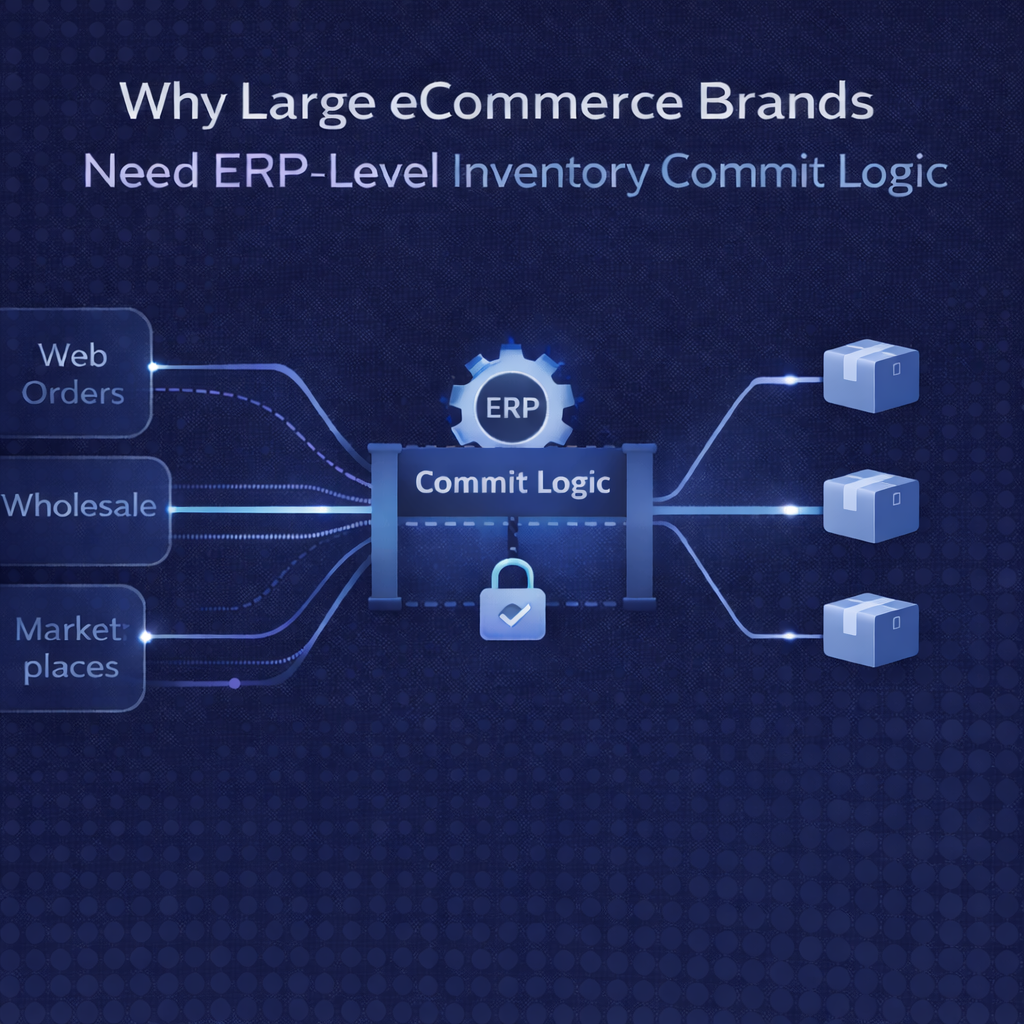
Why Large eCommerce Brands Need ERP-Level Inventory Commit Logic
When you’re processing thousands of orders daily across multiple sales channels, the question “do we have this item in stock?” becomes deceptively complex. The simple inventory count displayed on your product pages masks a sophisticated allocation challenge: who gets access to limited inventory when demand exceeds supply, how do you prevent overselling across channels while maximizing total sales, which orders receive priority when inventory becomes constrained, and how do you balance immediate fulfillment against anticipated demand from high-value customers?
Large eCommerce brands operating at scale—typically 1,000+ daily orders across 5+ sales channels—can’t answer these questions through manual allocation or basic inventory systems. They require sophisticated inventory commit logic: the automated rules and workflows that determine which specific inventory units get allocated to which specific orders, when allocations happen in the order lifecycle, how allocations get released when orders cancel or modify, and how allocation decisions respect strategic priorities around channels, customers, and business objectives.
Without enterprise-grade commit logic, high-volume operations inevitably encounter a predictable set of problems: simultaneous overselling where multiple channels sell the same inventory unit, chronic underselling where excessive allocation buffers prevent available inventory from generating revenue, channel conflicts where marketplace and DTC orders compete for limited stock, VIP customer disappointment when regular orders consume inventory needed for high-value relationships, and operational chaos during peak periods when allocation failures create thousands of correction transactions.
These aren’t isolated technical problems—they’re systemic failures that directly impact revenue, profitability, and customer satisfaction. Overselling creates cancellation rates that damage lifetime customer value. Underselling leaves revenue on the table during your highest-demand periods. Channel conflicts force you to choose between marketplace presence and DTC profitability. VIP allocation failures risk your most valuable customer relationships.
The solution lies in the sophisticated inventory commit logic that modern cloud ERP platforms provide: real-time allocation across all channels and locations, priority-based commits that respect strategic business rules, dynamic reallocation as conditions change, and comprehensive visibility into committed, available, and allocated inventory states. This capability transforms inventory allocation from a source of operational problems into a strategic tool for revenue optimization and customer experience management.
The Inventory Allocation Challenge at Scale
Small eCommerce operations rarely think explicitly about inventory allocation—orders come in, you ship them until inventory runs out, then you show “out of stock” until replenishment arrives. This simple approach works because transaction volume stays low enough that timing coincidences rarely create conflicts. When you’re processing 50-100 daily orders through 2-3 channels, the probability that two customers simultaneously order your last unit of product X is negligible.
When Simple Allocation Breaks Down
Everything changes at scale. When you’re processing 2,000 daily orders across your website, Amazon, eBay, wholesale portal, and retail store fulfillment—with orders arriving at 1.4 per minute during peak hours—the math fundamentally shifts. Now you’re virtually guaranteed to encounter simultaneous allocation conflicts. Multiple channels will attempt to sell the same inventory unit within the same second. Orders will be placed during the brief window between inventory depletion and channel synchronization.
The operational symptoms are unmistakable and financially painful. You experience 20-40 daily overselling incidents where orders get confirmed for inventory that doesn’t exist. Customer service spends hours daily contacting customers to cancel orders or offer alternatives. You maintain 25-30% safety stock buffers on fast-moving items specifically to prevent overselling—effectively hiding inventory from customers during your highest-demand periods. Your marketplace seller ratings decline due to cancellation rate penalties. During promotional campaigns, the overselling problem becomes severe enough that you avoid aggressive marketing despite having inventory to support it.
The root cause isn’t poor execution or inadequate staffing—it’s architectural inadequacy. The inventory systems that worked at 200 daily orders lack the allocation sophistication required at 2,000 daily orders. Basic inventory management treats availability as a simple quantity that decrements when orders ship. Enterprise inventory allocation recognizes that availability is a complex state involving multiple competing claims, strategic priorities, and temporal considerations that require sophisticated management logic.
Multi-Channel Competition for Shared Inventory
The multi-channel inventory allocation problem creates particularly visible failures. Consider a product with 10 units remaining in physical inventory. Your allocation strategy must answer several interconnected questions: How many units should each sales channel be able to access? Should wholesale customers receive priority over DTC orders? Do marketplace orders get the same allocation rights as website orders? How quickly should allocation rebalance when one channel sells faster than others?
Most eCommerce brands handle this through static channel allocations: 40% to your website, 40% to Amazon, 20% split across other marketplaces. This approach prevents the most egregious overselling but creates substantial inefficiency. When your website sells slowly while Amazon moves inventory quickly, the static split means Amazon shows “out of stock” while your website sits on 4 available units. You’re simultaneously underselling (website has available inventory generating no orders) and creating poor customer experience (Amazon shoppers see unavailability).
The alternative—sharing inventory freely across all channels without allocation controls—guarantees overselling. All channels show 10 units available, orders arrive from multiple channels simultaneously, and you’ve sold 15 units against 10 available. The synchronization lag between channels (typically 5-15 minutes even with “real-time” integrations) ensures that this overselling happens regularly during any period of concentrated demand.
Dynamic allocation that responds to real-time sales velocity represents the ideal solution but requires sophisticated commit logic. The system must monitor sales velocity by channel, progressively reallocate inventory toward higher-performing channels, maintain minimum availability thresholds to prevent total channel blackouts, and execute these reallocation decisions fast enough that they prevent overselling while maximizing revenue. This level of allocation sophistication exists in enterprise ERP platforms but not in basic inventory management systems.
Priority Conflicts and Strategic Allocation
Beyond channel allocation, large brands face strategic prioritization decisions about which orders deserve preferential access to limited inventory. A sophisticated allocation strategy might prioritize wholesale orders from major accounts above DTC sales, VIP customers above regular shoppers, subscription box fulfillment above one-time purchases, orders with expedited shipping above standard delivery, or pre-orders from early adopters above general availability orders.
These prioritization rules reflect strategic business judgments about customer value, relationship importance, and revenue optimization. Wholesale customers placing $50,000 quarterly orders deserve more allocation reliability than one-time DTC shoppers. Subscription customers who generate predictable recurring revenue merit allocation priority. VIP customers with $5,000+ lifetime value should receive better availability than first-time buyers.
Implementing these priorities manually is impossible at scale. When 2,000 orders arrive daily, operations teams can’t review each order against strategic priority rules and manually allocate inventory accordingly. Without automated commit logic that applies these rules consistently, allocation becomes effectively random based on order timing—the opposite of strategic optimization.
The business impact is substantial. When regular orders randomly consume inventory that should have been reserved for wholesale customers, you risk valuable B2B relationships over routine DTC fulfillment. When VIP customers encounter stockouts while browsing products that new customers successfully purchased hours earlier, you’re treating your most valuable customers worse than unknowns. These allocation failures don’t just create operational problems—they undermine customer lifetime value and strategic account management.
Temporal Allocation Complexity
Inventory allocation decisions also involve temporal considerations: when does inventory get committed to orders, how long do allocations persist before release, and how do future commitments interact with current availability? These timing questions become critical at scale.
Consider the order-to-fulfillment timeline. Orders placed at midnight might not ship until the warehouse opens at 6 AM. Should inventory be allocated immediately upon order placement, or only when the warehouse begins picking? Immediate allocation prevents overselling but commits inventory for 6+ hours before physical fulfillment begins. Delayed allocation maximizes inventory flexibility but creates overselling risk if multiple orders arrive before the warehouse processes the queue.
The allocation release timing presents similar challenges. When customers abandon shopping carts, when do those soft allocations release back to available inventory? When orders are placed but payment fails, how quickly does allocated inventory become available again? When customers modify orders to remove items, does that inventory immediately return to the pool or wait until the order fully completes?
Shopping cart allocation represents a particularly complex temporal challenge. Should adding items to cart soft-allocate inventory to prevent overselling during checkout? If so, for how long—5 minutes, 30 minutes, until session expires? Aggressive cart allocation prevents checkout disappointment but creates massive inventory tie-up (industry data shows 70% of carts are abandoned). No cart allocation maximizes inventory availability but guarantees frequent checkout failures when popular items sell out during the shopping experience.
These temporal allocation decisions require sophisticated logic that balances competing objectives: preventing overselling, maximizing inventory utilization, providing excellent customer experience, and maintaining operational efficiency. Basic inventory systems don’t provide the configuration flexibility to implement nuanced temporal allocation strategies—they apply simple rules that work adequately at low volume but fail at scale.
How Basic Inventory Systems Handle Allocation (And Why It Fails)
Understanding why large brands need enterprise commit logic requires examining how standard eCommerce inventory systems approach allocation—and where these approaches break down under scale and complexity.
Simple Inventory Decrements
Most eCommerce platforms and basic inventory management systems implement the simplest possible allocation logic: maintain a single “available quantity” field that decrements when orders ship and increments when inventory is received. This approach provides one significant advantage—it’s extremely simple to understand and implement. Everyone can comprehend “we had 50, we shipped 12, now we have 38.”
However, this simplicity creates several critical limitations. First, it doesn’t distinguish between different inventory states. That “available quantity” might include inventory that’s physically damaged, inventory allocated to orders being picked, inventory reserved for wholesale customers, inventory in quality inspection, or inventory at a location that can’t ship to certain regions. Treating all inventory as undifferentiated availability creates overselling situations when orders claim inventory that isn’t actually available for general sale.
Second, simple decrements don’t implement any allocation timing sophistication. Inventory decrements when orders ship, which might be 4-24 hours after orders are placed. During this window, the same inventory appears available across all channels and can be sold multiple times. The overselling only becomes apparent after warehouse processing reveals insufficient physical inventory.
Third, this approach provides no channel-specific allocation controls. All channels have equal access to the entire available quantity. While democratic, this prevents implementing strategic allocation priorities. Your $50,000 wholesale customer has identical inventory access to a first-time $30 DTC order—clearly suboptimal from a business strategy perspective.
Fourth, simple quantity tracking provides no visibility into why inventory levels are what they are. When available quantity is 38, you don’t know if that’s because you shipped 12 orders, because 12 units were damaged, because 12 units are allocated to pending wholesale orders, or some combination. This lack of visibility prevents effective inventory management and troubleshooting.
Scheduled Synchronization and Its Lag Problems
To coordinate inventory across multiple sales channels, basic systems implement scheduled synchronization: every 15-30 minutes, export current inventory levels from your master system and import them into each sales channel. This approach works reliably in a technical sense—the synchronization jobs execute consistently and data transfers successfully. The problem is the inherent lag that creates overselling opportunities.
Consider the timing sequence: At 2:00 PM, synchronization pushes 50 units available across all channels. At 2:08 PM, a customer orders 5 units on your website—your website immediately decrements to 45 units displayed. At 2:12 PM, an Amazon customer orders 5 units—Amazon decrements to 45 units in their system. At 2:15 PM, the scheduled sync runs. Now your website pushes “45 available” (reflecting the 2:08 order) while Amazon pushes “45 available” (reflecting the 2:12 order) but your master system thinks you should have 40 (reflecting both orders). The conflict requires reconciliation.
This example shows just two conflicting orders. At scale with thousands of daily orders across five or more channels, these synchronization conflicts occur hundreds of times daily. Each conflict requires resolution: which orders get fulfilled, which get cancelled, how do you communicate with affected customers, and how do you prevent the same conflict tomorrow?
The standard mitigation—more frequent synchronization—only partially addresses the problem and introduces new challenges. Synchronizing every 5 minutes instead of every 30 minutes reduces the window for conflicts but doesn’t eliminate them. It also increases system load and API usage. Many platforms impose rate limits on API calls, meaning extremely frequent synchronization hits technical barriers. You end up choosing between inventory accuracy and system performance constraints.
More fundamentally, synchronization-based approaches are architecturally incapable of true real-time allocation. Even with 1-minute sync intervals, you have 60-second windows where channels operate on stale data. During peak traffic periods or promotional campaigns, enormous numbers of orders arrive within these windows. The synchronization architecture guarantees allocation failures at exactly the moments when accurate allocation matters most.
Static Channel Allocation Buffers
Recognizing that synchronization lag creates overselling, many large brands implement static channel allocation buffers: reserve 30% of inventory exclusively for wholesale, allocate 40% to your website, allocate 30% to Amazon. This approach prevents the most egregious overselling by ensuring channels can’t oversell each other’s allocations. However, it creates significant revenue opportunity costs.
The efficiency problem is straightforward. When you allocate 40% of inventory to your website (20 units of a 50-unit product) but website traffic is slow, those 20 units sit idle while Amazon potentially sells out its 15-unit allocation. You’re showing “out of stock” on Amazon while your website displays “20 in stock”—simultaneously frustrating Amazon customers and underselling available inventory. The lost revenue from this artificial scarcity is substantial and entirely preventable with better allocation logic.
Static allocations also can’t respond to market dynamics. During a promotional campaign, your website might generate 3x normal traffic while marketplace sales remain steady. Static allocations force you to show website stockouts while marketplace inventory sits unused—precisely the opposite of optimal allocation during a revenue-generating promotion. Manual reallocation requires someone to monitor performance, recognize the imbalance, calculate appropriate adjustments, and execute changes across systems—a process measured in hours during events where minutes matter.
The strategic inflexibility of static buffers prevents implementing sophisticated priority rules. You might want wholesale customers to receive allocation priority, but static buffers can’t distinguish between wholesale and retail orders within a channel. You might want VIP customers to access reserved inventory, but channel-level buffers can’t identify VIP orders for preferential treatment. The allocation granularity is too coarse to implement strategic prioritization.
Finally, static buffers create operational overhead in buffer management itself. Someone must monitor sales velocity by channel, periodically recalculate appropriate allocation splits, update buffer settings across systems, and validate that changes took effect correctly. This buffer management consumes operational resources while still delivering suboptimal results compared to dynamic allocation.
Manual Exception Handling
When basic allocation logic fails—overselling occurs, VIP orders encounter stockouts, wholesale commitments can’t be fulfilled—most operations teams resort to manual exception handling. Customer service representatives contact affected customers to apologize and offer alternatives. Operations managers manually identify priority orders and direct warehouse staff to fulfill them preferentially. Purchasing rushes emergency inventory from alternative suppliers to cover shortfalls.
This manual approach works in the sense that problems eventually get resolved and customers eventually receive appropriate responses. However, it scales terribly and consumes enormous operational resources. Each exception requires 20-40 minutes of staff time for customer contact, resolution coordination, and system updates. At 30 daily exceptions (conservative for large brands with allocation problems), you’re consuming 10-20 hours daily on exception handling—equivalent to 2-3 full-time roles dedicated exclusively to fixing allocation failures.
The customer experience impact extends beyond the immediate interaction. Customers experiencing overselling cancellations receive apologetic communications, but the fundamental message is “we confirmed your order but can’t actually fulfill it”—a trust-breaking failure regardless of how nicely it’s communicated. Research consistently shows that 40-50% of customers don’t return after experiencing stockout-related cancellations. Each allocation failure creates permanent customer losses that compound over time.
Manual exception handling also prevents systematic learning and improvement. When each exception is handled individually through heroic customer service efforts, the underlying allocation problems never get addressed. You’re treating symptoms rather than causes, ensuring that tomorrow brings a new set of allocation exceptions requiring manual resolution.
Enterprise Commit Logic: How ERP Solves Allocation at Scale
Modern cloud ERP platforms implement sophisticated inventory commit logic that transforms allocation from a source of operational problems into a strategic capability. Understanding how enterprise commit logic works helps explain why it’s essential for large eCommerce brands.
Real-Time Allocation Architecture
The foundational difference between basic and enterprise allocation is architectural: ERP systems allocate inventory in real-time within a unified database rather than through scheduled synchronization between disconnected systems. When a customer places an order on any channel, the ERP system immediately evaluates available inventory, applies allocation rules, commits specific inventory to that order, and updates availability visible to all channels—all within milliseconds of order placement.
This real-time architecture eliminates synchronization lag entirely. There are no 5-minute or 30-minute windows where channels operate on stale inventory data. Every channel always sees current availability that reflects all allocations, across all channels, at all locations, as of the present moment. This architectural approach doesn’t just reduce overselling—it fundamentally prevents the timing-based allocation conflicts that plague synchronization-based systems.
The implementation relies on database-level transaction control that ensures inventory can’t be allocated to multiple orders simultaneously. When two orders attempt to claim the same inventory within the same millisecond, database locking ensures that one order completes its allocation before the second order evaluates availability. This technical detail might seem minor, but it’s the mechanism that prevents overselling even under extreme simultaneous demand.
Real-time allocation also enables sophisticated availability calculations that consider multiple inventory states simultaneously. Rather than displaying simple “quantity available,” the system can show “quantity available for immediate shipment” (excluding allocated, damaged, and quality-hold inventory), “quantity available for general sale” (including above but excluding wholesale reservations), “quantity available including scheduled receipts” (showing future availability from pending purchase orders), and “quantity allocatable to this specific channel based on current rules” (respecting channel-specific allocation limits).
This multi-dimensional availability visibility enables customer-facing experiences that dramatically exceed what synchronization-based systems can provide. You can confidently promise delivery dates based on actual available inventory plus scheduled receipts, show “low stock” warnings based on allocation rates rather than absolute quantities, display “available at other locations” for products that are out of stock locally, and provide “notify when back in stock” with accurate expected availability dates.
Priority-Based Commit Rules
Beyond real-time allocation, enterprise ERP systems implement sophisticated priority-based commit rules that encode strategic business logic into automated allocation decisions. These rules determine which orders receive preferential access to limited inventory based on configurable business priorities.
The rule structure typically involves multiple evaluation dimensions: customer segment (wholesale, VIP, regular, first-time), order characteristics (size, expedited shipping, subscription), channel origin (website, marketplace, retail store), product category (high margin, promotional, standard), and temporal factors (pre-order, regular order, backorder). The ERP system evaluates each incoming order against these dimensions and calculates a priority score that determines allocation sequence.
Implementation follows a waterfall approach where high-priority orders receive allocation before lower-priority orders can claim inventory. When a wholesale customer places a $10,000 order and a regular DTC customer places a $50 order simultaneously, the wholesale order allocates first. If insufficient inventory exists for both orders, the wholesale order receives full allocation while the DTC order gets whatever remains—possibly creating a backorder situation for the lower-priority order.
This priority-based allocation directly addresses one of the most significant weaknesses of basic systems: the random allocation that results from relying on order timing. With sophisticated commit logic, allocation reflects strategic priorities rather than coincidental timing. Your most valuable customers receive preferential inventory access, high-margin products receive allocation priority over promotional items, expedited orders that promise fast delivery receive earlier allocation than standard orders.
The business impact is substantial. Priority-based allocation typically improves customer lifetime value by 12-18% for VIP segments because these customers experience higher fulfillment reliability. Wholesale customer satisfaction increases, reducing churn in valuable B2B relationships. Strategic account managers can confidently commit to inventory availability knowing that the allocation system will respect these commitments when competing demands arise.
Configuration flexibility enables tailoring allocation priorities to your specific business model and strategy. A DTC-focused brand might prioritize subscription orders above one-time purchases to maximize recurring revenue retention. A wholesale-heavy business might reserve 40% of inventory exclusively for B2B customers. A flash-sale operator might temporarily elevate promotional orders during campaigns then revert to standard priorities. The ERP platform provides the configuration framework while you supply the strategic business logic.
Dynamic Reallocation Based on Velocity
Static allocation buffers waste inventory through artificial scarcity. Enterprise commit logic solves this through dynamic reallocation that continuously adjusts channel availability based on real-time sales velocity. The system monitors sales rates across channels, calculates relative velocity, and progressively reallocates inventory toward higher-performing channels while maintaining minimum availability thresholds everywhere.
The reallocation logic evaluates multiple factors simultaneously: current sales velocity by channel (units per hour), conversion rates (orders per visitor), inventory turn rates (days to sell remaining stock at current velocity), channel-specific margin structures, and minimum availability thresholds (never let any channel show zero even if it’s selling slowly). These inputs feed algorithms that calculate optimal allocation distributions that maximize total revenue while respecting business constraints.
Implementation happens through progressive adjustments rather than dramatic shifts. If Amazon sells product X at 5 units per hour while your website sells 1 unit per hour, the system doesn’t immediately allocate 100% to Amazon. Instead, it incrementally increases Amazon’s allocation from 40% toward 60% over several hours while reducing website allocation from 40% toward 25%. This gradualism prevents overcorrecting while allowing the allocation to track sustained velocity differences.
The system also implements velocity-based allocation forecasting. When promotional campaigns or seasonal patterns create predictable velocity changes, the ERP can pre-allocate inventory in anticipation of these shifts. A weekend promotional campaign might shift allocation toward DTC channels Friday afternoon in anticipation of higher weekend website traffic. Holiday shopping patterns might progressively increase marketplace allocations throughout November as marketplace share historically increases.
Dynamic reallocation typically improves inventory utilization by 20-30% compared to static buffers, meaning the same physical inventory generates more revenue through strategic allocation. You maintain presence across all channels without underselling due to allocation inflexibility. During promotional campaigns, the allocation automatically flows toward your campaign channel without requiring manual intervention. The inventory works harder because allocation decisions reflect current market dynamics rather than historical assumptions.
Allocation Release and Reallocation
Inventory allocated to orders but not yet fulfilled represents significant opportunity cost if those allocations don’t ultimately convert to shipments. Enterprise commit logic implements sophisticated allocation release and reallocation rules that return inventory to availability when orders cancel, modify, or fail payment authorization.
The release timing balances competing objectives: releasing immediately maximizes inventory availability, but releasing too quickly might cause problems if orders are pending legitimate actions (payment retries, address validation, fraud review). Configurable release rules enable tailoring this balance to your business needs: release immediately on explicit order cancellation, release after 4 hours if payment authorization remains pending, release after 24 hours if order is allocated but not yet picked, retain allocation indefinitely for high-priority customers until they explicitly cancel.
Shopping cart allocation represents a particularly important application of temporary allocation. When customers add items to cart, should the ERP soft-allocate inventory to prevent checkout disappointment? Sophisticated systems implement time-limited soft allocation: inventory is tentatively reserved for 15-30 minutes while customers complete checkout, preventing overselling during the shopping experience. If checkout doesn’t complete within this window, allocation automatically releases and inventory returns to general availability.
This cart allocation provides material conversion rate improvement. Industry data shows 8-12% improvement in checkout completion when customers are confident their cart items will be available through checkout. However, it requires careful configuration—overly aggressive cart allocation (long hold times, hard allocations) ties up massive inventory in abandoned carts. The ERP must balance conversion optimization against inventory utilization.
Allocation reallocation handles situations where partially fulfilled orders free inventory for other uses. When a 10-item order ships 8 items with 2 items backordered, should those 2 units of allocation remain with the original order or become available for other orders? Enterprise systems implement configurable reallocation rules: retain allocation for high-priority customers expecting complete fulfillment, release allocation after 72 hours if backorder persists, automatically allocate released inventory to next-highest-priority waiting order.
The operational impact of intelligent allocation release is significant. Without systematic release logic, allocated-but-not-fulfilled inventory creates phantom shortages where systems show “out of stock” while allocated inventory sits unproductively. Enterprise commit logic prevents this inefficiency by continuously optimizing allocation against current business priorities.
Lot and Serial Number Allocation
For products requiring batch control—food and beverages with expiration dates, health and beauty products with lot tracking, regulated products requiring serial number traceability—allocation becomes more complex than simple quantity management. Enterprise ERP systems implement lot-level and serial-level allocation that ensures proper rotation, compliance with regulations, and traceability for quality or safety issues.
FEFO (first-expired, first-out) allocation automatically selects the inventory lot with the nearest expiration date for each order. This rotation prevents waste from expired inventory while ensuring customers receive products with maximum remaining shelf life. The system tracks expiration dates at lot level, evaluates all lots of a product when allocating orders, selects the lot with earliest expiration date that still provides adequate shelf life for customer use, and reserves later-expiration lots for orders that will ship later.
This automated rotation eliminates the manual lot selection that warehouse staff would otherwise perform—reducing picking time while improving rotation discipline. It also enables sophisticated customer segment differentiation: retail store orders receive inventory with longer shelf life to allow in-store shelf time, subscription customers receive lots with expiration dates appropriate for monthly shipping cadence, bulk wholesale orders receive mixed lots to clear older inventory while maintaining average shelf life commitments.
Serial number allocation enables complete unit-level traceability for regulated products or warranty-tracked items. When a customer orders a serialized product, the ERP allocates a specific serial number to that order, maintains the connection between order and serial number through fulfillment and delivery, and retains this association for warranty service, support inquiries, or regulatory recalls. If a quality problem emerges with specific serial number ranges, the system can immediately identify all customers who received affected units.
The compliance and operational value of lot/serial allocation is substantial for businesses handling batch-controlled inventory. Food and beverage brands avoid costly waste from expired products that weren’t properly rotated. Health and beauty retailers comply with FDA regulations requiring batch traceability. Electronics businesses support warranty claims with confidence about product provenance. These capabilities require sophisticated allocation logic that basic inventory systems simply don’t provide.
Integration: Connecting Commit Logic to Your Operations
Sophisticated inventory commit logic only delivers value when fully integrated with your broader operational systems. Enterprise ERP platforms provide comprehensive integration that connects allocation decisions to order management, warehouse operations, financial accounting, and customer communication.
Order Management Integration
The order-to-fulfillment workflow begins with order entry from any channel—website, marketplace, retail store, wholesale portal. The ERP system receives the order and immediately evaluates it against allocation rules: Is inventory available at any location? Does this order have priority characteristics requiring preferential allocation? Should this order be allocated to a specific fulfillment location based on geography or other factors? Does this customer have any allocation reservations or restrictions?
Based on this evaluation, the system either allocates inventory immediately (confirming the order and committing specific inventory) or places the order in backorder status with expected fulfillment dates based on scheduled receipts. The allocation decision happens within milliseconds, enabling immediate order confirmation that customers expect from modern eCommerce.
The allocation creates specific, traceable commitments: Order #12345 is allocated 2 units of SKU ABC from warehouse Nashville, lot #789, expected pick time based on current warehouse queue depth. This specificity enables precise fulfillment execution and accurate delivery estimates. Customer communications can reference actual allocated inventory and expected processing timeline rather than generic “your order is being processed” messages.
Order modifications trigger allocation reevaluation. When customers add items, the system allocates additional inventory if available. When customers remove items or cancel orders entirely, allocated inventory releases according to configured rules. When shipping addresses change, the system reevaluates fulfillment location optimization considering inventory availability, shipping costs, and delivery times from each potential location.
The integration eliminates the manual coordination that plagues disconnected systems. Order management doesn’t export orders to warehouse systems in batch files. Allocation doesn’t require manual assignment to fulfillment locations. Modifications don’t create reconciliation nightmares between order systems and inventory systems. Everything flows automatically through unified allocation logic.
Warehouse Management Integration
Once orders are allocated, warehouse management systems receive directed fulfillment instructions that translate allocation decisions into physical picking, packing, and shipping tasks. The integration passes complete allocation information: which specific inventory (location, lot, serial number) to pick, in what sequence to optimize warehouse travel, with what priority based on order characteristics, and with what handling requirements based on product or customer needs.
This directed fulfillment eliminates the inventory search and selection decisions that consume warehouse labor in manual operations. Pickers don’t need to remember where products are stored, determine which lot to pick for proper rotation, or decide which orders to fulfill first based on shipping requirements. The allocation system has made all these decisions based on sophisticated logic that optimizes for strategic business priorities and operational efficiency.
The integration also flows fulfillment status back to allocation logic in real-time. When pickers scan products during fulfillment, the allocation status updates from “allocated” to “picked.” When packers complete orders, allocation advances to “packed.” When carriers collect shipments, allocation closes with “shipped” status. This status visibility prevents allocation of inventory that’s already committed to orders currently being fulfilled—a key mechanism preventing overselling.
Returns processing integrates with allocation to maintain accuracy through reverse logistics. When returns are received, the system validates return authorization, creates quality inspection tasks, and updates allocation state. Returned inventory enters “quarantine” status—physically present but not available for allocation until inspection confirms it’s resaleable. After inspection, inventory status updates to available and the units become allocatable to new orders.
The operational efficiency gains from integrated warehouse management are substantial. Picking productivity typically improves 30-50% through directed fulfillment that eliminates search time and optimizes routes. Allocation accuracy reaches 99%+ because physical fulfillment and system allocation happen simultaneously rather than through batch reconciliation. Returns processing becomes seamless because the allocation system knows the exact inventory expected from each return.
Financial Accounting Integration
Inventory represents significant financial value—typically 20-40% of total assets for eCommerce businesses—and allocation decisions create financial implications that must be accurately recorded. Enterprise ERP integration ensures that allocation and fulfillment activities automatically generate appropriate financial transactions without manual journal entries.
When orders are allocated, the system can optionally recognize the revenue commitment (for financial forecasting) while maintaining inventory on the balance sheet until shipment. When orders ship, the system automatically posts revenue recognition (crediting revenue accounts) and cost of goods sold (debiting COGS, crediting inventory asset accounts). These postings happen immediately upon shipment confirmation, providing real-time financial results rather than requiring month-end closing processes.
The COGS calculation respects the specific inventory that was allocated and shipped, including lot-specific costs if your inventory accounting tracks costs at that level. For businesses using FIFO or weighted average cost methods, the system maintains the detailed cost layers required to calculate COGS accurately. For businesses with lot-tracked inventory where different lots have different acquisition costs, the system posts actual costs of the specific lots that were allocated and shipped.
Inventory valuation across multiple locations is maintained automatically as allocation and fulfillment happen. When inventory is allocated from the Nashville warehouse, financial values decrement Nashville inventory accounts. When inventory transfers between locations, the system posts inter-location transfer transactions that keep balance sheet values accurate by location. This location-specific financial tracking supports accurate profitability analysis by distribution center.
Write-offs and adjustments from allocation releases or inventory damage flow automatically to financial statements. When allocated inventory is determined to be damaged and written off, the system posts inventory write-off expenses that reduce both physical inventory quantities and financial asset values. When allocation releases return inventory to available state after order cancellations, financial values adjust to reflect the inventory’s return to saleable status.
Customer Communication Integration
Perhaps the most customer-facing integration connects allocation decisions to customer communications that set accurate expectations and build trust through transparency. When orders allocate successfully, customers immediately receive confirmation with specific delivery estimates based on allocated inventory location and current warehouse queue depth. When allocation fails or requires backordering, customers receive immediate notification with expected availability dates based on scheduled purchase order receipts.
Inventory allocation status enables proactive customer service. Representatives can see not just whether orders have shipped, but where they are in the allocation and fulfillment workflow: allocated and queued for picking, currently being picked, in packing, or awaiting carrier pickup. This visibility enables specific, accurate responses to customer inquiries rather than generic “your order is being processed” statements.
Low inventory warnings become reliable when based on allocation logic rather than simple quantity thresholds. The system can display “only 3 left” when remaining inventory is approaching full allocation, warn customers that “this product may sell out during checkout” based on current allocation velocity, notify customers immediately when high-priority orders have consumed inventory that was visible moments ago, and suggest alternative products or notify-me-when-available options when allocation isn’t possible.
The customer experience impact of allocation-aware communication is substantial. Customers trust retailers that provide accurate availability information and reliable delivery commitments. Proactive notification when allocation problems occur—before customers contact support—demonstrates respect for customer time and builds loyalty even when operational issues arise. The transparency that sophisticated allocation enables differentiates your customer experience from competitors using basic inventory systems.
The Business Impact: Quantifying Allocation Value
Sophisticated inventory commit logic delivers measurable value across multiple dimensions of business performance. Understanding these impacts helps build the case for ERP investment and establishes benchmarks for measuring implementation success.
Reducing Overselling and Cancellation Costs
The most immediate and quantifiable benefit is dramatic reduction in overselling incidents and the operational costs they create. Large eCommerce brands using basic allocation typically experience 0.5-1.5% overselling rates—meaning 5-15 orders per thousand must be cancelled due to inventory allocation failures. At 2,000 daily orders, that’s 10-30 daily cancellations requiring resolution.
Each cancellation creates direct costs: 20-30 minutes of customer service time to contact the customer and coordinate resolution, potential expedited shipping costs if you’re fulfilling from alternative suppliers to honor the order, refund processing and transaction fees, and marketplace seller rating impacts that affect future visibility. Conservatively estimating $35 per incident, 20 daily cancellations cost $257,000 annually—pure operational waste directly attributable to allocation inadequacy.
Enterprise commit logic typically reduces overselling to under 0.1% of orders—meaning fewer than 2 overselling incidents daily at the same 2,000 order volume. This 90%+ reduction in overselling translates to approximately $230,000 in annual savings from eliminated cancellation processing. More importantly, it prevents the customer lifetime value destruction that cancellations create.
Customer retention impact exceeds immediate operational costs. Research consistently shows that 40-50% of customers don’t return after experiencing overselling cancellations. If your average customer generates $400 lifetime value and improved allocation prevents 6,000 annual cancellations, the retention benefit is enormous. Preventing just 25% of those customers from churning (1,500 customers × $400 LTV) creates $600,000 in preserved customer lifetime value annually—far exceeding the direct operational savings.
Improving Inventory Utilization and Turn
Sophisticated allocation improves how efficiently your inventory generates revenue by reducing the artificial scarcity created by excessive allocation buffers and enabling dynamic reallocation based on sales velocity. The operational metric is inventory turn rate—how many times annually you sell and replenish your average inventory level.
Basic allocation with static buffers typically achieves 6-8 annual inventory turns for eCommerce businesses. Enterprise allocation with dynamic reallocation typically improves this to 8-11 annual turns by reducing underselling from allocation inflexibility. This improvement means the same $2 million average inventory generates 25-40% more annual revenue through better utilization.
The working capital implications are substantial. If improved turn enables you to achieve the same revenue with 20% less inventory ($400,000 reduction), you’ve freed working capital that can fund growth initiatives, reduced carrying costs by $100,000 annually (at 25% carrying cost rate), and improved return on invested capital across your entire business. These benefits compound annually as long as you maintain superior allocation discipline.
Dynamic allocation also reduces obsolescence and markdown costs by preventing inventory aging. Products that would sit in underperforming channel allocations with static buffers get reallocated to higher-velocity channels, selling before they require deep discounts. For fashion, seasonal, or trend-driven products where timing determines profitability, this velocity improvement can mean the difference between healthy margins and 50% markdowns.
Channel Performance Optimization
Priority-based allocation and dynamic reallocation enable optimizing revenue and profitability across your channel mix. Rather than treating all channels equally or using coarse static allocations, you can strategically direct inventory toward channels and customer segments that generate the most value.
The revenue impact emerges through several mechanisms. Preferentially allocating inventory to higher-margin channels increases average contribution per unit sold. Prioritizing VIP and wholesale customers increases allocation reliability for segments with highest lifetime value and order sizes. Dynamically reallocating based on real-time conversion rates maximizes revenue capture during promotional campaigns and seasonal peaks.
Conservative estimates suggest channel-optimized allocation improves revenue by 3-7% compared to undifferentiated allocation. For a business generating $15 million annually, this represents $450,000-1,050,000 in incremental revenue directly attributable to allocation sophistication. The incremental margin on this revenue (typically 30-40%) translates to $135,000-420,000 in additional annual gross profit.
Beyond total revenue, channel optimization improves profitability mix by directing more inventory toward higher-margin channels. If your DTC website generates 38% gross margin while marketplace sales average 26% margin, preferentially allocating to DTC shifts mix toward higher profitability. Even a 5-percentage-point shift in channel mix (5% more revenue through DTC, 5% less through marketplaces) can improve overall gross margin by 0.5-1.0 percentage points—substantial at scale.
Supporting Strategic Growth Initiatives
Perhaps the most significant but hardest-to-quantify benefit is enabling growth strategies that would be operationally impossible with basic allocation. Multi-channel expansion, geographic market entry, customer segment differentiation, and omnichannel fulfillment all require allocation sophistication that basic systems can’t provide.
Multi-channel expansion illustrates this enabling value clearly. Launching on new marketplaces or retail channels with basic allocation means either accepting high overselling rates (damaging seller ratings and customer experience) or implementing conservative static buffers (limiting sales potential and leaving revenue on the table). Either approach compromises the expansion’s value. Sophisticated allocation enables aggressive channel expansion with confidence that inventory will be properly managed across the entire channel portfolio.
Geographic expansion through multi-location fulfillment requires allocating inventory across distributed locations while optimizing fulfillment for cost and speed. Opening a West Coast distribution center only creates value if you can intelligently allocate inventory between East and West Coast facilities and route orders to optimal fulfillment locations. Without enterprise allocation logic, multi-location operations create operational chaos rather than competitive advantage.
Customer segment differentiation—offering different service levels, pricing, or allocation priority to different customer types—is fundamentally impossible without sophisticated commit logic. You can’t preferentially serve VIP customers if your allocation system treats all orders identically based on timing. You can’t offer reliable wholesale fulfillment alongside aggressive DTC selling if allocation doesn’t respect B2B priority. Strategic customer segmentation requires allocation technology that supports strategic business logic.
When Basic Allocation Becomes a Growth Constraint
Understanding when your business has outgrown basic allocation helps you recognize the right time to invest in enterprise commit logic. Several clear indicators signal that allocation inadequacy has become a binding growth constraint.
Order Volume and Velocity Thresholds
The clearest indicator is crossing approximately 1,000 daily orders across multiple sales channels. Below this threshold, basic allocation with periodic synchronization and static buffers works adequately because the probability of allocation conflicts remains manageable. Above this threshold, allocation failures become daily occurrences that consume operational resources and damage customer experience.
Transaction velocity matters as much as volume. A business processing 1,000 daily orders evenly distributed across 12 hours (1.4 orders per minute) faces lower allocation conflict probability than one processing the same volume concentrated in 4 peak hours (4.2 orders per minute). Higher velocity creates more simultaneous allocation conflicts that require sophisticated real-time commit logic to prevent overselling.
The channel count amplifies these thresholds. Processing 1,000 daily orders through 2 channels (website and Amazon) creates less allocation complexity than the same volume across 6 channels (website, Amazon, eBay, Walmart, wholesale portal, retail stores). Each additional channel increases allocation conflict probability and makes synchronization-based approaches progressively less reliable.
If you’re experiencing 10+ daily overselling incidents requiring customer service intervention, or conducting weekly “inventory reconciliation” exercises to address cumulative allocation errors, or maintaining 25%+ safety stock buffers specifically to prevent overselling, you’ve clearly outgrown basic allocation. These symptoms indicate systematic allocation failure rather than occasional operational problems.
Multi-Channel Selling Challenges
Channel expansion creates allocation challenges that basic systems can’t solve. If you’re unable to launch on new marketplaces without risking seller rating damage from overselling, or maintaining separate physical inventory for each channel to prevent conflicts, or manually monitoring and rebalancing channel allocations weekly, or avoiding promotional campaigns on specific channels due to allocation concerns, you need enterprise commit logic.
The revenue opportunity cost of these limitations is substantial. Each forgone marketplace launch represents potential 7-15% revenue expansion. Separate physical inventory by channel ties up 20-30% more working capital than shared inventory would require. Manual allocation rebalancing means you’re weeks behind optimal allocation rather than optimizing in real-time. These limitations don’t just create operational friction—they directly constrain revenue growth.
Channel conflicts requiring manual intervention signal allocation inadequacy. If your customer service team regularly mediates between channel managers fighting over limited inventory, if wholesale customers complain about allocation unreliability despite having priority status, if marketplace seller ratings suffer from cancellations while your warehouse shows inventory available, your allocation system can’t handle your channel complexity.
Strategic Priority Implementation Failures
Perhaps the most frustrating symptom is inability to implement strategic allocation priorities despite clear business rationale. You know wholesale customers should receive allocation priority, but your system can’t distinguish wholesale from DTC orders during allocation. You want VIP customers to access reserved inventory, but tracking and enforcing these reservations requires manual coordination. You need subscription orders to receive preferential allocation, but your system treats all orders identically.
This strategic limitation forces you to choose between compromising business strategy (treating all customers equally despite value differences) or implementing manual workarounds (having someone review and manually prioritize orders daily). Either choice is suboptimal. Compromising strategy means operational systems prevent you from serving customers according to their value. Manual workarounds create operational overhead that doesn’t scale and inevitably fails during high-volume periods.
The competitive impact is significant. Competitors with sophisticated allocation can reliably serve their most valuable customers, enabling stronger relationship development and higher retention. They can optimize allocation across channels to maximize profitability. They can confidently expand into new markets knowing allocation will scale reliably. You’re operationally constrained from matching these capabilities regardless of your business strategy or market opportunity.
Peak Period Operational Chaos
Seasonal peaks and promotional campaigns expose allocation inadequacy with particular severity. If Black Friday/Cyber Monday creates operational chaos with 50+ daily overselling incidents despite extensive preparation, if promotional campaigns require limiting discount codes to prevent allocation disasters, if you avoid aggressive marketing during peak season specifically due to allocation concerns, or if peak period recovery requires weeks of post-event reconciliation and customer service cleanup, you desperately need better allocation technology.
Peak periods represent your highest-revenue opportunities and should be moments of celebration. When they instead become operational nightmares that you dread, something is fundamentally wrong with your operational capabilities. The revenue you’re leaving on the table by constraining peak marketing—or the customer relationships you’re damaging through peak period overselling—likely exceeds your annual ERP implementation investment in a single quarter.
Implementation Considerations for Large Brands
Implementing enterprise-grade inventory commit logic in a large, operating eCommerce business requires careful planning that balances improving allocation capabilities against maintaining operational continuity during transition.
Assessment and Readiness
Before implementing comprehensive allocation logic, you need clear understanding of your current allocation challenges, requirements for new allocation capabilities, and organizational readiness for the process and technology changes involved. This assessment typically requires 4-6 weeks and involves documenting your current allocation approaches and their failure modes, quantifying the operational and customer impacts of allocation problems, defining strategic allocation priorities you want to implement, identifying integration requirements with current systems, and establishing success metrics for allocation improvement.
Current state documentation should be brutally honest about allocation failures. How frequently does overselling occur? Which channels experience the most conflicts? Which customer segments are poorly served by current allocation? What operational resources are consumed managing allocation problems? This diagnostic clarity prevents implementing technology solutions that don’t address actual operational needs.
Strategic requirements definition articulates your allocation priorities: Do wholesale customers deserve allocation priority? Should VIP customers access reserved inventory? Do subscription orders need preferential treatment? Should promotional campaigns receive temporary allocation boosts? These strategic rules guide system configuration to ensure allocation logic supports business strategy rather than imposing generic best practices.
Data quality evaluation determines readiness for sophisticated allocation. Enterprise commit logic requires accurate product master data, reliable inventory quantities and locations, clean customer segmentation for priority allocation, and current channel and sales velocity information. If this foundational data doesn’t exist or contains significant errors, data cleanup becomes a prerequisite for allocation improvement.
Implementation Approach and Timeline
Most large eCommerce brands complete comprehensive allocation implementation in 14-20 weeks from contract signing to production go-live. This timeline reflects the complexity of integrating with multiple sales channels, configuring sophisticated allocation rules, migrating large product catalogs and inventory data, and testing allocation logic under various scenarios before risking production operations.
Weeks 1-4 focus on detailed design and configuration planning. Your implementation team works with ERP consultants to design allocation rule structure, plan integration architecture for each sales channel, establish data migration approach, document allocation workflow changes, and create implementation governance and decision-making process. This design phase ensures shared understanding about exactly what allocation capabilities you’re implementing and how they’ll work.
Weeks 5-11 center on system build and integration development. Technical teams configure allocation rule engine, develop integrations with eCommerce platform and marketplaces, build warehouse management connections, implement customer communication updates, migrate product master data and inventory, and conduct iterative testing of allocation logic. This technical build phase typically reveals integration complexities not anticipated during planning—building schedule buffer prevents surprises from causing delays.
Weeks 12-16 focus on comprehensive testing and training. Operations teams test allocation under normal conditions, peak volume scenarios, and edge cases. Customer service learns new allocation visibility tools. Warehouse staff understand changes to fulfillment workflows. Channel managers learn allocation monitoring and optimization. Marketing understands new capabilities around promotional allocation. This cross-functional training ensures organizational readiness for new allocation approaches.
Weeks 17-20 execute phased rollout and stabilization. Many large brands prefer phased rollout—implementing new allocation for one channel or product category first, validating performance, then progressively expanding scope. This approach reduces risk compared to “big bang” cutovers but extends overall timeline. The stabilization period involves intensive monitoring of allocation performance, rapid resolution of any unexpected issues, and refinement of allocation rules based on real-world operation.
Team Involvement and Resource Requirements
Successful allocation implementation requires significant involvement from operational leadership, technical staff, and front-line teams. The project sponsor—typically VP of Operations or Chief Operating Officer—dedicates 15-25% of their time making allocation strategy decisions, removing organizational obstacles, reviewing implementation progress, and maintaining executive visibility. This executive engagement signals organizational importance and ensures allocation decisions align with business strategy.
Technical project management coordinates implementation across multiple workstreams—integration development, system configuration, data migration, testing coordination, and training execution. This role requires 60-80% time commitment from someone with strong organizational skills, technical aptitude, operational knowledge, and ability to coordinate across IT, operations, and business teams. Successful project management significantly affects implementation success.
Channel managers participate in allocation rule design to ensure each channel receives appropriate strategic consideration. Wholesale channel managers articulate allocation priority requirements. Marketplace managers define synchronization and allocation frequency needs. Retail and omnichannel managers specify store fulfillment allocation. This channel representation ensures allocation logic supports rather than conflicts with channel strategies.
IT and integration specialists typically invest 40-80 hours weekly during integration development phases. This technical work includes developing channel integrations and APIs, implementing allocation rule logic, managing data migration and validation, conducting technical testing, and supporting cutover execution. Organizations lacking internal technical resources should plan for external support from implementation partners or technical consultants.
Warehouse operations provides critical input on how allocation changes affect fulfillment workflows. Warehouse managers validate that directed fulfillment based on allocation decisions aligns with physical operations, participate in configuration of location-based allocation rules, train warehouse staff on allocation-driven changes to fulfillment processes, and oversee warehouse testing and validation. Their operational expertise prevents implementation of allocation logic that’s theoretically optimal but practically unworkable.
Change Management and Adoption
Perhaps the most underestimated implementation challenge is organizational change management—helping teams adopt new allocation approaches and trust new system logic. Sophisticated allocation fundamentally changes how people think about inventory: from “do we have it?” to “who should get access to it?”, from manual allocation decisions to automated rule-based commits, and from channel-specific thinking to unified inventory with strategic allocation.
Early involvement of operational stakeholders builds buy-in and surfaces practical considerations. Including channel managers in allocation rule design ensures rules reflect actual business priorities. Having customer service representatives review allocation visibility helps identify gaps between provided tools and customer support needs. Engaging warehouse supervisors in fulfillment workflow design prevents allocation decisions that conflict with physical operations.
Transparent communication about why allocation must change prevents resistance from teams comfortable with current approaches. Explaining the customer lifetime value impact of overselling helps customer service understand why allocation rigor matters. Showing channel managers data on revenue lost to allocation inflexibility demonstrates why dynamic reallocation will improve their channel performance. Quantifying the operational resources consumed managing allocation problems illustrates why systematic improvement is essential.
Celebrating early successes builds confidence in new allocation capabilities. When overselling decreases measurably during initial rollout, publicize this improvement. When channel managers observe inventory flowing toward their campaigns during promotions, highlight how dynamic allocation supported their success. When warehouse productivity increases through allocation-directed fulfillment, share this with operations teams. These visible wins validate the change and accelerate adoption.
Providing intensive support during stabilization prevents frustration from undermining adoption. Expect frequent questions as teams learn new allocation monitoring, discover allocation capabilities they didn’t know existed, encounter edge cases requiring rule refinement, and adapt workflows to leverage allocation automation. Having implementation consultants and internal champions available during this period prevents minor issues from becoming major problems that damage confidence in new systems.
The Strategic Imperative: Allocation as Competitive Advantage
For large eCommerce brands processing thousands of daily orders across multiple channels, sophisticated inventory commit logic represents more than operational improvement—it’s a fundamental competitive capability that enables growth strategies and customer experiences that basic allocation can’t support.
The operational benefits are immediate and substantial: 90%+ reduction in overselling incidents saves $200,000+ annually in direct costs while preventing millions in customer lifetime value destruction, 20-30% improvement in inventory turn frees working capital and reduces carrying costs, dynamic channel allocation improves revenue 3-7% through strategic optimization, and elimination of manual allocation coordination recovers 2-3 FTE worth of operational capacity for strategic initiatives.
The strategic capabilities are ultimately more valuable than operational improvements. Sophisticated allocation enables confident multi-channel expansion without operational chaos, supports customer segment differentiation through priority-based allocation, enables promotional agility without risking allocation failures, and provides the operational foundation for omnichannel fulfillment that customers increasingly expect.
The competitive dynamics are increasingly unforgiving. Customers don’t compare your allocation reliability to what you delivered last year but to what Amazon, Shopify Plus merchants, and other operationally sophisticated retailers deliver today. A 1.5% overselling rate might seem acceptable in absolute terms, but customers experiencing cancellations perceive your operation as unreliable compared to competitors achieving 99.9%+ allocation accuracy. This perception gap compounds over time as word-of-mouth and reviews reinforce operational reputation.
The investment in enterprise ERP platforms with sophisticated commit logic is substantial—typically $250,000-400,000 first-year including software, implementation, and internal resources. However, the ROI calculation is compelling when you quantify operational savings, customer retention improvement, revenue optimization, and strategic capabilities enabled. Most large brands achieve payback within 12-18 months while building operational capabilities that support 3-5x growth without proportional cost increases.
The path forward requires executive recognition that allocation inadequacy has become a binding growth constraint, commitment to systematic improvement rather than incremental workarounds, realistic implementation planning that balances capability improvement against operational continuity, and sustained organizational support through the change management that technology transformation requires.
Bizowie delivers enterprise-grade inventory commit logic through our unified cloud ERP platform designed specifically for high-volume eCommerce and distribution operations. Our sophisticated allocation engine provides real-time commit logic across all channels and locations, priority-based allocation that respects strategic business rules, dynamic reallocation based on sales velocity and channel performance, comprehensive lot and serial number allocation for batch-controlled inventory, and deep integration connecting allocation to order management, warehouse operations, financial accounting, and customer communications.
We’ve helped dozens of large eCommerce brands transform inventory allocation from a source of operational problems and customer dissatisfaction into a strategic capability that optimizes revenue, protects high-value customer relationships, and enables growth strategies that basic allocation systems can’t support. Our implementation methodology balances allocation sophistication with operational continuity, ensuring you improve capabilities without disrupting your operating business during transition.
If you’re processing 1,000+ daily orders across multiple channels, experiencing regular overselling that damages customer relationships and operational efficiency, unable to implement strategic allocation priorities despite clear business rationale, or finding allocation inadequacy constraining your channel expansion and growth initiatives, you’ve reached the point where enterprise commit logic delivers immediate, substantial value.
Ready to transform inventory allocation from operational liability to competitive advantage? Schedule a demo to see how Bizowie’s sophisticated commit logic can optimize your allocation, improve customer experience, and build the operational capabilities your growth strategy requires.
Related Reading
- Why ‘Real-Time Inventory’ Breaks Down in High-Volume eCommerce (And How ERP Fixes It)
- ERP for eCommerce COOs: Turning Fulfillment Complexity into Competitive Advantage
- The Fulfillment Bottleneck: When eCommerce Growth Outpaces Warehouse Systems
- Why Large eCommerce Brands Need Accounting Built Into Operations—Not Bolted On
- Distribution ERP Software: A Buyer’s Guide