
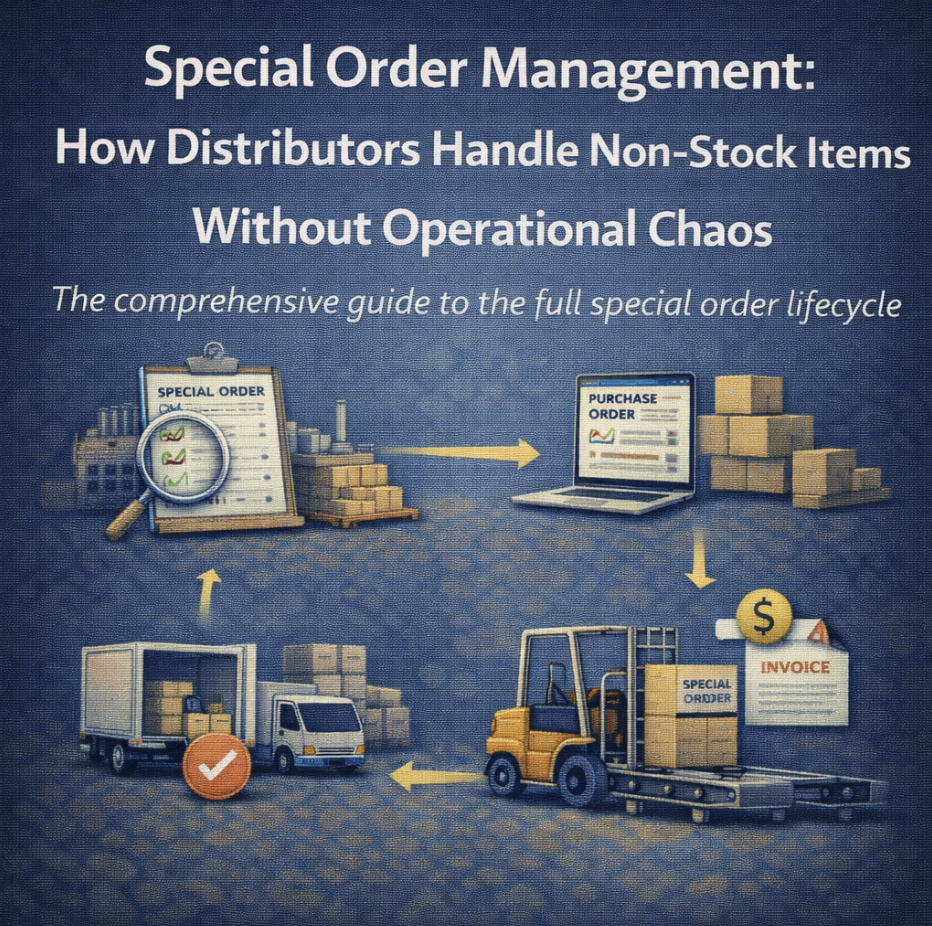
Special Order Management: How Distributors Handle Non-Stock Items Without Operational Chaos
Your sales rep just closed a deal. The customer needs a product you don’t normally stock, but you can get it from your vendor in a week. Easy enough—until it isn’t.
Three weeks later, the customer is calling daily asking where their order is. Your purchasing team swears the PO went out. The vendor says they shipped it last Tuesday. Receiving has no record of it arriving. And somewhere in your warehouse, a box sits on a shelf with no one knowing who it belongs to or why it’s there.
This is the special order problem that plagues distributors of every size. Non-stock items represent a growing share of revenue for most distribution companies—often 15% to 30% of total sales—yet the systems and processes designed for regular inventory simply break down when applied to these one-off purchases. The result is a cascade of inefficiencies: manual tracking in spreadsheets, endless phone calls between departments, frustrated customers, and margin erosion that’s difficult to even measure.
The irony is that special orders should be highly profitable. Customers typically pay premium pricing for non-stock items, and distributors take on less inventory risk since they’re buying specifically for a known order. But without proper systems to manage the complexity, those theoretical margins evaporate into labor costs, expedited freight, and customer credits for late deliveries.
Why Special Orders Create Unique Operational Challenges
Standard distribution workflows assume a predictable pattern: products arrive, get put away into bin locations, remain in inventory until ordered, get picked and shipped, and finally get invoiced. Every step maps to established processes with clear ownership and system support.
Special orders break this pattern at nearly every stage.
When a customer requests a non-stock item, someone has to determine whether the company can source it, at what cost, and with what lead time—often while the customer waits on the phone. If the sale proceeds, a purchase order must be generated specifically for this order, rather than through normal replenishment cycles. When the product arrives, it shouldn’t be put away into regular inventory; it needs to be identified, matched to the originating customer order, and routed directly to shipping. Throughout this process, the customer expects visibility into status and accurate delivery estimates.
The challenge isn’t any single step. The challenge is that most ERP systems treat special orders as exceptions rather than as a distinct workflow requiring its own logic. Purchase orders get created manually. Receiving personnel have no easy way to identify incoming product as a special order versus regular stock. Customer service has no visibility into vendor shipment status. And margin analysis becomes nearly impossible when special order costs are buried in general purchasing data.
This creates what might be called the “special order black hole”—a visibility gap where orders enter and information stops flowing until something goes wrong.
The Hidden Costs of Manual Special Order Tracking
Many distributors attempt to manage special orders through manual processes: spreadsheets maintained by customer service, notes in the ERP order comments, or simply relying on institutional knowledge and good intentions. These approaches create costs that are difficult to see but very real.
Consider the labor involved. When a customer calls asking about their special order, a service rep must first identify that it is a special order, then determine who placed the vendor PO, check whether the PO was acknowledged, contact the vendor for shipment status, and relay that information back to the customer. A single status inquiry might take fifteen minutes. Multiply that by dozens of special orders in progress at any time, and customer service becomes consumed by administrative work rather than actual service.
Receiving departments face similar challenges. Without clear identification of incoming special orders, products may be put away into general inventory by mistake. Days or weeks later, someone realizes the customer order can’t ship because the product was received but put in the wrong place—or worse, sold to a different customer.
The financial impact extends beyond labor. Special orders frequently involve negotiated pricing, shipping terms, and delivery commitments that differ from standard vendor agreements. When these details aren’t systematically captured and enforced, margins suffer. A sales rep quotes a price assuming standard freight, but the order ships expedited to meet the promised delivery date. Another order includes a restocking fee that no one remembers to charge when the customer eventually cancels. These leakages happen constantly, invisibly consuming profitability.
Industry experience suggests that distributors with manual special order processes lose between 3% and 8% of gross margin on non-stock items compared to what they should achieve. For a distributor doing $50 million in annual revenue with 20% of sales from special orders, that’s $300,000 to $800,000 in annual profit walking out the door.
What Effective Special Order Management Actually Requires
Solving the special order problem requires recognizing that non-stock items need a distinct workflow—not a workaround within existing processes. This workflow must address several critical requirements.
Immediate Visibility at Point of Sale
When a customer requests a non-stock item, the sales or service rep needs instant access to sourcing information. Can the company get this product? From which vendor? At what cost? With what lead time? This information must be available in real-time, not after a callback following research.
Effective systems allow reps to search vendor catalogs directly, see current pricing and availability, and generate quotes that reflect accurate costs and realistic delivery dates. The customer gets an answer in minutes rather than hours, and the quote captures all the information needed to execute the order profitably.
Automated Purchase Order Generation
Once a special order is confirmed, the linked purchase order should generate automatically. This isn’t just about efficiency—it’s about accuracy and traceability. When POs are created manually, they lose their connection to the originating customer order. Details get transcribed incorrectly. Ship-to addresses don’t match. Requested delivery dates don’t align with customer promises.
Automated PO generation maintains the link between customer order and vendor purchase throughout the lifecycle. This connection enables every downstream process: receiving knows what’s coming and why, customer service can check status without research, and accounting can match costs to revenue accurately.
Cross-Dock Identification at Receiving
Perhaps no single capability matters more than receiving visibility. When a special order shipment arrives, the receiving team must know immediately that this product is allocated to a specific customer order and should not be put away into regular inventory.
Best practices go further than simple identification. Advanced systems trigger cross-dock workflows that route the product directly to shipping, print the appropriate outbound labels, and notify customer service that the order is ready to ship. The product never touches a shelf. It arrives, gets verified, and goes right back out the door—minimizing handling costs and accelerating delivery.
Customer Communication Throughout the Lifecycle
Customers ordering non-stock items accept longer lead times than they would for stocked products. What they won’t accept is uncertainty. They need to know that the order was placed with the vendor, that the vendor acknowledged it, that the product shipped, and when it will arrive.
Effective special order management includes proactive communication at each milestone. Rather than waiting for customers to call asking for status, the system sends updates automatically. This isn’t just better service—it’s dramatically cheaper than fielding status inquiries manually.
Margin Visibility and Protection
Special orders often involve complex cost structures: product cost, freight, handling, and sometimes vendor drop-ship fees or expedite charges. Without systematic capture of all cost components, margin analysis becomes fiction.
Proper systems capture expected costs at order entry, compare them against actual costs at invoice, and flag variances for review. When a special order underperforms its expected margin, someone knows about it—and can determine whether it reflects a pricing problem, a process failure, or an isolated exception.
The Integration Imperative
What makes special order management particularly challenging is that it touches nearly every functional area of a distribution operation. Sales creates the order. Purchasing places the vendor PO. Receiving handles inbound product. Warehouse routes it to shipping. Accounting manages invoicing and payables. Customer service answers questions throughout.
When these functions operate in separate systems—or even separate modules with poor integration—special order workflows fragment. Information must be manually transferred between systems, creating delay and error. No one has a complete picture of order status because the data lives in different places.
This is why special order excellence requires a unified platform rather than bolted-together point solutions. When order management, purchasing, warehouse management, and accounting share a common database and real-time integration, the special order workflow can operate seamlessly. The customer order automatically generates the PO. The PO includes the customer order reference. Receiving immediately recognizes the inbound shipment. Shipping knows the order is ready. Customer service sees current status without making phone calls. Accounting matches everything up automatically.
Attempting to achieve this integration through middleware connecting separate systems is possible but rarely succeeds completely. The edge cases multiply, the failure points increase, and the maintenance burden grows over time. For distributors where special orders represent a significant revenue stream, integrated systems aren’t a luxury—they’re a competitive requirement.
Building a Special Order Process That Scales
Distributors who master special order management typically share several process characteristics beyond their technology choices.
Clear Sourcing Authorization
Not every product a customer requests should become a special order. Some items come from unreliable vendors. Some have lead times that exceed customer tolerance. Some involve costs that make profitable pricing impossible. Effective processes include clear guidelines about which non-stock requests to accept and which to decline.
This doesn’t mean saying no to customers. It means setting accurate expectations upfront. A customer who understands that a product has a six-week lead time and decides to proceed is very different from a customer who was promised two weeks and waits six.
Deposit and Prepayment Policies
Special orders involve financial risk that standard inventory doesn’t carry. If a customer cancels after the product arrives, the distributor may have no alternative outlet for the inventory. Wise distributors mitigate this risk through deposit requirements or prepayment for non-stock items, particularly for unusual products or new customers.
These policies need system support to be practical. When a customer order for a special item can’t progress to PO generation without a recorded deposit, the policy enforces itself. When deposits require manual tracking and follow-up, compliance erodes.
Vendor Communication Standards
Special order success depends heavily on vendor performance, yet many distributors take a passive approach to vendor management for non-stock purchases. They place POs and hope for the best.
Better approaches include vendor acknowledgment requirements, proactive status checking at defined intervals, and escalation procedures when commitments slip. The goal is early identification of problems while there’s still time to mitigate impact—finding alternative sources, adjusting customer expectations, or expediting shipment.
Exception Management Discipline
Despite the best processes, special orders generate exceptions. Vendors ship late. Products arrive damaged. Customer requirements change. How distributors handle these exceptions determines whether special orders become profitable or problematic.
Effective exception management requires visibility—knowing that an order is at risk before the customer calls to complain. It requires clear ownership—someone accountable for resolving each problem rather than shared responsibility that becomes no responsibility. And it requires closed-loop tracking to ensure exceptions actually get resolved rather than lingering indefinitely.
Measuring Special Order Performance
Distributors who treat special orders as a strategic capability rather than a necessary evil measure their performance rigorously. Key metrics include:
Order-to-PO Cycle Time measures how quickly customer special orders convert to vendor purchases. Delays here directly extend customer lead times and often indicate manual process bottlenecks or sourcing complexity.
Vendor On-Time Performance tracks whether vendors deliver special orders when promised. This metric isolates vendor issues from internal execution problems and identifies which vendors merit special order business versus those to avoid.
Cross-Dock Efficiency measures what percentage of special order receipts route directly to shipping versus requiring put-away and later picking. Higher cross-dock rates indicate better receiving identification and process execution.
First-Contact Resolution Rate tracks how often customer status inquiries are answered immediately versus requiring research and callback. This metric reveals whether customer service has adequate visibility into special order status.
Actual vs. Expected Margin compares the margin captured at invoicing against the margin projected at order entry. Variance indicates cost leakage, pricing errors, or unplanned expenses like expedited freight.
Distributors tracking these metrics typically discover that their special order performance is worse than assumed—but also identify specific improvement opportunities. The measurement discipline itself drives improvement by creating accountability and focus.
When Special Orders Justify Stocking Decisions
Effective special order management also informs inventory strategy. Products that repeatedly appear as special orders may deserve a place in regular inventory. But making this decision requires data that only proper special order tracking can provide.
How often is this product ordered? From which customers? At what margins? With what lead time expectations? If five customers order the same non-stock item every quarter, stocking it might improve service and reduce procurement costs. But if each occurrence comes from a different customer for a unique application, stocking it would simply tie up capital in slow-moving inventory.
The analysis depends on visibility that manual special order processes can’t provide. When special orders flow through integrated systems with proper categorization and tracking, the data exists to make informed stocking decisions. When they flow through spreadsheets and email, the data is scattered or lost.
The Competitive Advantage of Special Order Excellence
In many distribution verticals, the ability to handle special orders effectively has become a competitive differentiator. Customers increasingly expect access to broad product assortments without the constraints of what distributors happen to stock. The distributor who can source non-stock items quickly, price them accurately, and deliver them reliably wins business that competitors can’t serve.
This dynamic is particularly pronounced in industries facing SKU proliferation. Building materials distributors, electrical distributors, and industrial supply houses all confront catalogs with hundreds of thousands of items. No distributor can stock everything. The winners are those who can efficiently source and deliver the items they don’t stock—extending their effective product offering without proportional inventory investment.
Special order capability also protects existing customer relationships. When a loyal customer occasionally needs something outside the normal stocking range, the distributor who handles it smoothly reinforces the relationship. The one who fumbles it opens the door for competitors to demonstrate superior capability.
Moving from Chaos to Control
For distributors currently struggling with special order management, the path forward begins with honest assessment. How much revenue comes from non-stock items? What does the current process actually look like—not the documented procedure, but what really happens? Where do orders stall? Where does visibility disappear? What are customers actually experiencing?
This assessment often reveals that special orders have become a significant business within the business, yet receive minimal process attention or system support. The gap between importance and investment explains the chaos.
Closing that gap requires treating special orders as a distinct workflow deserving its own design, systems, and metrics. It requires technology that maintains connections between customer orders and vendor purchases throughout the lifecycle. It requires receiving processes that identify and route special orders appropriately. And it requires customer communication that keeps buyers informed without manual effort.
For many distributors, achieving these capabilities means reconsidering their core systems. Legacy ERPs designed for standard inventory workflows struggle to accommodate special order requirements without extensive customization. Separate point solutions create integration challenges that fragment visibility. Modern, purpose-built distribution platforms increasingly offer integrated special order functionality that addresses these requirements natively.
How Bizowie Addresses Special Order Complexity
Bizowie’s cloud ERP platform approaches special order management as a core distribution requirement rather than an afterthought. The system maintains explicit connections between customer orders and vendor purchases from creation through fulfillment, ensuring visibility never disappears into the special order black hole.
When customer service or sales receives a non-stock request, they can search vendor catalogs directly within the order entry workflow, seeing current pricing and availability without leaving the screen. Once confirmed, the system generates the linked vendor PO automatically, carrying all relevant information including customer order reference, ship-to address, and required dates.
At receiving, Bizowie’s integrated warehouse management immediately identifies incoming special orders and triggers appropriate workflows. Cross-dock routing moves product directly to shipping when appropriate, while the system automatically updates customer order status and can send proactive notifications.
Throughout the process, a unified view shows every stakeholder current status—where the vendor PO stands, whether product has shipped, when it will arrive, and whether the customer order is ready to fulfill. Customer service answers inquiries immediately without research. Management sees special order performance metrics alongside regular business reporting.
Because Bizowie integrates order management, purchasing, warehouse operations, and accounting in a single cloud platform, the connections that special orders require exist natively rather than through middleware or manual intervention. The complexity that defeats other approaches is simply part of how the system works.
Taking the Next Step
Special orders will never be simple. By definition, they involve products outside normal inventory, processes outside standard workflows, and lead times outside typical delivery patterns. But they don’t have to be chaotic.
Distributors who implement proper special order management capture the margins they’re entitled to, deliver the service customers expect, and extend their product offering beyond what any warehouse could hold. Those who don’t spend countless hours on manual tracking, suffer invisible profit leakage, and frustrate the customers they’re trying to serve.
The difference lies in recognizing that special orders require purpose-built processes and systems—not workarounds within tools designed for other purposes.
If special orders represent meaningful revenue for your distribution business and your current approach feels like constant firefighting, it’s worth exploring platforms designed to bring clarity and control to this critical workflow.
Ready to see how integrated special order management actually works? Schedule a demo to explore how Bizowie handles non-stock items from quote through delivery—without the operational chaos.