
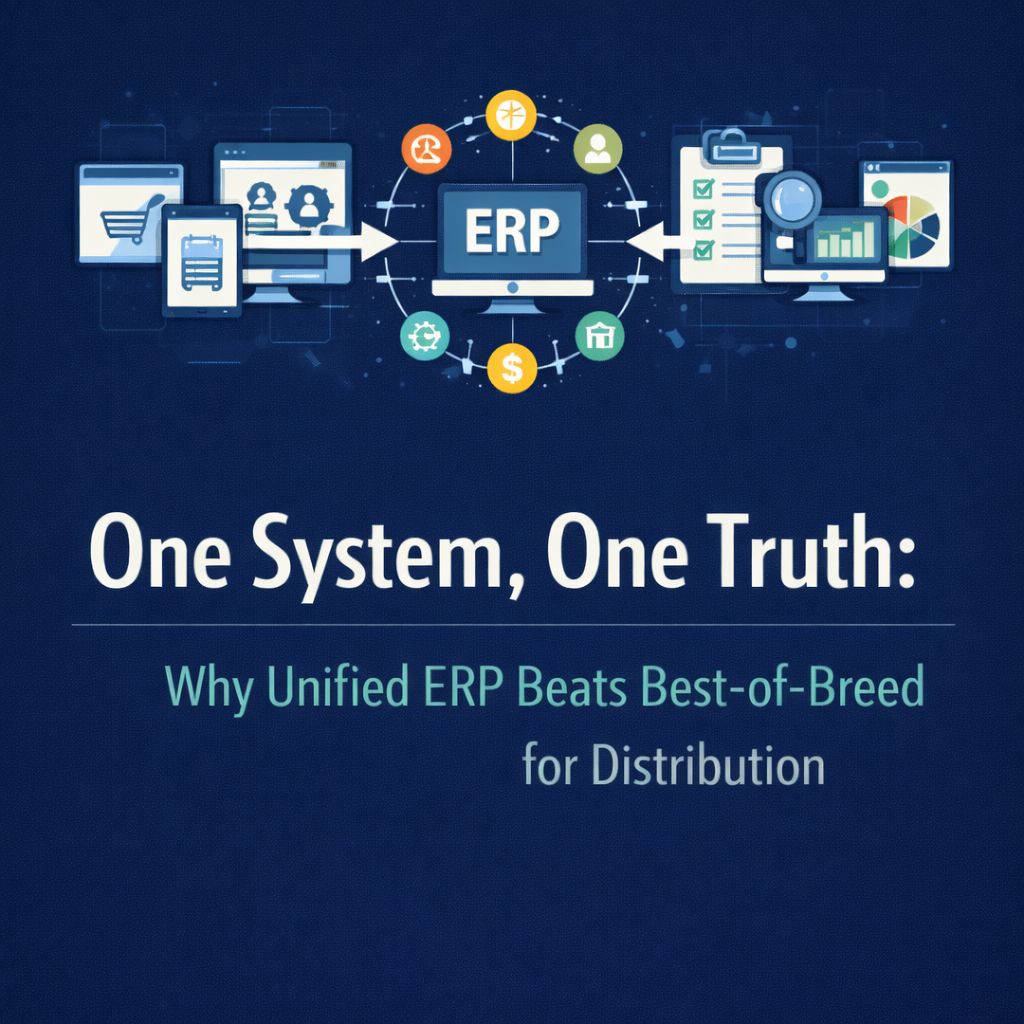
One System, One Truth: Why Unified ERP Beats Best-of-Breed for Distribution
It’s 4:15 PM on a Friday. A customer calls asking why their order hasn’t shipped. Your customer service rep checks the order management system—it shows the order released to the warehouse yesterday. She checks the warehouse management system—it shows the order still pending because inventory isn’t available. She checks the ERP—it shows 47 units on hand. She checks the inventory system—it shows 12 units, all allocated to other orders.
Four systems. Four different answers. One frustrated customer who just needed to know when their product would arrive.
This scenario plays out countless times daily at distribution companies running multiple disconnected systems. Each system was chosen for a reason. Each does its specific job reasonably well. But together, they create a fractured reality where no one can answer basic questions without checking multiple screens, making phone calls, or simply guessing.
The appeal of best-of-breed software—selecting the “best” specialized solution for each function—is understandable. Why settle for adequate warehouse management in an ERP when you can buy best-in-class WMS? Why accept basic CRM functionality when dedicated platforms offer sophisticated capabilities? The logic seems sound.
But the logic ignores the hidden costs that emerge when systems must work together. Integration complexity. Data synchronization failures. Reconciliation labor. Decision-making delays. And the fundamental problem that haunts every multi-system environment: when systems disagree, which one is telling the truth?
For distributors, where operational speed and accuracy directly determine profitability, these hidden costs compound into competitive disadvantage. The theoretical benefits of best-of-breed specialization rarely survive contact with the reality of running an integrated business.
The Seductive Logic of Best-of-Breed
The best-of-breed argument is straightforward and initially compelling.
Specialized software vendors focus entirely on their domain. A company that does nothing but warehouse management software will naturally build deeper functionality than an ERP vendor treating WMS as one module among many. They’ll understand edge cases better, innovate faster, and attract talent passionate about that specific problem.
The same logic applies across functions. Dedicated CRM platforms offer sophisticated sales automation that general ERPs can’t match. Specialized shipping software integrates with more carriers and optimizes rates more effectively. Purpose-built eCommerce platforms handle online selling with capabilities that ERP vendors struggle to replicate.
From this perspective, choosing an integrated ERP means accepting mediocrity across every function. You get adequate everything but excellent nothing. Why compromise when you can assemble a software stack where every component is best-in-class?
This argument has validity in some contexts. Large enterprises with dedicated IT departments, substantial integration budgets, and the scale to justify complexity sometimes benefit from best-of-breed strategies. Companies with genuinely unique requirements in specific areas may need specialized solutions that no integrated platform offers.
But for mid-market distributors—companies doing $10 million to $500 million in revenue—the best-of-breed approach typically creates more problems than it solves. The hidden costs accumulate until they overwhelm whatever functional advantages the specialized systems provide.
The Integration Tax Nobody Calculates
When evaluating specialized software, companies focus on functionality and price. They compare features against requirements. They negotiate licensing costs. They budget for implementation.
What they rarely calculate is the integration tax—the ongoing cost of making systems work together.
Integration isn’t a one-time project. It’s a permanent obligation. Every system that connects to another creates an integration point that must be built, tested, monitored, maintained, and eventually rebuilt when either system changes.
Initial Integration Costs are substantial but at least visible. Connecting a WMS to an ERP requires mapping data fields, building transaction flows, handling exceptions, and testing thoroughly. Professional integration projects commonly run $50,000 to $200,000 per connection point, depending on complexity. A typical best-of-breed stack with separate WMS, CRM, shipping, and eCommerce systems requires four to six major integrations—easily $300,000 to $1 million before the first order flows through.
Ongoing Maintenance Costs are less visible but equally real. Integrations require monitoring. They break when systems update. They need modification when business processes change. Companies typically spend 15% to 25% of initial integration costs annually on maintenance. That $500,000 integration investment becomes $75,000 to $125,000 in perpetual annual cost—money that buys nothing new, simply keeps existing connections functioning.
Opportunity Costs may be largest of all. Every hour IT spends maintaining integrations is an hour not spent on improvements that drive business value. Every integration limitation that prevents a process change is an opportunity foregone. Companies with complex integration environments often find themselves unable to pursue initiatives that require system changes because the integration implications are too daunting.
When evaluating best-of-breed approaches, these costs rarely appear in the analysis. Vendors selling specialized software certainly don’t highlight them. The result is decisions based on incomplete economics—choices that look smart initially but prove expensive over time.
When Systems Disagree: The Data Truth Problem
Integration costs are significant, but they’re ultimately solvable with enough money and effort. The deeper problem with multi-system environments is more fundamental: systems inevitably contain different versions of truth, and resolving those differences consumes enormous organizational energy.
Consider inventory. Inventory appears in multiple systems—the ERP’s financial records, the WMS’s bin-level tracking, the eCommerce platform’s available-to-promise calculations, the purchasing system’s supply planning. In an ideal world, these all synchronize perfectly, always showing the same quantities.
In the real world, synchronization is never perfect.
Timing differences alone create discrepancies. The warehouse receives a shipment and scans it into the WMS. That transaction must transmit to the ERP, which must process it and update inventory records. Until that cycle completes—minutes to hours depending on integration design—the systems show different quantities. During that window, the ERP might allow an order to release against inventory that the WMS already allocated elsewhere.
Error handling creates additional discrepancies. When integrations encounter exceptions—malformed data, missing references, system timeouts—they typically log errors and continue processing other transactions. Someone must review those errors and resolve them. Until they do, the affected records remain out of sync. In busy operations, error queues grow faster than staff can clear them.
Business process gaps create still more discrepancies. The warehouse damages a product and disposes of it. The WMS inventory decreases, but if the adjustment doesn’t flow correctly to the ERP, financial inventory remains unchanged. Weeks later, someone wonders why physical counts don’t match system records.
Multiply these scenarios across every data element that exists in multiple systems—customers, products, orders, shipments, payments—and the scope of potential discrepancy becomes staggering. At any moment, dozens or hundreds of records may be inconsistent across systems.
The organizational response is reconciliation labor. People spend hours daily comparing system outputs, identifying discrepancies, researching causes, and making corrections. This work adds no value—it simply addresses problems that wouldn’t exist if data lived in one place. Yet companies accept it as normal because they’ve never experienced anything different.
The Decision-Making Delay
Data discrepancies don’t just waste labor. They delay decisions that require accurate information.
A customer asks if you can ship 500 units next week for a special project. Simple question. But answering it requires knowing current inventory, incoming purchase orders, other committed orders, and warehouse capacity to handle the shipment. In a unified system, someone can see this information immediately. In a multi-system environment, they must check multiple sources, reconcile any differences they find, and make judgment calls about which numbers to trust.
A purchasing manager needs to decide whether to place an expedited order with a vendor. They need to know true demand versus forecast, current inventory position, and committed customer orders. Gathering this from separate systems takes time—time during which the expedite premium increases or the opportunity disappears entirely.
A operations leader suspects a process problem is causing fulfillment delays. Diagnosing it requires correlating data across order management, warehouse operations, and shipping. In a unified system, the data exists in one place for analysis. In a fragmented environment, someone must extract data from multiple sources, normalize it for comparison, and hope the timing aligns well enough to reveal patterns.
These delays matter competitively. Distributors who respond to customers in minutes win orders that competitors pursuing for hours never see. Companies that spot problems quickly address them before they cascade into larger failures. Speed depends on information access, and fragmented systems slow information access.
The Customer Experience Consequence
Customers experience your systems even though they never see them.
When a customer calls with a question, how quickly can you answer? In a unified environment, the service rep sees order status, inventory availability, shipment tracking, payment history, and customer notes in one view. They answer questions immediately because all information is accessible.
In a multi-system environment, the service rep toggles between applications, searches for information in different places, and often tells customers they’ll call back after researching. The delay frustrates customers who expect immediate answers. Worse, it creates opportunities for errors when reps must manually correlate information across screens.
When orders ship, does the customer get accurate tracking information? Unified systems generate shipping labels and capture tracking numbers as part of the fulfillment process. That information is immediately available to customer service and can flow to customers automatically. Multi-system environments depend on integrations to move tracking data from shipping systems to order management. Delays or failures in that integration leave customers without tracking information—prompting calls that waste their time and yours.
When problems occur, how quickly are they resolved? A customer reports receiving the wrong item. In a unified system, service can immediately see what was ordered, what was shipped, current inventory of the correct item, and options for resolution. In a fragmented environment, they must check order entry in one system, shipment details in another, and inventory in a third. The customer waits while your team gathers information.
Customer experience has become a primary competitive differentiator in distribution. Customers expect Amazon-like responsiveness regardless of who they’re buying from. Meeting those expectations requires information systems that enable immediate, accurate responses—not fragmented environments that create delays at every interaction.
The Hidden Fragility of Integrated Stacks
Multi-system environments don’t just create ongoing costs and inefficiencies. They create fragility that threatens business operations.
Every integration point is a potential failure point. When the connection between your WMS and ERP fails, orders stop releasing to the warehouse. When the link between order management and shipping breaks, packages can’t be labeled. When the eCommerce integration goes down, online orders don’t flow into fulfillment.
These failures happen. APIs time out. Middleware servers crash. Authentication tokens expire. File transfers fail silently. The more integration points in your environment, the more frequently something will break—and the more difficult diagnosing and fixing problems becomes.
Diagnosing integration failures requires understanding multiple systems and the connections between them. The problem might be in the source system, the target system, the middleware, the network, or the data itself. Finding the root cause means checking logs in multiple places, testing connections, and often calling multiple vendors who each claim the problem lies elsewhere.
While diagnosis proceeds, business operations suffer. Orders don’t flow. Shipments don’t release. Information doesn’t update. Staff develop workarounds—manual processes, spreadsheet tracking, phone calls—that keep the business moving but introduce errors and consume time.
Recovery from integration failures often requires replaying transactions, reconciling data, and manually correcting records that corrupted during the outage. This cleanup can take hours or days after systems come back online, extending the impact well beyond the actual downtime.
Companies with complex integration environments often don’t realize their fragility until a significant failure occurs. Then they discover how much of their operation depends on connections that nobody fully understands and that fail in ways nobody anticipated.
The Upgrade Nightmare
Systems don’t stay static. Vendors release updates, sometimes mandating upgrades that customers must accept. Business requirements evolve, requiring new capabilities. Technology advances make old approaches obsolete.
In a unified environment, upgrades are manageable. You’re updating one system, and the vendor has tested that all the components work together. The project has clear scope and predictable effort.
In a multi-system environment, upgrades cascade unpredictably. Upgrading the ERP may break integrations with the WMS. The WMS vendor may require its own update to maintain compatibility. That WMS update may affect the shipping integration. Each change ripples through connected systems, multiplying testing requirements and project complexity.
This upgrade complexity often leads to paralysis. Companies running multi-system environments frequently defer upgrades because the integration implications are too risky. They fall behind on versions, missing new features and eventually losing vendor support. They accumulate technical debt that makes eventual upgrades even more difficult and expensive.
Some companies find themselves trapped on obsolete platforms because they’ve invested so heavily in custom integrations that upgrading would essentially require rebuilding everything. Their best-of-breed strategy, chosen for flexibility and best-in-class functionality, has become an anchor preventing them from modernizing.
The Case for Unified Systems
The alternative to best-of-breed fragmentation is a unified platform where core distribution functions—order management, inventory, warehouse operations, purchasing, accounting, customer management—operate on a shared foundation.
Unified doesn’t mean limited. Modern cloud ERP platforms offer sophisticated functionality across all distribution domains. The historical argument that integrated systems meant accepting mediocrity no longer holds. Purpose-built distribution platforms provide depth that matches or exceeds specialized alternatives in the areas that matter for distribution operations.
What unified systems offer that best-of-breed cannot match is inherent data consistency. When order management, warehouse operations, and accounting share a common database, there’s no synchronization delay, no integration failure point, no possibility of discrepancy. The inventory quantity in order entry is the same as in warehouse management is the same as in financial reporting—because it’s the same data, not copies that must stay synchronized.
Unified systems offer operational coherence. Business processes flow through a single environment designed as a whole. The order-to-cash cycle doesn’t cross system boundaries where things can fall through cracks. Exception handling routes to appropriate queues within the same application. Users navigate one interface rather than learning multiple systems with different conventions.
Unified systems offer adaptability. When business requirements change, you modify one system rather than assessing integration impacts across multiple platforms. When you want new reporting, you query one database rather than aggregating data from multiple sources. When you hire new employees, you train them on one system rather than several.
Unified systems offer clarity. When something goes wrong, you look in one place to understand what happened. When a customer asks a question, you answer from one screen. When leadership asks about business performance, you report from one source of truth.
These advantages compound over time. The organization that operates on a unified platform moves faster, makes better decisions, serves customers better, and spends less on technology overhead than the organization fighting to keep fragmented systems aligned.
Addressing the Best-of-Breed Arguments
Advocates for best-of-breed approaches raise legitimate concerns that deserve response.
“Specialized systems have deeper functionality.” Sometimes true, but often the comparison reflects outdated assumptions. Modern distribution ERP platforms have invested heavily in areas like warehouse management, shipping integration, and eCommerce connectivity. The functionality gap that once justified separate systems has narrowed dramatically. More importantly, the comparison rarely accounts for the integration overhead that erodes specialized system value.
“We have unique requirements that no integrated platform addresses.” Genuinely unique requirements are rarer than companies believe. What feels unique is often standard functionality that the current system handles poorly, creating the impression that special capability is needed. When evaluating unified platforms, focus on whether they handle your actual workflows—not whether they replicate exactly how you’ve worked around current system limitations.
“We’ve already invested in our current systems.” Sunk cost reasoning traps companies in deteriorating situations. The investment in current systems is spent regardless of future decisions. The relevant question is whether ongoing investment in the current environment yields better returns than transitioning to a unified platform. For most distributors with fragmented systems, the answer is no—but reaching that conclusion requires honestly accounting for integration costs, reconciliation labor, and competitive impact.
“Migration is too risky and disruptive.” Migration does carry risk, but so does the status quo. Integration failures, data quality problems, and system limitations create ongoing risk that companies accept because it’s familiar. Migration risk is bounded and manageable with proper planning. Status quo risk is unbounded and compounds over time.
“Our team knows the current systems.” Team familiarity is valuable but also creates resistance to any change. The question is whether the organization is optimizing for employee comfort or competitive effectiveness. Modern systems are more intuitive than legacy platforms, reducing the learning curve for transitions. And the operational benefits of unified systems typically generate more job satisfaction than the frustration of fighting fragmented environments.
What to Look for in a Unified Platform
Not all unified platforms are equal. When evaluating integrated ERP solutions, several characteristics distinguish platforms that deliver on the unified system promise.
True Integration, Not Acquired Modules matters because some “unified” platforms are actually acquisitions stitched together. The warehouse module came from one company, eCommerce from another, CRM from a third. They share a brand name but not a codebase, and integration between them may be no better than integration between separate vendors’ products. Ask vendors directly: was this platform built as a unified system, or assembled through acquisition?
Distribution-Specific Design matters because generic ERP platforms often lack the functionality distributors need—customer-specific pricing, lot tracking, warehouse management, EDI, and specialized fulfillment workflows. A unified platform that doesn’t handle distribution requirements still forces you into specialized add-ons, recreating the integration burden you’re trying to escape.
Cloud Architecture matters because modern cloud platforms offer advantages that on-premise or hosted solutions struggle to match—automatic updates, accessibility, scalability, and reduced IT overhead. True cloud also typically means a single codebase that all customers run, ensuring ongoing investment in the platform benefits everyone.
Workflow Completeness matters because unified value depends on covering the processes you actually run. Evaluate whether the platform handles your end-to-end workflows without requiring external systems. If significant functionality gaps remain, you’ll add specialized systems and recreate integration challenges.
Scalability Evidence matters because the platform must handle your growth trajectory, not just your current state. Ask for references from companies at or above your target size. Understand how the platform handles transaction volumes, user counts, and multi-location complexity at scale.
How Bizowie Delivers Unified Distribution Operations
Bizowie was built from the ground up as an integrated cloud platform for distribution. There are no acquired modules with hidden integration layers, no bolted-on functionality from separate codebases, no middleware maintaining an illusion of unity.
Order management, warehouse operations, purchasing, inventory, accounting, CRM, and customer portals share a common foundation. When an order enters the system, it’s immediately visible to warehouse operations—no synchronization delay, no integration to fail. When inventory adjusts, financial records update simultaneously—no reconciliation required. When a shipment delivers, customer service sees it instantly—no data transfer to wait for.
This architecture means Bizowie users experience what unified truly feels like. Customer service answers questions from one screen. Warehouse staff work from one system. Purchasing makes decisions with complete visibility. Accounting closes books without chasing discrepancies across platforms.
The platform includes functionality that distributors typically buy separately: warehouse management with bin-level tracking, customer portals for self-service, EDI for trading partner integration, shipping with multi-carrier rate shopping. These capabilities are native to the platform, not add-ons that create new integration points.
For distributors tired of fighting fragmented systems, tired of reconciling conflicting data, tired of maintaining integrations that add complexity without adding value, Bizowie offers a different path. One system. One truth. Clarity and control across every aspect of the business.
Making the Transition
Moving from fragmented systems to a unified platform is significant but achievable. The key is approaching the transition strategically.
Start with honest assessment of current state costs. Most companies undercount what they spend maintaining integrations, reconciling data, and working around system limitations. Capturing these costs accurately builds the business case for change and sets appropriate expectations for return on investment.
Evaluate platforms against actual requirements, not assumptions about what you need. Many best-of-breed justifications rest on requirements that unified platforms now handle well. Challenge whether specialized systems remain necessary or whether integrated alternatives have closed the gap.
Plan for process improvement, not just system replacement. Migration is an opportunity to address workflow inefficiencies that accumulated over years of working around system limitations. Taking time to design improved processes yields benefits beyond what any software provides.
Invest in change management because technology alone doesn’t transform operations. People must adopt new systems and processes. Training, communication, and support during transition determine whether the unified platform delivers its potential value.
Measure results after go-live to confirm expected benefits materialize. Reduced reconciliation labor, faster customer response, improved data quality—these outcomes should be visible and quantifiable. Measurement creates accountability and identifies areas needing additional attention.
The Competitive Reality
Distribution is increasingly competitive. Margins compress. Customer expectations rise. The companies that thrive will be those that operate most efficiently, respond most quickly, and make best use of their information.
Fragmented systems work against all three goals. They create overhead that inflates costs. They delay responses that customers expect instantly. They bury information in disconnected silos where it can’t inform decisions.
Unified systems enable operational excellence. They eliminate integration costs that add no value. They provide immediate access to information customers and employees need. They create visibility that supports better decisions at every level.
The best-of-breed approach made sense in an era when integrated platforms couldn’t handle specialized requirements. That era has passed. Modern distribution ERP platforms offer the depth of functionality that only specialists once provided, combined with the integration that specialists could never offer.
For distributors still running fragmented environments, the question isn’t whether to consolidate—it’s how soon. Every month operating in multi-system complexity is a month of unnecessary cost, preventable errors, and competitive disadvantage.
Ready to see what unified distribution operations look like? Schedule a demo to explore how Bizowie brings clarity and control to every aspect of your business—from one platform, with one version of truth.