
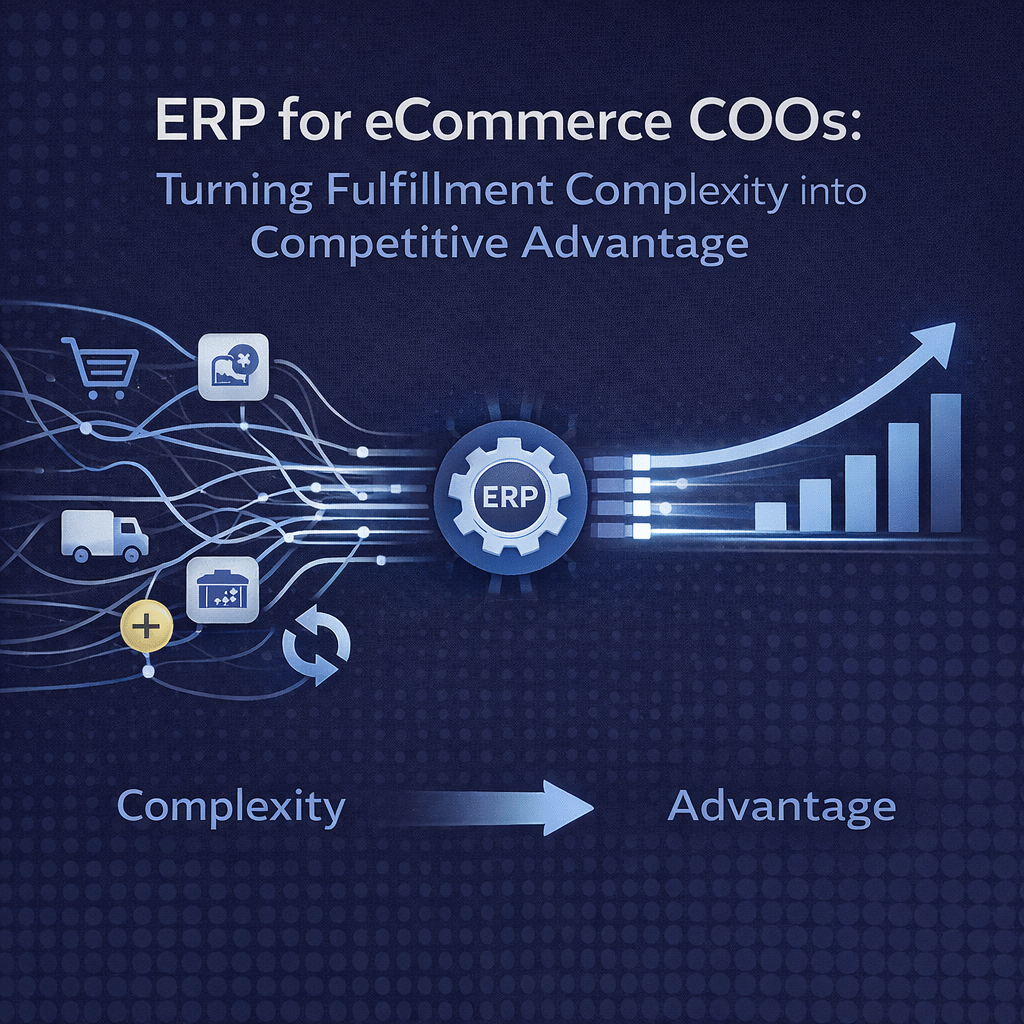
ERP for eCommerce COOs: Turning Fulfillment Complexity into Competitive Advantage
As Chief Operating Officer of a growing eCommerce business, you’re navigating a paradox that defines modern retail operations: the very complexity that threatens to overwhelm your fulfillment capabilities is simultaneously the barrier protecting you from competitors. Your multi-channel distribution, sophisticated inventory allocation, same-day shipping commitments, and omnichannel fulfillment aren’t operational burdens to be minimized—they’re strategic assets to be optimized.
The question isn’t whether to embrace operational complexity but how to transform it from a constraint into an advantage. Companies that manage complexity through manual processes and disconnected systems find themselves trapped in a cycle of escalating costs, declining service levels, and growth limitations. Those that systematically optimize operations through integrated platforms turn the same complexity into differentiation that competitors can’t easily replicate.
This transformation happens through comprehensive cloud ERP platforms that unify fulfillment operations across warehouses, channels, and customer touchpoints. Rather than managing complexity through ever-increasing operational staffing and coordination overhead, modern ERP converts complexity into automated workflows, intelligent routing, and real-time visibility that enables better decisions faster. The result is fulfillment operations that scale efficiently, adapt quickly to market changes, and deliver customer experiences that build lasting competitive advantage.
Understanding how ERP platforms address the specific operational challenges eCommerce COOs face—and how to evaluate, implement, and optimize these systems—is essential for any operations leader responsible for building scalable, profitable fulfillment capabilities.
The COO’s Dilemma: Scale, Speed, and Complexity
The operational challenges you face as eCommerce COO differ fundamentally from traditional retail operations. Your fulfillment network must handle exponentially more SKUs than brick-and-mortar stores, process orders from channels with different service level requirements, manage inventory across multiple locations with real-time visibility, fulfill single-unit orders as efficiently as bulk shipments, and maintain profitability while competing on delivery speed and accuracy.
The Complexity Cascade
This operational complexity doesn’t emerge suddenly—it accumulates gradually as your business scales and diversifies. Year one might involve straightforward DTC fulfillment: orders come in through your website, warehouse staff pick and pack them, carriers collect shipments. The operation is manageable with basic tools and processes because variables remain limited.
Year two introduces Amazon and marketplace selling. Now you’re managing inventory allocation across channels, dealing with different shipping requirements for each marketplace, coordinating returns from multiple sources, and maintaining inventory accuracy despite transaction volume doubling. The operational workload increases disproportionately to revenue growth.
Year three adds wholesale customers, retail store fulfillment, and international expansion. Suddenly you’re managing bulk orders alongside single-unit picks, coordinating store replenishment with DTC fulfillment, handling multi-currency pricing and documentation, and maintaining visibility across a distributed warehouse network. What started as straightforward fulfillment has become a complex orchestration challenge spanning multiple facilities, channels, and customer types.
The operational burden compounds through integration and coordination requirements. Each sales channel needs real-time inventory visibility to prevent overselling. Each warehouse location requires task direction and progress tracking. Each carrier relationship demands rate shopping and documentation automation. Each customer segment expects service levels tailored to their needs. Managing these interconnected requirements through manual processes or point solutions consumes exponentially more operational capacity as complexity increases.
The Scale Efficiency Challenge
Traditional wisdom suggests that operational efficiency improves with scale—higher volume spreads fixed costs across more units, increased purchasing power reduces input costs, specialized labor drives productivity gains. This holds true for manufacturing and traditional retail but breaks down in eCommerce fulfillment when operations lack systematic optimization.
The economics tell the story. A business fulfilling 100 orders daily might operate at $4.50 per order fully-loaded costs using manual processes. Doubling to 200 daily orders doesn’t reduce costs to $2.25—it might only drop to $4.00 because the efficiency gains are offset by coordination complexity. Scaling to 500 daily orders could see costs increase to $4.75 as quality problems, rework, and expedited shipping from operational chaos more than offset any volume efficiencies.
This diseconomy of scale stems from several factors. Manual processes that work at lower volumes become bottlenecks at scale—the warehouse supervisor who manually assigns pick batches each morning can’t effectively manage three shifts across two locations. Basic software that enabled adequate coordination at 100 daily orders lacks the workflow automation needed at 500 daily orders. Point solutions that seemed sufficient when introduced require progressively more integration maintenance as volume and complexity increase.
The result is a operational cost structure that scales linearly or worse with volume rather than improving with scale. Your fulfillment costs as a percentage of revenue remain stubbornly high or even increase despite volume growth. This cost structure limits pricing flexibility, reduces profitability, and constrains your ability to invest in growth initiatives.
The Service Level Expectations Arms Race
While your operational complexity increases, customer expectations continue escalating. Free two-day shipping transformed from competitive differentiator to baseline expectation. Same-day delivery in major metros is rapidly becoming standard. Real-time order tracking isn’t a premium feature but an assumed capability. Perfect order accuracy—right product, right quantity, undamaged condition—is the minimum threshold for customer satisfaction.
These rising expectations create operational pressure that compounds complexity challenges. Meeting two-day delivery commitments requires warehouse operations that ship orders within 4-6 hours of receipt—achievable with optimized workflows but nearly impossible with manual coordination. Same-day delivery demands geographic distribution and sophisticated order routing that evaluates inventory availability, shipping distance, and carrier cutoff times in real-time. Perfect order accuracy at high volume requires directed picking with validation rather than relying on human memory and attention.
The competitive dynamics are unforgiving. Customers don’t compare your service levels to what you delivered last year but to what Amazon, Chewy, and other operationally sophisticated retailers deliver today. A 5% error rate might seem acceptable in absolute terms, but customers experiencing one wrong shipment in twenty orders perceive your operation as unreliable compared to competitors achieving 99%+ accuracy.
This expectation escalation creates a strategic choice: invest in operational capabilities that meet evolving service level requirements, or accept that service level gaps will progressively limit your competitive positioning and growth potential. The investment isn’t optional if you’re committed to building a durable, growing eCommerce business.
Where Manual Processes and Point Solutions Fall Short
Most eCommerce operations evolve through predictable technology stages: spreadsheets and manual processes initially, basic inventory and order management software as volume grows, specialized point solutions for specific pain points (warehouse management, shipping, marketplace integration), and ultimately either comprehensive ERP platforms or increasingly unwieldy best-of-breed technology stacks. Understanding why intermediate solutions eventually become constraints helps frame the ERP discussion appropriately.
The Coordination Tax
The most significant hidden cost of disconnected systems is coordination overhead—the labor spent ensuring information flows correctly between systems, reconciling discrepancies when systems diverge, managing the complexity of multiple user interfaces and workflows, and troubleshooting integration failures that disrupt operations.
This coordination tax manifests across your entire operations team. Warehouse managers spend hours weekly reviewing inventory discrepancies between their WMS and your eCommerce platform. Customer service representatives must check three different systems to answer availability questions confidently. Your purchasing team manually exports data from inventory systems to create purchase orders in your accounting software. IT staff maintain integration scripts that break whenever any connected system updates.
The fully-loaded cost is substantial and scales with complexity. A mid-market eCommerce operation might consume 15-25 hours weekly on coordination tasks directly attributable to system fragmentation—equivalent to 40-65% of a full-time role. At fully-loaded operational labor costs of $65,000-85,000 annually, you’re spending $26,000-55,000 yearly on coordination overhead that creates zero customer value. This represents pure operational inefficiency directly attributable to technology architecture choices.
The opportunity cost exceeds direct labor costs. Time spent on system coordination isn’t available for strategic initiatives like process improvement, customer experience enhancement, or market expansion planning. Your operations team becomes reactive firefighters managing the consequences of system inadequacy rather than proactive strategists building competitive advantage.
The Data Fragmentation Problem
Disconnected systems create fragmented operational visibility that prevents effective decision-making. Each system maintains its own version of inventory levels, order status, financial results, and performance metrics. These versions diverge over time due to synchronization lag, causing the operational reality you’re managing to differ from the data you’re seeing in any single system.
The decision-making impact is severe. When planning inventory purchases, you need confidence in current stock levels, allocated quantities, and demand forecasts. Fragmented data means you’re making $100,000+ purchasing decisions based on information you don’t fully trust. The natural response is over-ordering to buffer against uncertainty—increasing carrying costs and tying up working capital that could fund growth initiatives.
Performance measurement becomes similarly uncertain. Your warehouse reports picking 350 orders yesterday with 97% accuracy. Your eCommerce platform shows 340 orders shipped with 12 pending investigation. Your shipping system processed 355 packages. Which number is correct? The variance might be explainable, but resolving these discrepancies consumes management time and erodes confidence in operational metrics.
Financial reporting becomes contentious when operational data doesn’t reconcile cleanly with accounting records. Your inventory system shows $550,000 in inventory value. Your accounting system shows $582,000. The gap requires investigation and adjustment, creating month-end closing delays and questions about whether financial statements accurately reflect business performance. These reconciliation issues frustrate finance teams and consume COO time that should focus on strategic priorities.
The Scaling Ceiling
Perhaps the most significant limitation of point solution architectures is the hard ceiling they impose on operational scaling. As transaction volume, SKU count, and operational complexity increase, the coordination burden and data fragmentation problems compound exponentially rather than linearly.
This scaling ceiling manifests through several symptoms. Integration maintenance becomes progressively more expensive as you add channels, locations, or capabilities. What started as a one-time integration project becomes ongoing maintenance that consumes increasing IT resources. Each system update risks breaking connections, requiring validation and occasional emergency fixes that disrupt operations.
Staff training complexity increases with system proliferation. New warehouse employees must learn your WMS, shipping software, inventory system, and potentially marketplace-specific tools. Customer service representatives need access to five or six systems to support customer inquiries effectively. This training burden limits hiring flexibility and increases onboarding time—directly constraining your ability to scale staffing in response to volume growth.
Process standardization becomes nearly impossible across locations when each facility might run slightly different system configurations or versions. Your Nashville warehouse optimizes workflows in their WMS instance, but those improvements don’t automatically propagate to your Denver facility. This inconsistency prevents you from achieving the operational excellence and efficiency that should come with multi-location scale.
The strategic impact is clear: your technology architecture becomes the binding constraint on growth. You might have adequate warehouse space, willing customers, and available capital—but operational scaling requires first solving your system fragmentation problem. This creates painful choices between investing in technology infrastructure versus growth initiatives, often at exactly the moment when competitive pressure demands aggressive growth investment.
The ERP Difference: Unified Operations at Scale
Modern cloud ERP platforms solve the coordination, fragmentation, and scaling limitations that plague point solution architectures through fundamentally different technical and operational approaches. Understanding these differences helps frame appropriate expectations and evaluation criteria.
Single Database Architecture
The foundational difference between ERP and best-of-breed approaches is the unified database that serves all operational functions. Rather than maintaining separate databases for inventory, orders, warehouse operations, financial accounting, and purchasing—each requiring synchronization with others—ERP systems store all operational data in a single, integrated database.
This architectural choice eliminates synchronization lag entirely. When a warehouse picker scans a product during fulfillment, the inventory deduction happens immediately in the same database that your eCommerce platform queries for availability, your financial system reads for inventory values, and your purchasing system uses for reorder calculations. There’s no export to schedule, no import to process, no reconciliation to perform. The inventory change is instantly visible to every system component because there’s only one inventory record.
The practical impact is transformative. Order-to-cash cycles that previously required 24-48 hours due to batch synchronization delays complete in real-time. Inventory accuracy that topped out at 95% with periodic syncs reaches 99%+ with instantaneous updates. Customer service representatives answer availability questions with confidence because they’re viewing the same data that controls actual fulfillment. Financial reporting matches operational reality because both draw from identical data.
This unified architecture also simplifies IT infrastructure and maintenance. Instead of managing five or six separate databases, integration scripts, and data pipelines, you maintain a single system with internal consistency enforced by the platform itself. System updates don’t break integrations because there are no integrations—just a unified application with coordinated functionality. This architectural simplification typically reduces IT maintenance costs by 40-60% compared to complex best-of-breed environments.
Process Automation and Workflow Orchestration
Beyond unified data, ERP platforms provide comprehensive workflow automation that coordinates activities across fulfillment, inventory, finance, and customer service without manual intervention. This orchestration transforms operations from collections of disconnected tasks requiring manual coordination into streamlined processes that execute automatically.
Consider the standard order-to-cash workflow. In disconnected systems, each step requires manual handoffs: orders export from eCommerce to warehouse management, picks get manually assigned to staff, completed picks export to shipping systems, shipping confirmations export back to eCommerce, invoice data transfers to accounting, and payment reconciliation happens through manual imports. Each handoff creates delay and error opportunity.
In integrated ERP, this entire workflow executes automatically. Orders enter the system from any channel, inventory allocation evaluates availability across all locations and assigns orders to optimal fulfillment facilities, wave picking automatically batches compatible orders for efficient processing, directed picking provides barcode-validated instructions to warehouse staff, packing suggests optimal box sizes and calculates shipping costs, shipping labels generate automatically with carrier integration, and financial transactions post automatically reflecting revenue recognition and COGS. The entire process from order to cash completes without manual data movement or coordination.
This automation extends to exception handling. When inventory becomes unavailable for an allocated order, the system automatically attempts alternative sources, notifies purchasing if replenishment is needed, and alerts customer service if customer contact is required. When returns are received, the system validates return eligibility, generates quality inspection tasks, and processes refunds automatically upon inspection completion. These automated exception workflows prevent problems from languishing unresolved while reducing the coordination overhead that buries operations teams.
The scalability implications are profound. Workflow automation that handles 300 daily orders handles 3,000 daily orders with identical staffing. The marginal operational cost of additional volume approaches zero because automation handles transaction processing. Your operational investments shift from transaction processing labor to strategic activities like process optimization, capacity planning, and customer experience enhancement.
Real-Time Visibility and Analytics
Unified data architecture and process automation create the foundation for comprehensive operational visibility that disconnected systems can’t match. When all operational activity flows through a single system, that system captures complete data about what’s happening across your fulfillment network in real-time.
This visibility operates across multiple dimensions simultaneously. You can see current order status for every active order—allocated, being picked, packed, shipped, delivered. You can view real-time inventory across all locations, including on-hand quantities, allocated to orders, in-transit from suppliers, and quarantined for quality inspection. You can monitor warehouse productivity—orders per hour, picking accuracy, and fulfillment cost per order—updated continuously as operations progress. You can track financial performance including daily revenue, COGS, and gross margin by channel, product category, and customer segment.
The operational decision-making impact is substantial. When inventory availability changes unexpectedly, you can immediately assess impact across pending orders and make informed priority decisions. When warehouse productivity drops, you can investigate whether specific products, locations, or staff members drive the variance. When customer complaints spike, you can correlate with operational changes to identify root causes. These capabilities require comprehensive, current data—exactly what unified ERP provides.
Advanced analytics transform operational data into strategic insights. Predictive inventory analytics identify optimal reorder points based on actual demand patterns rather than static forecasts. Customer profitability analysis allocates fulfillment costs to individual customers, revealing which relationships generate attractive margins versus consuming disproportionate operational resources. Channel performance comparison shows true profitability including fully-loaded fulfillment costs, enabling informed resource allocation decisions.
The reporting flexibility of modern ERP platforms also matters significantly. Rather than being constrained by pre-built reports from disconnected systems, you can create custom analyses that answer specific business questions: fulfillment cost trends by product category, accuracy rates by warehouse shift, carrier performance by shipping zone, or any other dimension relevant to your operational priorities. This analytical flexibility accelerates learning and optimization.
Strategic Capabilities That Drive Competitive Advantage
The operational improvements from ERP implementation—better accuracy, lower costs, faster fulfillment—are valuable but ultimately defensive. They help you match competitive service levels and operate efficiently. The strategic capabilities that ERP enables represent genuine competitive differentiation that’s difficult for competitors to replicate.
Omnichannel Fulfillment Orchestration
Modern eCommerce increasingly demands seamless fulfillment across multiple customer touchpoints: DTC orders from your website, marketplace orders from Amazon and others, wholesale orders from B2B customers, retail store replenishment, and buy-online-pickup-in-store (BOPIS) transactions. Managing this omnichannel complexity requires sophisticated fulfillment orchestration that evaluates inventory availability, shipping costs, customer expectations, and operational capacity in real-time to determine optimal fulfillment approaches.
Integrated ERP platforms enable this orchestration through unified inventory visibility combined with intelligent routing logic. When an order enters the system, the platform evaluates all possible fulfillment options: ship from primary warehouse, ship from regional distribution center, fulfill from retail store inventory, or dropship from supplier. The routing decision considers inventory availability at each location, shipping distance and cost to customer, expected delivery time from each source, and operational capacity at each potential fulfillment location.
This intelligent routing creates several competitive advantages. First, it optimizes shipping costs by selecting the fulfillment location that minimizes distance to customer while respecting inventory availability. This geography-based fulfillment can reduce average shipping costs by 20-35% compared to single-warehouse fulfillment while improving delivery speeds that enhance customer satisfaction.
Second, it maximizes inventory utilization by accessing stock across your entire network rather than treating each location as an isolated pool. Products that appear out of stock from your primary warehouse might be available at retail locations or secondary facilities. Unified visibility lets you fulfill orders from any location, reducing stockouts and increasing sales conversion.
Third, it enables sophisticated customer segmentation where VIP customers receive premium fulfillment (fastest shipping, most reliable carriers) while price-sensitive segments receive economical fulfillment that maintains profitability. This segmentation happens automatically based on customer attributes and order characteristics without requiring manual coordination.
Dynamic Inventory Allocation
Traditional inventory management treats stock as a undifferentiated pool available to any customer on a first-come, first-served basis. Strategic inventory allocation recognizes that different sales channels and customer segments vary in profitability, growth potential, and strategic importance—and allocates constrained inventory accordingly.
ERP platforms enable sophisticated allocation strategies through real-time inventory visibility combined with flexible allocation rules. You might configure the system to reserve 30% of fast-moving inventory for wholesale customers who generate high average order values, allocate 50% to your DTC website where margins are highest, and make remaining 20% available to marketplaces. As inventory depletes, the system respects these allocations while preventing overselling across any channel.
Dynamic allocation rules adapt to real-time conditions rather than following static splits. If your website is converting at 4.5% during a promotional campaign while marketplace velocity is normal, the system can progressively reallocate inventory toward the higher-performing channel. When wholesale customers are placing seasonal bulk orders, allocation priority can shift to ensure these valuable relationships receive reliable fulfillment. These dynamic adjustments maximize total revenue and profitability across your channel mix.
Backorder and pre-order capabilities extend allocation sophistication to future inventory. The system can accept orders against scheduled purchase order receipts, allocating future inventory based on order timing and customer priority. You capture revenue earlier, provide customers with accurate delivery expectations based on actual receipt schedules, and optimize working capital by only ordering inventory you’ve already presold.
The strategic impact is substantial. Dynamic allocation typically improves effective inventory utilization by 15-25%—meaning the same physical inventory generates more revenue through strategic prioritization. You reduce stockouts on high-margin channels while ensuring adequate availability for growth opportunities. Most importantly, you make allocation decisions based on strategic priorities rather than random order timing.
Fulfillment Cost Visibility and Optimization
Most eCommerce businesses understand gross margin by product—revenue minus cost of goods sold. Far fewer understand fulfillment costs with similar precision. Yet fulfillment represents 8-15% of revenue for typical eCommerce operations, and this cost varies significantly across products, channels, and customer types. Strategic cost visibility enables optimization that competitors lacking this data can’t match.
Integrated ERP platforms capture detailed fulfillment costs automatically through operational transactions. When warehouse staff pick orders, the system records labor time against specific orders and products. When products ship, the system captures actual carrier costs, packaging materials, and handling charges. When returns are processed, the system tracks the full cost of reverse logistics including inspection, restocking, and customer service time. This granular cost capture happens automatically through normal operational workflows rather than requiring separate cost accounting.
The strategic applications are powerful. Product profitability analysis including fully-loaded fulfillment costs reveals which items generate attractive margins versus consuming disproportionate operational resources. That product showing 45% gross margin might deliver just 20% contribution margin after allocating $12 in fulfillment costs due to oversized packaging requirements or fragility demanding special handling. These insights inform product line decisions, pricing strategies, and operational process improvements.
Customer profitability analysis allocates fulfillment costs to individual customers based on their ordering patterns and service requirements. Customers placing frequent small orders generate higher per-unit fulfillment costs than those batching purchases. Customers in remote locations cost more to serve than urban customers near warehouses. Quantifying these differences enables strategic account management, informed shipping policy decisions, and pricing strategies that improve overall profitability.
Channel performance comparison including complete fulfillment costs shows true profitability across your sales mix. Marketplace sales might show lower gross margins than DTC but require less operational overhead. Wholesale orders have lower transaction frequency but higher per-order fulfillment costs. Understanding these economics enables informed resource allocation and realistic growth planning across channels.
Scenario Planning and Capacity Management
As COO, you’re constantly making decisions about operational investments: Should you lease additional warehouse space? Hire seasonal staff? Invest in automation equipment? Open a regional distribution center? These decisions require understanding how operational capacity, growth trajectory, and cost structure interact—analysis that demands comprehensive operational data and modeling capabilities.
Modern ERP platforms provide the data foundation for sophisticated capacity planning. You can analyze historical order patterns to understand seasonal peaks, growth trends, and demand volatility. You can model how changes in order volume, SKU complexity, or channel mix affect fulfillment capacity requirements. You can simulate different operational scenarios to understand cost implications and capacity constraints before making expensive infrastructure investments.
This scenario planning capability has several strategic applications. Growth planning becomes data-driven rather than intuitive. You can model how 50% revenue growth affects warehouse capacity, staffing requirements, and fulfillment costs. These projections help you anticipate operational needs and make timely investments that prevent growth constraints rather than reacting after capacity limits are reached.
Network optimization evaluates whether multi-location fulfillment would improve operational performance. You can analyze order distribution by geography, calculate potential shipping cost savings from regional warehouses, and project the inventory investment required to stock multiple facilities. These analyses inform strategic decisions about when geographic expansion makes economic sense.
Process improvement ROI becomes quantifiable. Before investing $250,000 in automated packing stations, you can model the expected productivity improvement, calculate payback period based on projected labor savings, and verify that the investment aligns with growth trajectory. This analytical rigor prevents costly mistakes where automation investments never achieve projected returns.
The Implementation Reality: Building Operational Excellence
Understanding ERP’s strategic value is necessary but insufficient—successful implementation requires realistic planning, appropriate resource allocation, and systematic execution. Most implementations encounter predictable challenges that can be mitigated through proper preparation and experienced guidance.
The Assessment Phase: Understanding Current State
Before implementing ERP, you need comprehensive understanding of current operations, technology landscape, and business requirements. This assessment typically requires 3-4 weeks and establishes the foundation for successful implementation.
Current state documentation captures how operations work today: order volume by channel and seasonality patterns, SKU count and product characteristics, warehouse locations, sizes, and layouts, current technology systems and integration approaches, fulfillment accuracy and speed metrics, and key operational pain points and limitations. This documentation helps implementation teams understand what you’re moving from and ensures the new system addresses actual operational needs rather than generic best practices.
Future requirements definition articulates where you’re trying to go: growth projections over the next 24-36 months, planned channel expansion or new business models, geographic expansion or multi-warehouse strategies, anticipated changes in product mix or complexity, and service level goals for fulfillment speed and accuracy. These forward-looking requirements ensure the ERP implementation builds capacity for growth rather than just replicating current operations in new systems.
Gap analysis identifies specific capabilities that ERP must provide: integration requirements with current systems that will remain, workflow automation opportunities that reduce manual coordination, reporting and analytics needs for operational visibility, and compliance or regulatory requirements specific to your industry or products. This gap identification prevents surprises late in implementation when missing capabilities might delay go-live or require expensive customization.
Technology evaluation establishes selection criteria for ERP platforms: functional requirements for inventory, warehouse management, order management, and financial accounting, integration capabilities with your eCommerce platform, marketplaces, and carriers, scalability to support projected growth without re-implementation, and vendor stability, support quality, and product roadmap alignment. These criteria enable objective platform comparison rather than relying on vendor marketing claims.
Implementation Timeline and Milestones
Most mid-market eCommerce businesses complete ERP implementation in 12-16 weeks from contract signing to production go-live. This timeline assumes moderate complexity—one to three warehouse locations, 500-2000 active SKUs, standard eCommerce and marketplace integrations, and experienced implementation support.
Weeks 1-4 focus on detailed design and configuration. Your implementation team works with ERP consultants to finalize system configuration, design integration architecture, plan data migration approach, document new workflows and processes, and establish project governance and change management. This design phase establishes shared understanding between your team and implementation consultants about exactly what’s being built.
Weeks 5-9 center on system build and integration development. Technical teams configure the ERP platform, develop integrations with eCommerce platforms and marketplaces, build carrier and shipping integrations, migrate and validate master data, and conduct initial testing of core workflows. This technical build phase requires significant IT involvement and attention to integration details that often prove more complex than initially anticipated.
Weeks 10-12 focus on testing, training, and cutover preparation. Operations teams conduct user acceptance testing, warehouse staff receive comprehensive training on new workflows and systems, customer service learns new visibility tools and processes, you document standard operating procedures for new environment, and you plan detailed cutover activities and timeline. This preparation phase determines whether go-live succeeds or struggles—adequate training and testing are essential.
Weeks 13-16 execute cutover and stabilization. You complete final data synchronization from legacy systems, execute cutover during a planned window (typically over a weekend), validate all integrations are functioning correctly, monitor operations closely during first week of production, and provide intensive support as users adapt to new systems. This stabilization period is critical—expect intense operational support needs as teams learn new workflows while maintaining customer service levels.
Resource Requirements and Team Involvement
Successful ERP implementation requires significant time investment from operational leadership and staff. Underestimating these requirements is among the most common causes of implementation problems.
The project sponsor—typically the COO or VP of Operations—dedicates 20-30% of their time during implementation. This involvement includes making configuration decisions that affect operational workflows, removing organizational obstacles that emerge, reviewing and approving major design choices, and maintaining executive visibility and support. Implementation success requires sustained executive attention rather than delegated project management.
The project manager coordinates all implementation activities and typically dedicates 60-80% of their time during the project. This person becomes the single point of contact between your organization and implementation consultants, manages project schedule and deliverable tracking, coordinates resource availability and meeting schedules, and escalates issues that require executive decision-making. Successful project management requires someone with strong organizational skills, technical aptitude, and operational knowledge.
Warehouse management dedicates 30-40% of their time participating in workflow design, validating system configuration against operational reality, training warehouse staff on new systems, and overseeing cutover execution. Their operational expertise ensures the configured system supports actual fulfillment workflows rather than theoretical best practices that don’t align with your physical operations.
IT representatives typically invest 40-60 hours weekly during integration development phases. This technical work includes developing and testing system integrations, managing data migration and validation, providing technical troubleshooting during testing, and supporting technical aspects of cutover. Organizations without internal IT resources should plan for external technical support from implementation partners.
Finance team involvement is often underestimated but critical for implementations including financial accounting. Your controller or finance manager needs to participate in chart of accounts design, validate inventory accounting methods, review and approve financial integration, and oversee initial financial reporting validation. Plan for 15-20% of finance leadership time during weeks when financial configuration is being designed and tested.
Common Implementation Challenges
Even well-planned implementations encounter obstacles. Understanding common challenges helps you prepare appropriate mitigation strategies and maintain realistic expectations.
Data quality problems consistently rank among the top implementation obstacles. Your ERP system requires accurate product master data—descriptions, dimensions, weights, costs, vendor information—that might not exist or contains errors in current systems. Discovering these problems during implementation creates schedule delays while data is cleaned. Proactive data audit during the assessment phase identifies and resolves problems before they impact timelines.
Integration complexity often exceeds initial estimates, particularly when connecting to custom platforms or legacy systems. If your eCommerce site uses proprietary APIs, if you’re maintaining connections to systems you’re not replacing, or if marketplace integrations require specialized handling, technical work can extend beyond planned timelines. Building buffer into integration schedules and engaging experienced technical resources early helps manage this risk.
Change resistance from operational staff can undermine implementation success if not addressed proactively. Warehouse employees comfortable with manual processes may view ERP as unnecessary complexity. Customer service representatives resist learning new systems. Overcoming resistance requires involving staff early in design, addressing concerns directly and honestly, demonstrating how new systems improve their work, and celebrating early successes that validate the change.
Process standardization reveals operational inconsistencies that require resolution before ERP can be implemented. Different warehouse shifts might follow different procedures, product location strategies might exist only in staff members’ knowledge, return handling might vary by customer service representative. Implementing systematic ERP requires documenting and standardizing these processes—work that takes time but ultimately improves operations beyond the technology itself.
Scope management prevents implementations from expanding beyond original timelines and budgets. As you learn ERP capabilities during implementation, you’ll identify additional opportunities for automation and improvement. While enthusiasm for optimization is positive, uncontrolled scope expansion creates delays and cost overruns. Establish clear scope boundaries, document enhancement requests for post-implementation phases, and maintain focus on core capabilities that enable go-live.
Post-Implementation Optimization
Go-live represents the beginning of ERP value realization rather than project completion. The first 4-6 weeks after cutover focus on operational stabilization—monitoring system performance, addressing user questions that arise during real-world operation, refining configuration based on usage patterns, and building staff confidence. Expect intensive support requirements as teams learn new workflows while maintaining customer service levels.
After stabilization, a 3-6 month optimization phase enables progressive enhancement. You’ll analyze operational data to identify improvement opportunities, refine allocation rules and workflow automation, evaluate warehouse productivity and implement process improvements, expand reporting and analytics as analytical needs emerge, and progressively adopt advanced features as teams build competency. This phased value realization means many organizations operate at 60-70% of system potential initially, expanding capabilities over 12-18 months as ERP becomes embedded in operations.
Continuous improvement becomes culturally embedded when operations teams develop fluency in using operational data for decision-making. Monthly operational reviews analyze fulfillment costs, accuracy trends, and productivity metrics. Quarterly business reviews connect operational performance to financial results and strategic goals. Annual planning leverages ERP data for capacity planning, investment prioritization, and growth strategy. This data-driven operational culture represents ERP’s ultimate strategic value—enabling operational excellence through systematic measurement and improvement.
The Financial Case: Investment and Returns
ERP implementation represents significant investment in software, services, and organizational change. Building a compelling financial case requires quantifying both direct savings and strategic value creation.
Investment Components
Cloud ERP subscription costs for mid-market eCommerce businesses typically range $40,000-70,000 annually based on user count, transaction volume, and feature requirements. This subscription covers unlimited operational users (warehouse, customer service, purchasing), standard integrations with major platforms and carriers, regular platform updates and enhancements, and technical support and maintenance. The annual subscription model converts large capital investments into operational expenses while ensuring you always run current software versions.
Implementation services vary significantly based on complexity and integration requirements. Mid-market eCommerce implementations typically cost $50,000-120,000 including system configuration and design, integration development and testing, data migration and validation, user training and documentation, and go-live support and stabilization. The wide range reflects complexity differences—businesses with clean data, standard platforms, and straightforward operations fall toward the lower end, while those with custom systems, extensive data cleanup, or complex multi-location operations require more implementation investment.
Internal resource costs represent substantial investment that organizations sometimes overlook. Your team will invest 800-1,200 hours across operations, IT, finance, and executive leadership during implementation. At fully-loaded costs, this represents $50,000-90,000 in internal investment—time that would otherwise be spent on regular operational activities. Explicitly budgeting for this internal investment prevents project under-resourcing that delays timelines.
Change management and training costs include developing operational documentation, conducting staff training across warehouse and office teams, managing the transition from legacy systems, and providing intensive support during stabilization. These costs might add $15,000-30,000 depending on organization size and geographic distribution. While sometimes viewed as optional, inadequate change management significantly increases implementation risk and extends time to value realization.
Total first-year investment typically ranges $155,000-310,000 for mid-market eCommerce businesses, with subsequent years requiring only the annual subscription plus any expansion investments as you add capabilities or locations. This represents substantial investment but must be evaluated against the operational costs of continuing with inadequate systems and the strategic value of enhanced capabilities.
Direct Operational Returns
Labor productivity improvement represents the largest and most immediate return. Workflow automation, directed fulfillment, and elimination of manual coordination typically reduce fulfillment labor requirements by 30-45%. For a business currently spending $320,000 annually on fulfillment labor (equivalent to 5-6 full-time warehouse staff), a 35% reduction saves $112,000 annually—enough to achieve payback on implementation investment within 18-24 months while building capacity for 2-3x growth with minimal incremental staffing.
Inventory optimization reduces carrying costs and improves working capital efficiency. Better demand visibility, automated reordering, and multi-location balancing typically enable 15-25% reduction in average inventory levels while maintaining or improving service levels. For a business carrying $800,000 average inventory with 25% annual carrying costs, a 20% reduction saves $40,000 annually while freeing $160,000 in working capital for growth investments.
Fulfillment accuracy improvements reduce the operational cost of errors—returns processing, customer service time, expedited replacement shipping. Moving from 95% to 99%+ accuracy eliminates most error-related costs. For a business processing 400 daily orders at 5% error rates, reducing errors to 1% eliminates approximately 16 daily incidents. At $35 per incident for service time, return processing, and corrections, this saves $205,000 annually.
Shipping cost optimization through intelligent carrier selection and packing efficiency typically reduces shipping expenses by 8-15%. For a business spending $1,000,000 annually on shipping, a 10% reduction saves $100,000 annually through better rate shopping, optimized packing, and reduced dimensional weight charges.
Combined, these direct operational returns typically total $250,000-450,000 annually for mid-market eCommerce businesses. Using conservative assumptions—$225,000 first-year investment generating $325,000 annual benefits—breakeven occurs within approximately 8-9 months, with year two forward generating 400%+ annual return on invested capital.
Strategic Value Creation
Beyond direct operational savings, ERP enables strategic capabilities that create value through revenue growth and competitive positioning. These benefits are harder to quantify precisely but often exceed operational savings over multi-year periods.
Multi-channel expansion capability enables revenue diversification and growth. If ERP enables you to successfully expand into two additional marketplaces and wholesale channel that collectively generate $2,000,000 in incremental annual revenue at 32% gross margin, you’ve created $640,000 in annual gross profit. Even if half this growth would have eventually occurred without ERP, the acceleration and operational efficiency represent substantial value.
Customer experience improvements through faster fulfillment, higher accuracy, and better communication drive customer lifetime value increases. If improving service levels increases customer retention by 5 percentage points and retained customers generate $400 average lifetime value, the retention improvement for 10,000 annual customers creates $200,000 in incremental lifetime value annually.
Operational agility enables faster market response and competitive positioning. The ability to quickly launch promotional campaigns without operational chaos, rapidly onboard new products or categories, and confidently enter new markets represents strategic optionality with significant value even before it’s exercised. This agility becomes increasingly valuable as market conditions become more volatile and competitive intensity increases.
Data-driven decision-making improvements touch every aspect of business strategy. Better product mix decisions, informed pricing strategies, optimized inventory investments, and strategic channel resource allocation collectively impact profitability far more than individual operational improvements. While difficult to attribute precisely to ERP investment, the decision-making enhancement represents fundamental competitive advantage.
ROI Timeline and Value Realization
Using realistic assumptions for mid-market eCommerce business—$225,000 first-year investment generating $325,000 annual operational benefits plus strategic value creation—the financial case is compelling. First-year breakeven occurs within 8-9 months of go-live. Year two forward, with only $55,000 annual subscription against $325,000+ annual benefits, you’re generating 490% annual return on invested capital.
Five-year cumulative value typically exceeds $1,200,000-1,800,000 from a one-time implementation investment of $225,000. This calculation excludes strategic value from revenue growth, competitive positioning, and operational capabilities that enable business models or market opportunities that would be impossible without ERP. Including these strategic benefits, total value creation often reaches 10-15x implementation investment over five years.
The value realization timeline matters for planning and expectations. Months 1-3 post-implementation focus on stabilization with limited financial benefits. Months 4-9 show progressive value realization as operations teams optimize workflows and adopt advanced capabilities. Months 10-18 capture the majority of quantifiable benefits as ERP becomes fully embedded in operations. Year 2+ represents sustained value creation through continuous improvement and strategic capability utilization.
Evaluation Criteria: Choosing the Right ERP Platform
Not all ERP platforms are created equal, particularly for eCommerce-focused operations. Effective evaluation requires understanding which capabilities matter most for fulfillment-centric businesses and how different platforms address these requirements.
Functional Requirements
Warehouse management capabilities should include directed picking with mobile barcode scanning, wave and batch picking strategies, zone-based warehouse organization, cycle counting and inventory adjustment workflows, lot and serial number tracking for batch-controlled products, returns processing with quality inspection, and multi-location inventory visibility and transfer management. These capabilities determine whether the ERP can actually optimize warehouse operations or simply provides accounting system inventory tracking.
Order management sophistication matters significantly. Evaluate available-to-promise calculations considering current and future inventory, multi-location order routing and allocation, split shipment and backorder handling, priority-based fulfillment for customer segmentation, channel-specific allocation rules, and integrated return authorization and processing. Order management represents the heart of eCommerce ERP—inadequate capabilities here compromise the entire implementation.
Financial integration depth affects accounting accuracy and closing efficiency. Assess automatic COGS calculation and posting upon shipment, inventory valuation methods (FIFO, LIFO, weighted average), multi-location inventory accounting and transfers, landed cost allocation for accurate product costs, and integration with revenue recognition and financial reporting. Finance team confidence in ERP accounting is essential for successful adoption.
Reporting and analytics capabilities enable the operational visibility and continuous improvement that drive long-term value. Evaluate fulfillment productivity metrics by staff and shift, accuracy and quality tracking, inventory turnover and aging analysis, channel performance and profitability comparison, and customizable dashboards for different operational roles. Pre-built reports are necessary but insufficient—you need flexible analytical tools that answer evolving business questions.
Integration Architecture
Integration breadth determines how well ERP connects to your broader technology environment. Assess native integrations with major eCommerce platforms (Shopify, BigCommerce, Magento, WooCommerce, custom platforms), marketplace connectors (Amazon, eBay, Walmart, specialty platforms), shipping carrier integration (UPS, FedEx, USPS, regional carriers), and payment processors if handling financial transactions. Native integrations reduce implementation complexity and ongoing maintenance compared to custom API development.
Integration depth matters as much as breadth. Evaluate whether integrations handle bidirectional data flow (not just order import but inventory and tracking export), support real-time updates versus batch processing, handle exceptions and errors gracefully, and maintain audit trails for troubleshooting. Shallow integrations that only cover happy-path scenarios create operational problems during exceptions and edge cases.
API quality and documentation affect your ability to build custom integrations where necessary. Even platforms with extensive native integrations occasionally require custom development for specialized requirements. Assess whether API documentation is comprehensive and current, APIs support all core data objects and workflows, rate limits accommodate your transaction volume, and webhook support enables real-time event notifications.
Integration maintenance and updates represent ongoing considerations. Understand whether native integrations update automatically with platform changes, API changes follow versioning with backward compatibility, integration issues receive technical support, and you have access to integration monitoring and troubleshooting tools. Poor integration maintenance creates ongoing operational friction that undermines ERP value.
Scalability and Growth Support
Platform scalability ensures you won’t outgrow your ERP investment as your business grows. Evaluate system capacity limits (order volume, SKU count, users), multi-warehouse and multi-location capabilities, international support (multi-currency, multi-language, compliance), and performance characteristics at projected peak loads. Re-implementing ERP because you’ve outgrown the platform is expensive and disruptive—better to select appropriately scalable systems initially.
Pricing model scalability affects total cost of ownership as you grow. Understand whether pricing is based on order volume (creating progressive cost increases), user count (limiting your ability to provide broad system access), feature tiers (requiring expensive upgrades for capabilities you’ll eventually need), or fixed enterprise pricing (eliminating scale-related cost concerns). Transparent, predictable pricing enables accurate financial planning.
Vendor roadmap alignment ensures the platform continues meeting evolving eCommerce requirements. Assess vendor investment in eCommerce-specific capabilities, release frequency and feature velocity, customer input into product direction, and commitment to cloud architecture and modern technology. Selecting a vendor committed to eCommerce ensures your ERP investment remains current rather than becoming legacy technology requiring replacement.
Vendor Evaluation
Beyond product capabilities, vendor characteristics significantly affect implementation success and long-term satisfaction. Evaluate implementation methodology and support—do they provide dedicated implementation consultants? What’s their typical project timeline and success rate? How available is support during and after implementation?
Customer references from similar businesses provide reality checks on vendor marketing claims. Speak with eCommerce businesses of comparable size and complexity about implementation experience, post-implementation support quality, hidden costs or limitations discovered after purchase, and whether they would select the same vendor again. Reference conversations often reveal important considerations that don’t surface during sales processes.
Financial stability and company trajectory matter for long-term partnerships. Assess whether the vendor is financially sound with sustainable business model, investing in product development and customer success, growing customer base in your market segment, and likely to remain independent or be acquired. Selecting financially unstable vendors creates risk that your ERP investment becomes unsupported orphaned technology.
The Path Forward: Building Operational Excellence
The operational complexity you’re managing as eCommerce COO—multi-channel distribution, distributed fulfillment, real-time inventory, sophisticated allocation—isn’t a temporary phase to be endured until business matures. It’s the permanent reality of modern eCommerce operations. The strategic question isn’t whether to embrace this complexity but how to transform it from operational burden into competitive advantage.
Manual processes and disconnected point solutions worked at lower volumes and simpler operations, but they’ve become the binding constraint on your growth and profitability. The coordination overhead consumes operational capacity that should focus on strategic initiatives. The data fragmentation prevents confident decision-making. The scaling ceiling limits your ability to pursue market opportunities. These problems compound as your business grows, making the gap between your operational capabilities and competitive requirements progressively larger.
Modern cloud ERP platforms solve these challenges through fundamentally different architectural approaches: unified databases that eliminate synchronization lag and data fragmentation, comprehensive workflow automation that coordinates activities across fulfillment, inventory, finance, and customer service, real-time visibility and analytics that enable data-driven operational decisions, and sophisticated fulfillment orchestration that turns complexity into competitive differentiation.
The implementation investment—typically $155,000-310,000 for mid-market eCommerce businesses—delivers breakeven within 8-12 months through labor productivity, inventory optimization, accuracy improvements, and shipping cost reductions. Strategic value from multi-channel expansion, customer experience improvements, and operational agility often exceeds direct operational savings over multi-year periods. Five-year value creation typically reaches 8-12x implementation investment even using conservative assumptions.
The path forward requires several concrete steps. Begin with honest operational assessment that documents current capabilities, identifies specific pain points, and articulates future requirements. This assessment enables informed platform evaluation and realistic implementation planning. Secure executive commitment and resources for implementation, including appropriate time from operations leadership, IT support, and change management. This organizational commitment determines implementation success as much as technical factors.
Select an ERP platform based on functional fit for eCommerce operations, integration capabilities with your technology environment, scalability to support projected growth, and vendor partnership quality. Remember that you’re selecting a strategic partner for the next 5-10 years, not just purchasing software. Plan implementation systematically with appropriate timelines, resource allocation, and risk mitigation. Most importantly, maintain focus on business objectives—improving customer experience, reducing operational costs, enabling growth—rather than becoming consumed by technical details.
Bizowie delivers these capabilities through a unified cloud ERP platform designed specifically for eCommerce and distribution operations. Our comprehensive warehouse management optimizes fulfillment operations from receiving through shipping, our intelligent order orchestration enables sophisticated multi-channel strategies, our real-time inventory management prevents overselling while maximizing sales, and our deep integration connects operations to financial accounting, purchasing, and customer service. We’ve helped dozens of growing eCommerce businesses transform fulfillment complexity into competitive advantage through systematic operational optimization.
As COO, your mandate is building scalable, profitable operations that enable sustainable growth. That mandate requires operational capabilities that manual processes and point solutions can’t provide. Modern ERP platforms represent the systematic foundation for operational excellence that turns fulfillment complexity into strategic differentiation.
Ready to transform your fulfillment operations from growth constraint to competitive advantage? Schedule a demo to see how Bizowie’s integrated cloud ERP platform can optimize your operations, reduce costs, and build the fulfillment capabilities your business needs to scale confidently.
Related Reading
- The Fulfillment Bottleneck: When eCommerce Growth Outpaces Warehouse Systems
- Why ‘Real-Time Inventory’ Breaks Down in High-Volume eCommerce (And How ERP Fixes It)
- Why Large eCommerce Brands Need ERP-Level Inventory Commit Logic
- Why Large eCommerce Brands Need Accounting Built Into Operations—Not Bolted On
- Distribution ERP Software: A Buyer’s Guide