
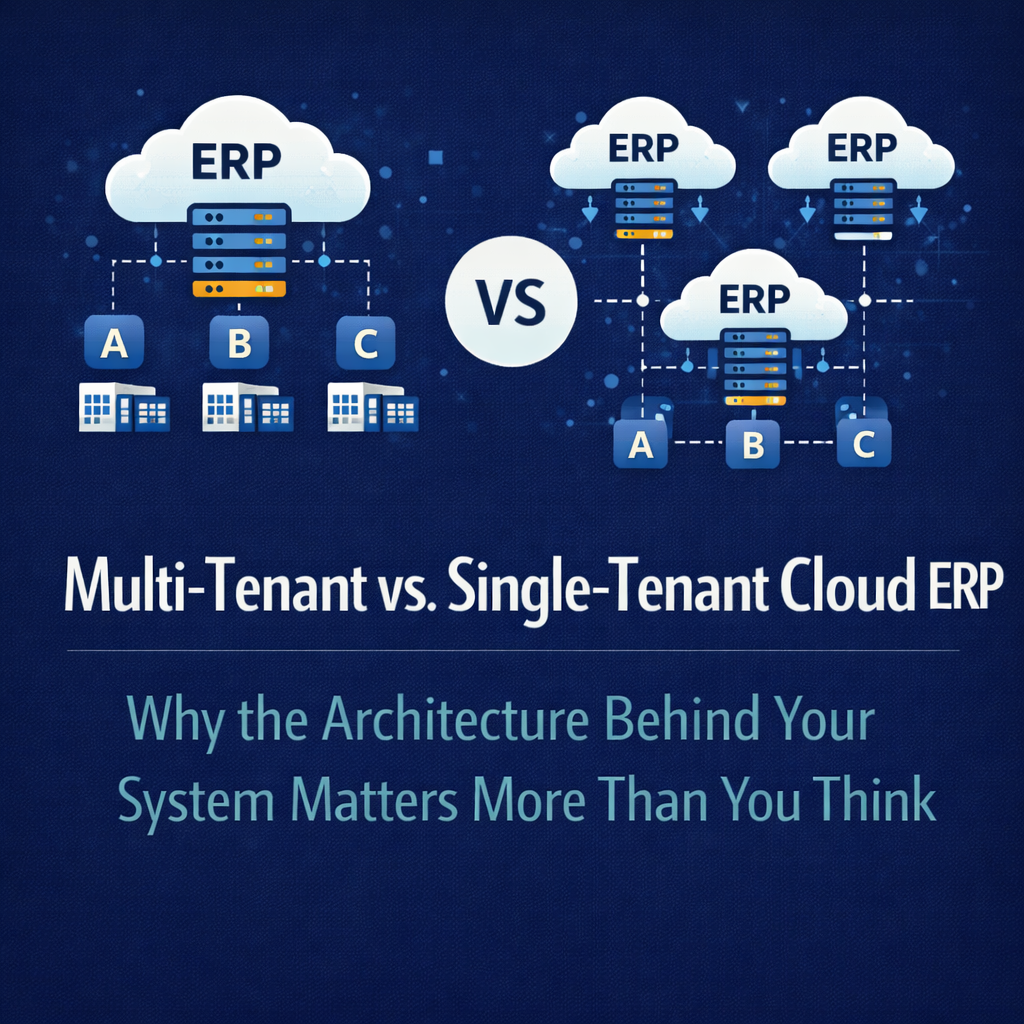
Multi-Tenant vs. Single-Tenant Cloud ERP: Why the Architecture Behind Your System Matters More Than You Think
When most businesses evaluate cloud ERP, they focus on features, pricing, and the demo experience. Almost nobody asks about tenancy architecture — and that’s exactly how legacy vendors like it. Because once you understand the difference between multi-tenant and single-tenant cloud ERP, the economics, the upgrade path, and the long-term cost of ownership become impossible to ignore.
This isn’t an academic distinction. It’s the difference between a platform that improves continuously without disrupting your business and one that traps you in a version of the software that falls further behind with every passing quarter. For distribution companies making a cloud ERP decision in 2025 or 2026, tenancy architecture may be the single most important factor that never makes it onto the evaluation checklist.
Here’s what you need to know — and what your vendor probably isn’t telling you.
The Basics: What Multi-Tenant and Single-Tenant Actually Mean
At the simplest level, the distinction comes down to how the software is deployed and how customers share — or don’t share — infrastructure.
In a single-tenant architecture, each customer gets their own dedicated instance of the software running on its own infrastructure. Think of it as renting an entire building. You have the whole thing to yourself, but you’re also responsible for everything that comes with it — maintenance, upgrades, and the cost of keeping the lights on even when you’re only using a fraction of the space.
In a multi-tenant architecture, all customers share a single instance of the software running on shared infrastructure, with strict logical separation ensuring that each customer’s data remains completely isolated and private. Think of it as a modern, professionally managed building where every tenant has a secure, private unit with its own locks and walls, but everyone benefits from shared building services — maintenance, security, upgrades — that no individual tenant could afford on their own.
Both approaches live in the cloud. Both are accessed through a browser. From the outside, they can look identical. The differences reveal themselves over time, in ways that affect your budget, your operations, and your ability to keep pace with a changing market.
The Upgrade Problem That Nobody Talks About
This is where the tenancy decision hits hardest, and it’s the issue most buyers don’t discover until it’s too late.
In a single-tenant environment, every customer runs their own version of the software. When the vendor releases an update, it has to be deployed to each customer’s instance individually. That means scheduling downtime, testing against your specific configuration, and hoping that the customizations your implementation consultant built three years ago don’t break when the new version rolls out.
The result is predictable: customers delay upgrades. They skip versions. They fall behind. And over time, they end up running software that’s two, three, or five versions old — missing out on new features, security patches, and performance improvements because the cost and risk of upgrading outweigh the perceived benefit.
This is the dirty secret of single-tenant cloud ERP. You’re technically in the cloud, but you’re experiencing the same version-lock and upgrade anxiety that defined on-premise software for decades. The vendor can point to a roadmap full of innovation, but if your instance is stuck on last year’s release — or the year before that — none of it matters.
Multi-tenant architecture eliminates this problem entirely. Every customer runs on the same version of the software at all times. Updates are deployed once, to the shared platform, and every customer benefits simultaneously. There’s no upgrade project to plan, no downtime to schedule, no consultant to hire to test compatibility. The platform improves continuously, and your business captures that value automatically.
For distribution companies operating in fast-moving markets, this isn’t a convenience — it’s a strategic advantage. Your ERP should be getting better every month, not aging in place while you wait for the next upgrade cycle.
The Real Cost Difference
Single-tenant pricing often looks comparable to multi-tenant pricing on the initial quote. Vendors know that buyers evaluate subscription cost, so they keep the sticker price competitive. But the total cost of ownership tells a very different story.
With single-tenant deployments, you’re absorbing costs that don’t exist in a multi-tenant model. Dedicated infrastructure means you’re paying for server capacity sized for your peak load, even when you’re running at a fraction of that capacity most of the time. Upgrades require professional services — either from the vendor or a third-party consultant — to test, schedule, and deploy. Custom integrations may need to be rebuilt or re-validated with each new version. And as your business grows, scaling a dedicated instance means provisioning additional infrastructure rather than simply expanding within a platform designed to scale elastically.
Multi-tenant platforms distribute infrastructure costs across all customers, which drives per-customer costs down significantly. Upgrades are included — there’s no separate line item for version migration because there’s no version migration to perform. Scaling happens at the platform level, handled by the vendor, without requiring you to forecast capacity or negotiate infrastructure expansions.
Over a five-year period, the total cost gap between single-tenant and multi-tenant cloud ERP can be substantial. And those are dollars that could be invested in the business rather than spent maintaining a software deployment model that was never designed for the way modern companies operate.
Security: Separating Perception From Reality
The most common argument in favor of single-tenant architecture is security. The logic sounds intuitive: if my data lives on its own dedicated infrastructure, it must be more secure than data on a shared platform.
This perception doesn’t hold up under scrutiny.
Multi-tenant cloud ERP platforms enforce strict logical data isolation at the application and database level. Each customer’s data is completely segregated, encrypted at rest and in transit, and accessible only through authenticated, role-based access controls. No customer can see, access, or interact with another customer’s data. The isolation is absolute — it’s just enforced through software architecture rather than physical hardware separation.
In practice, multi-tenant platforms often deliver stronger security than single-tenant deployments for a straightforward reason: the vendor is protecting every customer simultaneously. Security monitoring, threat detection, penetration testing, patch management, and compliance certification all happen at the platform level, maintained by dedicated security teams with resources that far exceed what any individual customer could justify investing on their own.
Single-tenant environments, by contrast, can create a false sense of security. Each instance needs to be patched and monitored individually. If a customer delays an upgrade — which happens frequently, as we’ve discussed — they may be running on software with known vulnerabilities that have already been fixed in newer versions. The dedicated infrastructure that’s supposed to be safer becomes a liability because it falls behind on security updates.
For distribution companies handling sensitive supplier data, customer information, and financial records, the security question shouldn’t be “is my data physically separate?” It should be “is my data protected by the most current, most rigorously maintained security infrastructure available?” In 2026, the answer to that question increasingly favors multi-tenant architecture.
Performance and Reliability
Single-tenant advocates sometimes argue that dedicated infrastructure means more predictable performance — no “noisy neighbor” problem where one customer’s heavy usage affects another customer’s experience.
This was a legitimate concern a decade ago. Modern multi-tenant platforms have solved it comprehensively through resource isolation, intelligent load balancing, and elastic infrastructure that dynamically allocates compute and storage based on real-time demand. The noisy neighbor problem exists in poorly architected multi-tenant systems, but any vendor still struggling with this in 2026 has bigger issues than tenancy architecture.
What multi-tenant platforms do offer is reliability at a level that single-tenant deployments struggle to match. Redundancy, failover, and disaster recovery are built into the platform infrastructure and maintained for all customers simultaneously. Single-tenant instances can achieve similar reliability, but the cost of building and maintaining that infrastructure for a dedicated environment is significantly higher — and the responsibility for testing and validating disaster recovery falls more heavily on the customer.
For distribution operations where system downtime translates directly into missed shipments, delayed orders, and damaged customer relationships, platform-level reliability isn’t a nice-to-have. It’s a requirement. Multi-tenant architecture delivers it as a standard feature of the platform rather than as an expensive add-on to a dedicated deployment.
Customization vs. Configuration
One of the selling points of single-tenant architecture has historically been the freedom to customize. With your own dedicated instance, you can modify the codebase, alter database schemas, and build custom functionality without worrying about affecting other customers.
This freedom comes at a steep price. Every customization creates a dependency that complicates future upgrades. The more you modify the core platform, the harder it becomes to adopt new versions — which is why single-tenant customers so often fall behind on updates. Customization feels like flexibility in the short term and becomes a cage in the long term.
Multi-tenant platforms take a fundamentally different approach: configuration over customization. Instead of modifying the underlying code, you configure the system through flexible business rules, workflow engines, user-defined fields, and open APIs. The platform adapts to your processes without compromising the shared architecture that makes continuous updates possible.
For distribution businesses, this means you can configure your ERP around your specific pick-pack-ship workflows, pricing structures, lot tracking requirements, and vendor compliance processes — all without writing custom code that will eventually hold you hostage. Your business is unique, but the way you adapt the software to reflect that uniqueness shouldn’t lock you out of the platform’s future evolution.
The companies that fare best over time are the ones that resist the temptation to customize and instead choose platforms where deep configuration capabilities make customization unnecessary.
The Integration Question
Modern distribution businesses don’t run on a single system. Your ERP connects to e-commerce platforms, shipping carriers, EDI networks, payment processors, CRM tools, and dozens of other systems that keep the operation moving. How your ERP handles integration matters, and tenancy architecture plays a role.
Single-tenant integrations are often built point-to-point between your dedicated instance and each connected system. These integrations work, but they’re your responsibility to maintain. When either system updates, the integration may break. When you eventually upgrade your ERP version, every integration needs to be tested and potentially rebuilt.
Multi-tenant platforms typically offer standardized integration frameworks — APIs, webhooks, and pre-built connectors — that are maintained as part of the platform. When the vendor updates the ERP, they ensure the integration layer remains compatible. When a trading partner changes their EDI specifications or a carrier updates their API, the vendor can push a platform-level update that addresses the change for all customers simultaneously.
This doesn’t mean multi-tenant integration is effortless. Complex integration scenarios still require planning and expertise. But the maintenance burden is distributed across the platform rather than concentrated on your team, and the upgrade-compatibility problem that plagues single-tenant integrations simply doesn’t exist.
When Single-Tenant Still Makes Sense
Intellectual honesty matters, so it’s worth acknowledging that single-tenant architecture isn’t wrong for everyone.
Organizations with genuine regulatory requirements mandating physical data isolation — certain government contracts, defense applications, or highly regulated industries with explicit infrastructure separation requirements — may need single-tenant deployments. Companies with extreme performance requirements that exceed what a shared platform can deliver may also benefit from dedicated infrastructure, though these scenarios are rare in the mid-market distribution space.
For the vast majority of distribution businesses, however, the multi-tenant model delivers better economics, better security, better reliability, faster innovation adoption, and a dramatically lower total cost of ownership. The question isn’t whether multi-tenant architecture has trade-offs — everything does — but whether those trade-offs are relevant to your business. For most operations-driven companies, they aren’t.
Making the Right Decision
The tenancy question should be near the top of your ERP evaluation criteria, not buried in a technical appendix. When you’re talking to vendors, ask directly: is this a true multi-tenant platform, or is it a single-tenant deployment hosted in the cloud? How are upgrades delivered? What’s the average version lag across your customer base? How do you handle security patching for customers who delay upgrades?
The answers will reveal more about the platform’s long-term value than any feature demo ever could. A vendor offering a true multi-tenant, cloud-native platform is offering a system that improves continuously, scales elastically, and protects your investment over time. A vendor offering a hosted single-tenant instance is offering a more expensive version of the same upgrade treadmill that made on-premise ERP so painful in the first place.
The Bizowie Approach
Bizowie is a true multi-tenant, cloud-native ERP platform built from the ground up for distribution businesses. Every customer runs on the same current version of the platform. Every improvement, every security update, every new capability is delivered to every customer simultaneously — no upgrade projects, no version lag, no consultant engagements to migrate between releases.
Combined with our vendor-direct implementation model, this means you get a platform that’s continuously improving, an implementation team that built the software they’re deploying, and a total cost of ownership that reflects modern cloud economics rather than the legacy overhead of dedicated infrastructure and third-party consulting.
See the difference architecture makes. Schedule a demo with Bizowie and experience a cloud ERP platform built the way cloud was always supposed to work — real-time, continuously evolving, and designed to bring clarity and control to every corner of your distribution operation.